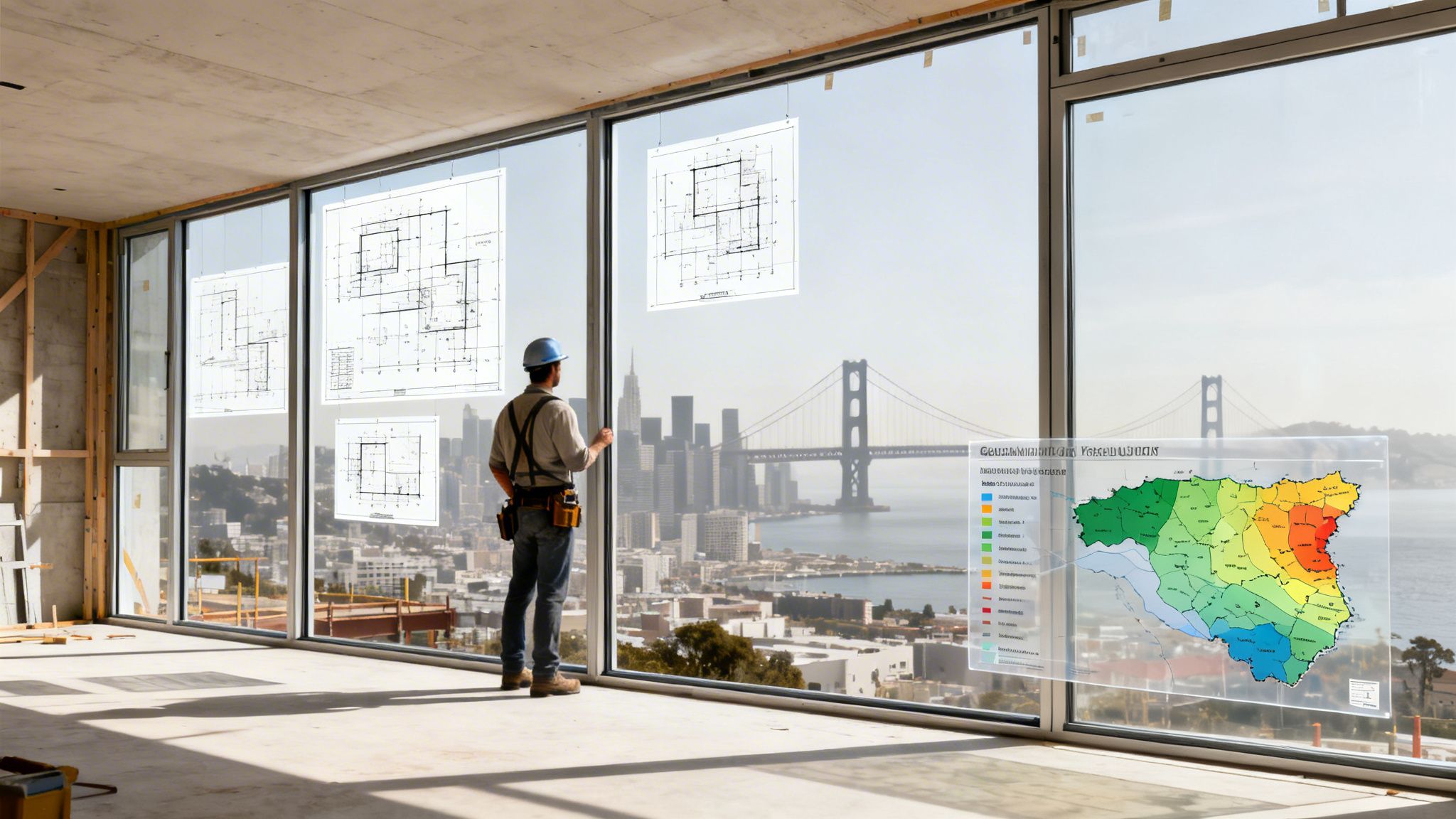
As of January 1, 2026, California’s 2025 Title 24 Energy Code is mandatory. For builders in the Bay Area, this means window specs that were fine before can now cause costly inspection failures. The biggest change is the new, stricter U-Factor requirement of 0.27 or lower for projects in Climate Zone 3.
Failing to comply isn't an option. Non-compliant window specs can delay plan approval or lead to a failed inspection, stopping your project cold.
The 2026 California Window Code Is Now in Effect
The 2025 Title 24 Energy Code updates are no longer a future concern—they are the new reality. This marks a major step in the state’s push for higher energy efficiency. For Bay Area builders, it brings immediate, non-negotiable changes.
Any new residential permit filed in cities like Berkeley, Oakland, and San Francisco must meet these tougher standards.

The key change impacting nearly every project is the drop in the maximum allowable U-Factor. This number measures how well a window prevents heat from escaping. For anyone working in Climate Zone 3, which covers most of the Bay Area, windows must now have a U-Factor of 0.27 or less.
This is a big deal because many standard, builder-grade windows no longer qualify.
Key 2026 Window Code Changes for Bay Area Climate Zone 3
| Requirement | Previous Code | New 2026 Code | Impact for Bay Area Builders |
|---|---|---|---|
| U-Factor | 0.30 | 0.27 or lower | Standard dual-pane windows often won't comply. Must spec high-performance or triple-pane units. |
| SHGC | 0.23 | 0.23 (unchanged) | Low-solar-gain glass is still required, but the main focus is on the new U-Factor. |
While the SHGC remains the same, the shift in U-Factor forces a change in product selection for most builders.
Understanding the Immediate Impact
This isn't a minor tweak; it’s a fundamental change affecting project planning and budgeting. Failing to adapt can lead to serious headaches.
Permit Delays: Submitting plans with non-compliant window specs will get them rejected, stopping your project before it starts.
Failed Inspections: Installing windows that don't meet the 0.27 U-Factor will result in a failed inspection, forcing expensive rework.
Material Sourcing: You can no longer grab the same products. Sourcing compliant windows now requires checking NFRC labels and performance data.
For a primer on regulations, see these insights on Navigating Building Codes and Regulations. This guide will give you the practical knowledge you need. For more on local upgrades, read our comprehensive Bay Area guide to energy-saving renovations.
Why Many “Standard” Windows No Longer Qualify
For years, Bay Area builders could use a standard dual-pane window to meet code. That era is over. Many common "builder-grade" windows fall short of the new U-Factor of 0.27 required in Climate Zone 3.
A basic dual-pane window might have a U-Factor of 0.30 or higher, making it non-compliant for new permits in Berkeley or Oakland. Builders must now verify NFRC ratings before ordering.
It’s Not Just the Glass—Frame Performance Matters
Think of a window as a complete thermal system. High-performance glass with advanced Low-E coatings doesn't mean much in an inefficient frame. The California Energy Commission now looks at how the entire assembly works together.
Frame material is now a huge factor in compliance. Fiberglass, vinyl, and wood composites outperform standard aluminum in stopping heat transfer, which lowers the overall U-Factor. This shift makes previous "upgrades" the new standard for meeting Title 24 window requirements.
Advanced Low-E Coatings: Multiple layers are now essential to reflect heat and meet the new U-Factor targets.
Argon Gas Fill: Inert gas like argon is used between glass panes to slow heat transfer.
Warm-Edge Spacers: Non-metallic spacers reduce heat loss around the edge of the glass.
Always Check the NFRC Label Before You Order
Here is the most important step to avoid costly mistakes: verify the NFRC (National Fenestration Rating Council) label for every window and door you order. This label is the official, third-party report card for the product's performance.
Relying on a brochure is a recipe for a project-killing headache. The exact combination of glass, frame, and size determines the final NFRC rating. You need that specific number for your plans.
Ordering non-compliant windows can bring a project to a dead stop. At Truitt & White, our team works with builders to confirm every window spec meets Climate Zone 3 rules before the order is placed. To dive deeper, check out our guide on the best windows for energy efficiency.
Compliance Is More Than Just U-Factor
Getting your Bay Area project compliant with Title 24 involves more than one number. While the 0.27 or lower U-Factor is the headline change, other details in the energy code can trip up builders. Installation documentation also matters for inspection.
The code offers two main paths to compliance: prescriptive and performance. Your choice impacts design flexibility and window selection.
Prescriptive Path: The Checklist Approach
The prescriptive path is the most direct route. It is a checklist of requirements for every part of the home. If you meet every requirement, your project is compliant.
However, this simplicity comes with limitations, especially for fenestration.
20% Glazing Limit: On the prescriptive path, the total area of windows and glass doors is typically capped at 20% of the home's conditioned floor area. This is a hurdle for modern designs with large glass walls.
No Trade-Offs: Every component must meet the exact standard. You can't use an ultra-efficient HVAC system to make up for windows that miss the U-Factor target.
This path works well for straightforward projects but can be restrictive for custom builds in Berkeley or Oakland.
Performance Path: Flexibility Through Energy Modeling
The performance path offers more creative freedom. It uses energy modeling software to calculate an energy "budget" for the house. As long as your design is more efficient than a standard home, it passes.
This method allows for smart trade-offs. You could exceed the 20% glazing limit by using high-performance windows or by adding extra ways to improve home insulation. It gives architects and builders room to innovate.

SHGC and Documentation Are Still Important
Our Climate Zone 3 doesn't have a hard cap on the Solar Heat Gain Coefficient (SHGC), but it still plays a role in performance path calculations. Choosing windows with a lower SHGC can help balance the energy model.
Finally, don't forget the paperwork. Inspectors are looking closely at NFRC labels and installation documents. To learn more, read about how Title 24 affects Bay Area homeowners.
Navigating Bay Area Climate Zone 3
The Bay Area has diverse microclimates. The windows you spec for a San Francisco project won't work for a project an hour east. A one-size-fits-all approach to Title 24 is a fast way to fail an inspection.

A single county can span multiple climate zones, each with its own rules. This makes one tool essential before ordering windows.
Your First Step: Confirm the Project’s Climate Zone
Before you do anything else, use the official California Energy Commission (CEC) Climate Zone Lookup Tool. Enter the street address to find out which of California’s 16 climate zones you are in.
This step tells you if your Berkeley project is in Climate Zone 3 (requiring a U-Factor of 0.27 or lower) or has different requirements. The "0.30 U-Factor everywhere" rule is gone.
Watch for Local "Reach Codes"
Many Bay Area cities add another layer of rules called "reach codes." These are local ordinances that go above and beyond Title 24 for even higher energy efficiency.
Cities like Berkeley and San Francisco often mandate:
All-electric new construction.
Stricter energy performance budgets.
Requirements for solar-readiness or EV chargers.
What this means for builders: These local codes make a high-performance building envelope essential. Your windows, insulation, and air sealing must work together. Compliant windows are the cornerstone of an approvable project.
We help builders select the right windows built to withstand the Bay Area’s coastal climate, seismic activity, and evolving energy codes, all while meeting strict state and local requirements.
Turn Code Compliance into a Competitive Advantage
The 2026 window code updates can feel like another hurdle. But smart Bay Area builders can use these new standards as a business opportunity. Instead of meeting the bare minimum, you can elevate your projects and stand out.
This is about building a better, more comfortable, and more valuable home. High-performance windows are a premium feature that delivers real value to the homeowner.
From Mandatory Cost to a Powerful Selling Point
Frame compliant windows as a smart investment in comfort and savings. Homeowners in Berkeley and Oakland understand energy efficiency. They value a home that costs less to heat and cool.
Use these talking points to turn Title 24 window requirements into a key selling feature:
Better Homeowner Comfort: Explain how modern windows eliminate cold drafts and block harsh solar heat. This creates a more stable indoor environment.
Lower Energy Bills: Connect a window's U-Factor to your client's wallet. A lower U-Factor means their HVAC system works less, saving them money.
Smaller HVAC Systems: A well-insulated building with efficient windows reduces the home's heating and cooling load. This may allow for a smaller, less expensive HVAC system.
Position Yourself as the Code Expert
In a competitive market, expertise is key. Understanding the 2026 window code updates builds trust with clients and architects. You become a trusted advisor who can explain the "why" behind your product choices.
By mastering these regulations, you send a clear message: you are committed to quality and forward-thinking construction. That expertise differentiates you and proves you build to a higher standard.
Builders who master Climate Zone 3 windows and Title 24 compliance are building a reputation for excellence. They deliver homes that are not just beautiful but also smarter, more comfortable, and more efficient. That is a competitive advantage.
A Partner for Compliant Bay Area Window Projects
Navigating the 2026 window code updates requires a real partner. At Truitt & White, we are your dedicated compliance team for Bay Area windows and doors. We help you pass inspections the first time.

Our approach is built on collaboration. When you visit our Berkeley window & door showroom, we work with your team. We review your plans to verify NFRC ratings and ensure every spec meets Title 24 window requirements for Climate Zone 3.
More Than a Dealer—A Full-Scope Building Partner
As both a Berkeley lumberyard and a window showroom, we offer a logistical advantage. You can source your windows and framing materials from one knowledgeable partner. This coordination ensures every component works together seamlessly.
This support is critical as cities add their own "reach codes." According to SPUR, Bay Area cities are advancing sustainability through building codes, making high-performance envelopes non-negotiable.
Working with us is a strategic decision to prevent costly errors and build better. We are invested in your project's success.
Our team provides:
Expert NFRC Verification: We check that your windows meet the U-Factor ≤ 0.27 mandate.
Plan Alignment: We review your plans to ensure window specs will pass in demanding cities like Berkeley.
Integrated Material Sourcing: Get compliant windows, framing lumber, and hardware from one team that knows your project.
Discover why Truitt & White is the best choice for windows and doors. Let’s build smarter, together.
Frequently Asked Questions About 2026 Window Codes
The 2026 window code updates have raised questions for builders. We have put together answers to common questions we hear from contractors and architects in our Berkeley showroom.
1. What is the single biggest change in the 2026 California Energy Code for Bay Area windows?
The biggest change for Climate Zone 3 (Berkeley, Oakland, San Francisco) is the new mandatory maximum U-Factor of 0.27. This is down from the previous 0.30 requirement. It means standard dual-pane windows often no longer comply, and builders must now specify high-performance products.
2. How can I ensure the windows I order meet Title 24 window compliance?
Always check the official NFRC (National Fenestration Rating Council) label before you order. This label provides the certified U-Factor and SHGC for that specific window. For any project in Climate Zone 3, the U-Factor on the label must be 0.27 or lower.
3. Do the new rules apply to remodels and window replacements?
Yes, if your project requires a building permit, any new windows must meet the current 2026 Title 24 window requirements. This applies to major remodels, additions, and projects where fenestration affects the home's energy performance. Always check with your local building department.
4. What are the Climate Zone 3 requirements for glazing area?
Under the standard prescriptive path, your total window and glass door area is usually capped at 20% of the home's conditioned floor area. To use more glass, you must use the performance path, which requires an energy model to prove overall efficiency. This usually means specifying ultra-high-performance windows.
5. What Bay Area building materials are best for window code compliance?
To meet the new U-Factor targets, frame material is more important than ever. High-performance fiberglass, vinyl, and wood-clad frames are excellent choices because they reduce heat transfer better than standard aluminum. Working with a knowledgeable Berkeley lumberyard like Truitt & White ensures you get products that meet code.
For expert guidance on selecting the right Bay Area windows and doors for your next project, trust the team at Truitt & White. We help builders navigate the complexities of Title 24 to ensure every window meets code and exceeds expectations.
Visit our Berkeley showroom for expert guidance.