Direct Answer: Three measurements decide fit: backset (door edge to bore center), bore diameter (the big hole itself), and door thickness. Measure all three before buying. Older Berkeley doors often fall outside standard sizes.
There is a new lever sitting on your kitchen counter, still half in the box. You already tried it. The latch is too short, or the rose does not cover the hole, or the spindle will not reach through the door.
That is one of the most common calls we get at the showroom, and it almost never means you bought junk. It usually means one of three separate measurements does not match what the packaging assumed.
Those three are backset, bore diameter, and door thickness. Two of them run in different directions on the door and the third is just a hole size, which is exactly why people mix them up. If your house was built in Berkeley, North Oakland, or Albany before 1940, the odds of a mismatch go way up.
The Three Measurements That Decide Door Hardware Fit
Any knob or lever has to agree with the door on three things. Get one wrong and nothing else matters.
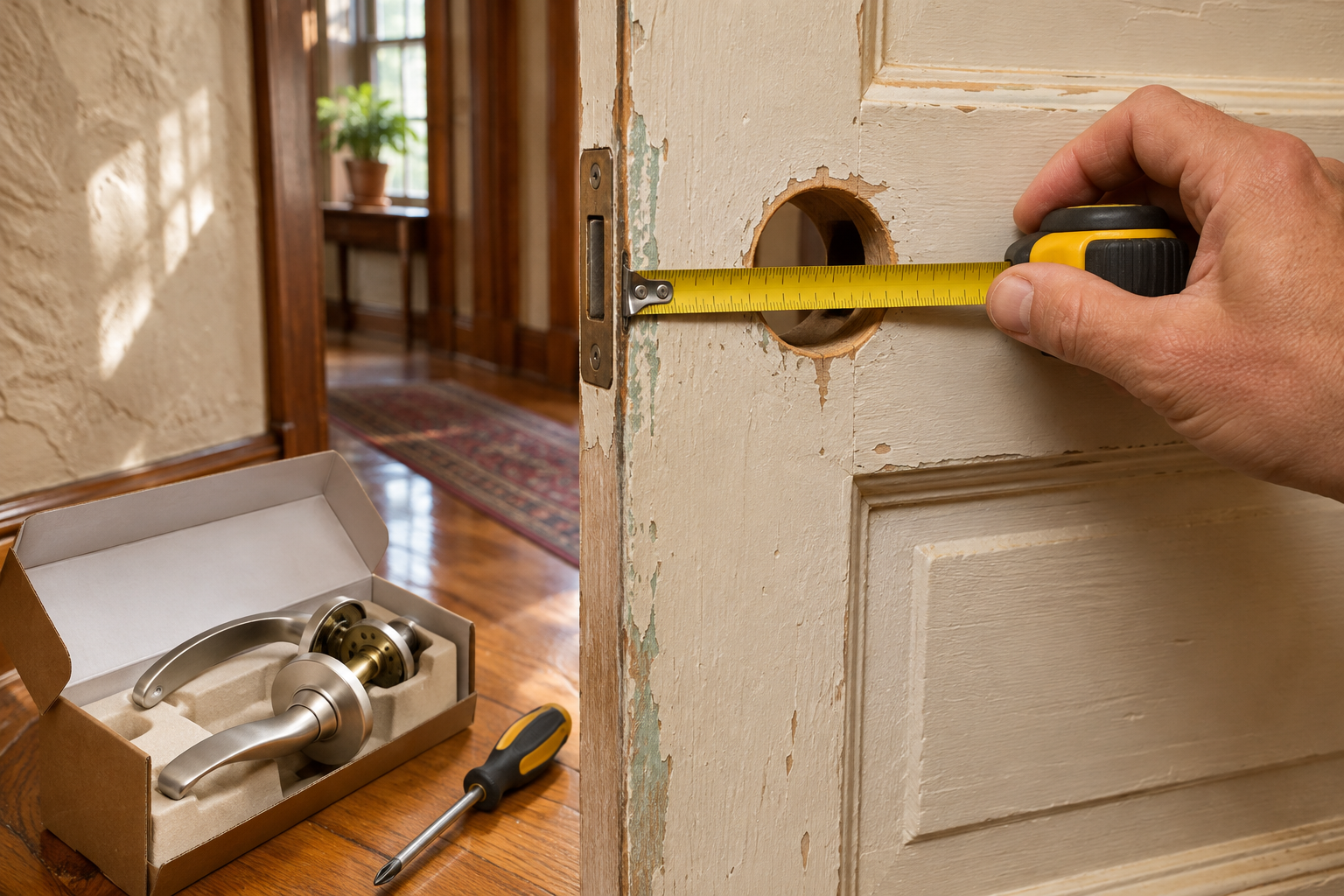
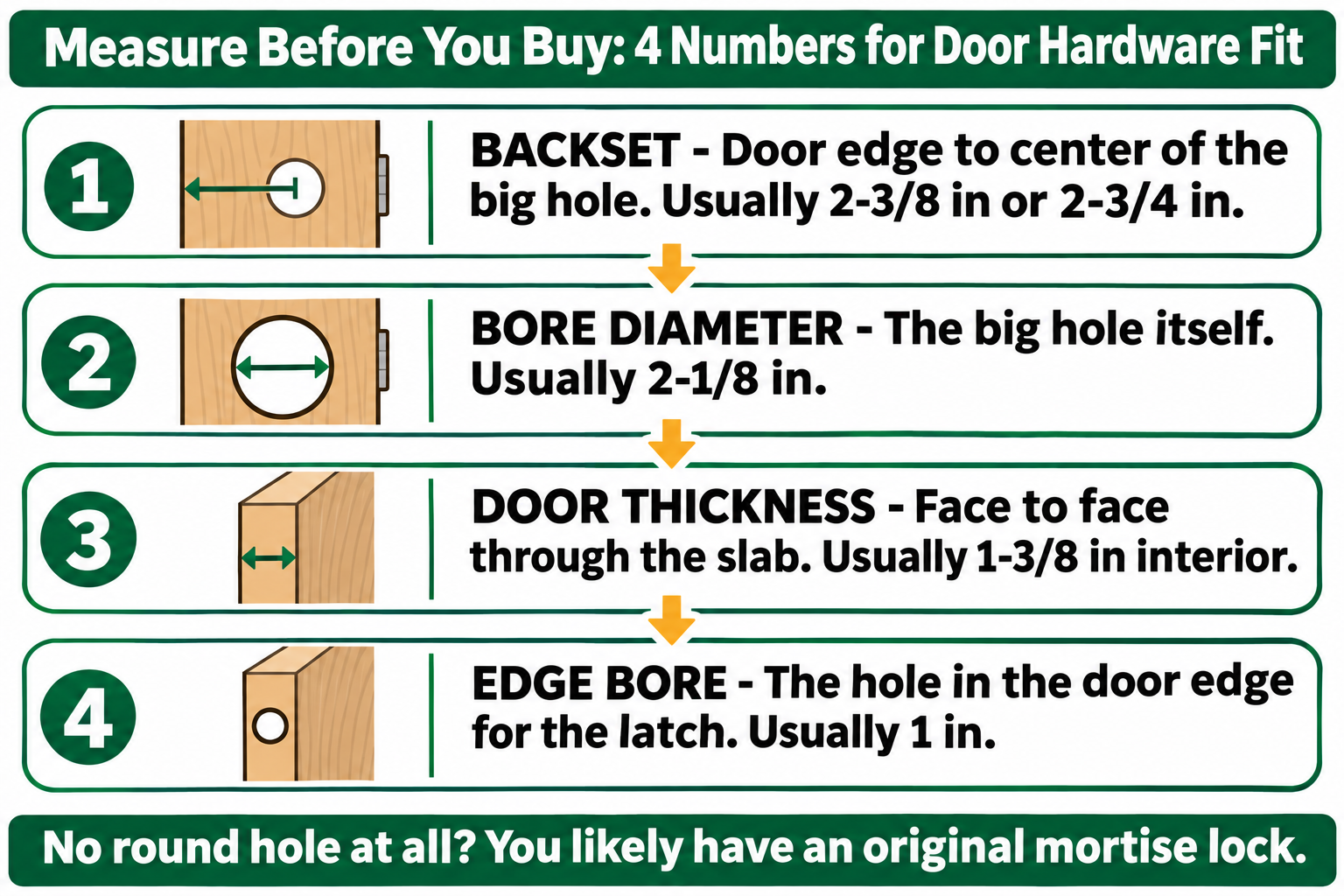
- Backset. The distance from the edge of the door to the center of the big round hole. This runs across the face of the door, horizontally. Two sizes cover most residential hardware: 2-3/8 inches and 2-3/4 inches.
- Bore diameter. The size of the big round hole itself. Most modern knob and lever sets expect a 2-1/8 inch bore. This is a hole size, not a distance.
- Door thickness. Face to face through the slab. Interior doors are commonly 1-3/8 inches and exterior doors 1-3/4 inches. Hardware has a thickness range it will accept, and older slabs sometimes fall under it.
There is a fourth number worth writing down while you are at it: the edge bore, the smaller hole drilled into the door edge where the latch sits. That is usually 1 inch.
Measure in that order and it takes about five minutes. Tape measure, nothing else. If you can, pop the latch out of the edge and measure the bore with the door open so you are reading the actual hole and not the old escutcheon covering it.
Why Pre-1940 Berkeley Doors Break the Pattern
Roughly 46 percent of Berkeley’s housing stock was built before 1940, with a median build year somewhere in the mid-1940s. That is where almost all of the fit problems we see come from.
Here is what tends to be different on those doors:
- Narrow lock stiles. The vertical rail the hardware mounts into can be slimmer than modern doors. A 2-3/4 inch backset on a narrow stile puts the bore too close to the panel, and sometimes there is not enough wood left to hold it.
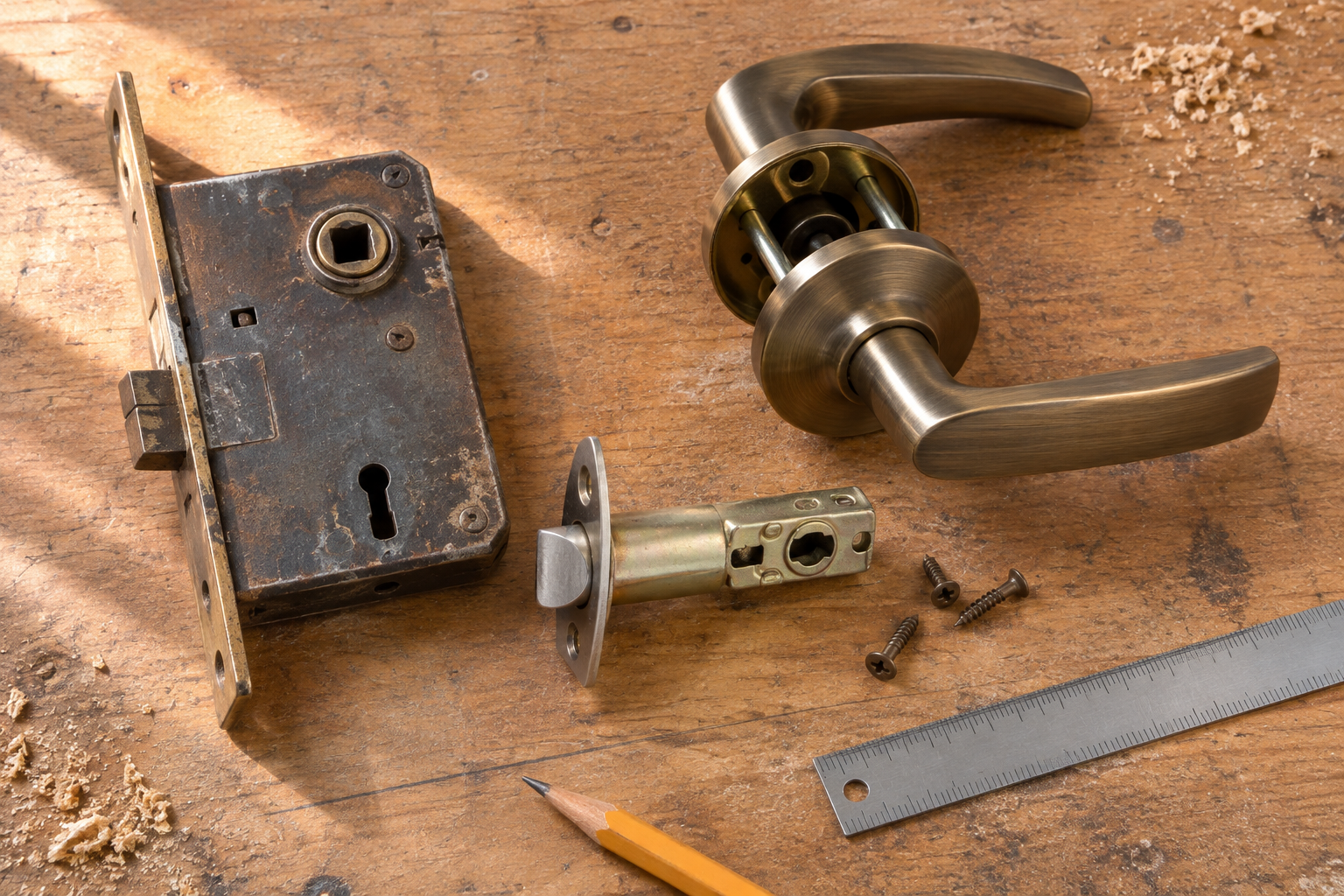
- A mortise pocket instead of a bore. Original hardware was often a mortise lock, a rectangular steel case slotted into the door edge. There is no 2-1/8 inch round hole at all. Modern tubular hardware will not drop into that pocket.
- Enlarged or off-center holes. Forty years of hardware swaps leave a mark. A hole drilled in 1978 for a different brand may now be oversized, egg-shaped, or sitting at a backset nobody sells.
- Thin slabs. Some older interior doors measure under 1-3/8 inches, especially closet and pantry doors that were never standard to begin with.
A 1920s door is not defective. It just means you pick the hardware to suit the door rather than forcing the door to suit the hardware. The same logic applies when you are deciding between a slab and a prehung unit for an old opening.
Quick Reference: What to Measure and Why It Matters
Write these four numbers down before you shop. Common sizes are listed, but older East Bay doors regularly land outside them.
| Measurement | Where You Take It | Common Sizes | What Goes Wrong If It’s Off |
|---|---|---|---|
| Backset | Door edge to the center of the big hole, across the face | 2-3/8 in or 2-3/4 in | Latch is too short or too long to reach the strike |
| Bore diameter | The big round hole itself | 2-1/8 in | Rose or escutcheon won’t cover the opening |
| Door thickness | Face to face through the slab | 1-3/8 in interior, 1-3/4 in exterior | Spindle too short, or the set sits loose and rattles |
| Edge bore | The hole in the door edge where the latch slides in | 1 in | Latch body binds or won’t seat flush |
The Five-Minute Measuring Order
Do these four steps in this order before you buy anything else. All you need is a tape measure.
What to Do When the Hole Is Already Wrong
Say you measured and the bore is 2-1/4 inches because someone chewed it out, or the backset reads 2-1/2 and nothing on a shelf matches. You still have options, roughly in order of effort:
- Adjustable latch. Many latches ship adjustable and cover both 2-3/8 and 2-3/4 backsets. This solves a surprising number of complaints before they start.
- Larger rose or an escutcheon plate. A bigger trim plate can cover a worn or slightly off-center hole. This is cosmetic cover, not structural repair.
- Re-prep the existing slab. If there is enough sound wood in the stile, a door shop can plug, re-bore, or mortise the slab to match the hardware you actually want. Our in-house door shop does custom mortising and lock prep for exactly this reason.
- New slab, bored correctly. When the stile is split or the hole is too far gone, a new slab prepped to your hardware is usually the cleaner path.
The cleanest sequence is choosing the door and the hardware together, not one after the other. A new slab can be bored to the hardware. Hardware cannot be re-engineered to fit a hole drilled decades ago.
Cost depends on things like solid core versus hollow core, stock versus custom size, and how much prep work the slab needs. We are happy to walk through those factors with you at the counter.
Counting Function and Finish Across the Whole House
Most people call us about one stuck door and then realize the hallway has four finishes on five doors. That is what happens when hardware gets replaced one failure at a time over ten years.
If you are already measuring one door, count the rest while you are at it. Go room by room and sort every opening into one of four functions:
- Passage. Latches, no lock. Hallways, most bedrooms in a pinch, pantry doors.
- Privacy. Latches with a push-button or turn lock. Bathrooms and bedrooms.
- Dummy. No latch at all, just a pull. Closet doors and one half of a double door.
- Entry. Keyed. Exterior openings.
Then pick one finish family and stay in it. Lines like Emtek and Baldwin offer matching levers, knobs, and trim across functions, so a privacy set in a bathroom reads the same as the passage set down the hall.
Hinges are the piece everyone forgets. Three hinges per door, times eight doors, in a finish that does not match the new levers, and the whole job looks half done. Strikes count too. According to the Builders Hardware Manufacturers Association, finish designations are standardized across the industry, which makes matching across brands far easier when you know the code you are working from.
What to Have Ready Before You Call or Visit
Door orders go wrong at the specification stage, not at delivery. A short list of numbers and two phone photos turns a frustrating counter visit into a five-minute one.
Have this written down:
- Backset, bore diameter, edge bore, and slab thickness
- Which way the door swings and which side the hinges are on
- Whether the door needs to lock, latch, or just pull
- The finish you are matching, including hinges
- A photo of the door edge and a photo of the existing hardware
If you have an original mortise lock, bring the old one in. It tells us more in ten seconds than a description does in ten minutes.
One customer put it well in a review: “he took the time to understand my project and guided me to the right solution.” That is a lot easier to do when the numbers are already in hand. And while you are planning, it is worth reading up on why new doors warp and stick if they are not finished on all six sides, because a door that swells in the fog will throw off hardware that fit perfectly in July.
Frequently Asked Questions About Door Hardware Fit
How do I measure backset if the old hardware is still on the door?
Take the knob or lever off first. Measuring to the center of the rose can be close, but it is not reliable on an old door where the hole may be off-center under the trim. With the hardware removed, hook your tape on the door edge and read to the center of the bore.
My door has a rectangular slot in the edge and no round hole. What is that?
That is a mortise lock pocket, standard on a lot of pre-1940 East Bay homes. Modern tubular hardware will not fit it. You either source mortise hardware sized to the existing pocket, or have the slab re-prepped for a tubular set.
Can a 2-3/4 inch backset lever be used on a door bored for 2-3/8?
Often yes, if the latch is the adjustable type that covers both. Check the latch before you assume the set is wrong. If it is a fixed 2-3/4 latch, it will not reach the strike properly on a 2-3/8 bore.
My door is thinner than 1-3/8 inches. Is that a problem?
Not necessarily, but it narrows your choices. Many sets list an acceptable thickness range, and some include a shorter spindle or spacers. Bring the measurement with you so we can point you to hardware that actually covers it.
Does the same hardware work on both interior and exterior doors?
Usually not. Exterior slabs are typically thicker at 1-3/4 inches, and entry sets are keyed and built differently. Measure the thickness on every opening rather than assuming the whole house matches.
Not Sure Which Number Is the Problem?
If you have your measurements and a couple of photos of the door edge, the staff at our Windows and Doors showroom at 1831 Second Street in Berkeley can look at them and talk through what will fit. Emtek and Baldwin are both on display there, and our door shop is in the same building if the slab needs re-prepping. The showroom line is 510-649-4400, or you can browse interior doors and hardware at https://truittandwhite.com/residential-door-supplier-san-francisco-bay-area first.