Direct Answer: WUI windows are exterior glazing approved for California wildfire zones. As of January 2026 those rules sit in the California Wildland-Urban Interface Code, Chapter 5, not Building Code Chapter 7A.
You submit a window schedule for a hillside remodel the same way you have for the last ten years. Plan check comes back citing a code section you have never seen, and nobody in the office recognizes it either.
That is happening a lot right now on Oakland and Berkeley hillside lots. The wildfire rules for exterior glazing did not get looser. They got moved to a different book, and jurisdictions are updating their handouts at different speeds.
This article stays on one thing: glass and openings. What counts as compliant glazing, what to actually write on an order, and which pieces of exterior glass people forget to count until an inspector points at them.
Chapter 7A Did Not Go Away. It Moved.
If you have been building in a fire zone around here, “7A” is shorthand you have used for years. Fire rated siding, ember resistant vents, approved glazing, all of it lived in Chapter 7A of the California Building Code.
That changed with the current code cycle. The 2025 California Building Standards Code was published July 1, 2025 and took effect January 1, 2026. In that cycle the Building Standards Commission deleted Chapter 7A from the Building Code and relocated the wildfire exposure material standards into the new California Wildland-Urban Interface Code, Title 24 Part 7.
The material requirements now live in CWUIC Chapter 5. The old Building Code chapter still exists, but it reads more like a pointer to the new code than the requirement itself.
Here is what matters on a real project:
- The product listings and test standards you already know still apply. Nothing about tempered glass or 12-7A-2 testing got easier.
- The section numbers on your drawings and specs are probably stale if they were written before 2026.
- Different East Bay building departments are rewriting their handouts on their own schedule, so a Berkeley comment and an Oakland comment may cite things differently.
Before you submit, confirm the current section reference with your plan checker. It is a two minute phone call that saves a resubmittal cycle.
What Actually Makes a Window a WUI Window
Most homeowners show up at a counter having been told “you need fire windows.” That phrase does not exist on any order form, and it is not how the code is written.
The code gives three compliance paths for exterior windows, skylights, and glazed door assemblies:
- A multipane glazing unit with at least one tempered pane
- A 20-minute fire protection rated assembly
- An assembly tested to State Fire Marshal Standard 12-7A-2
The first path is the one most hillside replacement projects use, and it is simpler than people expect. The University of California ANR Fire Network explains that glass complies by being part of an insulating glass unit with at least one tempered pane, and that the tempered lite can be the inner or the outer pane.
If you want to know whether an existing window already has tempered glass, look at the lower corner of the lite. Tempered glass carries an etched manufacturer stamp there. No stamp, no assumption.
When you place an order, say it the way the code says it. Ask for a dual pane unit with at least one tempered lite, and ask the salesperson to confirm it on the acknowledgement before the order goes to the plant.
And ask for paper. A brochure claim is not a compliance document. A manufacturer product listing or a test report is what a plan checker actually wants to see, and it is far cheaper to get it up front than to chase it after delivery.
Three Ways Exterior Glazing Can Comply
All three paths are legitimate. They differ in cost, lead time, and how much documentation you have to produce.
| Compliance path | What to ask for | What to keep on file |
|---|---|---|
| Multipane with tempered lite | Dual pane insulating unit with at least one tempered pane, inner or outer | Order acknowledgement showing tempering, plus glass etch stamp on delivery |
| 20-minute fire rated assembly | A labeled, fire protection rated window or glazed door assembly | Manufacturer listing and the permanent label on the unit |
| Tested to SFM 12-7A-2 | An assembly with a current State Fire Marshal listing or test report | Listing number or test report matching the exact model and size ordered |
| Skylights | Tempered glazing, or a listed plastic assembly, not an unlisted acrylic bubble | Product listing documentation for the specific skylight model |
One Order, Two Rulebooks
A fire zone address in the East Bay means two separate code requirements land on the same window order. That is where specifications go sideways.
The wildfire code governs the glass makeup and the frame materials. The energy code governs the thermal performance, and it does not care one bit about ember exposure.
For residential work in Title 24 Climate Zone 3, which covers Berkeley, Oakland, and San Francisco, the 2025 energy standards that took effect January 1, 2026 set the prescriptive targets:
- U-Factor of 0.27 or lower
- No SHGC requirement in this climate zone
- Fenestration area limited to 20% of conditioned floor area
That 0.27 number is tighter than the previous cycle, and it has caught a few people who reused an old spec sheet. If you want more detail on why the local numbers run differently from the rest of the state, we covered that in why Bay Area windows need different specs than the rest of California.
The short version for a specifier: check both gates in one pass. Confirm the glazing path for the fire side, confirm the NFRC rated U-Factor for the energy side, and confirm the fenestration area math before the package goes out.
A unit that clears one gate and fails the other is a restock fight nobody wins.
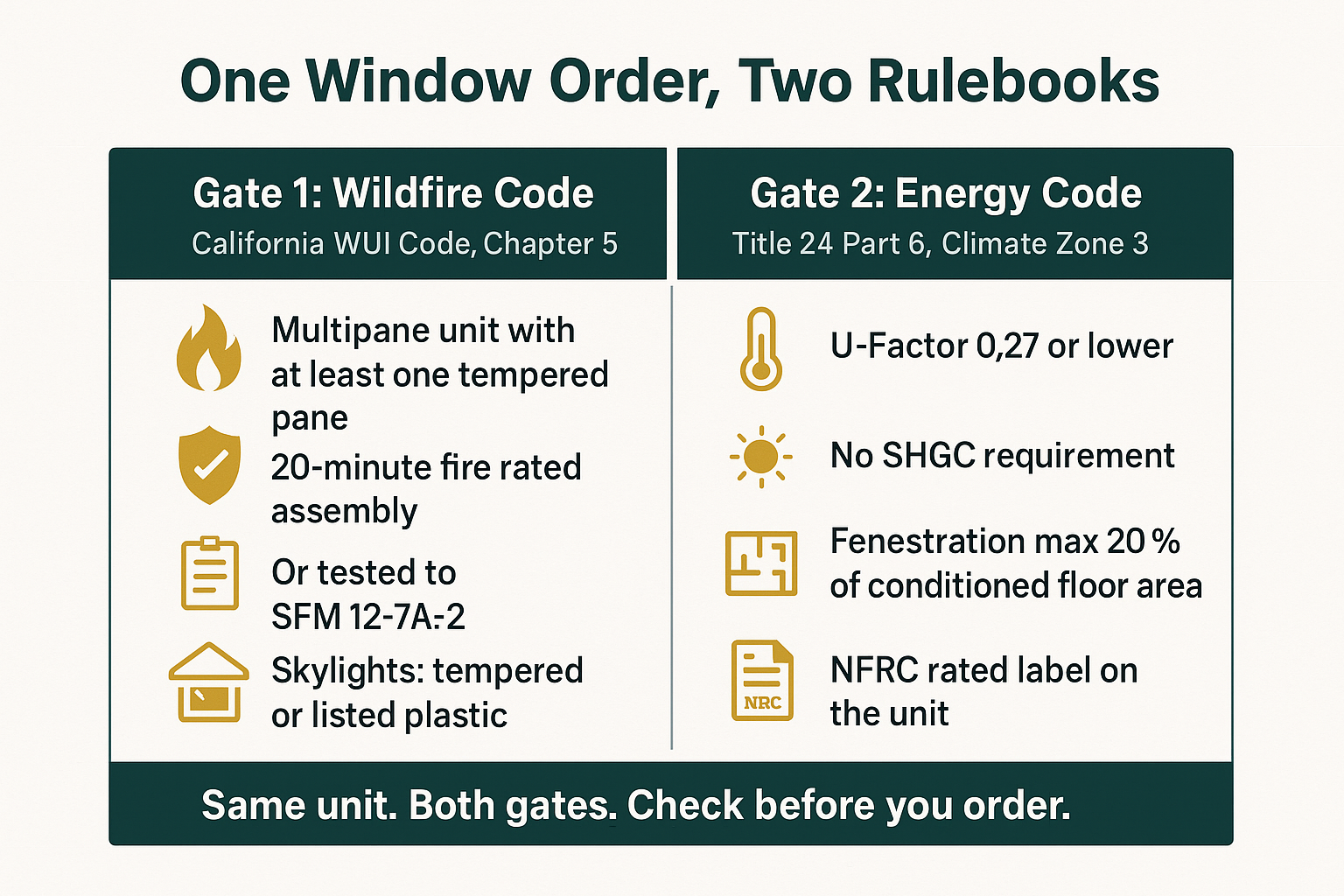
The Two-Gate Check for a Hillside Window Order
Every exterior glazing unit on a hillside project has to clear two separate code requirements. This breaks down what each one asks for.
The Openings People Forget to Count
Window budgets get built off a window schedule. The code language is broader than that, and the gap shows up as a change order halfway through the job.
The requirements cover:
- Exterior windows
- Exterior glazed doors, including patio sliders and French units
- Glazed openings within exterior doors, meaning the little lite in a service door
- Glazed openings within exterior garage doors
- Exterior structural glass veneer
- Skylight glazing
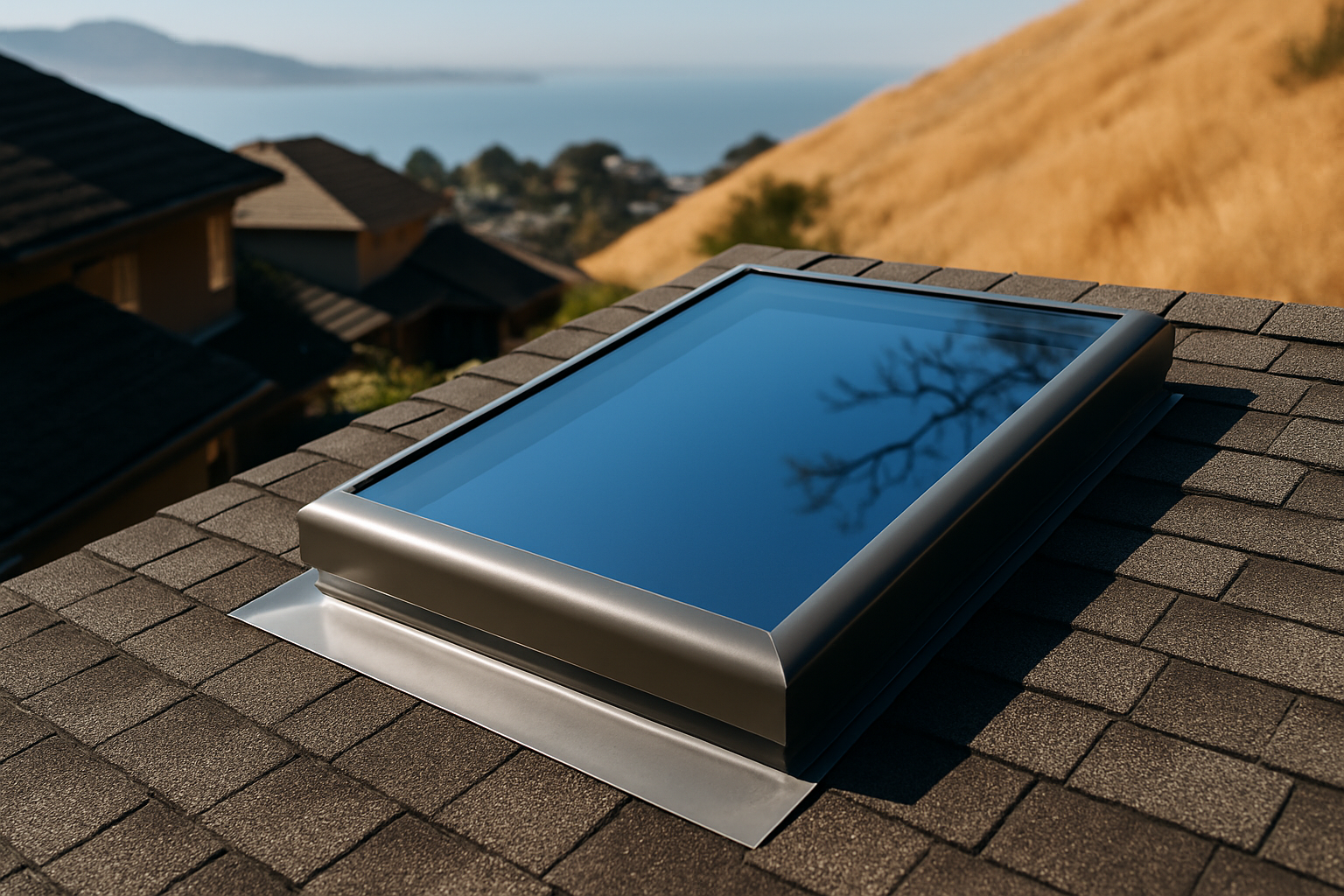
Skylights are the most common miss. A plain acrylic bubble skylight that carries no listing is not a compliant assembly, and swapping one in during a reroof on a hillside lot is an easy way to fail an inspection.
Do a one-pass walk around the house before you price anything. Count every single piece of exterior glass, including the three small lites in the garage side door and the transom above the entry nobody thinks about.
Patio doors deserve their own look, because the operating style changes the weather performance as much as the fire listing does. We went through that tradeoff in sliding or swinging patio doors and what Bay Area weather should decide.
On cost, expect listed and tested assemblies to run above standard units, with the gap depending on size, operating style, and whether the model is a stock configuration or a custom order. Lead times stretch too. Price the glazing package early rather than treating it as a line item you can firm up later.
Is Your Hillside Address Even In Scope?
This is the question that stops most people before they get to materials, and the answer in Berkeley is genuinely confusing right now.
CAL FIRE released updated Fire Hazard Severity Zone maps for Local Responsibility Areas in February 2025. In Berkeley, the very high hazard acreage dropped from 1,269 acres to 454 acres.
A lot of hillside owners read that headline and assumed their requirements evaporated. They did not. Berkeley layered its own mapping on top of the state map, and adopted the Ember Resilience ordinance requiring a five-foot noncombustible Zone 0 around structures, decks, and fences in locally designated Very High areas.
So the state map is not the last word here. Check your specific parcel with the city before you make any assumption about what applies.
We have already gone deep on both of those elsewhere, so this article stays on glass. For the mapping changes, see what the Oakland and Berkeley fire hazard zone updates mean for your project. For the five-foot rule, see Zone 0 and the East Bay’s first five feet. If you are also replacing a deck on the same job, what the 2026 WUI code changed for decking covers that side.
What to Bring to the Counter
Hillside work lives or dies on documentation. A plan checker is not going to take a product name on faith, and neither should you.
We stock fire rated framing material, and our showroom staff pull manufacturer listing and performance documentation as part of a quote rather than after the fact. On a fire zone job that paperwork is the difference between a clean plan check and a second round of comments.
Bring three things when you come in:
- Your parcel address, so the zone question gets settled first
- Any plan check comments you have already received, including the section numbers cited
- A count of every exterior opening, windows, glazed doors, garage lites, and skylights
One contractor review on our Google page put the value of that kind of back and forth simply: “So great to work with other professionals in the construction trades.” That is the whole idea. If you are still building the spec, what to ask before buying replacement windows in Berkeley or Oakland is a good starting list.
Frequently Asked Questions About WUI Windows in the East Bay
Do all my windows need to be fire rated if I’m in a fire zone?
Not necessarily. The most common compliance path is a multipane unit with at least one tempered pane, which is not the same thing as a 20-minute fire protection rated assembly. A full fire rated or 12-7A-2 tested assembly is one of three options, not the only one.
How do I tell if my existing windows are already tempered?
Look at the lower corner of each pane for an etched manufacturer stamp. Tempered glass carries one. If you cannot find a stamp, treat the glass as untempered until a manufacturer record says otherwise.
My parcel came off the state fire hazard map. Am I done?
Probably not in Berkeley. The city layered its own local mapping on top of the February 2025 state map, and the local designation is what drives the Ember Resilience ordinance and the five-foot Zone 0 requirement. Check your specific address with the city rather than relying on the state map alone.
Does an acrylic bubble skylight comply?
An unlisted acrylic bubble does not. Skylight glazing has to be tempered or a listed plastic assembly, and this is one of the most common failure points industry people flagged after the 2026 code took effect.
What section should my drawings cite now?
The wildfire material requirements moved into the California Wildland-Urban Interface Code, Title 24 Part 7, with the material standards in Chapter 5. Confirm the exact reference with your plan checker before you submit, because East Bay jurisdictions are updating their handouts at different speeds.
Does the fire rated glass still have to meet Title 24 energy requirements?
Yes. The two codes are separate gates on the same unit. Residential work in Climate Zone 3 still needs a U-Factor of 0.27 or lower, has no SHGC requirement, and limits fenestration area to 20% of conditioned floor area.
Working Through a Hillside Project in Berkeley or Oakland?
If you have plan check comments in hand and a code section you do not recognize, you are not the only one. Our two Berkeley locations are open to walk through what the manufacturer listings actually say for a given opening, and the Windows and Doors showroom on Second Street can be reached at 510-649-4400. Truitt & White has been sorting out East Bay material questions since 1946, and hillside glazing is a regular one.