
Direct Answer: Bay Area homes sit in Climate Zone 3, where California’s 2025 Title 24 code requires windows rated U-Factor 0.27 or lower — a tighter standard than most of the state — driven by coastal fog, thermal loss, and year-round heating demand.
If you’ve ever ordered windows for a Southern California project and then tried to use the same spec sheet for a job in Berkeley or the Oakland hills, you already know something felt off. The climate numbers didn’t match. The inspector flagged it. Or the energy consultant sent you back to the drawing board.
Climate Zone 3 — which covers Berkeley, Oakland, San Francisco, and most of the immediate Bay Area — runs on different rules than Fresno, Riverside, or San Diego. The fog, the marine layer, the cool summers, the heating-dominated load profile: all of it changes what a window actually needs to do on this side of the Coast Range.
This article focuses on two things that genuinely matter for anyone specifying or purchasing windows for Bay Area residential projects: what the 2025 Title 24 code actually requires in Zone 3, and why the local climate makes those requirements more than just a compliance checkbox.
What the 2025 Title 24 Code Requires in Climate Zone 3
California’s building energy code — Title 24 — divides the state into 16 climate zones. Zone 3 covers the immediate Bay Area coast and East Bay flatlands. The requirements for this zone reflect a climate that stays cool and overcast far more than the California stereotype suggests.
For residential fenestration in Climate Zone 3, the 2025 Title 24 standard sets these thresholds:
- U-Factor: 0.27 or lower — this is the maximum allowed thermal transmittance for windows
- SHGC: no minimum requirement in Zone 3 — solar heat gain is less of a concern here than in inland or desert zones
- Fenestration area: limited to 20% of conditioned floor area for residential projects using the prescriptive compliance path
The U-Factor requirement is the one that trips people up. U-0.27 is tight. Standard double-pane units with aluminum frames typically land around U-0.35 to U-0.45, which doesn’t clear the bar. You’re generally looking at triple pane, or high-performance double pane with warm-edge spacers and a low-e coating specifically tuned for the heating-dominant load in Zone 3.
The absence of a SHGC floor is also worth understanding. In Fresno or Riverside — hot interior zones — code pushes for low SHGC to block summer solar gain. In Berkeley, that heat is often welcome. A window that blocks too much solar gain in a fog-belt home can actually work against comfort and energy efficiency. Understanding what SHGC means for your specific climate helps clarify why the Zone 3 spec looks different from what you’d see on a Southern California project.

Why the Bay Area Climate Makes These Numbers Non-Negotiable
Most of California’s inland zones deal with a cooling-dominated energy load. Summers are hot, so the main job of a window is to keep solar heat out. Zone 3 flips that equation. Berkeley and Oakland average fewer than 1,000 cooling degree days per year but well over 2,500 heating degree days. Your windows aren’t fighting summer sun — they’re fighting winter heat loss and year-round thermal leakage through the frame and glass.
The marine layer compounds this. Fog that rolls in off the Bay doesn’t just block sunlight — it keeps ambient temperatures low and moisture levels high for extended periods. A window with a poor thermal break or an aluminum frame without a thermal barrier will show condensation on the interior surface during those overcast stretches. Over time, that moisture damages surrounding framing, finishes, and sill materials.
There’s also the microclimate variability that anyone who’s worked in the East Bay knows well. A home on the Berkeley flats might see full afternoon sun while a house six blocks uphill sits in fog half the day. A house in the Oakland hills facing west gets a different solar exposure entirely — and if it’s in a WUI fire zone, there are additional considerations around fire-rated glazing and frame materials that layer on top of the Title 24 requirements. For hillside projects with those dual compliance demands, it’s worth reviewing fire-rated lumber and material requirements for Berkeley alongside your window specs.
The practical upshot: a window that meets code in Sacramento doesn’t automatically meet code here. And a window that meets code here may still underperform if it’s not matched to the specific microclimate of the site.
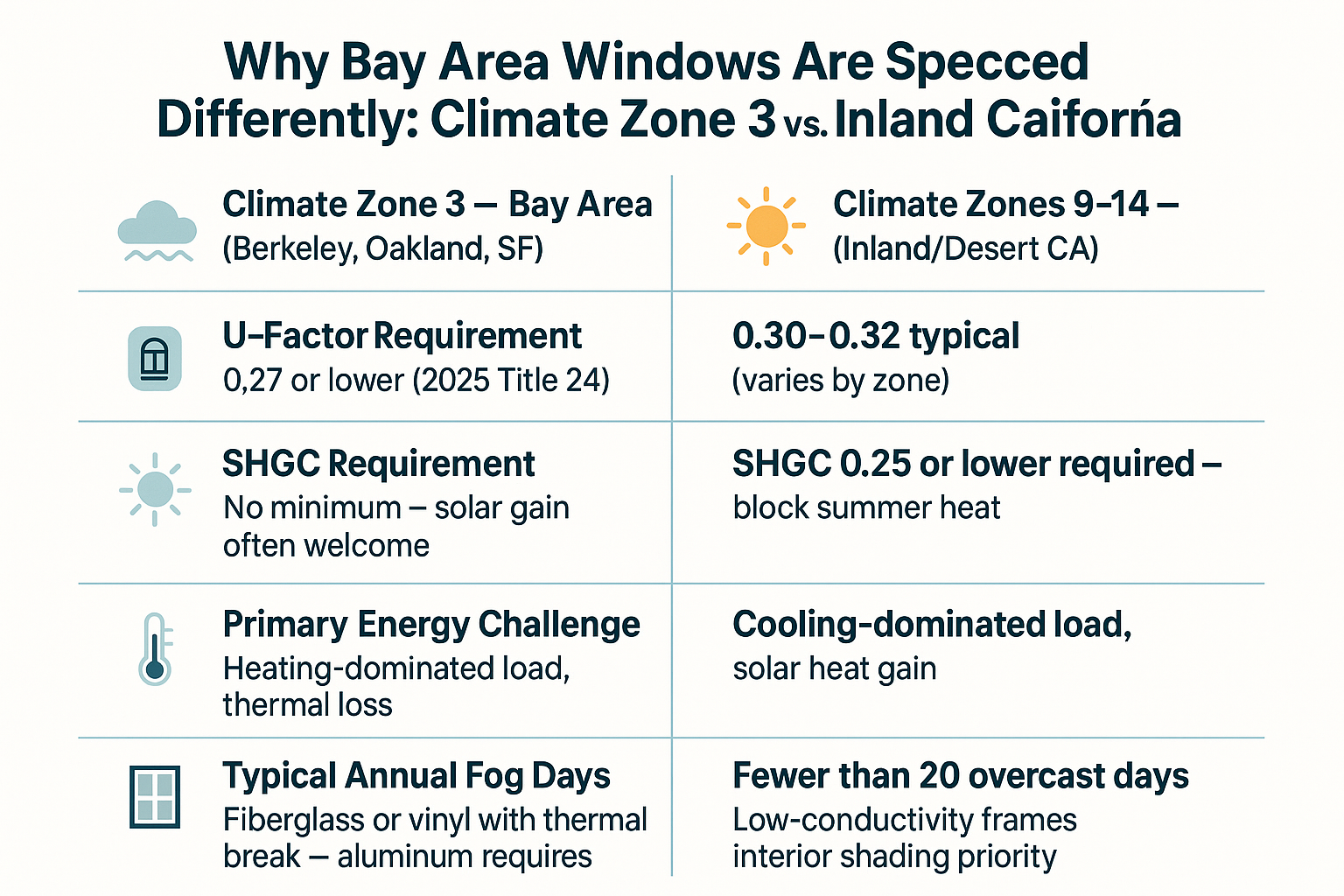
Climate Zone 3 vs. Inland California: Window Spec Comparison
This visual breaks down how Title 24 window requirements shift between Climate Zone 3 and hotter inland zones, and why the differences exist.
What This Means When You’re Actually Selecting Windows
Hitting U-0.27 in a real product lineup narrows your choices considerably. Here’s what to look for and what to watch out for when you’re pulling specs:
Frame material matters as much as glass. Aluminum frames are common on Bay Area mid-century homes and multi-unit buildings, but bare aluminum conducts heat rapidly. An aluminum-framed window without a thermal break will struggle to reach U-0.27 even with excellent glazing. Fiberglass and vinyl frames handle the Zone 3 thermal requirement more reliably, and they hold up better against the moisture and salt air in coastal-adjacent neighborhoods.
Low-e coatings are not all the same. Low-e glass reflects infrared energy — but which direction matters. In Zone 3, you want a coating that keeps interior heat from escaping outward during cool nights and overcast days. Some low-e coatings are tuned for hot climates and prioritize blocking solar input, which can actually reduce passive solar gain on a north-facing Berkeley bungalow that needs every BTU it can get in January.
Triple pane is worth evaluating, not assuming. Triple-pane units reliably hit U-0.20 to U-0.25, which clears the Zone 3 bar with room to spare. But they add cost and weight — roughly $50 to $150 more per window depending on size and manufacturer. For a large historic renovation with a tight schedule, that difference in rough opening clearance and installation time adds up. Knowing how to measure rough openings accurately before finalizing your order prevents expensive field adjustments.
For projects where you’re also evaluating whether a showroom visit makes sense before committing to a window order, this guide on buying architectural windows in Berkeley lays out when in-person review actually changes the outcome.
Common Window Frame Types: Zone 3 Performance at a Glance
Frame type has a direct effect on whether a window can reach U-0.27. This table shows how common frame materials generally perform in Zone 3 conditions.
| Frame Material | Typical U-Factor Range | Zone 3 Code Compliance | Moisture/Corrosion Notes |
|---|---|---|---|
| Fiberglass | U-0.20 to U-0.28 | Yes — reliable | Excellent — resists coastal moisture and salt air |
| Vinyl (PVC) | U-0.22 to U-0.30 | Yes — with quality glazing package | Good — some expansion in direct sun exposure |
| Wood-clad | U-0.25 to U-0.35 | Yes, if paired with correct glazing | Moderate — requires maintenance on exterior cladding |
| Aluminum with thermal break | U-0.28 to U-0.38 | Borderline — depends on glazing and break design | Good — thermal break prevents condensation on interior |
| Bare aluminum (no break) | U-0.40 to U-0.60 | No — does not meet Zone 3 standard | Poor — high condensation risk in fog-belt conditions |
The Compliance Path Question: Prescriptive vs. Performance
Title 24 gives you two ways to show a building meets energy code: the prescriptive path and the performance path.
The prescriptive path is straightforward — hit the numbers in the table. U-0.27 or lower, fenestration area at or below 20% of conditioned floor area, done. Most residential remodels and smaller new construction projects use this path because it’s faster to document and easier for inspectors to verify.
The performance path uses whole-building energy modeling software — typically EnergyPro — to show that the building as a whole meets the energy budget, even if individual components don’t hit the prescriptive thresholds. This gives architects and builders flexibility: you might use a window slightly above U-0.27 if it’s offset by exceptional wall insulation, an upgraded HVAC system, or other efficiency measures.
For most contractors doing residential work in Berkeley and Oakland, the prescriptive path is the right call. It’s predictable, the inspection process is well-established with local building departments, and it keeps window selection clean and direct. The performance path makes more sense on larger or more architecturally complex projects where a specific window is non-negotiable for design reasons.
Frequently Asked Questions About Bay Area Window Specs
Do I need to meet the U-0.27 requirement if I’m just replacing a few windows, not doing a full remodel?
It depends on how your local building department classifies the work. In Berkeley and Oakland, window replacement that requires a permit — which most does — triggers Title 24 compliance for the replaced units. If you’re pulling a permit, plan on hitting U-0.27. Some jurisdictions allow a like-for-like exemption for single-unit replacements, but that’s the exception, not the rule. Confirm with your local building department before ordering.
Why doesn’t Zone 3 have a minimum SHGC requirement when most of California does?
Because the Bay Area doesn’t have a cooling problem — it has a heating problem. SHGC limits exist to prevent solar heat gain from overloading air conditioning in hot climates. In Zone 3, cool temperatures and frequent fog mean passive solar gain is often a benefit, not a liability. Code reflects that reality by not penalizing you for a higher SHGC in this zone.
Is triple pane worth the extra cost for a Bay Area project?
Often yes, but it’s not automatic. Triple pane clears the U-0.27 threshold easily — typically landing at U-0.20 to U-0.25 — and delivers noticeably better comfort near glass on cold, foggy nights. The added cost runs roughly $50 to $150 more per window over a comparable high-performance double pane. For a 15-window project, that’s a real number to weigh against long-term energy savings and comfort. On a north-facing or shaded elevation, it’s usually worth it. On a south-facing wall with significant sun exposure, a well-specified double pane often performs comparably.
What happens if my windows don’t pass the Title 24 check during inspection?
The inspector will flag the fenestration as non-compliant and the project won’t receive final sign-off until it’s corrected. Depending on where you are in the project, that can mean removing and replacing already-installed windows — which is an expensive and time-consuming correction. Getting the spec right before ordering is far cheaper than field remediation.
Does the 20% fenestration limit apply to every window on the building, or just new windows?
The 20% of conditioned floor area limit applies to total fenestration area on the building when you’re using the prescriptive compliance path for a permit-required project. If your existing window area already exceeds 20% and you’re doing a full replacement, you’ll likely need to use the performance path and run energy modeling to demonstrate overall code compliance. This is a common scenario on older Bay Area homes with large window-to-wall ratios.
Can I use an aluminum window and still meet Zone 3 code?
Yes — but only if the frame has a proper thermal break and the glazing package is strong enough to pull the whole-unit U-factor down to 0.27 or lower. Bare aluminum frames without thermal breaks will not get there. If you’re working on a mid-century building where aluminum windows are architecturally appropriate, look specifically for thermally broken aluminum systems from manufacturers who publish NFRC-rated whole-unit performance data.
Have Questions About Window Specs for Your Project?
Whether you’re working on a permit-required replacement job in the Berkeley flats or a new build in the Oakland hills, getting window specs right before you order saves significant time and money down the line. Truitt & White’s Windows and Doors showroom at 1831 Second Street in Berkeley carries energy-efficient window lines rated for Zone 3 compliance, and the staff there can walk through NFRC labels, glazing packages, and fenestration calculations with you in person. Call the showroom at 510-649-4400, or visit truittandwhite.com to learn more before your next project.