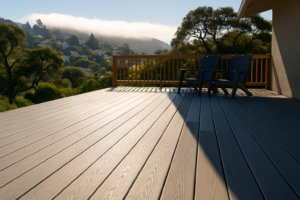
Direct Answer: As of January 1, 2026, new and replacement decks in California Very High Fire Hazard Severity Zones must meet Class A flame spread requirements under the California Wildland-Urban Interface Code, Title 24 Part 7.
A lot of contractors working the Oakland and Berkeley hills are operating under an outdated assumption: that WUI requirements are something you worry about on rural projects, not urban hillside remodels. As of January 1, 2026, that assumption is wrong, and it’s creating real plan-check problems for jobs that were scoped under the old framework.
California’s Building Standards Commission consolidated the wildfire construction requirements that used to live across CBC Chapter 7A and the California Residential Code into a single standalone document: Title 24 Part 7, the California Wildland-Urban Interface Code (CWUIC). If a project adds or replaces a deck on a property in a Very High Fire Hazard Severity Zone, the deck material now has to meet the current ignition-resistant construction standard, not just the general building code.
This article breaks down what actually changed, what it means for material selection on East Bay hillside projects, and where the compliance gaps tend to show up before plan check.
What the New CWUIC Actually Requires for Decking
The California Building Standards Commission relocated CBC Chapter 7A provisions into the new CWUIC, effective January 1, 2026. The code now applies to new construction and qualifying exterior alterations in mapped fire hazard areas, including the hillside neighborhoods of Oakland and Berkeley that fall within Very High Fire Hazard Severity Zones.
For decking specifically, the core requirement is a flame spread index not exceeding 25, tested to ASTM E84 or UL 723. That’s a Class A rating. But the code doesn’t stop at the board itself.
Ember intrusion beneath decks is one of the most documented ignition pathways during wildland fires, so the CWUIC also sets board spacing limits that are tighter than most contractors expect:
- Composite decking in WUI zones: maximum 3/16-inch board spacing
- Wood decking in WUI zones: maximum 3/8-inch board spacing
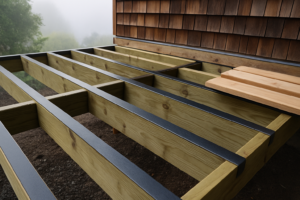
Those spacing limits aren’t just a materials spec question. They affect how fastener layout is drawn, how fascia board details are detailed, and whether the framing below uses open or closed joist bays. Contractors who are used to spec-ing standard composite or pressure-treated decking for hillside jobs need to revisit those details at the drawing stage, not after lumber is ordered.
Not Every ‘Fire-Resistant’ Product Is Actually WUI-Listed
This is where a lot of material schedules go sideways. A product can be marketed as fire-resistant, composite, or low-maintenance without carrying an active California State Fire Marshal Building Materials Listing. A product that passed testing in another state may not meet California’s specific test standards. Those are not equivalent.
For any East Bay hillside project, the right workflow is to confirm that the decking product carries active State Fire Marshal listing status before it goes on the material schedule, not after plan check flags it.
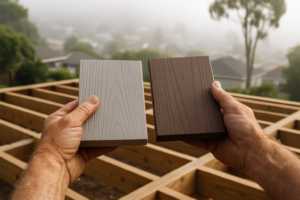
TimberTech, MOSO Bamboo Thermo, and certain Trex product lines each have specific SKUs with WUI listing. But not every product within those brand families carries that designation. A contractor who has been spec-ing a standard capped composite board from either brand and switches to a hillside project without checking listing status is creating a plan-check risk that costs real time.
A few things worth confirming at the supply counter before the order goes in:
- Does this specific SKU carry California State Fire Marshal listing?
- Is the listing current, or has it lapsed?
- Does the listing cover the installation method being used (hidden fasteners, face screw, etc.)?
- Does the substructure framing also need to meet WUI requirements under this scope of work?
If you’re sourcing TimberTech or composite decking for a hillside project, confirming listing documentation at the counter is a step that’s much cheaper than a plan-check revision.
For a broader look at how composite options compare to wood and modified wood on Bay Area projects, this breakdown of composite decking brands in the East Bay covers the performance differences in more detail.
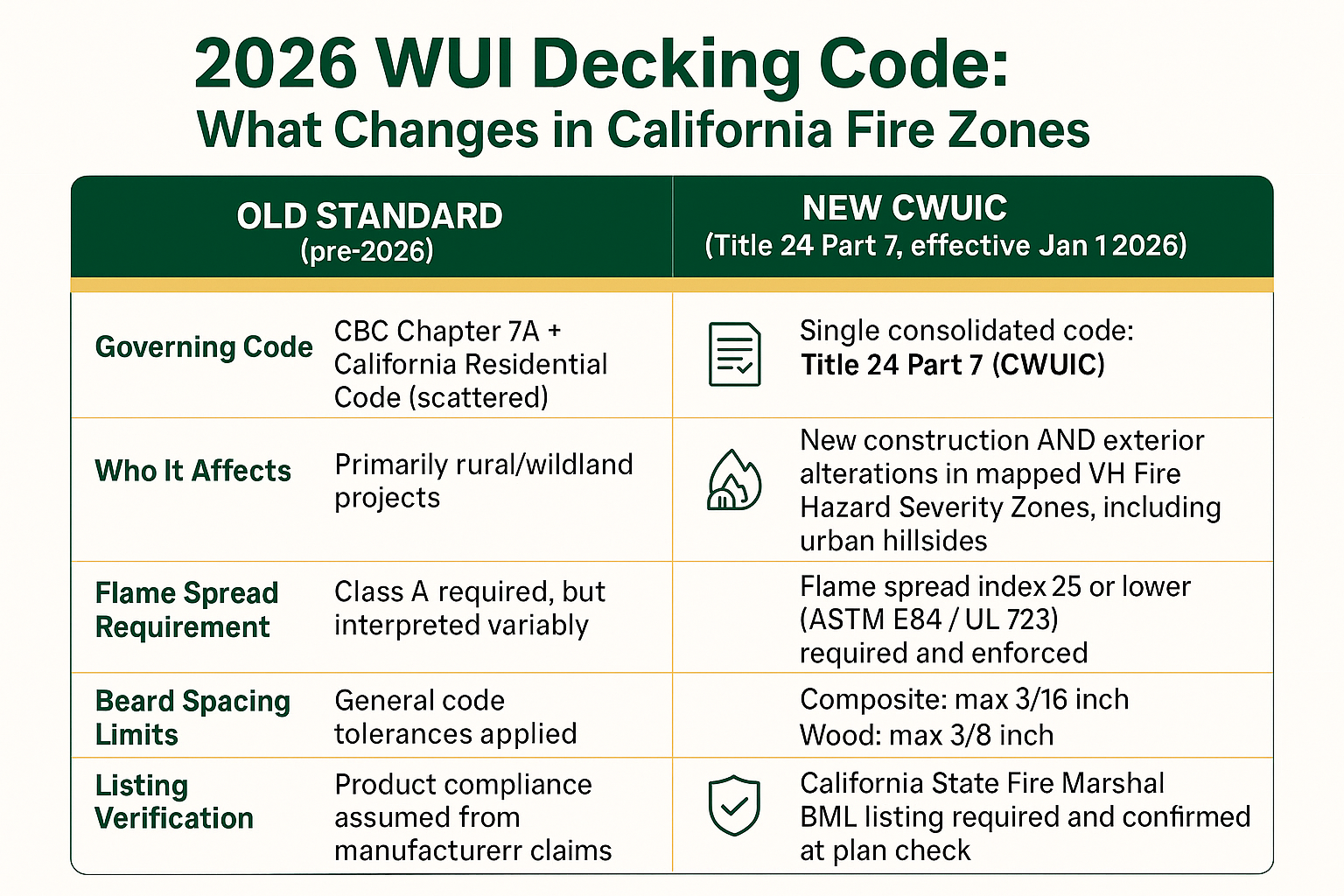
WUI Decking Compliance: What Changes Under the 2026 Code
This infographic summarizes the key compliance requirements for decking in California Very High Fire Hazard Severity Zones under the 2026 CWUIC.
When Does the New Code Trigger on an Existing Deck?
The CWUIC is not a retroactive retrofit mandate. An existing deck on a hillside property doesn’t automatically need to be rebuilt to the new standard just because the code changed.
But the alteration trigger catches a lot of remodelers off guard. The new code applies when an existing deck is replaced, extended, or significantly repaired in a fire hazard zone. For a Berkeley or Oakland hills homeowner who simply wants to re-board a deck that’s otherwise structurally sound, whether that scope triggers WUI compliance depends on two things: the permit application date and the extent of the work.
The local building department makes that call, and Berkeley requires permits for most construction and repair work. That conversation needs to happen before lumber is ordered, not after the crew shows up.
A few scenarios worth thinking through:
- Full deck replacement (all boards removed, new decking installed): Almost certainly triggers WUI compliance in a mapped fire zone
- Partial re-boarding (replacing a portion of damaged boards): Depends on scope percentage and permit type, confirm with the building department
- Structural repair only (substructure work, no new decking surface): May not trigger the decking material requirement, but framing materials may have their own WUI requirements
- New deck addition to an existing home: Triggers the full standard
The safest approach is to pull the permit before the material conversation, not after. Berkeley’s building department will tell you exactly what triggers compliance on that specific scope, and that answer changes what goes on the material schedule.
WUI Compliance at a Glance: Decking Materials in the East Bay
This table summarizes how common decking materials stack up against the 2026 CWUIC requirements for Very High Fire Hazard Severity Zones. Always verify current California State Fire Marshal listing status for the specific SKU before specifying.
| Material | Class A Capable? | WUI Listing Available? | Key Consideration |
|---|---|---|---|
| TimberTech (select lines) | Yes | Yes, specific SKUs only | Confirm listing on exact product, not all TimberTech lines qualify |
| Trex (select lines) | Yes | Yes, specific SKUs only | Standard Trex boards may not carry WUI listing, verify before spec |
| MOSO Bamboo Thermo | Yes | Yes | Check current State Fire Marshal BML status; listing must be active |
| Thermory (thermally modified wood) | Varies by product | Confirm with supplier | Thermal modification improves fire performance but verify CSFM listing |
| Redwood (all-heart) | Typically Class B-C without treatment | Generally no standalone WUI listing | Not the first call for fire zone compliance, see redwood decking grades |
| Pressure-treated wood (standard) | No | No | Does not meet flame spread requirement for WUI decking |
What This Means for How You Write the Material Schedule
The practical implication of the 2026 CWUIC for contractors in Oakland and Berkeley is that material selection can no longer be separated from code compliance research. The two steps have to happen together.
A contractor who specs composite decking by brand name without confirming WUI listing status for that specific product line is taking on plan-check risk. And that risk compounds: if the decking fails plan check, it may also mean the framing details, spacing specs, and fascia drawings all need revision.
The smarter workflow is to bring the project address and the proposed material to the supply conversation early. If the property is in a mapped VHFHSZ, that’s the first filter on the product list, not an afterthought.
For projects where fire zone performance intersects with Bay Area weather demands, the comparison of redwood, composite, and modified wood is worth reviewing alongside the code requirements. And if you’re weighing MOSO specifically for a hillside project, this breakdown on MOSO Bamboo for Bay Area conditions covers the real-world performance question.
Frequently Asked Questions About WUI Decking Code Compliance
How do I know if my project address is in a Very High Fire Hazard Severity Zone?
The California Department of Forestry and Fire Protection (CAL FIRE) maintains online maps of fire hazard severity zones. Most of the Berkeley and Oakland hills fall within VHFHSZ boundaries. You can also confirm the designation with the local building department when you pull the permit, they’ll tell you whether WUI requirements apply to your specific parcel.
Does the 2026 CWUIC apply to my project if it was already permitted before January 1, 2026?
The trigger is typically the permit application date, not the construction date. Projects permitted before January 1, 2026 may fall under the previous code. But if you’re pulling a new or revised permit in 2026 or later, the new standard applies. Confirm with the local building department for the specific permit type.
Can I use standard Trex or TimberTech composite boards on a hillside fire zone deck?
Not necessarily. Both brands have specific product lines with California State Fire Marshal WUI listing, but not all SKUs within those brands carry that designation. A standard capped composite board from either brand may not meet the flame spread requirement. Confirm the exact product’s listing status before it goes on the material schedule.
What’s the maximum board spacing allowed for composite decking in a WUI zone?
3/16 inch. That’s tighter than standard composite installation practice, and it affects fastener layout and how drainage details are handled. Wood decking in WUI zones allows up to 3/8-inch spacing, but wood products generally face tougher flame spread hurdles to begin with.
Do I need to bring documentation of WUI listing to plan check?
Yes. The California State Fire Marshal Building Materials Listing is the authoritative source, and plan checkers for hillside projects in Berkeley and Oakland will typically ask for confirmation that the decking product is actively listed. Having that documentation in hand before submittal avoids back-and-forth that delays the project.
Does the substructure framing also need to meet WUI requirements?
Depending on the scope and how the project is permitted, the framing below the deck may also fall under WUI requirements, particularly for open joist bay configurations where ember accumulation is a documented ignition risk. This is worth confirming with the building department and your plans examiner at the start of the project, not mid-construction.
Confirming WUI Listing Before the Order Goes In
If you’re building or replacing a deck on a hillside property in the East Bay, confirming WUI listing status before the material schedule is finalized is the step that saves time on the back end. The team at Truitt & White’s Berkeley lumberyard at 642 Hearst Avenue works with contractors on exactly these questions, which specific products carry active State Fire Marshal listing, how spacing requirements affect the install, and what documentation you’ll need at plan check. You can call the lumberyard directly at 510-841-0511, Monday through Friday, or visit truittandwhite.com to explore available decking products before your next hillside project.