Direct Answer: For most Bay Area decks, clear all-heart redwood or thermally modified wood holds up best. The right pick depends on your site’s fog, sun exposure, and how close you sit to the bay.
You pull up a national buying guide, and it tells you cedar lasts 15 to 20 years. Then your deck in the Berkeley hills goes gray and starts checking in four seasons, and you wonder what you did wrong.
The problem is that most decking advice is written for climates that do not include a marine layer that rolls in every afternoon and burns off by noon the next day. That wet-dry-wet cycle is harder on wood than steady rain or steady sun.
We sell a lot of deck lumber to contractors and homeowners across Berkeley, Oakland, and San Francisco, and the honest answer to “which wood lasts longest” always starts with a question about the site. Below is how to read your own deck’s exposure first, then how the main wood options actually behave once they are out there.
Read Your Site Before You Pick a Species
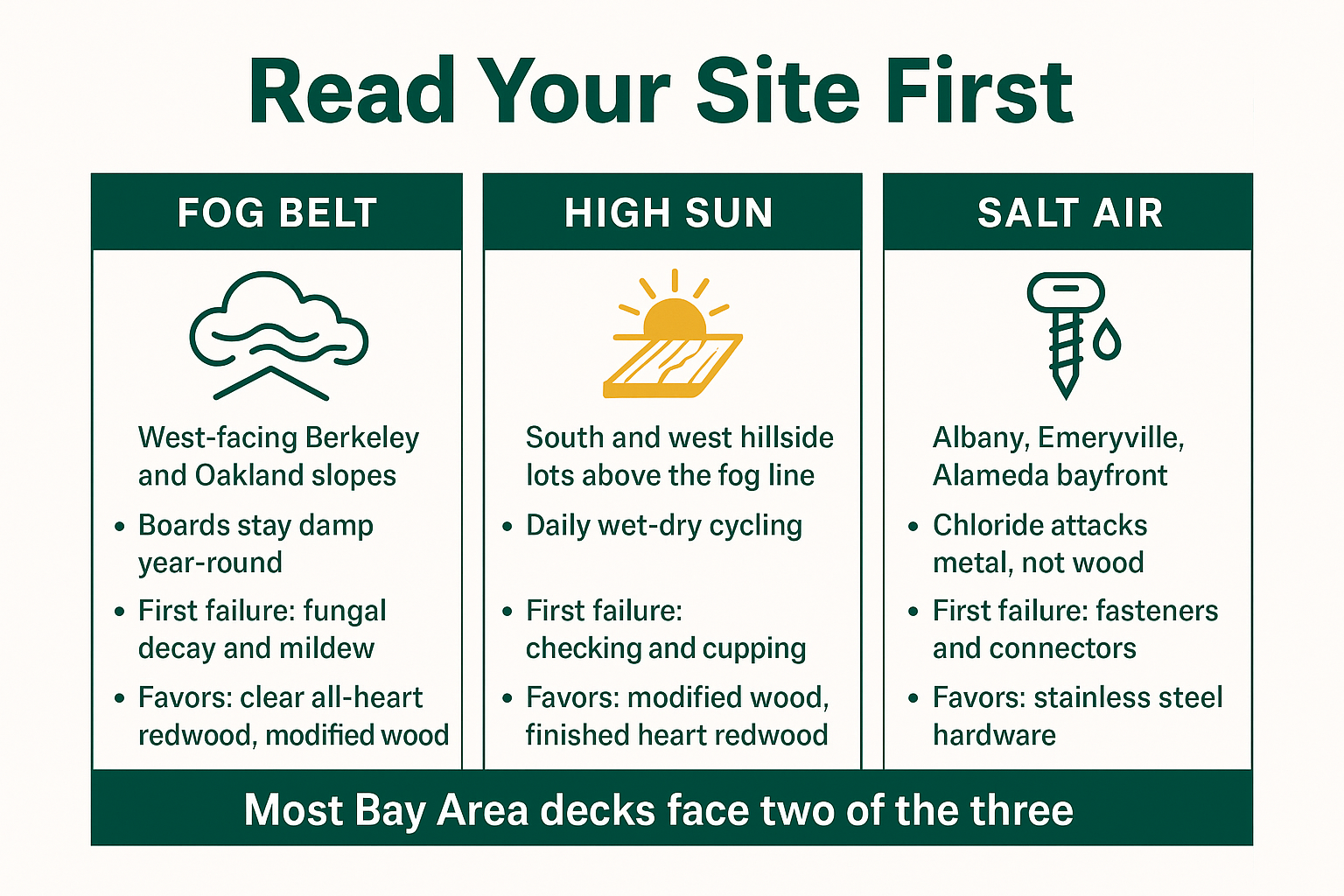
Two decks four miles apart in the East Bay can face completely different stress. Before you commit to a species, figure out which of these three conditions dominates your lot.
- Fog belt and marine layer. Western slopes of Berkeley and Oakland, plus most of San Francisco, stay damp much of the year. Boards never fully dry out, so fungal decay and surface mildew are the main enemies.
- High UV, south and west exposure. Hillside lots that clear the fog line take real sun. Here the failure mode is surface checking, cupping, and boards drying faster on top than underneath.
- Salt air. Bayfront neighborhoods like Albany, Emeryville, and parts of Alameda push chloride into everything. Wood tolerates it. Fasteners and connectors do not.
Most Bay Area decks get a mix. A south-facing deck in the Berkeley hills can bake at 2 p.m. and sit in fog by 6 p.m. That daily swing moves moisture in and out of the boards over and over, which is exactly what pulls fibers apart.
If your deck faces south or west, the sun side of the equation is worth its own read. We covered that in more detail in which deck wood holds up in Bay Area sun.
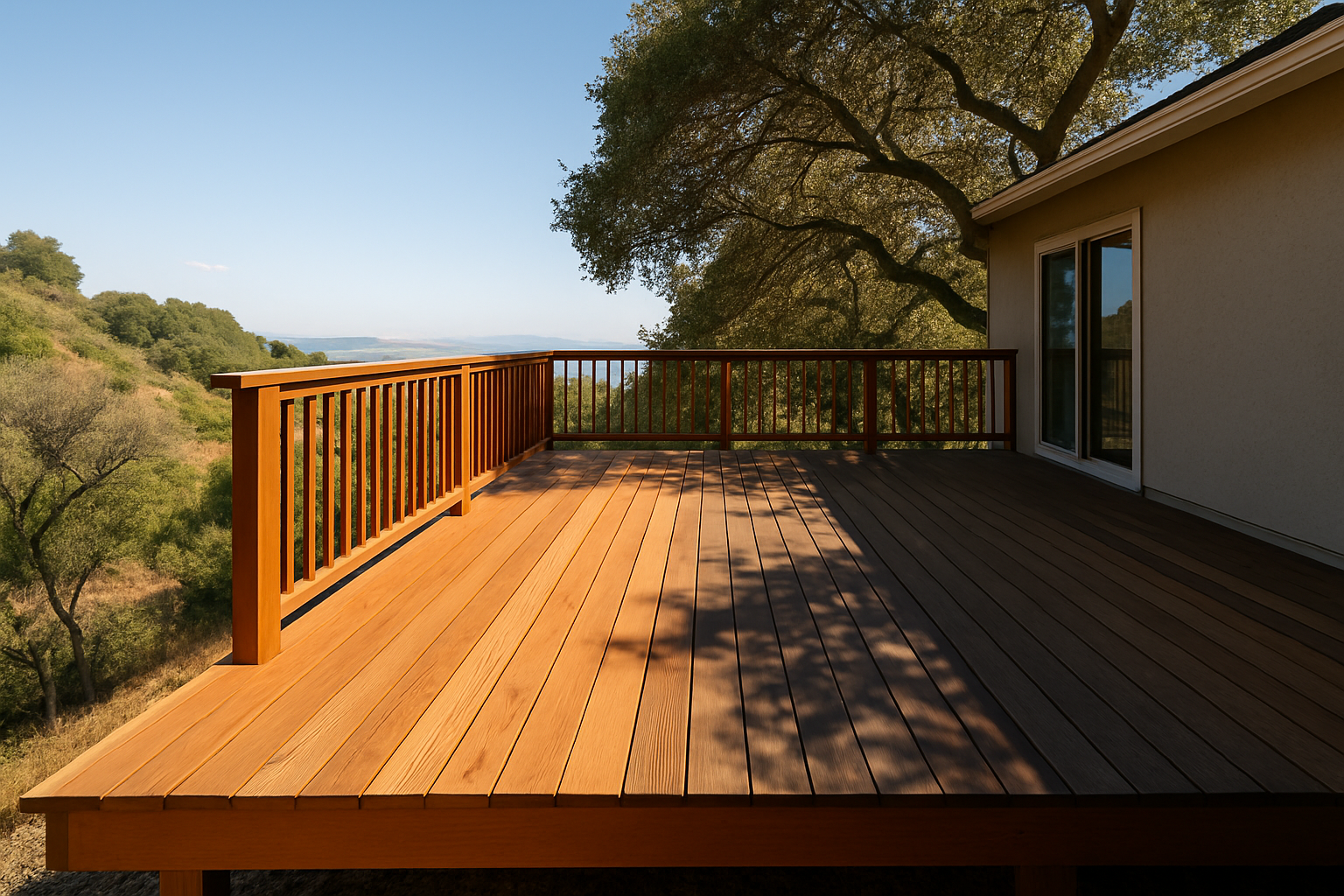
Redwood: Start Here, But Know Your Grade
Redwood is the local default for good reason. Coast redwood heartwood carries a high level of tannins and extractives, which is what gives it natural resistance to fungal decay and insects. The USDA Forest Products Laboratory groups redwood heartwood with the naturally durable species, and outdoor decking is one of its classic uses.
The part buyers usually miss is that not all redwood is the same wood. The price gap between grades is not a markup game. It reflects how much heartwood is in the board.
- Clear all-heart. All heartwood, no sapwood, few or no knots. This is the grade that earns redwood its decay-resistant reputation, and it is the one that belongs on a fog-belt deck.
- Construction heart. Heartwood with knots. Still good decay performance, more movement and more surface character.
- Construction common or deck common. Contains sapwood. Sapwood has almost none of the tannins that resist rot. In a damp Berkeley yard, sapwood boards can show decay years before the heart boards next to them.
So when someone tells you “my redwood deck rotted in six years,” the useful follow-up question is what grade it was. A mixed-grain construction common deck on the shady north side of a house is a different product than clear all-heart on the same frame.
Redwood also takes finish well and stays cool underfoot, which matters more than people expect on a west-facing deck in September.
Douglas Fir and Pressure-Treated: The Honest Version
Both come up constantly as budget options. Both can work. Both come with conditions.
Douglas fir is strong, straight, and widely stocked. It is a workhorse for framing. As a deck surface in the Bay Area, it is a higher-maintenance choice. Fir has little natural decay resistance, and it checks and splinters faster than redwood under the sun-then-fog cycle. If you use it, plan on a consistent sealing schedule, realistically every year or two, and expect to keep after it.
Pressure-treated lumber is a different animal. The preservative does the work the wood cannot do on its own, and the details on the end tag matter:
- Above-ground versus ground-contact rating. Ground contact carries a higher preservative retention. Anything within six inches of soil, sitting on concrete, or in a poorly ventilated spot under a low deck should be ground-contact rated.
- Retention level. Two boards can both say “treated” and hold very different amounts of preservative. The tag tells you which.
- Moisture content at delivery. Freshly treated lumber is wet and will shrink. Gapping it like dry lumber leads to wide joints later.
Most Bay Area builders we work with use pressure-treated for the frame and something better looking on top. That combination is hard to beat. If you want the tag details broken down, see what pressure-treated wood labels actually mean.
Bay Area Deck Wood at a Glance
A quick reference for how the common wood options behave under local conditions. Maintenance intervals vary with exposure, so treat these as planning ranges rather than promises.
| Wood | Best-fit Bay Area site | Main weakness | Typical refinish cycle |
|---|---|---|---|
| Clear all-heart redwood | Fog belt, shaded, or mixed sun and marine layer | Softer surface, dents from furniture | Every 2-3 years to hold color |
| Construction heart redwood | Sunny lots where knots are acceptable | More movement and checking | Every 2 years |
| Douglas fir | Covered porches, low-moisture spots | Checks and splinters, low decay resistance | Every 1-2 years |
| Pressure-treated | Framing, joists, ledgers, ground-contact areas | Shrinkage, appearance, fastener chemistry | Frame does not need finish |
| Thermally modified (Thermory) | Marine air, salt exposure, high-moisture yards | Silvers quickly if left unfinished | Every 2-3 years if holding color |
How to Read Your Deck’s Exposure
Three site conditions drive most Bay Area deck material decisions. Here is how they map to what fails first.
Thermally Modified Wood for Damp and Salty Sites
Thermal modification is a heat process, not a chemical one. The wood is cooked at high temperature in a controlled, low-oxygen kiln, which drives out moisture and breaks down the sugars in the cell structure.
Those sugars are what decay fungi feed on. Take away the food source and the wood becomes far less appealing to rot, without any preservative added. That is the reason architects and homeowners who want a chemical-free exterior material keep asking about it.
The practical benefits on a Bay Area jobsite:
- Dimensional stability. It absorbs much less moisture, so it cups and swells less through a wet winter.
- Decay resistance without chemicals. Useful near vegetable beds, play areas, or anywhere the owner is particular about treated wood.
- Consistent boards. Modified stock tends to come through straighter than mixed-grain softwood.
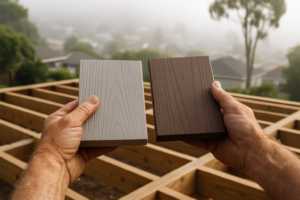
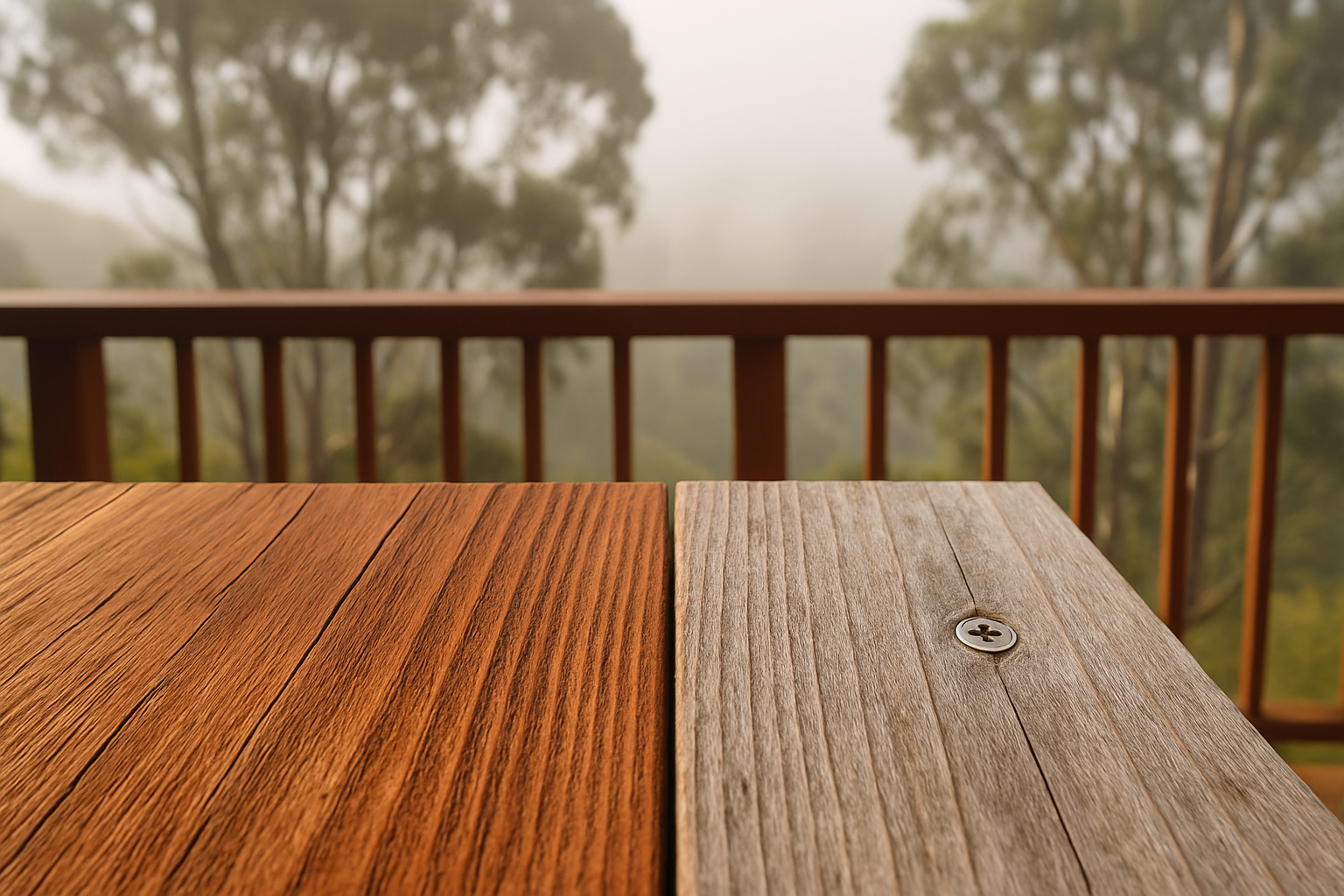
The tradeoff is appearance over time. Left unfinished in marine air, thermally modified wood silvers out fairly quickly, similar to how redwood grays. If the owner wants the deep brown color to stay, that means a UV-protective oil on a regular schedule, roughly the same cadence you would give good redwood.
We get into the head-to-head detail in does Thermory decking actually outperform cedar and composite.
Fasteners Are Part of the Species Decision
Picking a wood and then grabbing whatever screws are on the shelf is how good decks fail early. The metal has to match the wood and the air.
- Redwood: stainless steel. Redwood tannins react with standard galvanized coatings. That reaction shows up as black streaking around every fastener head, and it can accelerate corrosion. Stainless costs more up front and it is the right call.
- Pressure-treated: hot-dipped galvanized at minimum for above-ground work. Modern copper-based preservatives are corrosive to unprotected steel. Check that connectors and hangers carry a matching rating, not just the screws.
- Salt air anywhere: stainless, no exceptions. In Albany, Emeryville, and along the Alameda shoreline, fasteners are usually the first thing that gives out on an otherwise sound deck.
- Hardwood and modified wood: screws, not nails. Denser boards split more readily, and pre-drilling or using hidden fasteners rated for the product saves a lot of grief.
The same logic applies under the boards. Joists, ledgers, and flashing take more moisture than the surface does. Five details under the deck boards walks through the framing side.
What This Usually Comes Down To
If you are on a shaded, damp lot on the west side of the hills, clear all-heart redwood or thermally modified wood will outlast anything cheaper you put down there.
If you are on a sunny hillside above the fog line, stability matters more than raw decay resistance, and finish schedule becomes the deciding factor.
If you are near the water, spend the money on stainless hardware first and then pick your species.
One longtime customer put it simply in a review: “Love working with Joe, and the whole lumber sales team.” That is the part a national buying guide cannot do. Which grades are actually in the yard this week, how a particular run of boards looks, and what has performed on similar decks two neighborhoods over is a five-minute conversation, not a search result.
Frequently Asked Questions About Bay Area Deck Wood
Why does clear all-heart redwood cost so much more than construction common?
Because it is a different product. Clear all-heart contains no sapwood and few or no knots, and sapwood is the part with almost none of redwood’s natural decay resistance. You are paying for the portion of the tree that actually holds up in wet conditions. Grade pricing moves with the market, so call the lumberyard for current numbers.
Can I use pressure-treated lumber for the deck surface, not just the frame?
You can, and plenty of decks do. Just use above-ground rated material, let it dry before finishing, and expect more shrinkage and movement than you would get from redwood. Most Bay Area builders use pressure-treated below and something better looking on top.
How often do I really need to reseal a redwood deck around here?
In the fog belt, most owners get two to three years out of a good penetrating finish before color starts going. On a hot south-facing deck it is often closer to two. If you are fine with silver-gray, you can skip color entirely and just keep the deck clean, though a clear water repellent still slows checking.
Does WUI fire zone status change which decking wood I can use?
It can. Hillside properties in Berkeley and Oakland that fall in a wildland urban interface zone have exterior material requirements that apply to decks. Check with your local building department before you order, because the answer depends on your specific parcel and project scope.
Is Douglas fir ever the right choice for a deck?
On a covered porch or a well-drained, sunny spot with an owner who will actually maintain it, sure. In open fog-belt conditions it is fighting uphill. It has little natural decay resistance and it splinters, which matters if kids or dogs use the deck barefoot.
Sorting Out the Right Deck Wood for Your Site
Deck material questions get a lot easier when someone can tell you what grades are on the racks and how they have performed on similar East Bay lots. Our lumber sales team at the Hearst Avenue yard in Berkeley is around if you want to talk through grades, fasteners, and exposure before you order. The Lumberyard and Hardware line is 510-841-0511, and there is more decking material information at truittandwhite.com.