Direct Answer: Thermory generally outperforms cedar on durability and moisture resistance, and beats most composites on heat retention and aesthetics — but it costs more upfront and requires some maintenance.
If you’ve been pricing out decking materials lately, you’ve probably run into Thermory — thermally modified wood that gets marketed as the best of both worlds between natural wood and composite. The question contractors and homeowners keep asking us is a fair one: does it actually earn that reputation, or is it just a premium price tag?
The Bay Area makes this question harder to answer than it looks. Between Oakland hillside projects in the WUI zone, Berkeley backyards shaded by the marine layer six months of the year, and south-facing San Francisco decks that bake in the afternoon sun, no single material performs the same way everywhere. Which decking material holds up in Bay Area weather depends heavily on exposure, orientation, and what you actually want out of the material over 10 to 20 years.
This article compares Thermory against Western red cedar and composite decking across the factors that matter most in real Bay Area conditions — moisture performance, heat behavior, appearance over time, and total cost. We’ll skip the marketing language and stick to what we’ve seen work in the field.
What Thermory Actually Is — and Why It Behaves Differently
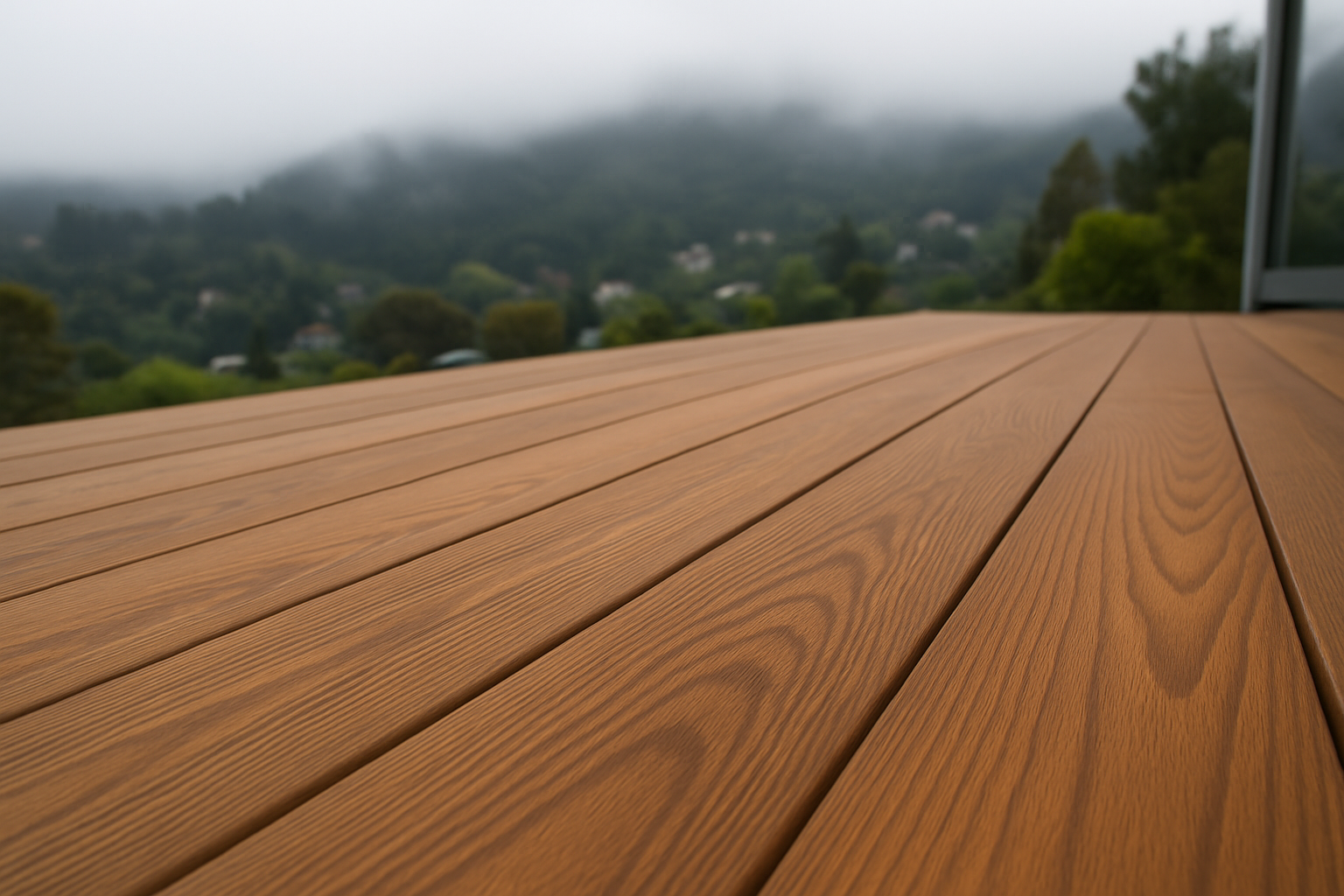
Thermory is wood — typically Scots pine or ash — that’s been heat-treated in a kiln at temperatures between 180°C and 215°C using only steam, no chemicals. That process drives out the sugars and moisture that wood-boring insects and fungi feed on, and it permanently changes the cell structure of the wood.
The result is a board that absorbs significantly less water than untreated softwood. Thermory typically reaches equilibrium moisture content around 4–6%, compared to cedar which can swing between 10–19% depending on seasonal exposure in a coastal climate. Less moisture cycling means less swelling, cupping, and splitting over time.
If you want to understand the science behind the process, what is thermally modified wood and why architects are specifying it covers the technical side in more depth. For this comparison, what matters is the practical outcome: Thermory behaves more like a hardwood in terms of dimensional stability, but it’s still a natural wood product with grain, texture, and a finish that changes over time.
Cedar vs Thermory: Where the Real Differences Show Up
Western red cedar has earned its reputation for a reason. It’s naturally rot-resistant, dimensionally stable compared to most softwoods, and it works beautifully on jobsites — easy to cut, easy to fasten, and forgiving on crews. In the Bay Area, it’s been the go-to natural wood decking material for decades.
But cedar has limits that show up fast in certain exposures:
- Gray weathering starts within one season if the deck isn’t sealed consistently
- End grain checking and surface cracking appear in boards that see alternating wet fog and dry sun
- Softer grades allow denting from furniture and foot traffic over time
- Quality has gotten inconsistent as old-growth supply has declined — what you get today is not what builders used 30 years ago
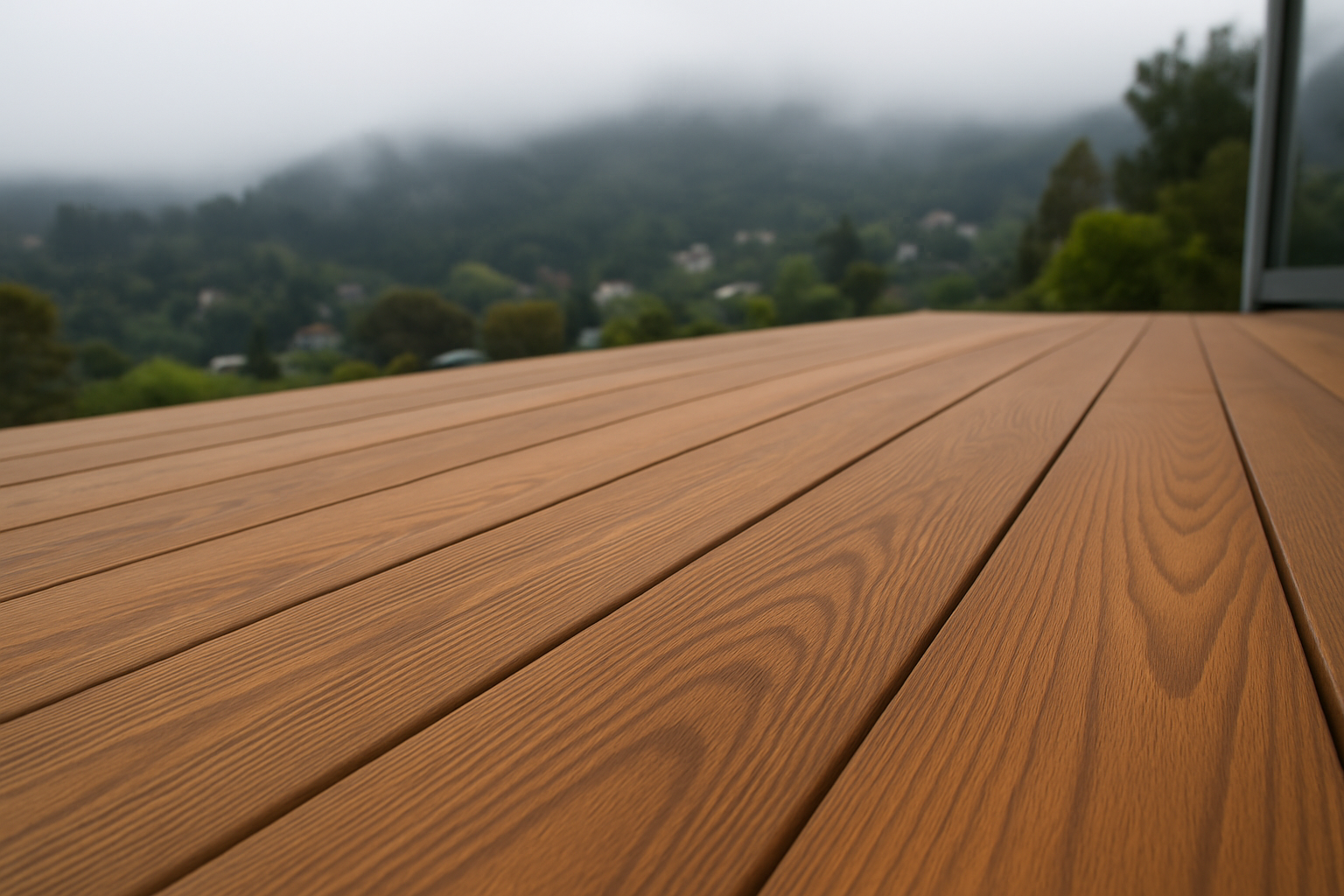
Thermory holds an edge on moisture cycling because of the modified cell structure. On a Berkeley flat where the deck faces northwest and stays damp from October through April, Thermory will show noticeably less cupping and surface checking after five years than cedar will under the same conditions.
On cost, clear vertical grain cedar in the Bay Area is currently running roughly $6–$9 per linear foot for standard decking profiles, while Thermory runs $9–$14 per linear foot depending on the species and profile. That gap is real. Whether it’s worth it depends on how long the customer plans to own the property and how much annual maintenance they’re willing to do. Cedar needs oil or sealer every 1–2 years to hold its color and resist checking. Thermory needs maintenance too, but the window between applications is longer and the consequences of skipping a season are less severe.
Thermory vs Composite: A Different Kind of Tradeoff
Composite decking — brands like TimberTech and Trex — is the zero-maintenance pitch. No sealing, no oiling, no annual upkeep. And for a lot of homeowners, that’s genuinely appealing. The wood vs composite decision in Bay Area fog and sun gets complicated fast depending on deck orientation and how much direct sun exposure is involved.
Here’s where composite starts to lose ground against Thermory:
- Heat retention on south-facing decks. Composite boards can reach surface temperatures of 140–160°F on a clear summer afternoon in parts of the East Bay and Peninsula where afternoon sun is strong. Thermory stays meaningfully cooler underfoot because wood doesn’t absorb and hold radiant heat the same way composite does.
- Appearance over time. Premium composite products look good at install, but the wood-grain embossing on composite boards tends to flatten and fade differently than natural grain. Thermory weathers to a silver-gray if left unfinished, or holds its warm color with periodic oiling. Either way, it reads as a natural material.
- Repairability. If a composite board gets damaged — impact crack, a bad cut, structural issue underneath — replacement boards need to match the current product line, which can be discontinued. A damaged Thermory board can be replaced with new stock that matches within normal natural variation.
Where composite wins is in the honest zero-maintenance category. If a customer genuinely won’t maintain the deck — no oiling, no sealing — composite will hold up better than any wood over 15 years. That includes Thermory. What California homeowners get wrong when choosing decking often comes down to exactly this: choosing a wood product and then not maintaining it.
Composite decking from TimberTech or Trex in capped profiles is currently running $10–$18 per linear foot installed for materials in the Bay Area market, which puts it in similar territory to Thermory when you factor in the labor savings from not having a deck that needs prep and sealing.
Thermory vs Cedar vs Composite: Quick Field Comparison
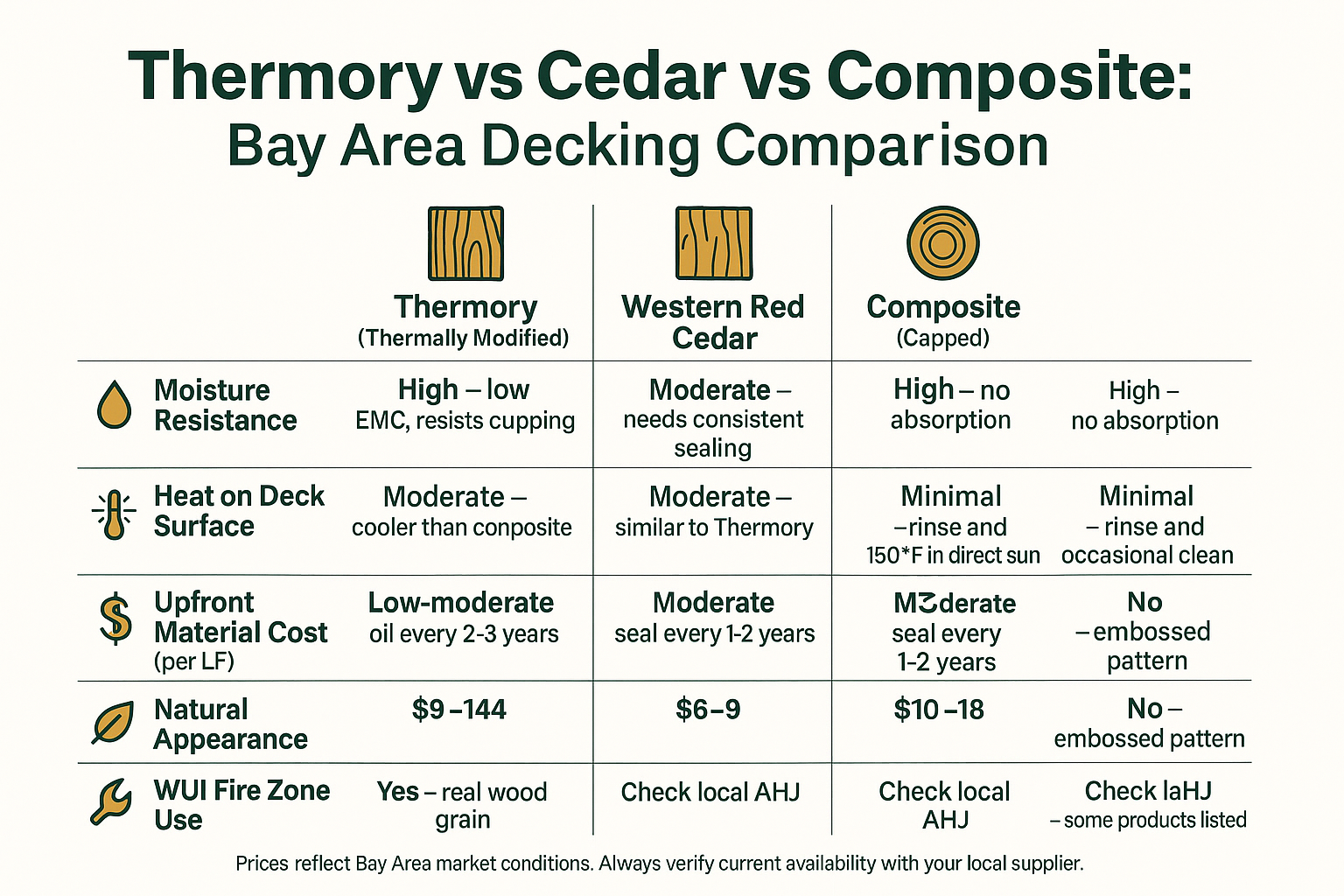
This comparison covers the factors that matter most on actual Bay Area projects — not lab specs, but real-world performance categories.
Thermory, Cedar, and Composite at a Glance
Use this as a quick reference when comparing options with a client or speccing a project.
| Category | Thermory | Cedar | Composite (Capped) |
|---|---|---|---|
| Material Cost (per LF) | $9–$14 | $6–$9 | $10–$18 |
| Moisture Performance | High | Moderate | High |
| Surface Heat (South-Facing) | Moderate | Moderate | High |
| Maintenance Frequency | Every 2–3 years | Every 1–2 years | Minimal |
| Real Wood Appearance | Yes | Yes | No |
| Repairability | Good | Good | Limited |
| Expected Lifespan (maintained) | 25–30 years | 15–20 years | 25–30 years |
Which One Makes Sense for a Bay Area Project?
There’s no universal answer here — it depends on the site, the customer, and what they’re actually willing to do over time.
Thermory makes the most sense when:
– The deck gets heavy morning fog or stays damp through winter and the customer wants a natural wood look without cedar’s maintenance schedule
– The project is on a north or east-facing exposure where composite heat isn’t an issue but moisture cycling is
– The spec calls for a natural material with genuine grain texture and the budget supports it
Cedar makes more sense when:
– Budget is the primary constraint and the customer is committed to maintenance
– The project is a standard residential deck in a sheltered East Bay backyard without extreme moisture exposure
– The framing contractor prefers a familiar material with predictable fastening behavior
Composite makes more sense when:
– The customer explicitly doesn’t want to maintain the deck — no exceptions
– The deck is in a high-traffic area where denting or surface wear from furniture is a concern
– The project involves a south-facing deck in full California sun where heat buildup is the tradeoff the customer understands and accepts
For Oakland and Berkeley hillside projects in WUI zones, the material conversation gets more specific. Not every decking product is listed for use in fire hazard severity zones, and your local AHJ will have the final word. The advanced guide to fire rated lumber in Berkeley covers the compliance side of that in detail.
Frequently Asked Questions About Thermory Decking
Does Thermory need to be sealed or oiled like regular wood?
Yes, but less frequently than cedar. Thermory can be left unfinished and it will weather to a natural silver-gray — similar to teak or ipe. If you want to maintain the warm color, a penetrating oil every 2–3 years is typically enough. Cedar on the same schedule would show more weathering and surface checking without more frequent attention.
How does Thermory hold up in the Bay Area fog and marine layer?
Better than cedar in sustained wet conditions. The thermal modification process lowers the wood’s equilibrium moisture content to around 4–6%, so it doesn’t swell and contract as dramatically when it cycles between wet fog and dry sun. That’s the main reason architects and contractors in coastal zones have been specifying it more often over the last several years.
Is Thermory approved for WUI fire zones in Oakland or Berkeley?
This depends on the specific product and your local Authority Having Jurisdiction. Thermal modification does change how the wood responds to ignition compared to untreated softwood, but Thermory isn’t automatically listed or approved for all WUI applications. Talk to your AHJ before specifying it for a hillside project in a designated fire hazard severity zone.
Can I stain Thermory to match other materials on the project?
Yes. Thermory accepts penetrating stains and oils well. It doesn’t accept film-forming finishes like paint as cleanly — the modified cell structure affects adhesion — so stick to penetrating products. Semi-transparent oil stains in warm tones tend to look the most natural on the modified wood grain.
Is Thermory a sustainable choice compared to composite or tropical hardwood?
Thermory is typically sourced from FSC-certified Scandinavian forests, which makes it a more traceable option than most tropical hardwoods. It uses no chemical preservatives — only heat and steam. Composite contains recycled content but is petroleum-based and not recyclable at end of life. If sustainability is a specification requirement, Thermory’s sourcing documentation is generally cleaner to present.
Looking at Thermory for an Upcoming Project?
Truitt & White carries Thermory thermally modified wood alongside cedar, composite, and other decking options — and the staff at our Berkeley lumberyard can walk you through the performance differences based on your specific site conditions, not a spec sheet. Stop by the Lumberyard and Hardware at 642 Hearst Avenue in Berkeley, call us at 510-841-0511, or browse more at truittandwhite.com.