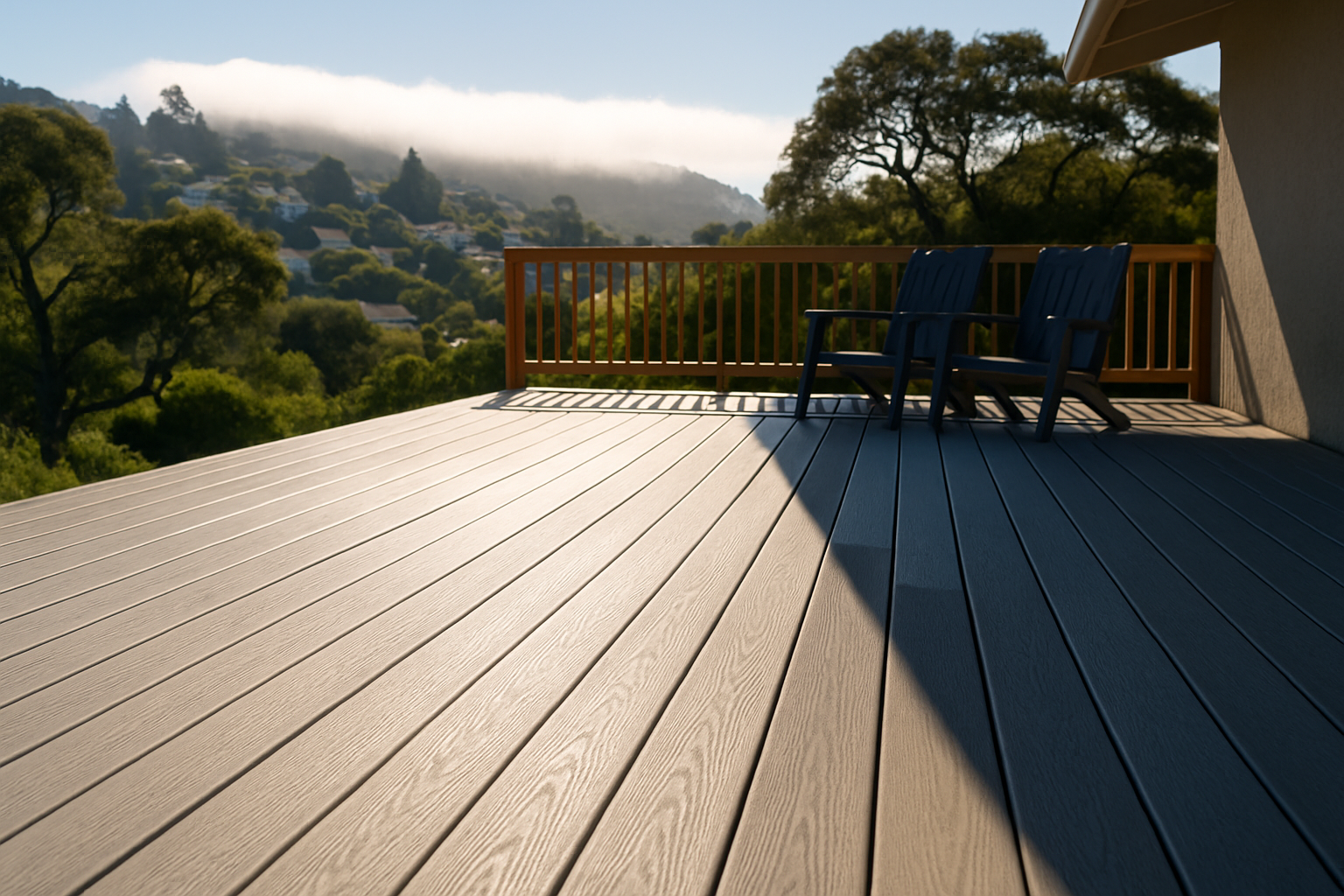
Direct Answer: Deck orientation decides how hot your boards get. South and west-facing decks take full afternoon sun and need lighter composite colors or modified wood. North-facing decks under fog have far more freedom.
Almost every conversation about composite decking heat happens too late. The boards are already down, the family is already hopping across the deck in July, and now somebody is shopping for rugs and shade sails.
The decision that actually controls surface temperature happens months earlier, at the order desk. It comes down to one question most homeowners never get asked: which way does the deck face, and how much direct sun does that spot really get?
In the Bay Area that question matters more than almost anywhere else, because two decks five miles apart can live in completely different climates. Here is how orientation should change what you order.
Two Bay Area Decks, Two Very Different Heat Problems
Picture a west-facing deck off the back of a bungalow in the Oakland flats, somewhere near Fruitvale. It catches sun from about noon until sunset, and the marine layer usually burns off well before it gets there.
In late July and August, that deck behaves a lot like a Southern California installation. Full afternoon exposure, no fog buffer, and heat that builds from 1 p.m. through dinner.
Now move up into the Berkeley hills on a north-facing slope above Grizzly Peak. That deck spends much of the summer morning under fog, gets indirect light for most of the day, and rarely reaches the temperatures that make dark composite unpleasant underfoot.
Same county. Same distributor. Completely different material math.
Most national decking content ignores this split entirely, which is why homeowners in Albany or El Cerrito end up with advice written for Phoenix or Atlanta. Before you pick a product, figure out where your project lands on this spectrum:
- Full afternoon sun, little fog influence: Oakland flats, Emeryville, parts of Richmond and Alameda
- Mixed exposure: most of the Berkeley and Albany flatlands, where fog burns off mid-morning
- Heavy fog influence, limited direct sun: north-facing hillside lots, canyon-shaded sites, west Berkeley near the shoreline on summer mornings
That placement should drive the order, not the showroom sample that looked best on a cloudy Tuesday.
How Hot Capped Composite Really Gets in Direct Sun
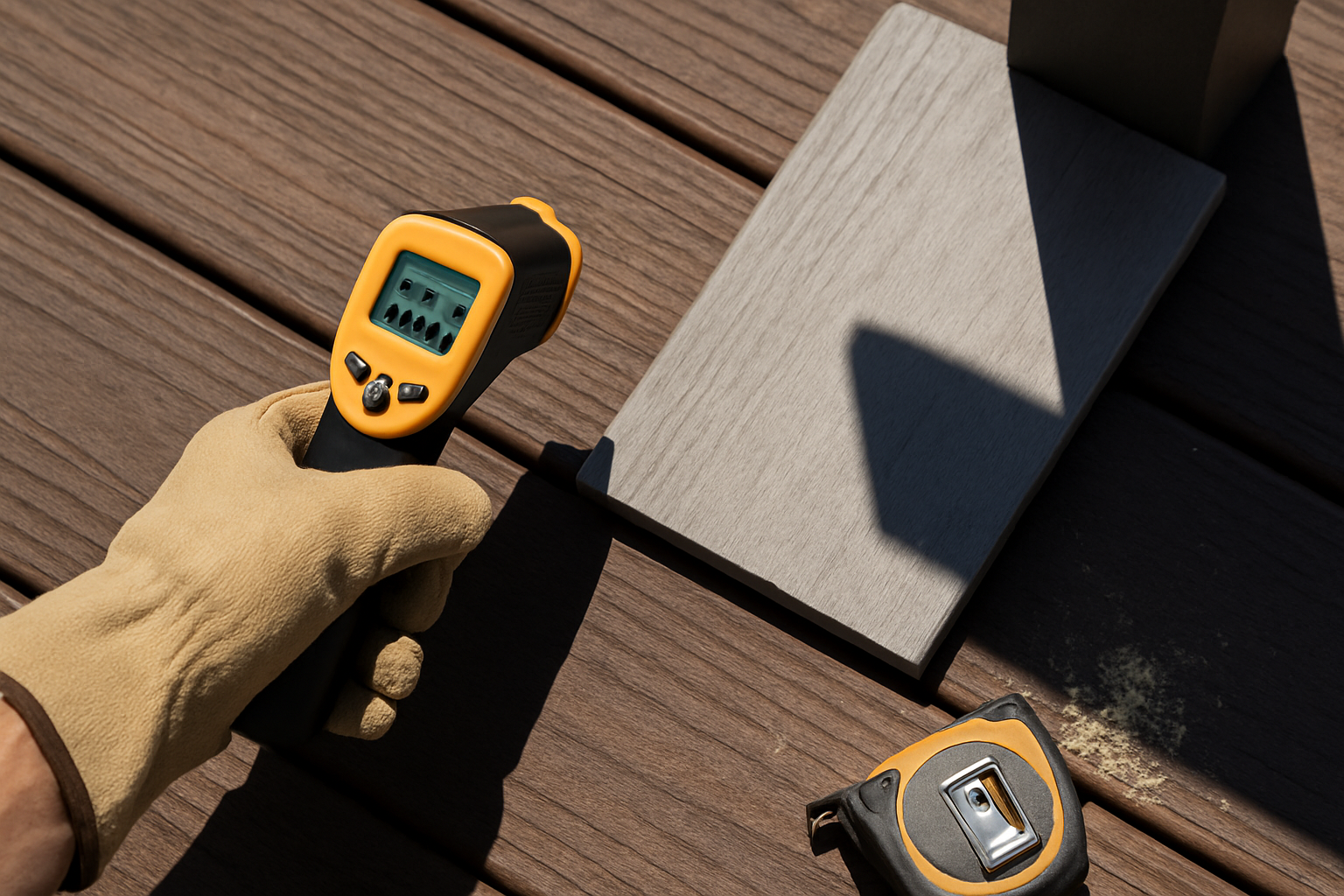
This part gets softened too often, so here it is plainly. Surface temperature testing published in 2026 found that composite and modified decking boards can reach 140 degrees Fahrenheit or higher in direct sun.
One set of findings showed that in direct sunlight, standard composite decks can run 34 to 76 degrees hotter than the surrounding air. Do that math on a normal East Bay 80-degree afternoon and you are looking at a surface above 150 degrees.
That is not fine print. That is a usability issue. It shows up as:
- Bare feet that cannot cross the deck between roughly 2 p.m. and 6 p.m.
- Dogs refusing to walk out onto the boards
- Furniture and planter feet leaving heat marks on the surface
- A deck you paid for and only use after sundown for two months a year
A north-facing deck in the hills may never hit those numbers. A west-facing deck in Emeryville will hit them regularly in August. Same product, same warranty, completely different daily experience.
If you want the deeper version of what to do once heat is already a problem, we covered that in composite decking heat retention through a Bay Area summer. This article is about avoiding it at the order stage instead.
Deck Orientation and What It Should Change About Your Order
Use this as a starting point, then adjust for trees, neighboring buildings, and how much fog your specific block actually gets.
| Facing Direction | Typical Bay Area Exposure | What It Should Change |
|---|---|---|
| South | Sun most of the day, year-round, strongest in summer | Lighter composite colors, or modified wood. Avoid the darkest board options. |
| West | Hard afternoon and evening sun, least fog relief in the flats | The toughest case for dark composite. Consider lighter colors or thermally modified wood. |
| East | Morning sun, shade by mid-afternoon, often fog-cooled early | Most colors work. Heat is rarely the limiting factor. |
| North | Indirect light, heavy fog influence on hillside lots | Widest material freedom. Focus on moisture, drainage, and mildew instead. |
Color Is a Performance Decision, Not Just a Look
Color is the single most underweighted choice in composite buying, and orientation makes it more consequential.
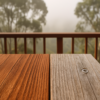
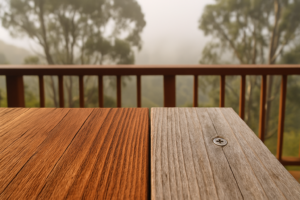
Dark boards can run 20 to 30 degrees hotter than light-colored boards in identical sun exposure. That is the same product line, the same cap stock, the same warranty. Just a different color pulled off the same rack.
On a north-facing Berkeley hills deck, that spread barely registers. On a south-facing deck in the Oakland flats, it is the difference between a usable afternoon and a deck nobody touches until 7 p.m.
The physics behind this is not new. Researchers at the Lawrence Berkeley National Laboratory Heat Island Group have spent decades documenting how solar reflectance changes surface temperatures on roofs and paving, and the same principle applies to a deck board.
Here is how we suggest working through it:
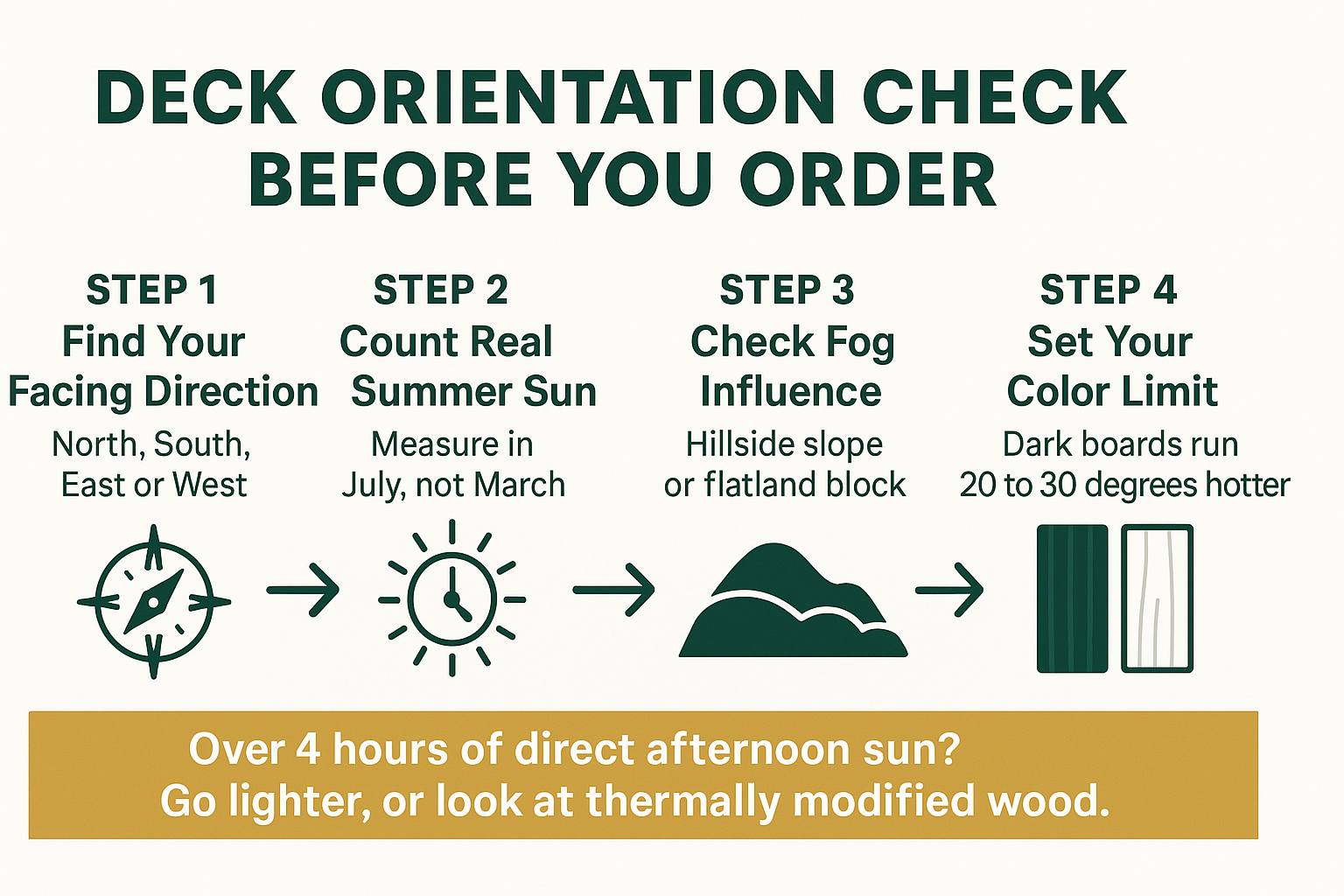
- Step one: Note the facing direction and the hours of true direct sun the site gets in July, not in March.
- Step two: If that number is above roughly four hours of unshaded afternoon sun, move a shade or two lighter than your first pick.
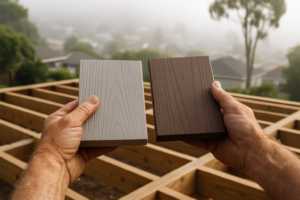
- Step three: Look at samples outdoors in the sun, not under showroom lights. Dark browns and charcoals read very differently at 3 p.m.
- Step four: Check the board texture. Deeply grained, matte finishes usually feel less punishing than smooth, glossy surfaces at the same temperature.
For a broader look at brand and product tradeoffs before you commit, what to know before you buy composite decking in the East Bay walks through the rest of that decision.
The Orientation Check, Before You Order
A quick way to run your own site through the same questions we ask at the counter.
When Orientation Rules Out Dark Composite, Look at Modified Wood
Plenty of homeowners get through the orientation and color exercise and still feel stuck. They want the look of a dark board on a west-facing deck, they do not want the heat, and they are not ready for the sanding-and-oiling commitment that comes with raw tropical hardwood.
Thermally modified wood sits in that gap. Products like Thermory are real wood that has been heat-treated to change its cell structure, which improves stability and rot resistance without chemical preservatives.
For heat, the relevant part is simple: modified wood absorbs and releases heat more like solid timber than like a plastic-capped composite board. On sun-exposed faces, it tends to run cooler underfoot than composite of a similar color.
The tradeoffs are worth knowing before you decide:
- It will gray over time unless you apply a UV-protective finish, similar to redwood
- Maintenance is lighter than ipe but not zero
- Board availability and lead times vary, so plan the order ahead of your framing schedule
We put the side by side detail in does Thermory decking actually outperform cedar and composite, and the fog-versus-sun angle in how Bay Area fog and sun change the wood vs. composite decision.
Frequently Asked Questions About Deck Orientation and Composite Heat
How do I figure out which direction my deck faces if I am still in the planning stage?
Stand where the deck will go and use the compass app on your phone, pointing away from the house. Then check the site at 3 p.m. on a clear summer day. That single afternoon visit tells you more than any sun-path chart.
Does a lighter composite color really make that much difference?
Yes. Dark boards can run 20 to 30 degrees hotter than light boards in the same exposure. On a west-facing deck in the Oakland flats that spread is the difference between usable and unusable on an August afternoon.
My deck is north-facing in the Berkeley hills. Should I still worry about heat?
Not much. Your bigger concerns up there are moisture, mildew growth on shaded boards, and drainage through a wet winter. Color freedom is one of the perks of a fog-shaded lot.
Do shade structures fix the problem after the fact?
They help, but they are a workaround. A pergola, awning, or shade sail cuts direct exposure on the covered portion, and that is real relief. It just costs more than picking a lighter board at the order desk would have.
Does orientation change anything about the framing underneath?
It can. South and west-facing decks see more thermal movement in the boards, so gapping and fastener choice matter more. Shaded north-facing decks stay damp longer, which puts more pressure on joist protection and flashing details.
Working Out Which Way Your Deck Faces
Orientation, color, and material all connect, and the samples look different in the sun than they do on a screen. Our decking staff at the Hearst Avenue yard in Berkeley walk through this with contractors and homeowners across the East Bay most weeks, and outdoor samples are there to look at. The Lumberyard and Hardware line is 510-841-0511 if you want to talk through a specific site before you order.