Direct Answer: Nothing has changed for hardwoods yet. The 10 percent Section 232 tariff covers softwood. A federal review of hardwood imports is due October 1, 2026, and duties may follow.
You are pricing an ipe deck in the Berkeley hills or a stair and trim package in an Oakland remodel, and somebody on the job asks whether tariffs are about to blow up the number. Fair question. And right now the honest answer is that nothing has changed for hardwoods yet.
That is exactly why this is worth reading in September. There is a decision date on the federal calendar: October 1, 2026, and it applies to hardwood timber, hardwood lumber, and products made from them.
If you quote hardwood work this fall and build it in spring, you are quoting into an open question. Below is what the review actually says, which parts of a typical East Bay materials list are exposed, and how to handle the gap between a fall quote and a spring order.
What the October 1 Hardwood Review Actually Is
In October 2025, a federal proclamation put a 10 percent Section 232 tariff on softwood timber and lumber, effective October 14, 2025. Softwood. Not hardwood.
The same proclamation did something else that got much less attention. It directed the Secretary of Commerce to give the President an update on hardwood timber and lumber imports by October 1, 2026, so the President can decide whether an additional duty is warranted, including one phased in over time, and whether duties should extend to derivative products made from hardwood.
You can read the proclamation text yourself in the Federal Register notice on timber, lumber, and derivative products.
A few things are worth being precise about:
- No hardwood rate has been announced. There is a reporting deadline, not a published duty.
- A phased duty is explicitly on the table, which means any change could arrive in steps rather than all at once.
- Derivative products are named, so finished items made from hardwood are in scope for consideration, not just raw boards.
This is separate from the antidumping and countervailing duties on Canadian softwood that have been reshaping framing budgets. That is a softwood story with its own math, and we covered it elsewhere. Keep the two filed apart in your head, because they hit different lines on your take-off.
Which Parts of Your Materials List Are Actually Exposed
Most people have no idea which items on their order even sit in the hardwood category. That single distinction is the most useful thing you can take out of this article.
Closest to the review:
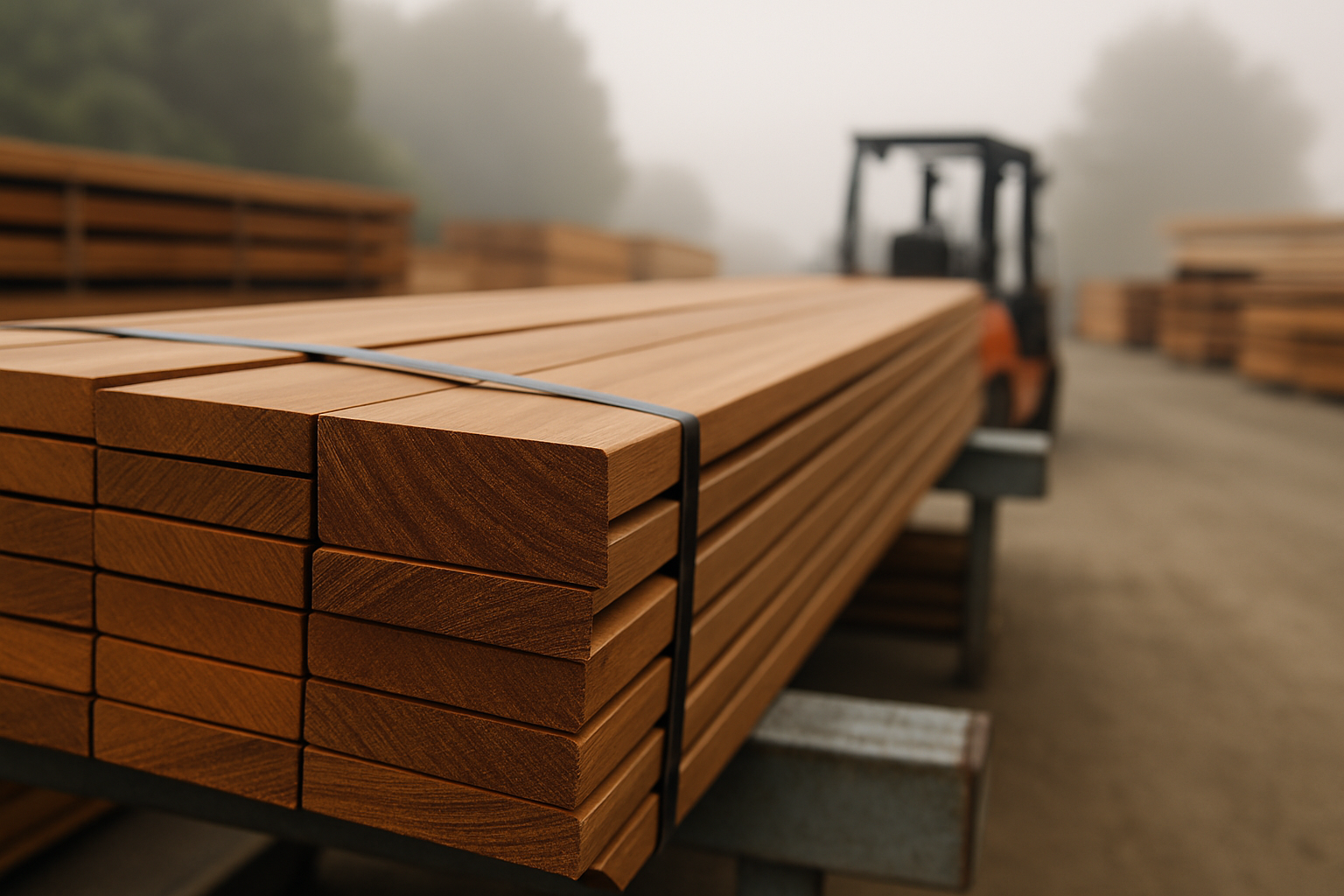
- Tropical hardwood decking, including ipe, cumaru, garapa, and Fijian mahogany
- Hardwood interior trim, hardwood stair treads, risers, handrail, and newel parts
- Hardwood plywood and veneered panel goods
- Hardwood derivative products such as prefinished millwork and some cabinet components
Sitting outside the hardwood review:
- Domestic redwood decking and fencing
- Douglas fir framing lumber
- Engineered beams, LVL, and TJI joists
- Capped composite decking such as TimberTech and Trex
- Thermally modified softwood decking
So a redwood deck and an ipe deck of the same square footage carry completely different exposure to the same federal decision. Same goes for a whole house trim package specified in hardwood versus paint-grade.
If you are still deciding between board types, our guide to ipe and other hardwood decking for Bay Area buyers walks through the performance side of that call.
Exposure Map for a Typical East Bay Order
Here is how common line items sort against the October 1 hardwood review. Use it to find the handful of lines on your take-off that actually deserve a conversation.
| Material | Category | Exposure to the hardwood review |
|---|---|---|
| Ipe, cumaru, garapa decking | Tropical hardwood | High |
| Hardwood stair parts and handrail | Hardwood millwork | High |
| Hardwood plywood and veneer panels | Hardwood derivative | High |
| Paint-grade MDF or primed softwood trim | Non-hardwood millwork | Low |
| Redwood decking and fencing | Domestic softwood | Outside the review |
| Douglas fir framing | Domestic softwood | Outside the review |
| LVL, glulam, TJI joists | Engineered wood | Outside the review |
| Capped composite decking | Composite | Outside the review |
| Thermally modified softwood decking | Modified softwood | Outside the review |
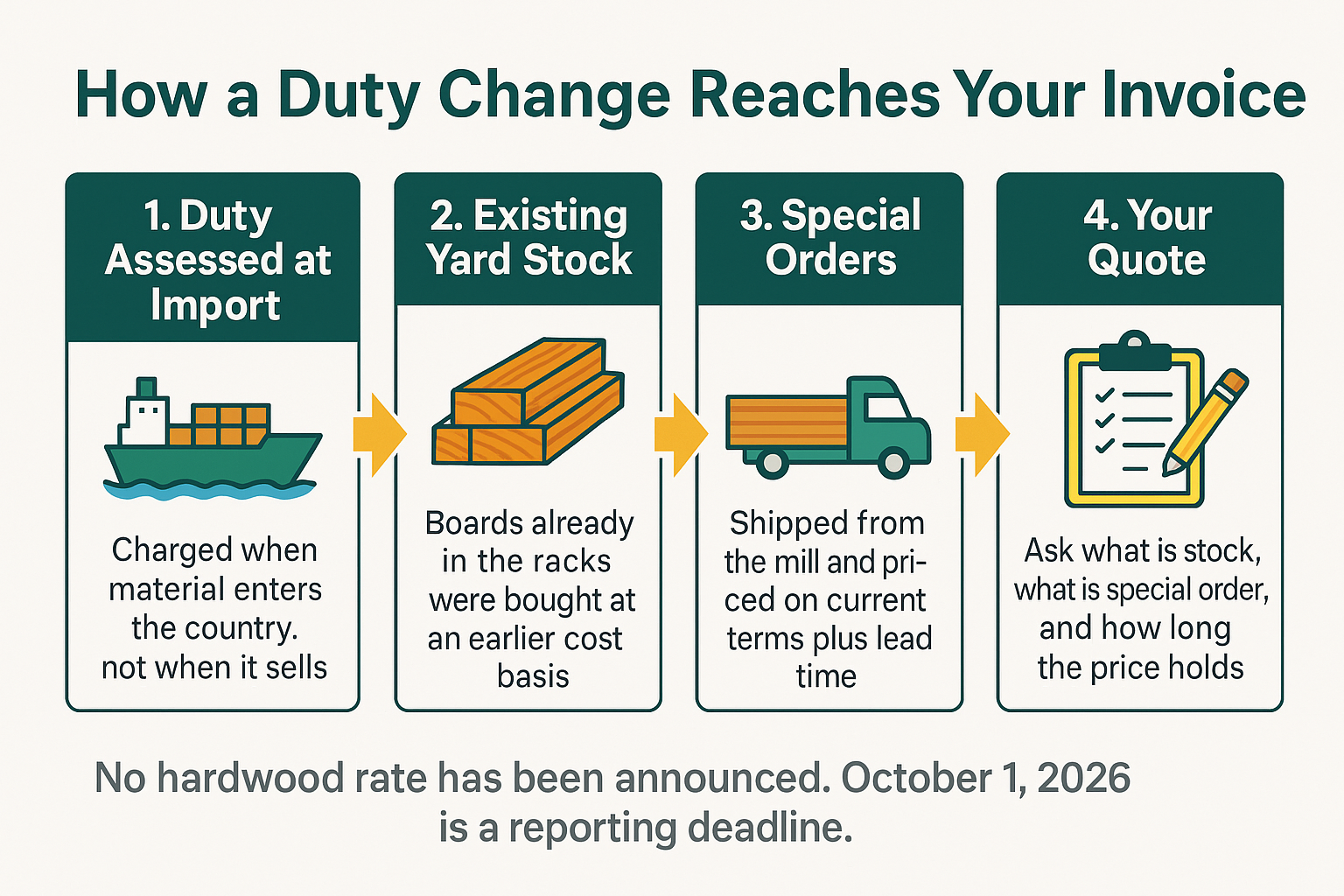
How a Duty Change Reaches a Contractor’s Invoice
A tariff does not hit every board in the rack on the same day. This is the path it travels.
How Pricing Actually Moves at a Lumber Yard
People search this constantly: is it cheaper to buy from a yard, who is cheaper, where do contractors buy. The mechanics matter more than the comparison shopping.
Duties are assessed when material is imported. That means boards already sitting on the ground were bought at an earlier cost basis, and they do not automatically reprice the day a rule changes. A special order shipped in from a mill, on the other hand, prices on whatever terms apply when it ships.
So two hardwood quotes from the same counter can behave very differently. One is stock. The other is an order with a lead time and a live cost.
For market context, national builder groups have estimated the added cost of recent tariff actions at roughly ten thousand dollars on a new single family home. That is an industry-wide estimate, not any yard’s pricing, and it says nothing about your specific list.
Questions worth asking at the counter:
- Is this item in stock right now, or is it a special order?
- How long does this quote hold?
- What is the current lead time on this species and thickness?
- Is there a domestic or modified alternative that performs the same on this site?
Costs vary by species, grade, thickness, and order size, so the only number that means anything is the one priced against your actual take-off.
The Real Decision Is Timing
Here is the squeeze that catches builders in the East Bay. Exterior hardwood work quoted in October in Berkeley or Oakland frequently does not get built until March, once the rain sets in and grading and framing windows close down.
That five month gap between quote and order is exactly where a cost change bites a fixed-price contract. The client signed in fall. You buy in spring.
Practical planning, not prediction:
- Get the take-off done before the spec is locked, so you know your hardwood exposure in board feet, not vibes.
- Write a quote validity window into the proposal instead of leaving it open-ended.
- Separate stock items from special orders on the estimate so everyone can see which lines carry lead time risk.
- Decide deliberately whether to buy ahead and store covered and stickered, or hold off and accept the spring price.
- If you buy ahead, plan the storage. Hardwood stacked wrong through a wet East Bay winter creates its own problems.
None of this requires guessing what the federal government will do. It is scheduling and procurement discipline, and it pays off whether the review produces a duty or not.
Do Not Panic-Substitute Into a Performance Problem
The worst outcome here is a species swap made purely on cost that creates a problem lasting far longer than any tariff.
Bay Area microclimates are brutal on generic material advice. A yard in the West Berkeley fog belt stays damp for days after a storm, while a south-facing deck in the Oakland hills bakes all afternoon. A board that behaves beautifully in one of those conditions can check, cup, or run hot in the other. Our breakdown of how deck orientation changes the material math gets into that in detail.
There is also a local code constraint that national tariff coverage never mentions. Berkeley’s Ember Resilience ordinance requires properties in locally designated Very High fire hazard zones to maintain a five-foot noncombustible Zone 0 buffer around structures, decks, and fences. On a hillside lot, that already rules out wood boards in the first five feet, regardless of what happens with duties.
So the order of operations on any substitution is:
1. Site conditions and exposure first
2. Local code and fire zone requirements second
3. Cost third
If you are weighing alternatives anyway, the decking material comparison guide for Bay Area pros lines up the realistic options side by side.
Frequently Asked Questions About Hardwood Tariffs and Bay Area Building Materials
Is there a tariff on ipe decking right now?
There is no Section 232 hardwood duty in effect. The 10 percent tariff that took effect October 14, 2025 applies to softwood timber and lumber. Hardwood is under review, with a report due to the President by October 1, 2026.
Will prices on hardwood in the racks jump the day a duty is announced?
Not automatically. Duties are charged at import, so material already on the ground was purchased at an earlier cost basis. Special orders shipping from a mill are the lines that move first, which is why it helps to know which of your items are stock and which are not.
Should I buy my hardwood decking now and store it until spring?
It depends on your storage, your cash position, and whether the project is firmly scheduled. Buying ahead removes price uncertainty but adds handling risk. If you do it, keep the bundle covered, off the ground, and stickered so air moves through it through the wet months.
Does this affect redwood or Douglas fir?
No. Redwood and Douglas fir are domestic softwoods and sit outside the hardwood review entirely. Canadian softwood carries its own separate antidumping and countervailing duty situation, which is a different topic with different math.
What about hardwood plywood and stair parts, not just decking?
Those are worth watching. The proclamation specifically raises the possibility of duties on hardwood derivative products, which is the category that would cover hardwood plywood, hardwood trim, and stair components. A whole house trim package specified in hardwood carries meaningfully more exposure than the same package in paint-grade.
Want to Know Where Your Hardwood List Actually Stands?
We have been buying materials through the Hearst Avenue gates in Berkeley since 1946, which means roughly eighty years of trade disputes, mill shortages, and supply swings have already passed through this yard. One longtime contractor put it simply in a review: “Their special order capabilities have saved me countless times on unique projects.” If you want to talk through what is in stock, what is a special order, and what current lead times look like on your hardwood lines, the counter and yard staff are here at 510-841-0511.