Quick Answer
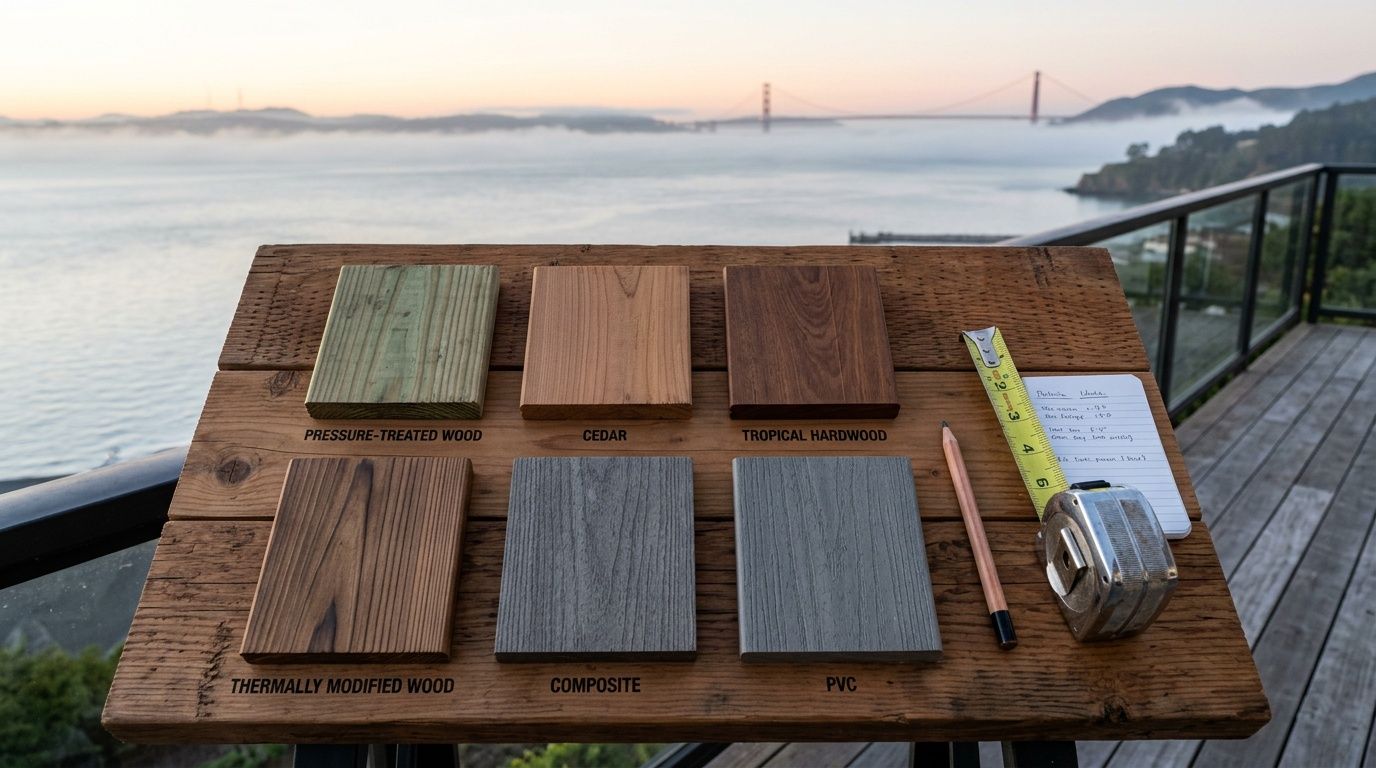
The right deck board depends on where it's going and what the client expects to live with over time. In a Bay Area decking material comparison guide, wood still wins on natural look, composite fits many low-maintenance builds, and PVC stands out where fog, salt, splash, and long service life matter most.
You're probably having the same conversation most Bay Area contractors have. The client wants a deck that looks good on day one, still looks good years later, and doesn't turn into a callback machine after a few wet winters and hot afternoons.
A national decking chart won't answer that by itself. Berkeley fog, Oakland sun, coastal salt exposure, hillside framing, and local code considerations change what makes sense on an actual job.
Your Decking Material Comparison Guide
There isn't one universal “best” decking board. There's only the right board for the site, the budget, the maintenance tolerance, and the way the deck is framed and used.
That matters more in the Bay Area than most guides admit. Standard comparisons often skip over seismic movement, salt spray, and local energy-code awareness, even though some builders report up to 20% higher failure rates for uncapped composites in coastal exposure, and local installation requirements can call for enhanced anchoring for potential 7.0+ magnitude quakes according to this regional decking performance guide.
If a client is also thinking through the whole yard, not just the deck, it can help to look at adjacent outdoor planning ideas such as landscaping concepts for Peoria homeowners. The plant palette and hardscape layout are different there, but the broader lesson still applies. Decking works better when it's chosen as part of the full outdoor build, not as an isolated finish material.
| Material family | General fit | Main trade-off |
|---|---|---|
| Wood | Natural appearance, traditional detailing | More maintenance, more climate sensitivity |
| Composite | Lower upkeep, broad style range | Performance varies a lot by product line |
| PVC | Wet locations, heavy use, long horizon ownership | Higher material cost, more synthetic feel |
Practical rule: Match the board to the exposure first. Match the color and texture second.
Understanding the Three Decking Families Wood Composite and PVC

A board that works in Walnut Creek can be the wrong call in Pacifica. Bay Area deck failures often start with that mismatch. The material family matters before you get into color, price, or brand.
Wood gives you the authentic material
Wood still sets the standard for appearance, repairability, and traditional detailing. That includes pressure-treated deck boards, cedar, redwood, tropical hardwoods, and newer thermally modified products.
It also asks for the most owner participation. In sun-heavy inland areas, boards dry, shrink, and show surface checking faster. In fog belts and shaded lots, the bigger problem is prolonged dampness, mildew, and movement at fasteners. Near the coast, salt air does not destroy the board by itself, but it raises the stakes on hardware selection and regular upkeep.
For projects with long southern or western exposure, this guide on the best decking material for full sun in California helps narrow down which board types and colors hold up better.
Composite sits between wood and PVC
Composite covers a wide range of products, which is why contractors get mixed field results. Some capped boards hold color and resist moisture reasonably well. Lower-end or older formulations can swell at cut ends, trap heat, or wear poorly in heavy traffic.
Specification details matter more here than the category name. Solid versus scalloped profile, cap coverage, board stiffness, and approved span all affect how the deck feels underfoot. In the Bay Area, I pay close attention to expansion gaps on hotter inland jobs and to drainage on coastal jobs where moisture hangs around longer than national install guides assume.
PVC is built for moisture, but it has its own quirks
PVC contains no wood fiber, so it handles wet exposure differently from wood-plastic composites. That makes it a practical choice for pool decks, low-sun yards, and coastal sites where fog and salt air stay in the assembly for long stretches.
The trade-off is movement and feel. PVC expands and contracts more than many contractors expect, especially on long runs with strong afternoon sun. It can also sound and feel a little more hollow unless the framing is tight and flat. On hillside Bay Area work, where seismic movement already puts stress on connections, clean framing and manufacturer-correct fastening matter more with PVC than many sales sheets admit.
Clients who like the look of natural exterior materials often compare decking choices with furniture and trim at the same time. If teak is part of that conversation, this buyer's guide to teak outdoor furniture is a useful reference for how natural wood behaves outdoors over time.
Compare decking families by moisture tolerance, thermal movement, fastening requirements, and maintenance burden. Brand comes after that.
A Contractor's Guide to Wood Decking Options

A redwood deck in Mill Valley and a deck in Walnut Creek do not age the same way. Fog, salt air, hard afternoon sun, and hillside movement change how wood performs, and that matters more here than any generic national ranking.
Pressure-treated wood
Pressure-treated lumber still gets the call on budget-driven jobs, rental properties, and utility decks where function matters more than finish. It is easy to source, familiar to most crews, and forgiving at install.
The trade-off shows up later. In Bay Area conditions, especially where joist bays stay damp or the deck gets little sun, pressure-treated boards can cup, check, and look tired well before the framing is done earning its keep. End cuts, fastener corrosion resistance, and airflow underneath the deck make a big difference.
It also needs a code-minded approach. On hillside and seismic retrofit work, the decking choice does not carry the structure, but heavier moisture retention at the deck surface can add wear at connections if drainage and flashing are weak.
Cedar and redwood
Cedar and redwood remain the local baseline for clients who want real wood and care how it looks from day one. Redwood, in particular, still fits Bay Area architecture better than many manufactured boards.
They install cleanly and are easier on blades and bits than dense hardwoods. They are not low-maintenance products. In coastal fog belts, the boards can stay wet for long stretches. In inland heat, they dry fast, move more, and need regular finishing if the client wants to hold color.
Grade matters as much as species. Clear, heart-heavy boards perform differently than lower grades with mixed grain and more sapwood. For a closer look at species and grade choices, see this guide to the best wood for deck applications.
Tropical hardwoods
Tropical hardwoods fit a narrow slice of projects. They make sense when the client wants premium wood, accepts the labor cost, and understands that installation is slower.
These boards are dense and stable, but they are not crew-friendly in the way redwood is. Expect more predrilling, more blade wear, more attention to hidden fastener compatibility, and tighter moisture management during storage before installation. If the framing is out of plane, hardwood makes the problem obvious.
They also raise sourcing and inspection questions that some homeowners do not consider until late in the bid process. For clients comparing deck materials with furniture choices at the same time, this buyer's guide to teak outdoor furniture gives a useful reference point for how premium exterior wood weathers and what upkeep ownership involves.
Thermally modified wood
Thermally modified wood shows up more often on architect-led jobs and modern remodels. Clients like that it is real wood without pressure treatment, and the look is cleaner than many expect.
It still needs disciplined detailing. The process changes the wood, but it does not cancel out Bay Area moisture cycling, summer shrinkage, or the need for good fastening practice. I would pay close attention to manufacturer fastening rules, board spans, and how the product is being used near doors, stairs, and other spots where movement and code tolerances become obvious.
When wood still makes sense
Wood is a good fit under a few specific conditions:
- The owner wants a natural surface: Real grain, texture, and weathering matter more than low maintenance.
- The site supports it: Good drainage, airflow, and sun exposure reduce the problems that show up in foggy or shaded yards.
- The budget accounts for upkeep: Lower material cost can turn into more labor over the life of the deck.
- The crew details it well: Flashing, ventilation, fastening, and clean cut treatment determine how the deck ages.
Wood rewards good detailing and regular upkeep. Bay Area microclimates punish shortcuts fast.
Evaluating Composite and PVC Decking Performance

A deck in Pacifica, Walnut Creek, and Tiburon can use the same board on paper and get three different results in service. Fog, heat, salt exposure, and low winter sun change how synthetic decking moves, stays clean, and holds its finish. That is why composite and PVC need to be judged by site conditions, not just by color sample or warranty length.
Composite is not one thing
Composite covers a wide range of products. Core density, cap coverage, board profile, and fastening method all affect how the deck performs after a few Bay Area seasons.
Lower-tier boards can still work on dry, sunny sites with good airflow, but they are less forgiving where the deck stays damp or collects debris. Premium capped lines usually do better around planters, grill zones, and narrow side yards where moisture lingers. I would also pay attention to whether the cap wraps all sides or only the top and grooves, because exposed undersides and cut ends are often where trouble starts.
A brand name alone does not answer the spec.
What capped composite actually improves
Capped composite earns its keep by reducing surface staining, slowing moisture pickup, and holding color more consistently than earlier generations. For a lot of Bay Area remodel work, that is the practical middle ground. Clients get a board that looks closer to wood than PVC, without signing up for sanding, sealing, and regular finish maintenance.
It still has limits. Composite usually runs heavier than wood or PVC, which matters on rooftop decks, stairs, and older structures where dead load deserves a second look. In seismic retrofit work, added weight is not the only structural question, but it is part of the conversation.
Heat is another real trade-off. On inland jobs in places like Lafayette or Pleasanton, darker composite colors can get uncomfortable in full afternoon sun. On the coast, that same board may be completely acceptable because the marine layer cuts surface temperature and UV exposure.
Where PVC earns the premium
PVC makes the most sense on sites that stay wet, shaded, salty, or hard to maintain. It does not carry wood flour in the core, so it generally handles standing moisture and repeated wet-dry cycling better than composite. That matters on decks near the ocean, under heavy tree cover, or tucked into north-facing yards where boards may not dry quickly.
The trade-off is feel and movement. PVC often has more thermal expansion and contraction than composite, so layout, gapping, and fastening discipline matter more. Crews need to respect manufacturer rules at butt joints, picture frames, and long runs, especially where glass doors, stair landings, and guard posts make movement obvious. If you are comparing premium synthetic lines, it helps to review what is stocked through a TimberTech decking dealer in the Bay Area and compare span ratings, fastening options, and color availability before the job is sold.
PVC can also sound a little hollower underfoot on some framing layouts. Good framing and tighter span control help, but that feel difference is real, and some clients notice it right away.
Bay Area performance checks that matter
For local jobs, these are the questions worth asking before you choose between composite and PVC:
- Does the site dry out fast? Foggy, shaded, or irrigated areas favor PVC or a higher-grade capped composite.
- How much direct summer sun hits the deck? Darker boards can become a comfort issue inland.
- Is the project near salt air? Corrosion-resistant fasteners and hardware matter as much as board choice.
- Will the framing need stricter review? Heavier boards, rooftop applications, and remodels tied to seismic upgrades deserve attention before material is ordered.
- How visible will board movement be? Long runs, miters, and borders make expansion and contraction easier to spot.
What works and what does not
Composite fits jobs where the owner wants a lower-maintenance surface with a more wood-like appearance and is willing to pay for a better capped board. PVC fits jobs where moisture resistance, low upkeep, and long replacement cycles matter more than a natural feel.
Problems usually start when the spec ignores the site. A budget uncapped product on a shaded, salty lot is asking for call-backs. So is a dark board in a hot inland backyard where barefoot comfort matters.
On wet Bay Area sites, choose the board for moisture behavior, movement control, and fastening details first. Texture and color come after that.
The Ultimate Decking Material Comparison Table

A deck in Orinda does not age like a deck in Pacifica. Add salt exposure in Marin, afternoon heat in Walnut Creek, or year-round shade in the Berkeley hills, and a generic comparison chart stops being very useful. For Bay Area jobs, the right table has to weigh moisture behavior, heat buildup, movement, and how the material holds up under local inspection and framing realities.
Decking Material Comparison
| Material | Cost Tier | Service Life Range | Maintenance Load | Moisture and Pest Resistance | Best Bay Area Fit |
|---|---|---|---|---|---|
| Pressure-treated wood | Lower | Shorter than synthetic boards | High | Fair | Budget-driven builds in drier inland sites where regular upkeep is expected |
| High-quality capped composite | Mid to upper-mid | Longer than wood | Low to moderate | Good to very good | General-purpose residential decks where owners want less upkeep without going fully synthetic in feel |
| PVC | Premium | Longest of the three | Low | Excellent | Coastal, shaded, poolside, and high-moisture sites where durability drives the spec |
Those ranges are broad on purpose. Product tier, framing quality, drainage, and board color all affect how long a deck stays serviceable. The material family gets you in the right lane. The actual board and the install determine whether the job performs for years or starts generating call-backs early.
What the table cannot capture on its own
The table also does not show comfort, finish quality, or serviceability.
Wood still has the most natural look, and it is easy to sand, patch, or swap a board when a remodel changes direction. Composite usually lands in the middle. It reduces maintenance, gives clients more color control, and still reads closer to wood than PVC on many jobs. PVC handles wet conditions better than either of them, but it can look and feel more manufactured, especially on lower-texture lines.
That matters during selection meetings. Some owners will pay more for a board that stays stable through fog and salt. Others care more about surface appearance on day one and accept the maintenance that comes with it.
Bay Area jobsite read
Microclimate should drive the decision.
On coastal and fog-belt jobs, moisture cycling is usually the first filter. Around the Peninsula, western San Francisco, and parts of Mill Valley, boards that dry slowly tend to expose weak caps, poor fastening, and sloppy framing faster than inland jobs do. Inland sun flips the priority. In Concord, Livermore, or south-facing East Bay yards, dark boards can become a usability problem even when the material itself is holding up fine.
Salt air changes the equation again. Near the coast, board choice and hardware choice need to work together. If the job calls for specialty screws, clips, or plugs, it helps to confirm availability early through a local source such as Sure Drive USA fasteners in Berkeley, especially when corrosion resistance is part of the spec.
Local code review can also affect material choice. Heavier boards, rooftop decks, and remodels tied into existing structures may trigger closer attention to attachment, lateral load connections, and framing condition. That is not a reason to avoid a material. It is a reason to verify the full assembly before ordering a premium surface product that ends up waiting on structural corrections.
Decision shortcuts that usually hold up
- Choose pressure-treated wood for cost-sensitive builds where the owner understands the maintenance cycle and the site dries reliably.
- Choose capped composite for broad appeal. It fits many Bay Area residential jobs where clients want lower upkeep, decent aesthetics, and a price point below PVC.
- Choose PVC for wet, shaded, salty, or pool-adjacent conditions where long replacement cycles matter more than natural wood feel.
- Be careful with low-tier products on coastal and fog-heavy sites. The savings disappear fast if board movement, staining, or premature wear leads to replacement.
A cheaper board can still be the expensive choice if the site is hard on materials and the owner expects the deck to stay clean and serviceable with minimal upkeep.
Fastener Systems and Installation Insights

A deck that looks clean on day one can still become a callback if the fastening system does not match the board, the framing, and the site exposure. In the Bay Area, that problem shows up fast. Fog slows drying in Oakland and Berkeley hills, salt works on hardware near the coast, and hot inland sun in Walnut Creek or Concord can make synthetic boards move more during install than crews expect.
Face fasteners versus hidden systems
Face fastening still makes sense on a lot of wood decks because it is forgiving. You can pull a board, correct a crown issue, and service the deck later without fighting a proprietary clip pattern. On repair work and partial replacements, that matters.
Hidden systems give a cleaner surface and more uniform spacing, but they ask more from the frame. Joists need to stay consistent, board grooves need to match the clip, and stairs usually need a different fastening approach than the field. On hillside jobs, where existing framing is rarely perfect, hidden fasteners can add layout time that does not show up on the first material takeoff.
PVC and composite boards need tighter install discipline
Synthetic decking does not install like cedar or redwood. It reacts more to temperature, and the fastening schedule matters because the boards can creep out of alignment if crews rush the layout.
That is especially true on Bay Area projects that start cold and foggy in the morning, then heat up by afternoon. A board cut tight at 8 a.m. can read differently by the time the last course goes down. For composite and PVC, follow the manufacturer's gap and end-match requirements exactly, and do not improvise with leftover screws or generic clips.
Hardware selection also needs to track exposure. For crews trying to match screw coatings and clip systems to the board and site conditions, a local source for Sure Drive USA deck fasteners in Berkeley can save a second trip and help avoid mix-and-match errors.
A few field rules hold up:
- Match the fastener system to the decking line. Off-brand clips and substitute screws are a common cause of squeaks, loose boards, and denied warranty claims.
- Check framing before the first board goes down. Hidden-fastener decks show bad joist crowns and spacing mistakes immediately.
- Use higher corrosion resistance near salt air and persistent moisture. Standard hardware can stain boards and fail early on coastal jobs.
- Plan for inspection access on structural connections. Bay Area remodels and raised decks often get closer review at ledgers, hold-downs, and hardware locations.
- Keep the assembly able to dry. Fasteners last longer when water is not trapped against the framing and board underside.
Good fastening work is usually invisible. Bad fastening work shows up in movement, staining, callbacks, and extra labor a year later.
Estimating and Sourcing Your Decking Project
Estimating decking isn't just counting square footage. Board length strategy, picture-frame details, stair layouts, breaker boards, fascia, hidden fastener quantities, and framing condition all move the material list.
That's why a clean takeoff starts with the whole assembly, not just the deck boards. If the framing needs adjustment for a synthetic board profile or fastener system, catch it before the order is staged.
A practical starting point is a thorough deck building materials list that accounts for framing, hardware, decking, trim, and the small items that usually get missed until install day. On a real job, those missed items are what slow the crew down.
For Bay Area work, material sourcing also has to reflect local conditions. Shade, salt exposure, hillside access, and title-aware product selection all affect what should be ordered and how much risk you're taking with substitutions.
This is one place where Truitt & White is useful as a local building-materials source. Contractors can work through decking selections, structural lumber, hardware, and related jobsite supplies in one place at the Hearst Ave lumberyard, then confirm whether the planned system still makes sense once samples and accessories are in front of them.
Decking Material FAQs for Contractors
What decking holds up best in Bay Area fog and salt air?
On a foggy Daly City deck or a salt-exposed job near the Bay, PVC is usually the lowest-risk board because it does not carry wood fiber. Capped composite can also perform well, but product quality matters more here than in drier inland areas. Lower-grade composite is where you tend to see more swelling, edge wear, and early appearance issues once moisture sits on the deck day after day.
Site exposure still decides the answer. A covered Berkeley backyard deck has a different moisture load than a roof deck in Pacifica or a fully exposed run in Alameda.
Is composite always cooler than wood?
No. Heat build-up depends on board color, surface texture, density, and how much direct afternoon sun the deck gets. In the Bay Area, that means a dark board in Walnut Creek can feel very different from the same board under marine air in the Sunset.
The safe way to sell this is simple. Do not promise that composite will run cooler than wood. Lighter colors usually help, and sample testing in direct sun is worth doing if heat is a client priority.
Do I need different fastening plans for synthetic decking?
Yes. Synthetic decking is less forgiving than wood if the framing, gapping, or fastener layout is off. Hidden clip systems, breaker board details, stair treads, and fascia all have product-specific rules, and crews get into trouble when they install composite or PVC like a redwood deck.
This matters on Bay Area remodels because older framing often is not laid out for the span limits or fastening pattern the new board requires. Check joist spacing, drainage, edge support, and approved hardware before the order is locked.
Is PVC worth the higher upfront cost?
It often is on wet sites, high-traffic decks, and jobs where access makes future replacement expensive. I would price PVC seriously for roof decks, shaded yards that stay damp, and coastal projects where the client wants low maintenance and fewer callbacks.
On a dry inland job with a tighter budget, capped composite may be the better value. The right answer depends on exposure, budget, and how long the owner plans to keep the property.
How do you handle Bay Area code and seismic concerns on a deck project?
Start with the structural attachment, lateral load path, guard detailing, and connector selection. Finish decking does not solve a weak ledger, undersized hardware, or a hillside condition that needs engineering.
Local review can vary by city, especially on hillside lots and exterior stairs. Use the current California code set and confirm project-specific requirements with the building department or design professional responsible for the plans. The California Department of Building and Safety publishes code information and local guidance at dbs.lacounty.gov.
Should I steer clients toward wood if they care most about appearance?
If the client wants natural grain, weathering character, and a deck that looks at home on an older East Bay house, wood still has an advantage. Redwood and other real-wood options give you a visual depth that synthetics still imitate more than match.
Frame the decision realistically. Wood appearance comes with maintenance, movement, and more owner involvement over time.
If you're working through a decking material comparison guide for a project in Berkeley, Oakland, San Francisco, or the East Bay, Truitt and White can help you sort through deck boards, structural lumber, fasteners, and jobsite materials. Call the Lumberyard and Hardware at (510) 841-0511, visit 642 Hearst Ave, Berkeley, CA 94710, or reach out through info@truittandwhite.com. If your project also includes window or door selections, the showroom is at 1831 Second Street, Berkeley, CA 94710 and can be reached at (510) 649-4400.