Direct Answer: Hardwood decking can still be the right choice for Bay Area homes, but only if the species, site conditions, and maintenance commitment actually match. For many projects, alternatives now outperform it.
Hardwood decking has been the premium choice for decades — and for good reason. Species like ipe, cumaru, and Fijian mahogany are genuinely beautiful, extremely dense, and built to last when maintained properly. But the Bay Area isn’t a generic climate, and the question isn’t whether hardwood is good. It’s whether it’s the right call for your project, your microclimate, and your actual maintenance schedule.
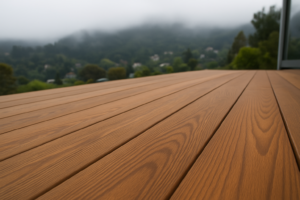
The East Bay and coastal neighborhoods present real challenges for any exterior wood. Marine fog, seasonal moisture swings, and the temperature difference between a Berkeley flatlands deck and an Oakland hills deck can shift the performance math significantly. What holds up beautifully in one yard may check, crack, or go silver in another within a few seasons.
This article focuses on two things: where hardwood still makes sense in Bay Area conditions, and where the tradeoffs quietly tip against it. We’ll skip the surface-level product pitches and get into what actually matters when you’re specifying or selecting decking material for a real project.
What Hardwood Decking Actually Offers — and What It Demands
The appeal of tropical hardwood is straightforward. Species like ipe and cumaru have natural oils that resist rot, insects, and moisture far better than most softwoods. They’re also extremely hard — ipe scores around 3,500 on the Janka hardness scale, which is why you see it on commercial boardwalks and high-traffic residential decks that need to last 25 or 30 years with proper care.
But that density is also what makes hardwood demanding to work with. Pre-drilling is not optional — skip it and you’ll split boards. Fastening systems matter more than with softer materials. And oil-based finish maintenance is real work, typically every 1 to 3 years depending on sun exposure, foot traffic, and how much fog the deck absorbs.
The cost side of the equation has also shifted. Ipe decking currently runs $8–$14 per linear foot for material alone in the Bay Area market, and that’s before labor, hidden fasteners, and finish. For a 400-square-foot deck, that can put you at $10,000–$18,000 in materials depending on board width and grade. That’s a meaningful number when alternatives like thermally modified wood or premium composite are now competing in the same performance tier.
For contractors and homeowners who are serious about understanding the full tradeoff picture, The Real Tradeoffs of Tropical Hardwood Decking Nobody Talks About gets into the supply chain, certification, and long-term cost issues that don’t show up in product spec sheets.
How Bay Area Microclimates Affect the Hardwood Decision
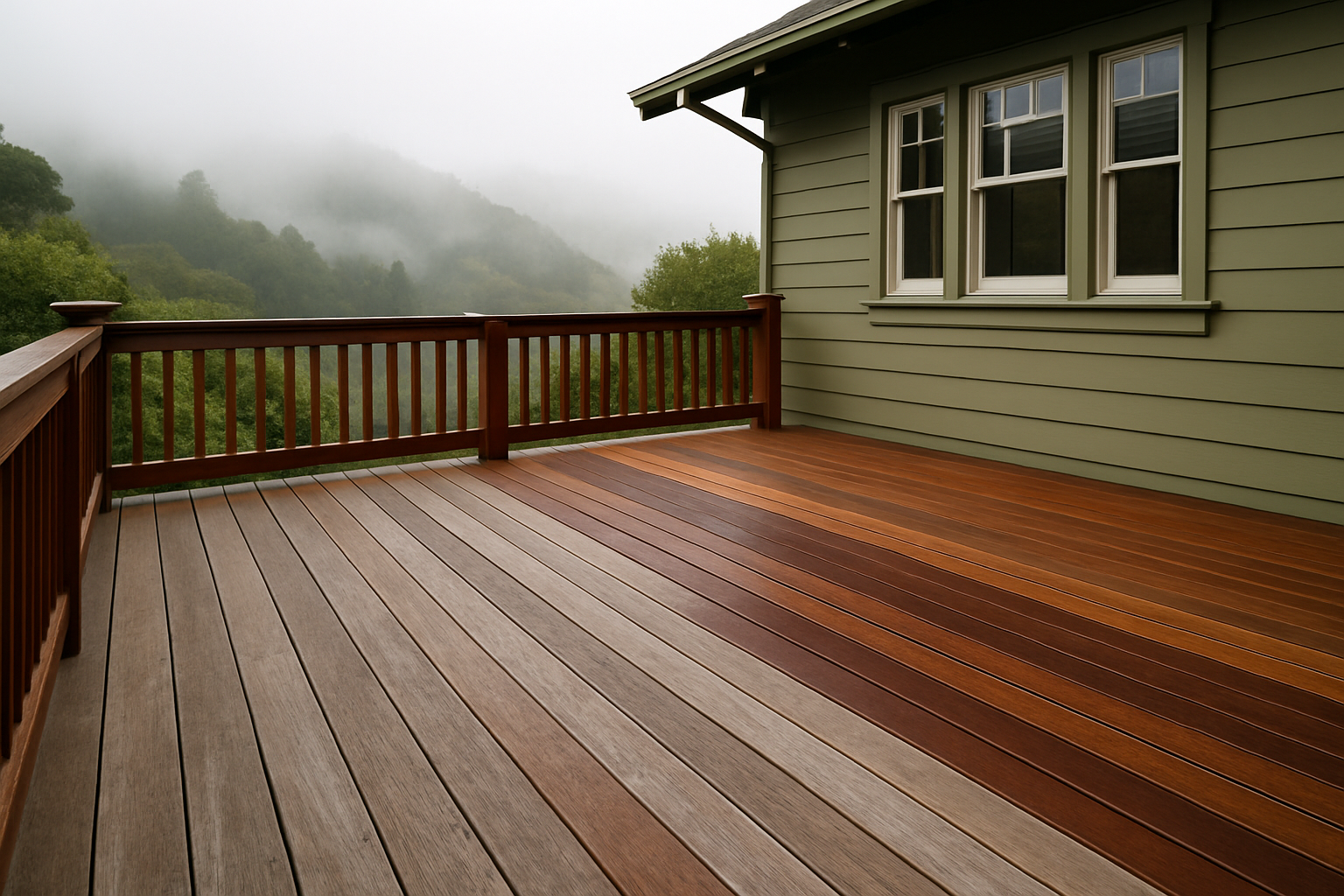
The Bay Area doesn’t have one climate — it has dozens. A south-facing deck in Rockridge that gets direct afternoon sun is a completely different environment from a north-facing deck in the Berkeley flats that stays damp from fog half the year. Hardwood performs differently in each.
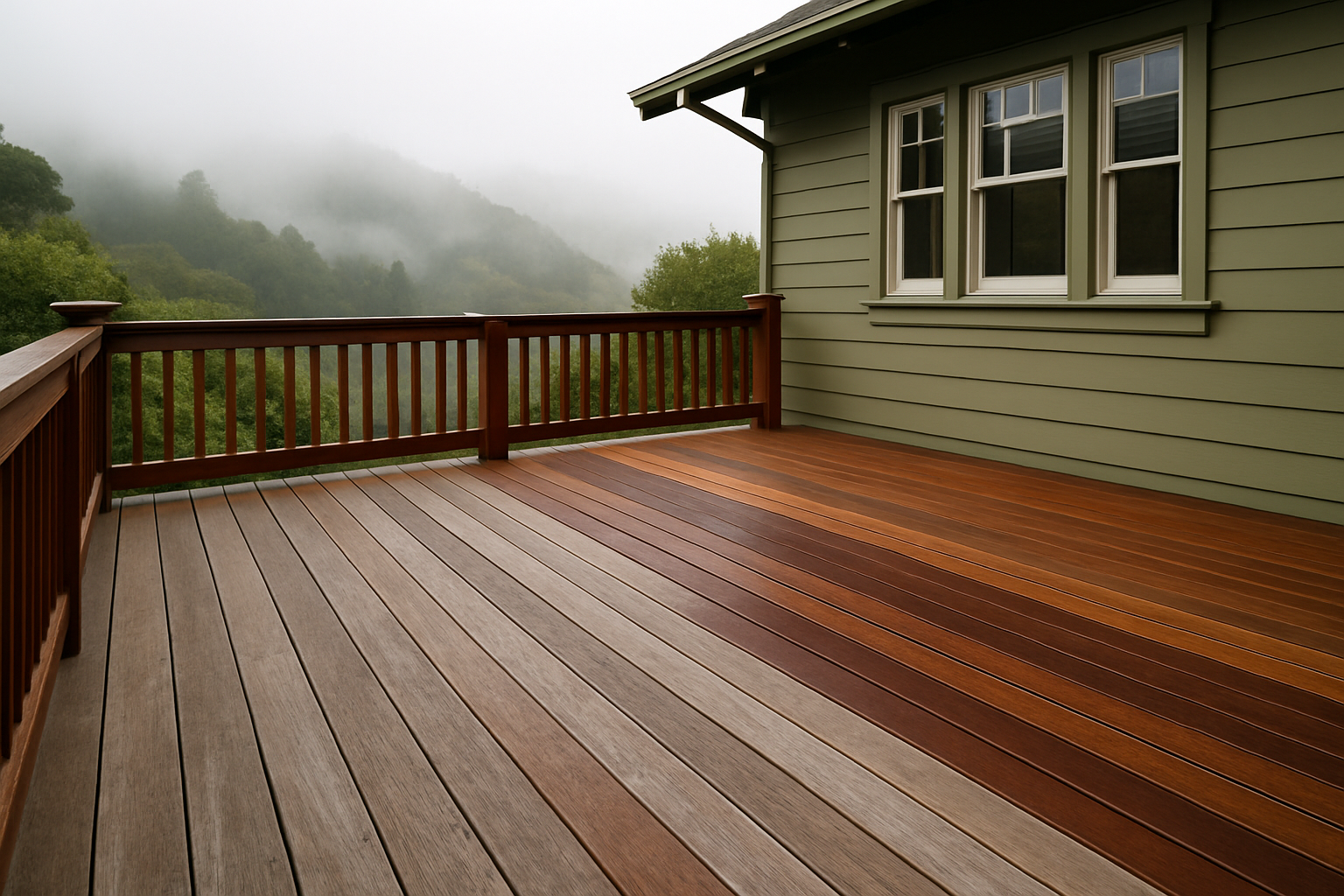
In high-moisture, low-sun conditions — think Oakland hills, north-facing Berkeley lots, or coastal Marin — even naturally oily hardwoods can develop mildew, surface checking, and uneven weathering if they’re not maintained consistently. The wood doesn’t rot the way a softwood would, but it won’t look the way the showroom sample looked either.
In full-sun, south-facing exposures, hardwood can hold up beautifully — but heat retention becomes a real concern. Dense tropical hardwoods absorb and hold solar heat significantly more than composite or thermally modified wood. Barefoot usability on a hot July afternoon is a real conversation to have with a client before specifying ipe on a south-facing deck. We covered the sun and fog dynamics in detail at How Bay Area Fog and Sun Change the Wood vs. Composite Decision — it’s worth a read if you’re still deciding.
For WUI-zoned properties in the Oakland or Berkeley hills, the species question becomes a compliance question, not just an aesthetic one. Class A fire-rated materials are required in many of these zones, and most tropical hardwoods do not carry that rating. Before specifying any wood decking on a hillside lot, verify the fire zone designation with the city — Oakland and Berkeley both have mapped WUI zones that trigger stricter requirements than flatlands projects.
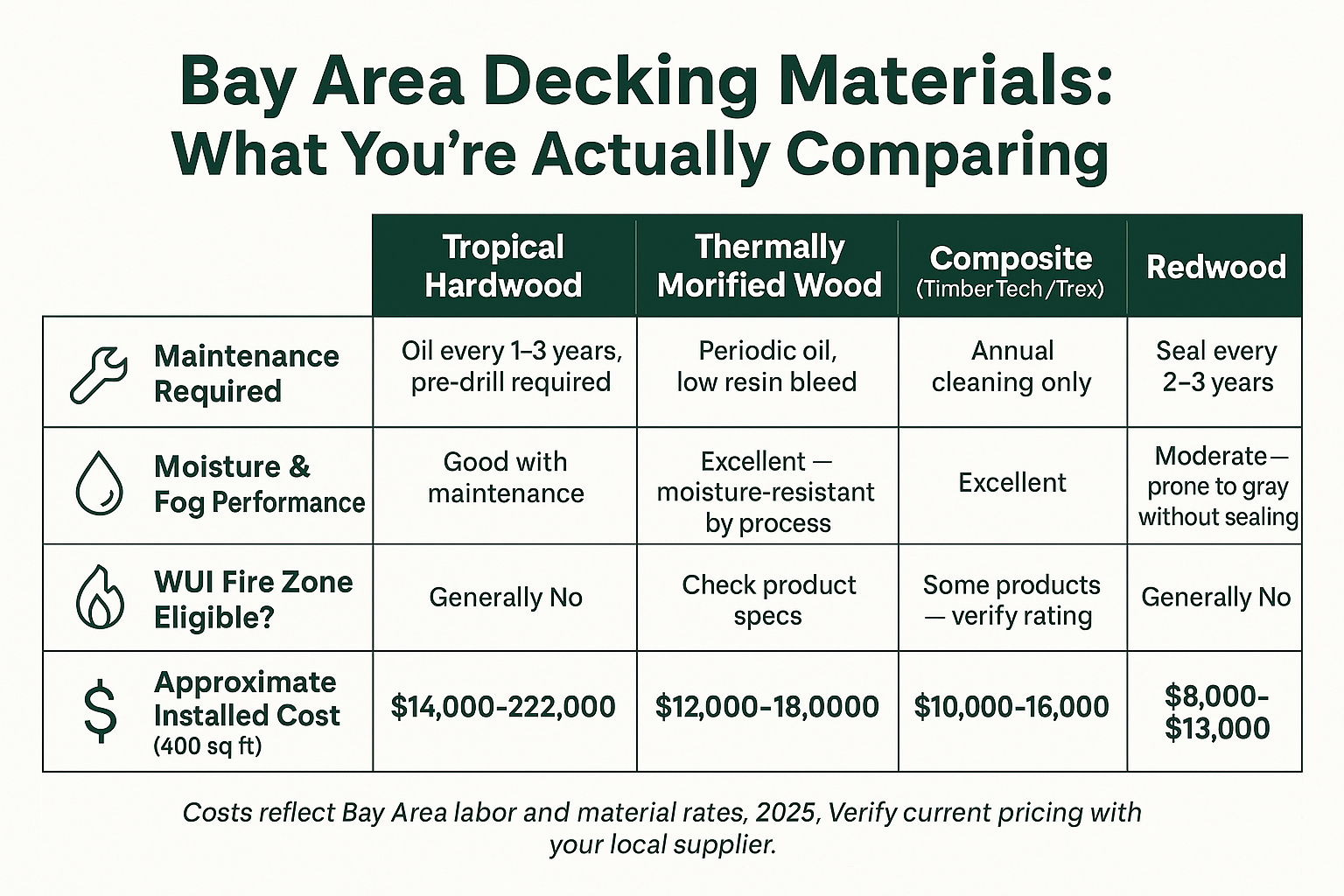
Hardwood vs. Alternatives: Quick Performance Comparison for Bay Area Conditions
This breakdown shows how the major decking material categories compare across the factors that matter most on Bay Area projects — maintenance load, fire compliance, moisture performance, and typical installed cost.
Where Hardwood Still Makes Sense — and Where It Doesn’t
There are projects where hardwood is still the right answer. A high-use commercial deck, a long-horizon residential project with a committed maintenance owner, or a design spec that genuinely calls for the visual warmth of real wood grain — these are legitimate cases for ipe or Fijian mahogany.
But there are also projects where hardwood is being specified mostly out of habit, or because it’s what the client has heard is “the best.” That’s worth interrogating a bit. If the owner travels frequently, has a shaded north-facing deck, or isn’t prepared to oil the surface every two years, hardwood will disappoint — not because the material failed, but because the match was wrong from the start.
Situations where hardwood holds up well:
– South or west-facing decks with good sun exposure and low standing moisture
– Clients with realistic maintenance plans and budgets to support them
– Projects where the natural wood aesthetic is a firm design requirement
– High-traffic or commercial applications where density and longevity justify the cost
Situations where alternatives often perform better:
– Fog-heavy or north-facing exposures in Berkeley, Oakland hills, or coastal areas
– WUI fire zone lots that require Class A-rated materials
– Clients who want low maintenance and a 25-year performance horizon without annual upkeep
– Tighter budgets where composite or thermally modified Thermory offers comparable durability at lower installed cost
It’s also worth knowing that not all hardwood is equal. FSC-certified tropical hardwood from a verified source is a very different product than commodity tropical lumber with murky chain-of-custody documentation. If you’re specifying hardwood, sourcing from a supplier who can verify the certification chain matters — both for the project record and for the client.
Hardwood Species Commonly Used for Bay Area Decking
These are the species we see most often specified for residential and light commercial decking projects in the East Bay and surrounding areas. Performance characteristics vary meaningfully between them.
| Species | Janka Hardness | Natural Rot Resistance | Maintenance Level | Relative Cost |
|---|---|---|---|---|
| Ipe (Brazilian Walnut) | 3,510 | Excellent | Moderate-High (oil required) | High — $8–$14/LF |
| Cumaru (Brazilian Teak) | 3,540 | Very Good | Moderate (oil recommended) | High — $7–$12/LF |
| Fijian Mahogany | 800–1,000 | Good | Moderate (seal or oil) | Mid-High — $5–$9/LF |
| Garapa (Brazilian Ash) | 1,650 | Good | Moderate | Mid — $5–$8/LF |
| Tigerwood | 1,850 | Good | Moderate | Mid — $5–$8/LF |
Frequently Asked Questions About Hardwood Decking in the Bay Area
Does ipe decking hold up in the fog and moisture we get in Berkeley and Oakland?
Yes, but with maintenance. Ipe’s natural oils give it strong resistance to moisture and rot, but Bay Area fog conditions can cause surface checking and graying if the deck goes years without oiling. A 1–2 year oiling schedule keeps it looking good. Skip maintenance for 3–4 years in a high-fog location and you’ll have significant surface work ahead of you.
Can I use hardwood decking on a lot in the Oakland hills WUI fire zone?
Most tropical hardwoods do not carry a Class A fire rating, which is required in WUI-designated zones in Oakland and Berkeley. Before specifying any wood species for a hillside lot, check the property’s fire zone designation with the city. Some composite products do carry fire ratings — your supplier should be able to confirm which products qualify.
Is there a hardwood that requires less maintenance than ipe?
Fijian mahogany is a common alternative for clients who want real wood with slightly less demanding upkeep. It’s not as dense as ipe, but it performs well in Bay Area conditions and is somewhat more forgiving if a maintenance cycle gets skipped. For a deeper comparison, Is Ipe Decking Worth the Price for a Bay Area Backyard? walks through the tradeoffs.
How does thermally modified wood compare to tropical hardwood for a Bay Area deck?
Thermally modified wood like Thermory has been heat-treated to reduce moisture absorption and improve dimensional stability — two properties that matter a lot in the Bay Area’s wet-dry seasonal cycle. It’s not as hard as ipe, but it performs well in fog-heavy exposures and requires less intensive maintenance. Installed cost is generally in a similar range to mid-tier tropical hardwood.
Do I need to pre-drill hardwood decking boards?
Yes, always. Tropical hardwoods like ipe and cumaru are dense enough that driving fasteners without pre-drilling will split boards — especially near the ends. This is not optional and it’s one of the places where DIY installs frequently go wrong. Hidden fastener systems are worth the added cost on hardwood projects because they also allow for the slight expansion and contraction these species see seasonally.
Where can I see hardwood decking samples before committing to a species?
Physical samples matter a lot with hardwood because the color and grain variation between boards — and between species — is significant. Seeing a small sample under showroom lighting and then seeing it on your actual site in Bay Area sun or fog can look quite different. We carry samples at our Berkeley lumberyard on Hearst Avenue where you can compare options in person and talk through what the site conditions actually call for.
Not Sure Which Decking Material Fits Your Project?
If you’re working on a deck project in the Bay Area and want a straight answer on whether hardwood makes sense for your specific site and conditions, Truitt & White’s team at the Berkeley lumberyard can walk through it with you in person. Bring your site details, your exposure, and your maintenance expectations — and we’ll tell you what we’d actually recommend. Stop by 642 Hearst Avenue in Berkeley, call us at 510-841-0511, or visit truittandwhite.com to learn more.