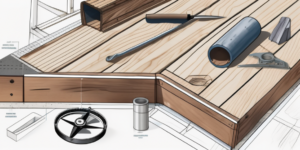
Direct Answer: A complete TimberTech AZEK order lists deck boards, matching fascia, riser board, hidden fastener clips and plugs, color-matched face screws, joist tape, and railing components together, all in one takeoff.
The boards land Tuesday morning. The crew starts framing out the field Wednesday. By Thursday the job is sitting still because the hidden fastener clips are short, the fascia was never ordered, and nobody spec’d color-matched screws for the stair treads.
We hear some version of that story every summer. Contractors consistently tell us composite installs run longer than wood decking, and when they trace the lost days back, it is almost never the boards. It is a clip, a trim piece, or a riser board that should have been on the same purchase order.
TimberTech AZEK is a system, not a stack of lumber. This guide covers what belongs on the order, how to build the takeoff off a framing plan instead of a square footage number, and how delivery and staging actually work on narrow East Bay streets.
An AZEK Order Is a System, Not a Board Count
Before anything else, know which TimberTech line you are buying. The AZEK line is capped PVC with no wood fiber in the core. TimberTech’s other lines are capped composite, with a wood and polymer core.
That core difference is not trivia. It changes how the board moves with temperature, how the manufacturer instructions want you to gap it, and which fastener system is called out. Two boards that look nearly identical on the sample rack can carry different install rules.
The next decision is edge profile, and it commits you to a fastening approach:
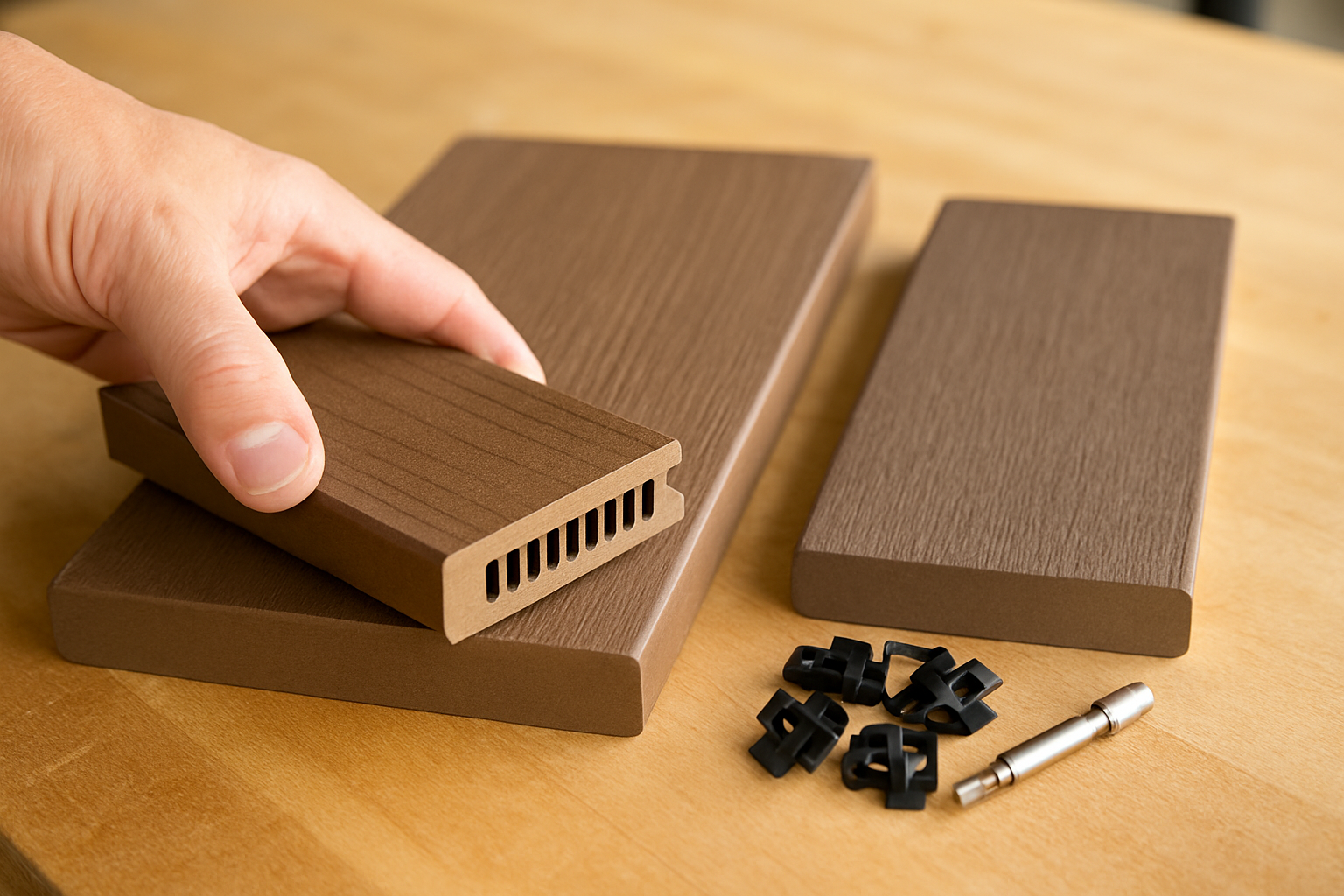
- Grooved edge boards are made for a hidden clip system. Once you pick grooved, the clips, plugs, and starter clips are part of the order, not an afterthought.
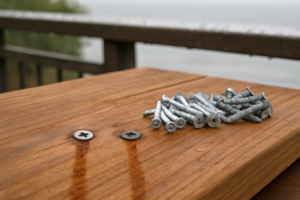
- Square edge boards get face screwed. You almost always need some, because picture-frame borders and stair treads usually cannot run grooved.
- Most decks need both. A field of grooved boards with a square edge perimeter is a common layout, and the square edge count gets forgotten constantly.
We go deeper on the fastening decision in our guide on hidden fasteners versus face screws, and on the line differences in TimberTech collections compared.
Build the Takeoff Off the Framing Plan, Not a Square Footage Number
This is where homeowners and even seasoned remodelers lose the most time. Someone measures the deck, multiplies length by width, adds ten percent, and orders that many square feet of board.
Then the crew starts cutting and the waste piles up, because board lengths were never matched to the joist layout. Bring the joist spacing and framing plan to the counter and lengths can be picked to land on joists and cut down butt joints.
What to have with you when you order:
- Joist layout and spacing, including any blocking at the perimeter and under picture frame borders
- Deck height above grade, which drives fascia quantity on a raised deck
- Stair count and stringer detail, because treads eat board length fast and rarely cut cleanly from leftovers
- Riser board decision, closed or open, since closed risers are a separate product line item
- Final color and texture, locked before the order goes in
The fascia and riser math surprises people. A deck sitting four feet above grade on a sloped Berkeley lot can carry more linear footage of fascia than a homeowner expects, and fascia is sold as its own product.
Color is the other one. Once boards are on site and a homeowner decides they want a different tone, you are not swapping one bundle, you are re-ordering the field, the fascia, the risers, and the plugs together.
What Belongs on a Complete AZEK Order
Here is the short list we walk through at the counter, and why each line item gets left off.
| Line Item | Why It Matters | Why It Gets Missed |
|---|---|---|
| Deck boards (grooved and square edge) | Field, borders, and stair treads often need both profiles | Ordered as one square footage number with no profile split |
| Matching fascia | Covers rim joist and finishes the deck edge | Not counted because it is not part of the walking surface |
| Riser board | Closes stair risers in a matching color | Assumed to come with the tread material |
| Hidden fastener clips and plugs | Required by the install instructions for grooved boards | Quantity based on square feet instead of joist spacing |
| Color-matched face screws | Used on borders, stairs, and any square edge board | Ordered later once the crew hits the perimeter |
| Joist tape | Protects framing tops from trapped moisture | Treated as optional on a covered or dry-looking site |
| Railing system components | Posts, rails, balusters, brackets, and gate hardware ship as parts | Longest lead time on the whole order |
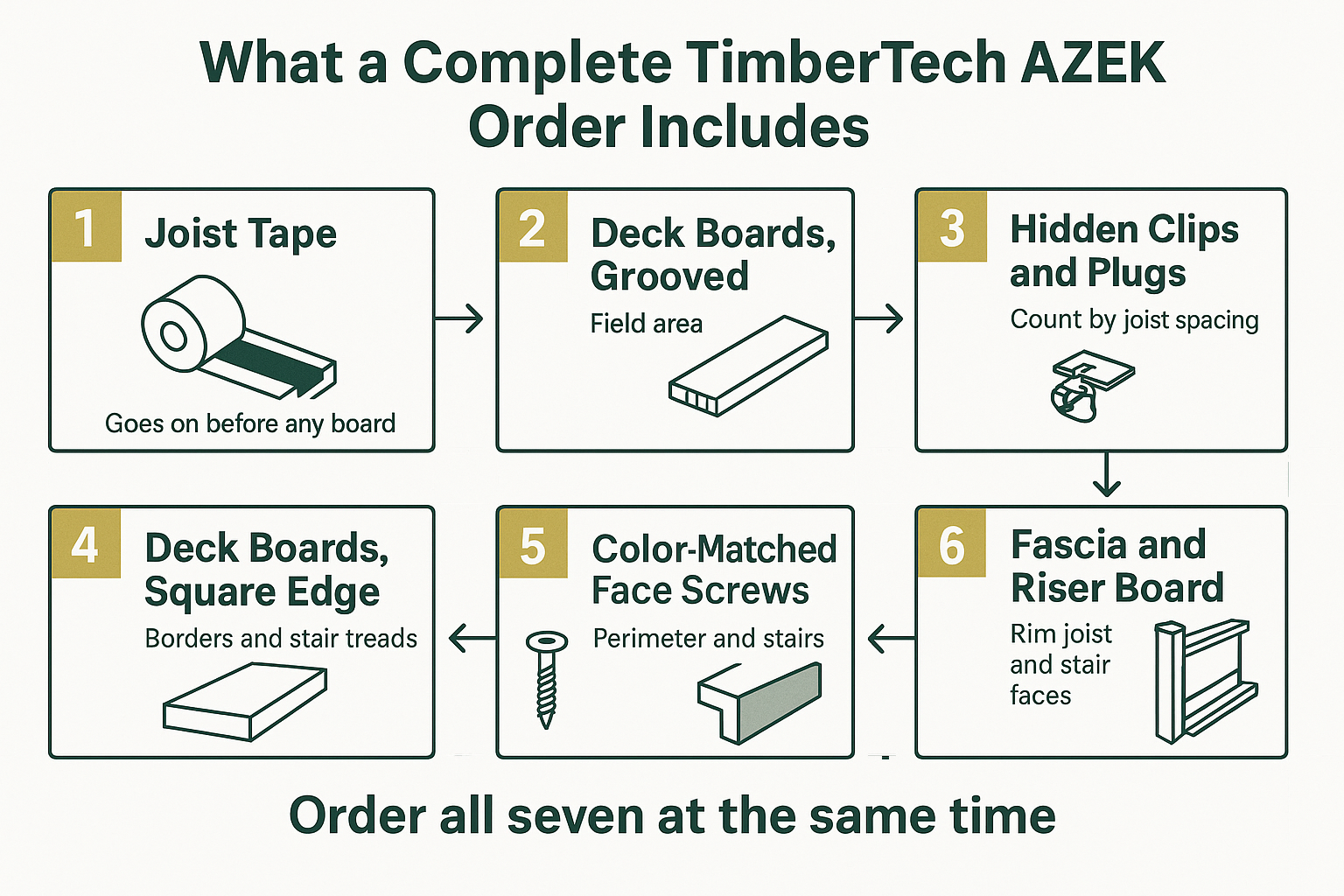
The Composite Deck Order Checklist
A quick visual of the seven pieces that should appear on the same takeoff, in the order a crew actually needs them on site.
Delivery and Staging on East Bay Hill Streets
National decking content skips this part entirely, and it is the part that costs Bay Area crews real hours.
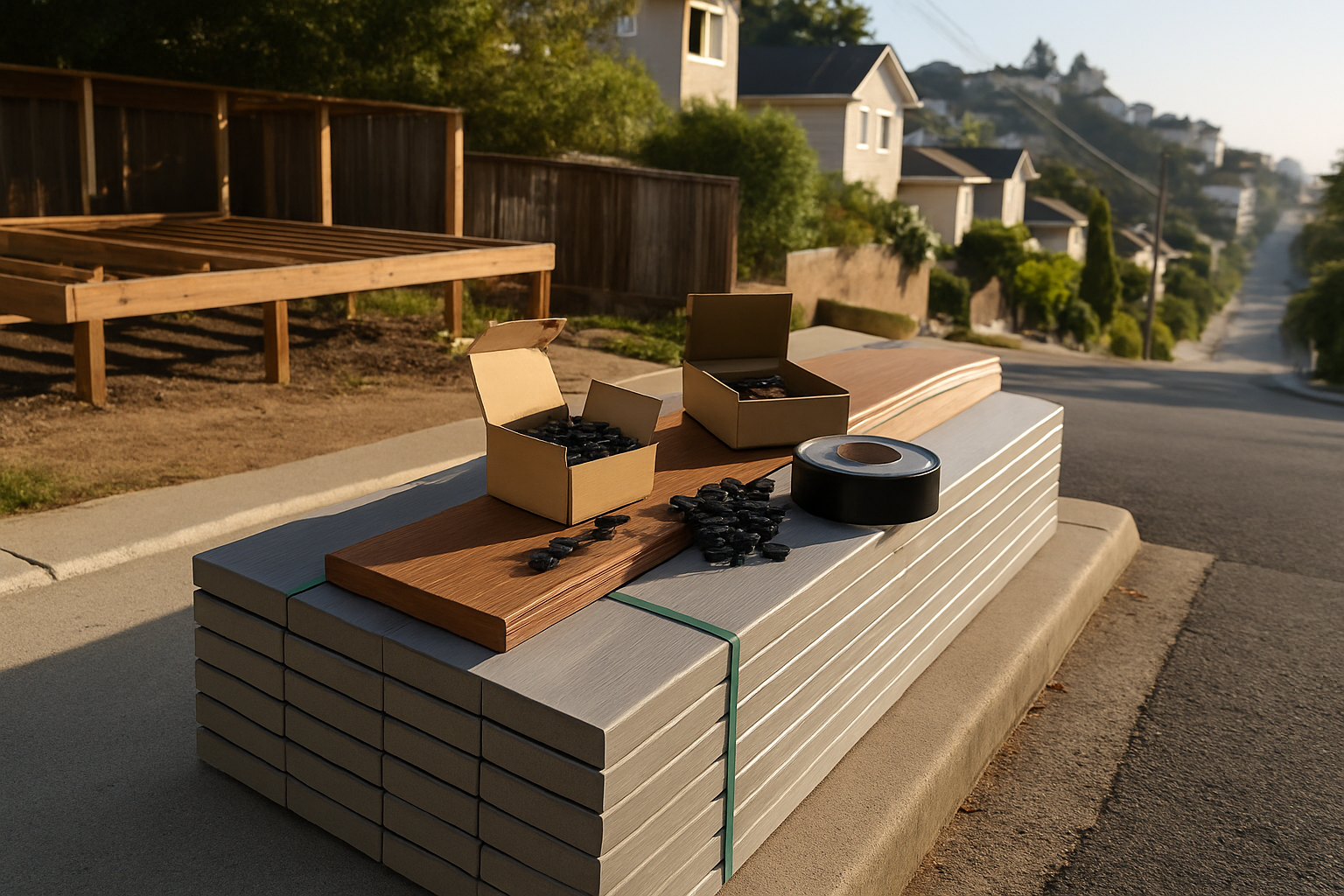
Local deliveries here run Monday through Friday, roughly 7:00 a.m. to 3:00 p.m., scheduled in two-hour windows. Book at least two days ahead. Large loads move on a flatbed with a piggyback forklift and get rolled off curbside where access allows.
Curbside is the word to pay attention to. On the narrow streets above Berkeley and up in the Oakland hills, curbside means the bundle lands at the street, and getting it to a backyard deck site is your crew’s problem, not the truck’s.
So have a staging plan before the truck rolls:
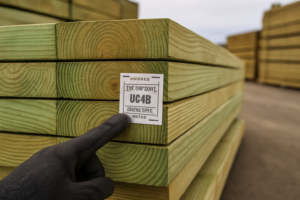
- Store boards flat and fully supported, not leaning or spanning between two sawhorses
- Keep them out of direct sun while they wait, especially darker colors on a south-facing lot
- Leave the banding intact until you are ready to install
- Confirm someone will be on site during the window, since curbside drops need a receiving hand
One more timing note. Summer is the busiest build window in the East Bay, and railing systems and less common colors move slower than boards. Order those first and let the field boards follow.
Paperwork and Naming That Trips People Up in 2026
TimberTech and AZEK are now part of the James Hardie portfolio, so brand naming on quotes, spec sheets, and plan sets can look inconsistent from one document to the next.
Fix that in the spec. Name the exact line, collection, and color rather than writing “composite decking” and hoping everyone lands on the same product.
For hillside projects in Berkeley and Oakland, plan check may ask for product listing documentation. California maintains a state directory of WUI approved building products tied to Chapter 7A of the building code, and decking is listed as its own product category there.
Keep that listing paperwork with your submittal instead of hunting for it during review. We cover the fire zone requirements in more detail in our post on what the 2026 WUI code changed for decking.
Why the Counter Conversation Beats the Online Cart
You can add deck boards to a cart in four minutes. What you cannot do online is have somebody look at your framing plan and say the clip count is wrong for 12-inch joist spacing on the diagonal section.
That is the difference on a composite order. The boards are the easy part, and the parts that stall jobs are the ones that only surface when someone asks about your stairs, your border detail, and how high the deck sits off grade.
One long-term contractor customer put it plainly in a review: “They are knowledgeable, reliable, easy to work with and have a great network of their own venders.” That is the whole value of a counter conversation on a system product.
If you are still narrowing material choices, our guide on what to know before you buy composite decking in the East Bay is a good starting point, and the broader deck planning guide walks through sequencing.
Frequently Asked Questions About Ordering TimberTech AZEK
How many hidden fastener clips do I actually need?
Clip count follows joist spacing, not square footage. A deck framed at 12 inches on center needs meaningfully more clips than the same deck at 16 inches, and diagonal board layouts push the count up again. Bring your framing plan and the count gets calculated instead of guessed.
Can I order boards now and railing later?
You can, but we would flip that order. Railing systems ship as component parts and typically carry the longest lead time on a composite deck package, especially during the summer build season. Get railing and any uncommon color moving first.
Do I really need joist tape on a composite deck?
It is not the board that rots, it is the framing under it. Joist tape protects the top of the joist where fasteners penetrate and water sits. In a fog belt neighborhood with a heavy marine layer, it is cheap insurance on a deck you expect to last decades.
What does a TimberTech AZEK order cost compared to redwood?
Composite carries a higher material cost up front, and the system components add to it beyond the board price. How much depends on your deck size, board profile mix, railing choice, and color availability, so pricing really needs to come off your actual takeoff rather than a per-square-foot number online.
Can boards sit on site for a few weeks before install?
Yes, if they are stored flat, supported along their length, and shaded. Leaning bundles against a fence or stacking them on uneven ground in full sun is how you end up fighting bow on install day.
Questions About Your Deck Takeoff?
Both Berkeley locations are open for in-person questions: the lumberyard and hardware store at 642 Hearst Avenue, reachable at 510-841-0511, and the windows and doors showroom at 1831 Second Street at 510-649-4400. Bring your framing plan and someone will walk the takeoff with you before anything gets ordered. Truitt & White has been sourcing decking for Bay Area builds since 1946.