Direct Answer: Hidden fasteners need grooved-edge boards and give a screw-free surface. Face screws work with any board and install faster, but need color-matched screws and pre-drilling. Pick before ordering boards.
You planned three days for the deck surface. Then the clips showed up a week after the boards, and the crew is standing around on a framed platform with nothing to fasten down.
That delay almost never starts on the jobsite. It starts weeks earlier, at the moment someone picks a board profile without deciding how the boards will be attached.
We hear about this constantly from builders working Berkeley, Oakland, and San Francisco projects, where crew days are expensive and jobsite storage is a narrow driveway. Below we walk through how the hidden fastener versus face screw decision changes the finished look, the install time, and the order itself.
The Decision Happens Before the Boards Are Ordered, Not After
Composite decking comes in two edge profiles, and they are not interchangeable.
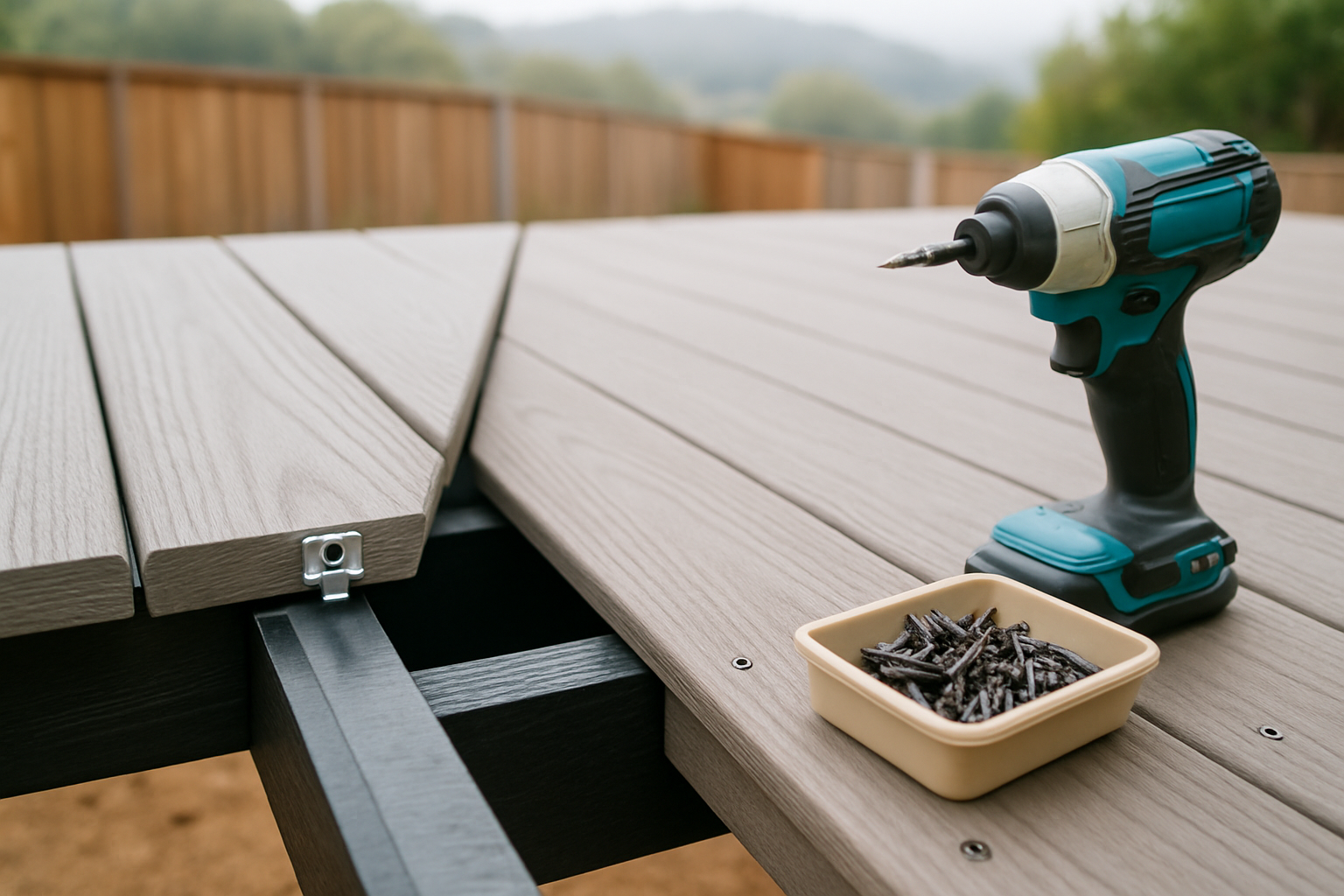
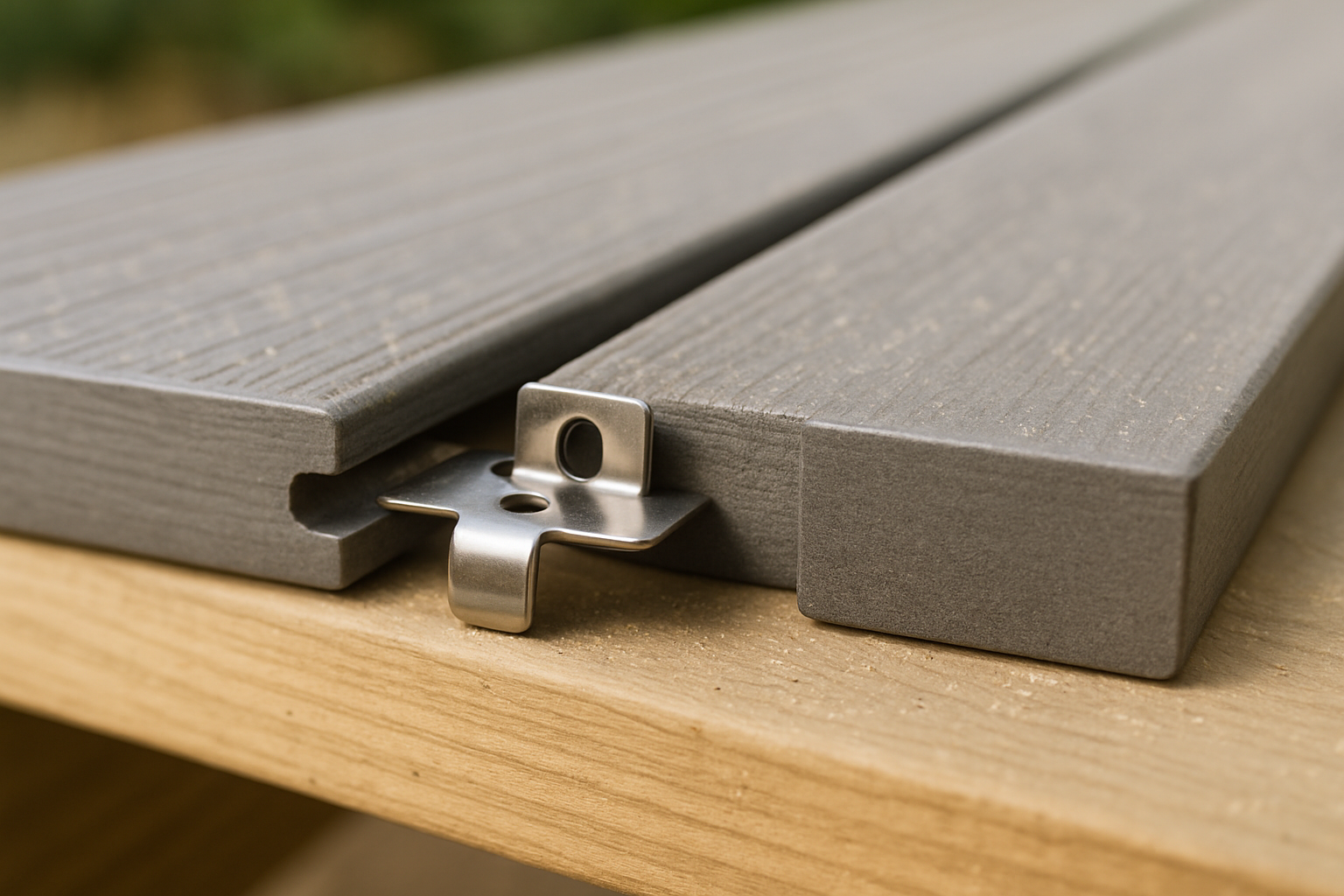
- Grooved edge boards have a channel milled into both long edges. Hidden fastener clips, sometimes called clip systems or grooved-edge fasteners, seat into that channel and screw down into the joist.
- Square edge boards have no channel. They are fastened through the face of the board with screws.
Here is the part that causes real pain: you cannot retrofit a hidden fastener look onto square edge boards. If the boards are already on site and someone decides they want a screw-free surface, the fix is replacing the decking. Not the fasteners, the decking.
It works the other way too. Grooved boards can usually be face screwed, but you paid for a milled profile you are not using, and the groove can leave a small visible reveal at the board edge.
Grooved boards are also typically used for the field of the deck only. Perimeter boards, stair treads, and picture-frame borders usually still get face screwed or plugged, so most decks end up using both methods somewhere. Plan the layout early so you order the right mix. Our pre-purchase guide to composite decking in the East Bay covers the rest of the ordering checklist.
Hidden Fastener Systems: Clean Surface, Tighter Supply Chain
Hidden clips give you a deck surface with no screw heads. For a rooftop deck in San Francisco or a highly visible back deck in the Berkeley hills, that finish is often the whole reason someone chose composite in the first place.
What to know before you commit:
- Clips are usually brand and profile specific. A clip made for one manufacturer’s groove often will not seat correctly in another’s. Mixing brands mid-project is how gaps get inconsistent.
- Install is slower per board. Every clip gets set and driven individually. Crews new to a system typically move noticeably slower on the first deck than on the third.
- Board spacing is set by the clip. That is a benefit for consistency, but it means you do not get to tune the gap on site.
- Lead times can differ from the boards. Clips and boards are separate SKUs, and they do not always ship together. This is the single most common source of the “our composite install took longer than planned” complaint.
One repair note worth knowing: pulling a single damaged board out of the middle of a clipped deck usually means releasing several boards to get to it. Face screwed boards come up one at a time.
Face Screwing: Faster, Simpler, and Fussier Than People Expect
Face screwing works with any board profile and any composite brand. On a large deck, that flexibility and speed can save real crew hours.
But it only looks right if the details are handled:
- Use color-matched composite screws. Standard deck screws leave visible heads and can mushroom the board surface.
- Pre-drill. Composite surfaces can crack or dimple when a screw is driven cold, and pre-drilling is standard practice, not an optional step.
- Keep placement consistent. Two screws per joist, set back from the board edge and lined up down the run. Sloppy spacing shows from across the yard.
- Follow the manufacturer’s fastener spec. Board thickness, joist spacing, and screw length requirements vary, and going off spec can affect warranty coverage.
Cost varies by brand, board profile, and deck size, so treat any number you find online as a rough starting point. Generally, hidden clip systems carry a higher fastener cost per square foot than color-matched screws, and grooved boards can price differently than square edge. For an accurate number on your board count, it is worth getting a quote against your actual layout.
The Order of Decisions That Keeps Your Deck on Schedule
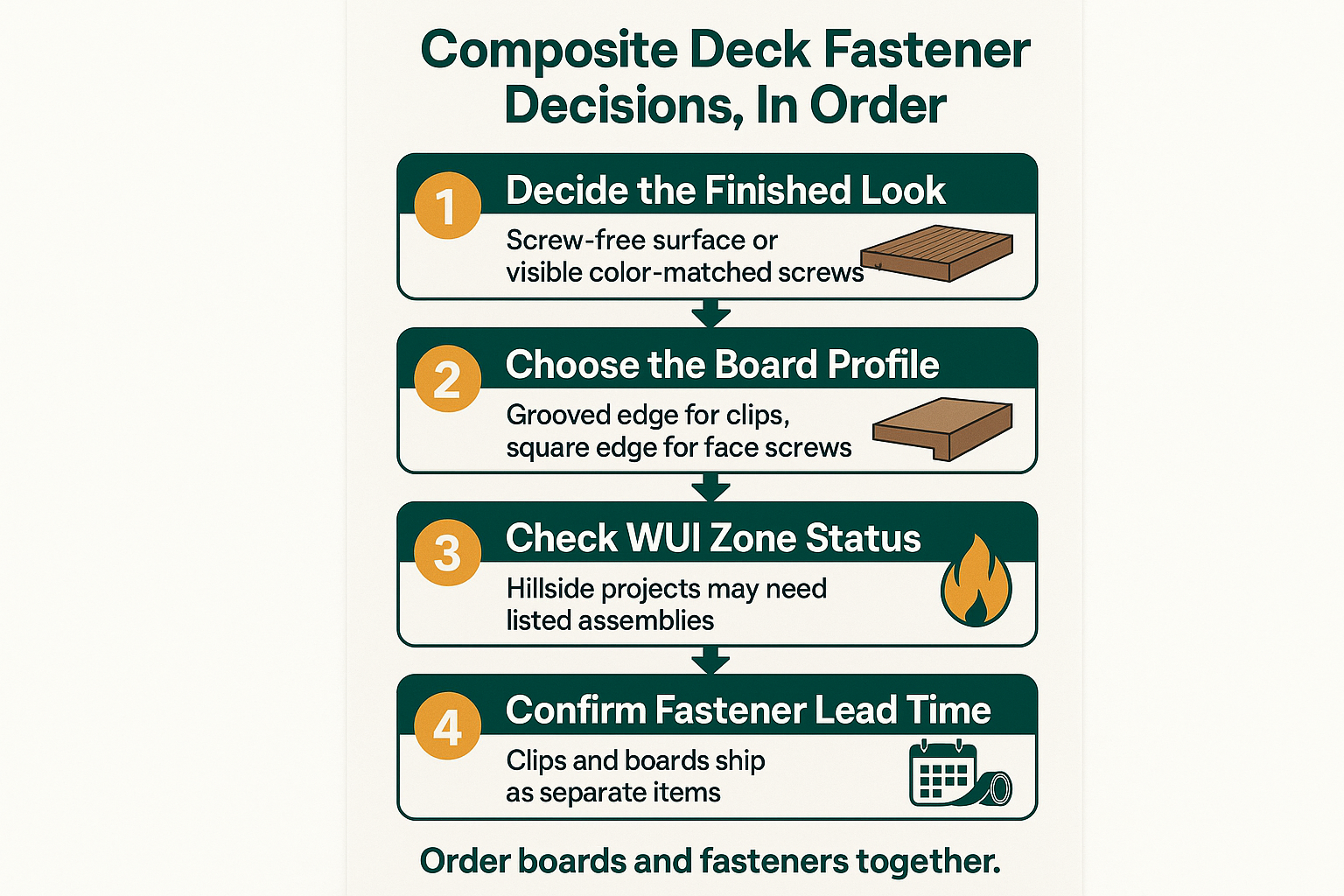
Work through these five steps in order and the fastener question answers itself before anything gets ordered.
Hidden Fasteners vs Face Screws at a Glance
A side-by-side look at how the two methods differ on the factors that actually change your build.
| Factor | Hidden Fasteners (Grooved Boards) | Face Screws (Any Profile) |
|---|---|---|
| Board profile required | Grooved edge only | Grooved or square edge |
| Finished surface | No visible screw heads | Color-matched screw heads visible up close |
| Install speed | Slower per board | Faster, especially for crews new to composite |
| Board spacing | Set by the clip | Set by the installer |
| Single board replacement | Usually requires releasing nearby boards | One board at a time |
| Ordering risk | Clips and boards are separate SKUs and lead times | Screws are widely stocked |
| Fastener cost | Generally higher per square foot | Generally lower per square foot |
| Retrofit later | Not possible on square edge boards | Possible on grooved boards |
WUI Zones and Joist Tape: Two Details That Are Not Optional Here
In the Oakland and Berkeley hills, fastener choice can stop being an aesthetic question. Deck assemblies in Wildland Urban Interface areas are held to ignition-resistant requirements, and some hidden fastener clips are specifically listed for use in those assemblies while others are not.
If your project sits in a fire hazard severity zone, verify the listing for the exact clip and board combination you plan to use, not just the decking brand. The California Office of the State Fire Marshal maintains the building materials listing program that plan checkers reference. Our breakdown of what the 2026 WUI code changed for decking goes deeper on that.
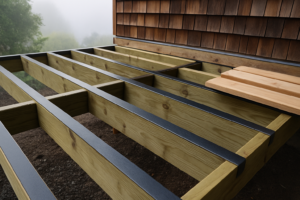
The second detail gets skipped far too often: joist tape. It is a self-adhesive membrane applied along the top of each joist before decking goes down.
Why it matters in a fog belt:
- Every fastener penetration is a path for water into the joist top.
- Composite boards sit tight against the framing and hold moisture at the contact point.
- Marine layer moisture cycles year round in Berkeley, Albany, and El Cerrito, so joists rarely get a long dry stretch.
The composite surface can look perfect for fifteen years while the framing underneath quietly goes soft. Joist tape belongs in the budget from day one, not as a line item someone cuts to save a few hundred dollars.
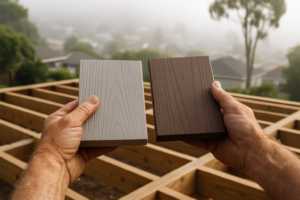
On a related note, board color and orientation matter too, since composite decking retains heat on south-facing decks.
Frequently Asked Questions About Composite Deck Fasteners
Can I use hidden fasteners on square edge composite boards?
No. Hidden clips need the milled channel on a grooved board to seat properly. If square edge boards are already on site, the only way to get a hidden fastener look is to replace the decking, which is why this call has to be made before the order goes in.
Do face screws void a composite decking warranty?
Not on their own. Most manufacturers publish an approved fastener spec that includes screw type, length, and placement. Going outside that spec, or skipping pre-drilling where it is called for, is where warranty problems usually come from.
Why do composite deck installs run long so often?
Two reasons show up again and again. Clips arrive on a different lead time than the boards, and crews used to wood framing move slower on their first clipped deck. Ordering boards and fasteners together and building in a little extra labor for a first-time system handles most of it.
Is joist tape really necessary on a Bay Area deck?
In our climate we treat it as standard. Fog and marine moisture keep framing damp for much of the year, and composite boards trap water right at the joist contact point. Tape is a small cost against the price of rebuilding a substructure later.
Which method looks better on a small deck?
On a compact deck or landing where people stand close to the surface, hidden fasteners make the biggest visual difference. On a large deck viewed mostly from a distance, quality color-matched screws installed with consistent spacing read as clean to almost everyone.
Talking Through the Whole Deck Before You Order
The fastener question is one of those decisions that goes better as a conversation than as a checkbox, because board profile, joist material, WUI zone status, and the look you want are all connected. Contractors who come into the Hearst Avenue yard in Berkeley tend to lay out the whole project first, then pick components, and their orders arrive complete. Our lumber and hardware staff are around Monday through Friday at 510-841-0511 if you want to walk through a deck layout, and the decking and fastener lines are on the shelf at truittandwhite.com.