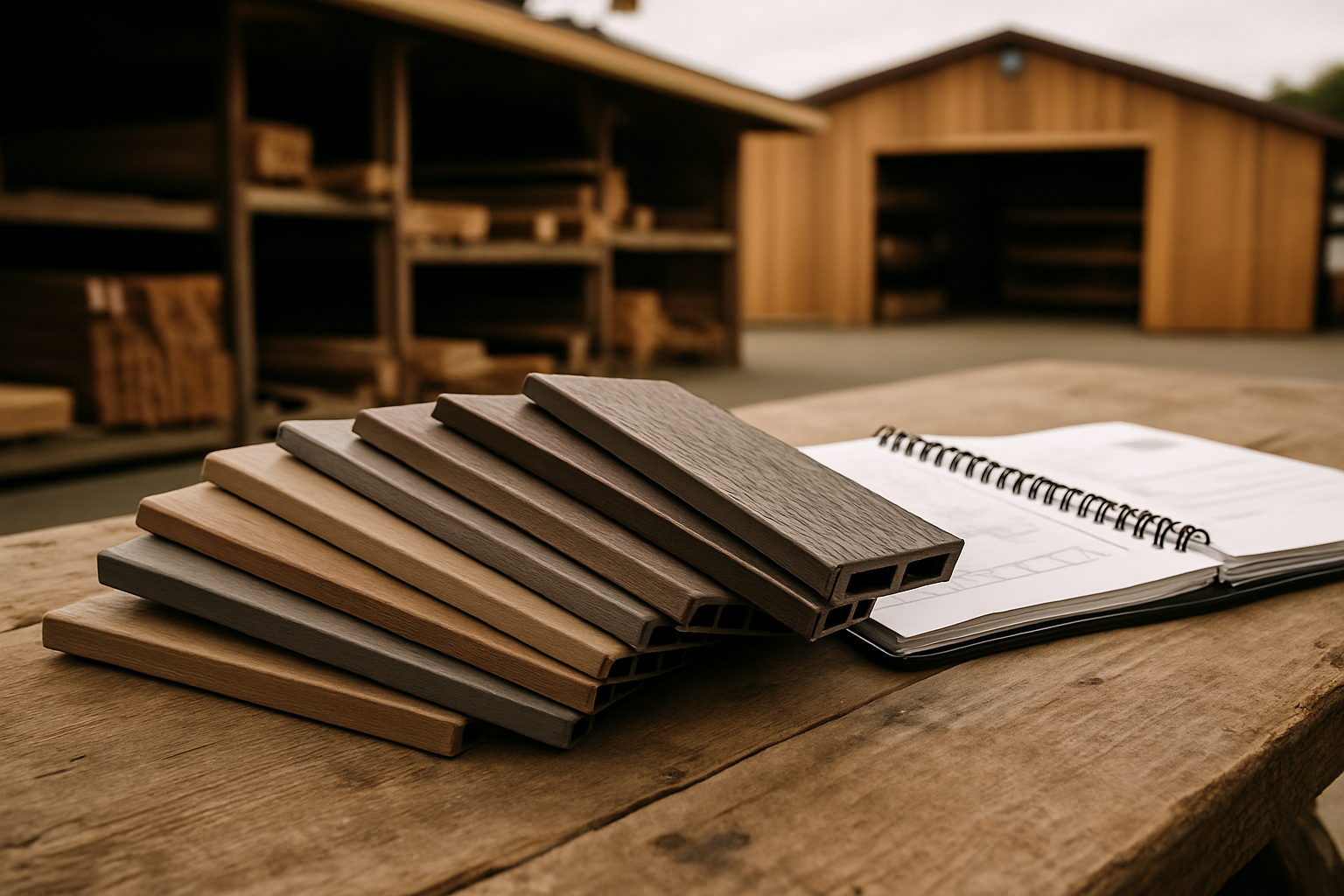
Direct Answer: Before buying composite decking in the East Bay, confirm whether the board is fully capped, check WUI compliance for hillside permits, and order fasteners and boards from the same source to avoid mid-job delays.
If you’re searching for a composite decking supplier in the East Bay, you’ve probably already decided composite is the right call for your project. The question now is which product, from which source, and what you need to nail down before boards hit your jobsite. Those are different questions than ‘should I choose composite?’, and they deserve different answers.
The East Bay’s climate makes material selection genuinely consequential. Decks in Berkeley and Oakland sit under bay oaks and redwoods for months of wet weather, then bake on south-facing exposures when the marine layer clears. A board that looks fine on a manufacturer’s website can perform very differently in those conditions after one full wet season.
This guide covers the three things that matter most at the point of purchase: capped versus uncapped construction, WUI fire zone compliance, and fastener and accessory coordination. Get these right before you order, and you avoid the rework conversations that come later.
Capped vs. Uncapped Composite: The Distinction That Gets Skipped at Point of Purchase
Composite decking products can look nearly identical on a spec sheet, but the difference between fully capped and uncapped (or single-capped) boards shows up fast in the field, especially in the East Bay.
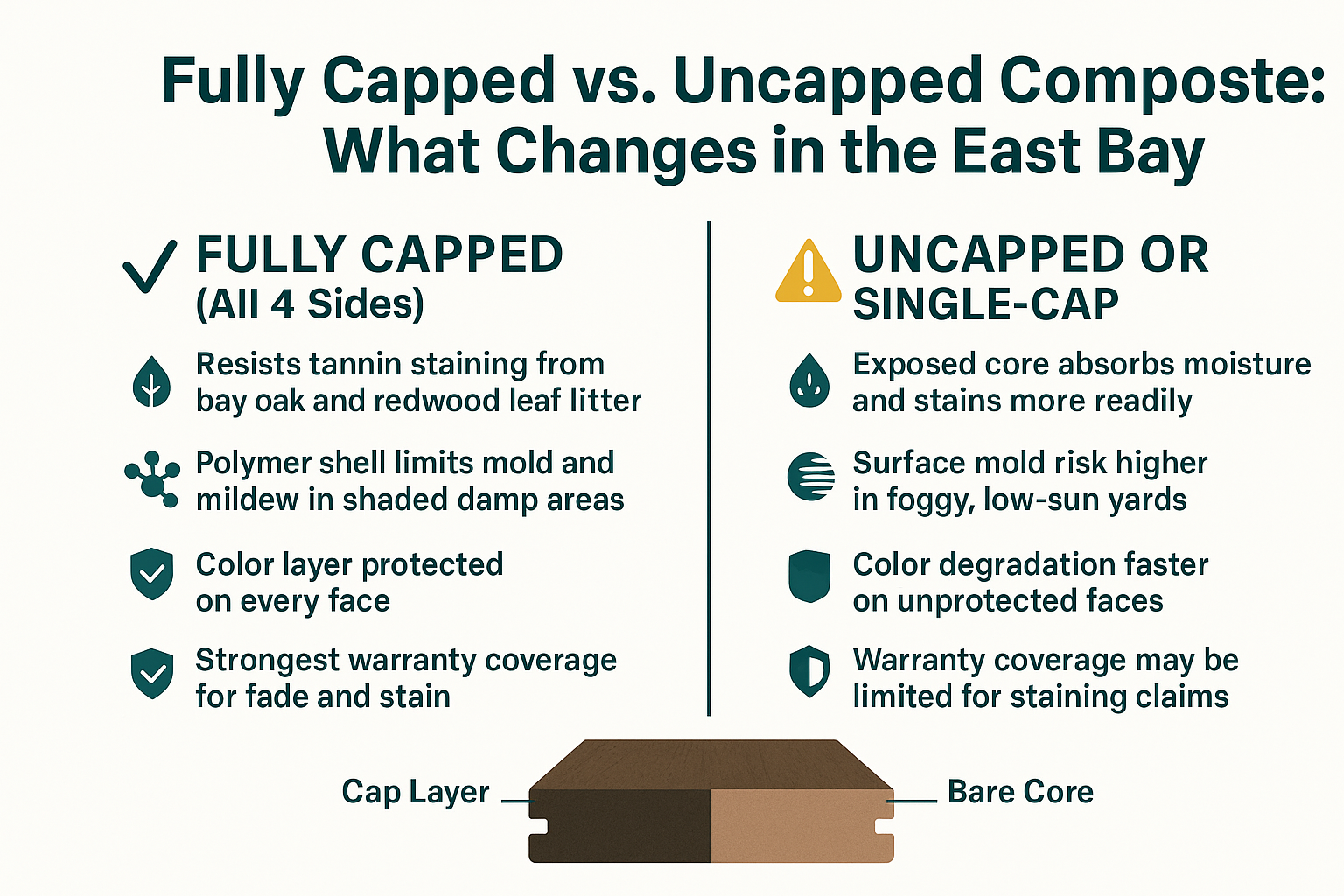
A fully capped composite board has a protective polymer shell on all four sides. That shell resists staining from leaf tannins, mildew, and moisture absorption. An uncapped or single-capped board leaves one or more faces exposed to whatever the environment throws at it. Both products meet minimum composite decking definitions. Both appear in manufacturer literature. But after a wet Berkeley winter under a canopy of oaks, they perform very differently.
The buyers who feel misled later are almost always the ones who weren’t told to ask about capping at the time of purchase. Common differences between capped and uncapped products include:
- Stain resistance, fully capped boards shed tannin staining from bay leaves and redwood needles far better than uncapped cores
- Mold and mildew performance, the polymer shell limits moisture wicking that leads to surface mold in shaded, damp conditions common to East Bay yards
- Long-term color retention, capped boards hold their surface finish longer because the cap protects the color layer, not just the structural core
- Warranty coverage, capping tier directly affects what most manufacturers will cover for staining and fade claims
TimberTech‘s AZEK and PRO lines, for example, are fully capped on four sides. Before committing to any composite product, ask specifically: is this board capped on all four sides, and what does the warranty cover for staining and fade? If the answer is unclear, that’s a reason to pause.
For a broader look at how composite compares to wood and modified wood options, Redwood vs. Composite vs. Modified Wood: A Bay Area Deck Breakdown covers the tradeoffs by material type.
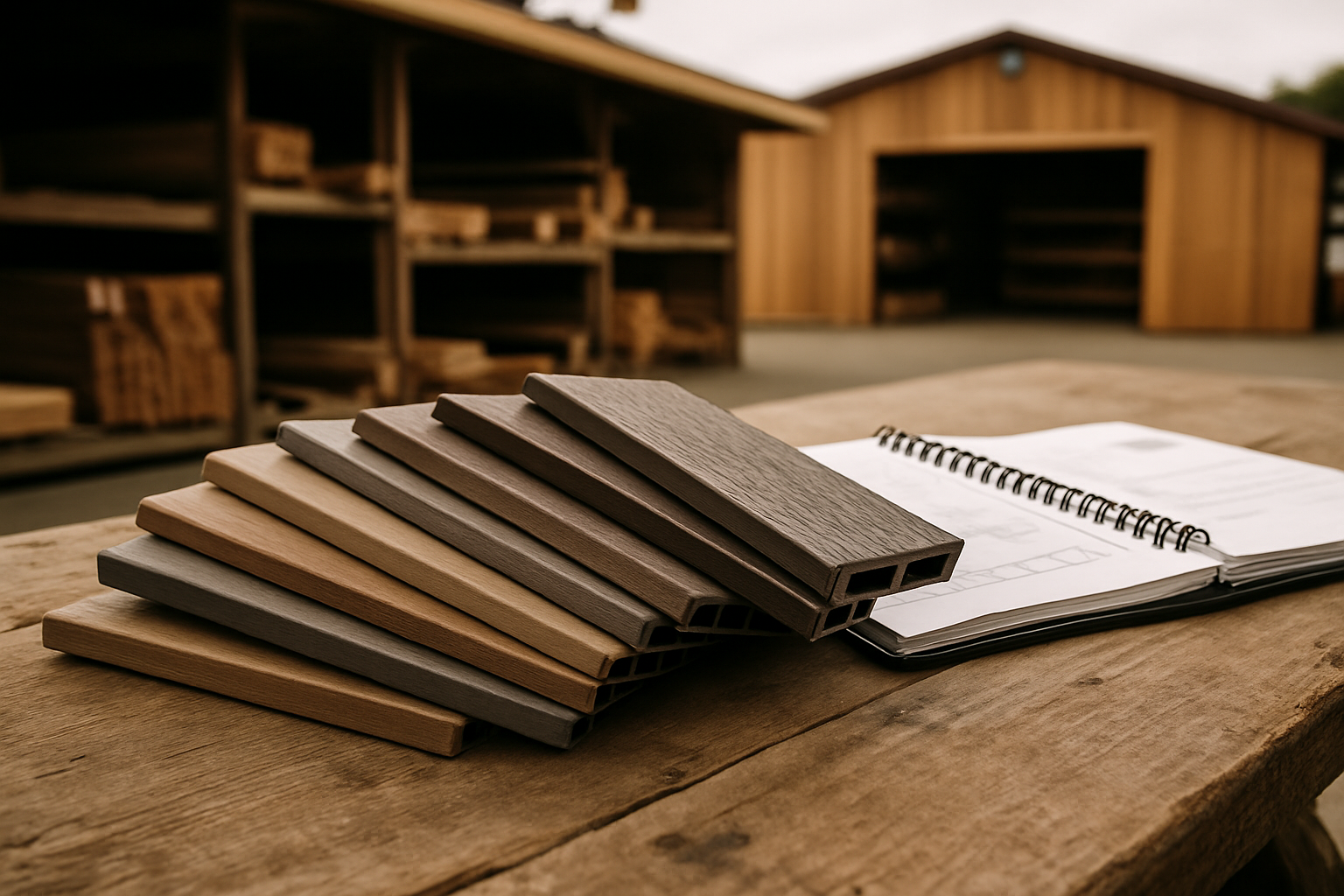
The Heat Retention Question: What the Manufacturer Disclaimers Actually Say
Heat buildup in composite decking is a real performance factor, and it’s worth addressing plainly rather than pretending premium products are problem-free.
TimberTech‘s composite lines are made from approximately 85% recycled material, a genuine sustainability advantage that matters to a lot of East Bay buyers. But recycled content doesn’t eliminate heat retention. Composite boards absorb and hold more heat than wood, and darker colors absorb significantly more than lighter ones.
TimberTech’s own manufacturer disclaimers, including those on their heat-mitigating product lines, explicitly warn against extended skin contact on hot sunny days. That’s not a knock on the product, it’s an honest statement about physics. And it’s the kind of thing worth knowing before you specify a dark-colored board for a south- or west-facing deck in Oakland.
Practical guidance for managing heat before you purchase:
- Choose lighter board colors for decks with significant sun exposure, the difference in surface temperature between a light and dark board on a sunny afternoon can be substantial
- Factor deck orientation early, south- and west-facing surfaces are the worst cases; if your project faces those directions, color selection matters more than usual
- Plan for shade structures, a pergola or sail shade makes a meaningful difference in comfort and surface temperature on exposed composite decks
- Read the specific product’s disclaimer before finalizing your color selection, especially on the heat-mitigating lines
The How Bay Area Fog and Sun Change the Wood vs. Composite Decision article goes deeper on how microclimate and orientation interact with material choice.
Capped Composite at a Glance: What the Cap Actually Protects Against
This infographic breaks down what a full four-sided polymer cap does, and where uncapped boards are vulnerable in East Bay conditions.
WUI Compliance in the Oakland and Berkeley Hills: Check the List Before You Commit
WUI compliance is no longer a theoretical concern for East Bay deck projects, it’s an operational requirement for a meaningful share of builds in the Oakland and Berkeley hills.
California’s CBC Chapter 7A and CRC R337 govern building materials used in Wildland-Urban Interface zones. For decking specifically, the California HCD maintains a directory of approved products under Building Materials Listing category 8110. Contractors pulling permits in WUI-designated areas need to specify from that approved list, and the updated 2025 California Building Standards Code tightened those requirements further for projects permitted in 2026 and beyond.
The practical problem: not every composite product on the market appears on the HCD’s approved list. A product can be high-quality, fully capped, and well-regarded by contractors nationally, and still not be listed for WUI use in California. Discovering that after you’ve committed to a material and framed a deck is a painful and expensive moment.
Before buying composite for any Oakland or Berkeley hillside project, confirm:
- Whether the specific product (not just the brand) appears on the California HCD BML category 8110 list
- Whether your permit jurisdiction requires WUI-compliant decking for your parcel
- That your supplier can document the listing number if the inspector asks
This is a question worth asking directly at the point of purchase, not something to sort out at permit submission. The Which Decking Material Actually Holds Up in Bay Area Weather? article also touches on how fire zone requirements intersect with material selection for hillside decks.
Composite Decking Checklist: Questions to Ask Before You Order
Use this as a quick reference when evaluating any composite product from a supplier. These are the questions that prevent the most common post-purchase problems on East Bay projects.
| Question to Ask | Why It Matters | Who to Ask |
|---|---|---|
| Is the board fully capped on all four sides? | Single-cap boards stain and mold faster under Bay Area leaf litter and damp | Supplier at point of purchase |
| What does the warranty cover for staining and fade? | Cap tier directly controls warranty scope, uncapped boards often carry narrower coverage | Manufacturer warranty doc |
| Is this product listed on CA HCD BML category 8110? | Required for WUI-zoned permits in Oakland and Berkeley hills | Supplier or HCD directory |
| What fastener system does this board require? | Grooved boards need hidden fasteners; square-edge can face-screw, systems are not interchangeable | Supplier stocking the same brand |
| Are hidden fasteners, joist tape, and fascia in stock now? | A delay in any accessory can stall a framed job for weeks | Same supplier, before ordering boards |
Fasteners, Grooved Boards, and Why Everything Should Come from One Source
Composite installation accessory coordination is one of the most consistent contractor pain points we hear about, and it’s preventable with one conversation before the order is placed.
Here’s the basic mechanical reality:
- Grooved-edge boards require a hidden fastener system, the fastener clips into the groove and holds the board without surface screws. These fasteners are typically proprietary to the brand and sometimes to the specific product line.
- Square-edge boards can use face screws, which gives you more flexibility on fastener sourcing but leaves screw heads visible on the finished surface.
- Joist tape is applied to the top face of each framing joist before boards go down. It protects the joist from moisture that migrates through the board joints and significantly extends the life of the substructure.
The problem that stalls jobs: a contractor orders grooved boards from one supplier, then discovers the proprietary hidden fasteners are backordered from a different distributor, or the fascia material in the matching color isn’t stocked locally. The deck is framed and ready. Nobody’s moving until the fasteners arrive.
Ordering boards, fasteners, joist tape, and fascia material from the same authorized dealer eliminates most of that risk. It also means the person pulling your order can catch mismatches, like a hidden fastener specified for one TimberTech line that isn’t compatible with a different one, before the job is in progress.
For a detailed look at what goes into planning the full scope of a composite build, How to Plan and Build a Deck: A 2026 Guide covers sequencing and material coordination from the ground up.
If you’re still weighing composite against wood alternatives, Wood vs Composite Decking for Bay Area Decks breaks down the tradeoffs across maintenance, cost, and performance.
Frequently Asked Questions About Buying Composite Decking in the East Bay
What’s the actual price difference between capped and uncapped composite in the Bay Area?
Fully capped boards generally cost more per linear foot than uncapped or single-capped products, though the specific gap varies by brand, product line, and current market pricing. In the Bay Area, material costs for composite decking can range widely depending on the tier and whether you’re looking at entry-level composite or premium capped lines. The more useful framing: the price difference between capped and uncapped is almost always smaller than the cost of refinishing, replacing, or disputing warranty coverage on a board that underperformed after a wet winter. Ask your supplier for a side-by-side comparison at both price points.
Does all composite decking require hidden fasteners?
No. Grooved-edge boards require a hidden fastener system. Square-edge boards can be face-screwed. The board edge profile determines your fastener option, so confirm which type you’re ordering before assuming one system or the other. Some product lines are only available in grooved; others offer both edge profiles.
How do I know if my East Bay deck project is in a WUI zone?
The easiest starting point is your local building department, Berkeley and Oakland both have parcel lookup tools that show fire hazard severity zone designations. You can also check the California Department of Forestry and Fire Protection’s (CAL FIRE) official fire hazard severity zone maps. If your parcel is in a WUI zone, you’ll need to specify decking from the California HCD Building Materials Listing category 8110. Confirm the specific product is listed, not just the brand.
Is composite decking really hot to walk on barefoot? Even the premium lines?
Yes, composite holds more heat than wood regardless of the product tier. Darker colors absorb significantly more heat than lighter ones, and south- or west-facing decks in full sun are the worst-case scenario. Even TimberTech’s heat-mitigating product lines include manufacturer disclaimers warning against extended skin contact on hot sunny days. Choosing lighter board colors and planning for shade structures are the most practical mitigations, and both decisions are better made before purchase than after.
Can I see TimberTech and Trex samples in person before ordering?
Yes. The Hearst Avenue location carries actual board samples for both brands, which is meaningfully different from choosing a color from a website swatch. Surface texture and color read differently in person, especially in East Bay light conditions. If you’re making a final color call on a large project, it’s worth the trip.
What is joist tape, and do I actually need it under composite decking?
Joist tape is a self-adhesive moisture barrier applied to the top face of each framing joist before the decking boards go down. It prevents moisture from migrating through board joints and sitting on the joist, which is a major driver of premature framing rot. Most composite manufacturers recommend or require it, and in the East Bay’s damp climate it’s one of the more practical things you can do to protect the substructure. It’s typically ordered at the same time as the decking boards.
Ready to Compare Products Before Your Order Goes In?
Truitt & White at 642 Hearst Avenue in Berkeley carries actual TimberTech and Trex board samples you can hold and compare in person, not just website swatches. If you have WUI compliance questions, fastener compatibility questions, or just want to work through which product tier makes sense for your specific project conditions, the lumber and decking team is the right place to start that conversation. Call the Lumberyard and Hardware at 510-841-0511 or visit truittandwhite.com to learn more about what’s in stock.