Direct Answer: Zone 0 is the ember resistant area within 5 feet of a home. California’s statewide rule is still in rulemaking as of the April 2026 draft, which phases requirements in over roughly five years.
If you own a house in the Berkeley or Oakland hills, you have probably seen a headline this year saying flammable fences were banned as of January 1, 2026, and that fines are on the way. Several of those headlines are being written by companies that sell fence panels.
The calmer, more accurate version is that California’s Zone 0 rule, the ember resistant zone covering the first five feet around a structure, is still working its way through rulemaking. The Board of Forestry and Fire Protection put out an updated draft on April 17, 2026, and that draft leans on education, outreach, and a phased rollout rather than immediate penalties.
So before anyone rips out a gate, it helps to understand what the first five feet actually covers, what the phases likely look like, and which parts of the work are worth pricing now. We deal with these questions across the counter every week.
Where the Zone 0 Rule Actually Stands
The short version: the concept is real, the deadlines are not final, and nobody is issuing citations over a redwood fence in Berkeley this week.
The April 2026 draft from the Board of Forestry is explicit about a phased approach. The early years focus on getting people informed and getting the easy stuff cleaned up, with the harder material changes landing later.
A few things worth holding onto:
- The rule applies in State Responsibility Areas and in Very High Fire Hazard Severity Zones inside Local Responsibility Areas, which covers a lot of the East Bay hills.
- In Local Responsibility Areas, the draft would let local fire agencies authorize alternative practices based on lot size, slope, building density, and local conditions.
- The actual compliance schedule would be set by the responsible fire authority, not by a single statewide date.
That last point matters most for anyone here. Berkeley, Oakland, and the districts around them will not necessarily land in the same place at the same time.
Before you spend money, confirm current status with your local fire authority. A ten minute phone call to the fire prevention division beats a rebuilt fence you did not need yet.
The First Five Feet Are Not Measured From the House
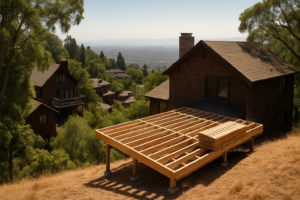
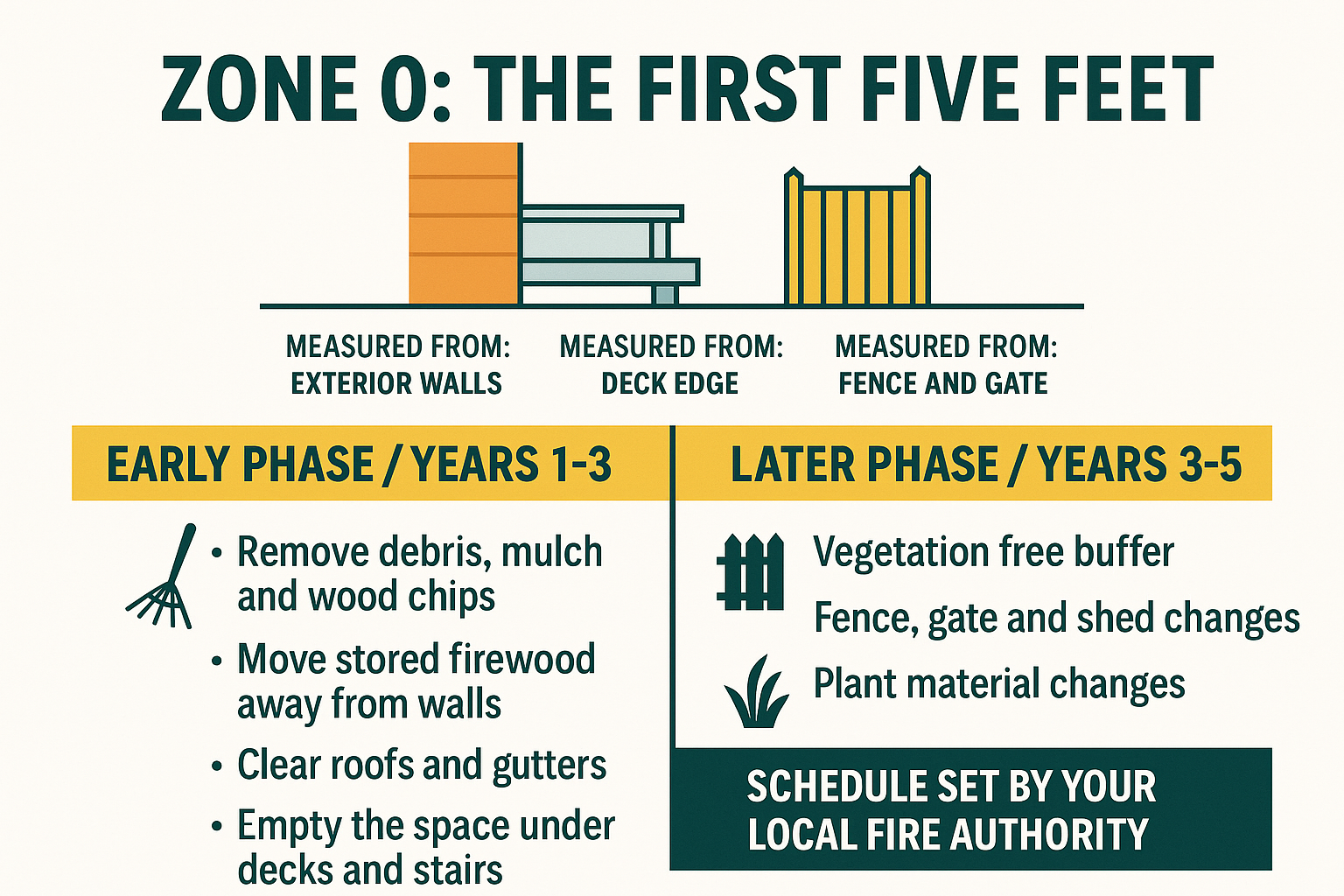
This is the part that surprises people. Zone 0 runs 0 to 5 feet out from the exterior walls of a building, but it also measures out from decks, fences, and attached structures.
Under the April draft, a self supporting feature sitting within about a foot of the main structure would generally get treated as an attached structure. So the boundary moves outward with whatever is bolted or crowded up against the house.
On a typical hills lot, that changes the math fast:
- A deck that cantilevers 8 feet off the back wall pushes Zone 0 out to 13 feet from the siding at that face.
- A gate frame tight against the wall sets the measuring point at the gate, not the wall.
- A tall side yard fence running parallel a foot off the house can pull the zone into the neighbor’s planting bed.
Plenty of Berkeley lots have side yards under six feet wide. On those, the entire side yard is Zone 0, fence line included. Walk your property with a tape before you assume anything is outside the line.
The Phased Timeline Is What You Can Actually Plan Around
The draft splits the work into two rough phases, and they call for very different amounts of money and planning.
Early phase, roughly the first three years. This is housekeeping, and most of it is a weekend with a rake and a wheelbarrow:
- Removing combustible debris, bark mulch, and wood chips from the five foot band
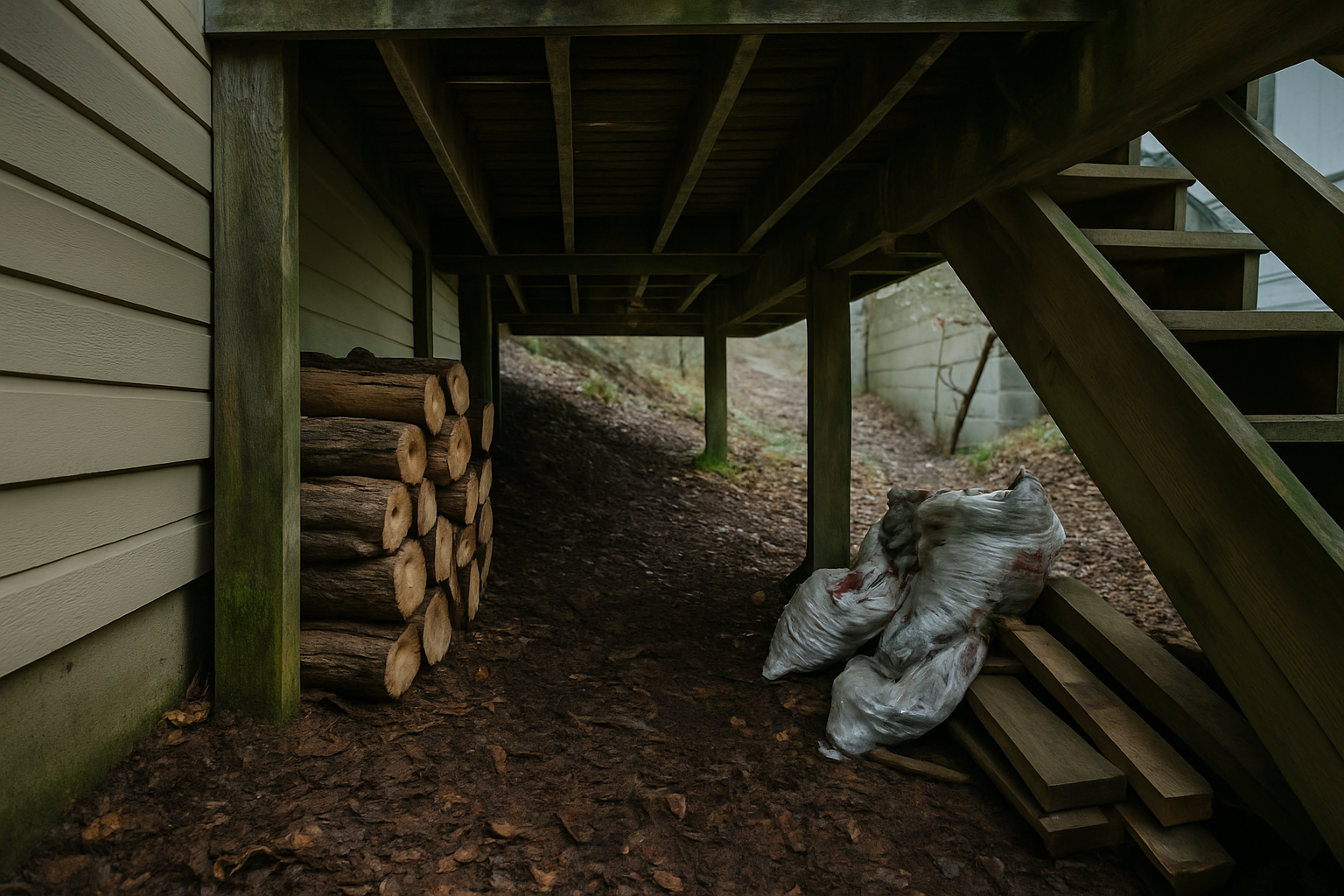
- Moving stored firewood away from walls and out from under stairs
- Clearing roofs and gutters, which in the East Bay means after the oaks and eucalyptus drop
- Pulling stored items, scrap lumber, and bagged soil out from under decks
- Routine tree maintenance around the structure
Later phase, roughly three to five years. This is where the real decisions live:
- Vegetation free buffers in the first five feet
- Required changes involving plants, fences, gates, sheds, and outbuildings
We tell customers to treat the early phase as maintenance they should be doing anyway and the later phase as a budget item to start pricing now. A gate rebuild, a fence transition, and any grading fix all take longer to plan than people expect.
Zone 0 at a Glance
Here is how the measurement and the phasing fit together on a typical hillside lot.
The Fence Detail Everyone Asks About
This is the single most common Zone 0 question we get from owners of older East Bay houses, and the answer is narrower than most people fear.
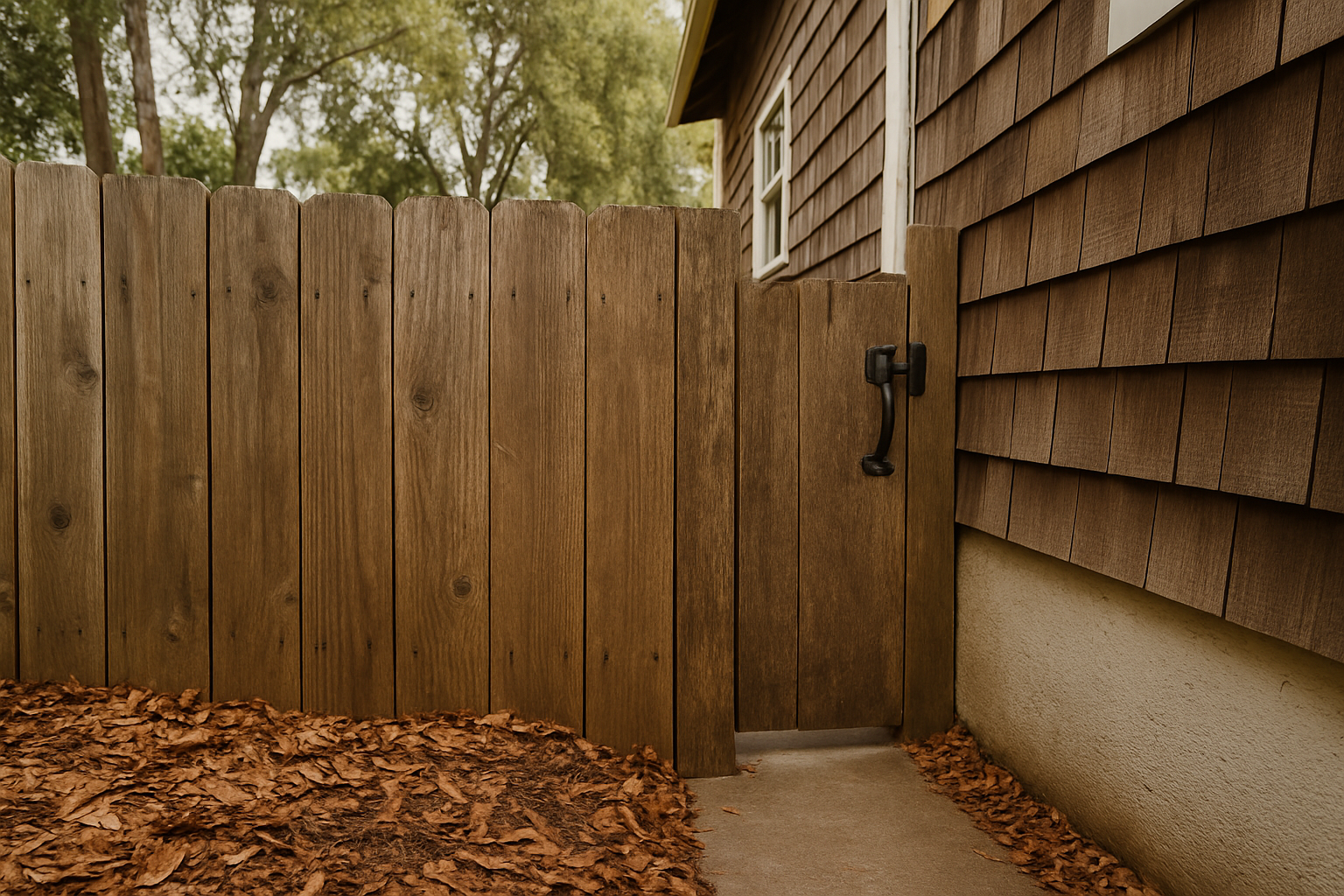
The concern is not your whole fence. It is the run of fence or gate that comes perpendicular to the house and dead ends into the siding. A wood fence board tight against a shingled wall behaves like a wick. An ember lands in the leaf litter at the base, the bottom rail catches, and the fire walks straight to the wall.
Some California cities have already written this into local code ahead of the state. Auburn requires the portions of combustible gates or fences that run perpendicular to or touch a structure to be built of noncombustible material for a minimum of five feet, and it lists metal and fiber cement as acceptable examples. You can read the ordinance language in the city’s Ember Resistant Zone requirements document.
The practical build is a noncombustible first section with a clean transition to wood fence boards past the five foot mark. Details that actually decide whether it works:
- A post at the transition. Steel or a concrete embedded post carries the joint. Do not end the noncombustible run in mid air.
- Hardware on the right side. Hinges, latches, and drop rods for a metal gate are not the same parts you would use on a wood gate.
- Fasteners rated for the pairing. Mixing dissimilar metals in the marine layer will chew through a connection. The same logic that drives stainless versus hot-dip galvanized fastener choices on decks applies at a fence transition.
- No mulch bed at the base. A noncombustible fence section sitting in six inches of bark chips is doing half a job.
Decks: Clean It Out First, Then Talk Material
The near term draft language about decks is mostly about what sits on top of and underneath them. That is good news, because it is the cheapest work on the list.
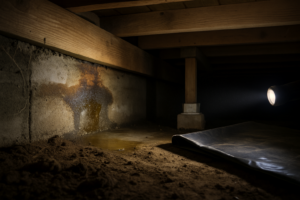
In the fog belt, debris under a hillside deck stays damp and piles up fast. Leaf litter, scrap lumber from the last project, bags of soil, and the firewood tucked behind the stair stringers all belong somewhere else.
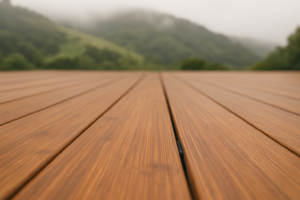
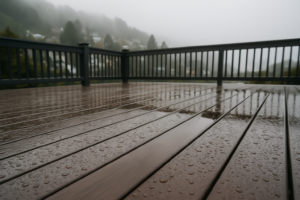
Material questions come later and get more involved. When you get there, one distinction is worth knowing: California’s state Building Materials Listing program carries a dedicated Decking category for WUI approved products, but it has no fencing category.
That is exactly why fence material claims deserve a closer read than deck material claims. With decking you can ask for a listing number. With fencing you are often looking at a marketing label instead of a documented listing, so ask what standard the claim is actually tied to.
If you are already planning a deck rebuild, the material and fire questions overlap. Our breakdowns of what the 2026 WUI code changed for decking and the framing details under the boards cover that ground.
Zone 0 vs. the WUI Building Code
Contractors and homeowners mix these two up constantly. They are enforced by different people, at different times, on different things.
| Question | Zone 0 defensible space | Chapter 7A / CRC R337 |
|---|---|---|
| What it governs | Clearance and maintenance in the first 5 feet | Materials and assemblies on the structure |
| Legal basis | Defensible space framework tied to Public Resources Code 4291 | California Building and Residential Code |
| Who checks it | The fire authority | The building inspector, at permit time |
| When it applies | Ongoing, for as long as you own the house | At permit and inspection for new work |
| Where it applies | State Responsibility Areas and Very High Fire Hazard Severity Zones in Local Responsibility Areas | Designated WUI areas per the adopted code |
| Typical trip-up | Mulch beds, under-deck storage, a fence into the siding | Wrong vent, wrong soffit, unlisted decking |
Why Late Summer Is the Window in the East Bay
A hillside remodel in the Berkeley or Oakland hills can pass its building inspection on materials and still have a fence, a mulch bed, and an under deck woodpile that the fire side of the equation would flag. Those are two separate conversations, and only one of them ends at final inspection.
The calendar pushes this work toward late summer and early fall. Oakland enforces a wet weather grading moratorium from October 15 to April 15 on work that changes site slope or elevation, so any drainage or regrading tied to a fence line needs to happen before mid October.
A reasonable sequence for the next few months:
- Knock out the early phase housekeeping on a weekend. Rake, haul, restack the firewood, clear the gutters.
- Measure your actual Zone 0 boundary from the deck edge and the fence, not the wall.
- Call your fire authority and ask where the local schedule stands.
- Price the fence transition and any gate hardware now, while yards and shops are not slammed.
If heavy rain is on your list of concerns too, our El Niño winter prep guide for East Bay homes covers the drainage side of the same fall window.
Frequently Asked Questions About Zone 0 Rules for Fences and Decks
Do I have to tear out my wood fence?
Almost certainly not the whole thing. The concern is the section that runs perpendicular into your house and the gate framing near the wall, not the fence line along the back of the lot. Cities that have already adopted this, like Auburn, require noncombustible material for the first five feet at the point of contact and leave the rest alone.
Were flammable fences banned on January 1, 2026?
No. The statewide Zone 0 rule is still in rulemaking, and the April 17, 2026 draft emphasizes education and a phased rollout instead of immediate penalties. Some individual cities have adopted their own ember zone ordinances ahead of the state, so your local fire authority is the only reliable answer for your address.
Does Zone 0 measure from my house or from my deck?
Both. It runs 5 feet out from exterior walls and from decks, fences, and attached structures. On a narrow side yard, the gate frame or deck edge usually sets the boundary before the siding does.
Is there such a thing as a WUI listed fence?
Not in the same documented sense as decking. California’s Building Materials Listing program has a Decking category but no fencing category, so a fence product claiming fire performance is usually referencing a material property or another standard rather than a state listing. Ask the seller which standard the claim points to before you buy on the label alone.
My remodel passed inspection. Am I covered?
Not necessarily. Building inspection checks Chapter 7A materials at permit time. Zone 0 is a maintenance and clearance obligation enforced by the fire authority, and it keeps applying long after your final sign off.
Sorting Out a Fence Transition or a Deck Material Question
Most of this comes down to counter knowledge: which decking products carry a state WUI listing, what a noncombustible fence transition needs for posts and fasteners, and where the line falls between a code question and a defensible space question. One reviewer put it plainly: “The place professionals go to get professional service for professional work.” Our lumberyard and hardware store at 642 Hearst Avenue in Berkeley is open for those conversations, and you can reach the counter at 510-841-0511 or the windows and doors showroom at 510-649-4400.