Direct Answer: Inspect your crawl space and garage on a dry day in September, cover bare soil with a vapor barrier, use pressure-treated wood against concrete, and buy pump and seal supplies before storms start.
NOAA’s Climate Prediction Center said in its August 13, 2026 ENSO discussion that there is a greater than 90% chance of a very strong El Niño through fall and winter 2026-27, with roughly a 69% chance the October to December period runs stronger than any event on record back to 1950. You can read the discussion yourself at NOAA’s ENSO diagnostic page.
Here is the honest part. Northern California rainfall tracks El Niño much more loosely than Southern California does, so nobody can tell you how many inches Berkeley will get. What we can say with confidence is when storm season arrives, and that is enough to act on.
This Super El Niño storm preparedness checklist stays below the first floor. Crawl spaces, garages, and slab-level water entry are a different problem from roofs and windows, and in older East Bay housing stock they are where the expensive damage quietly starts.
1. Walk the Crawl Space on a Dry Day in September
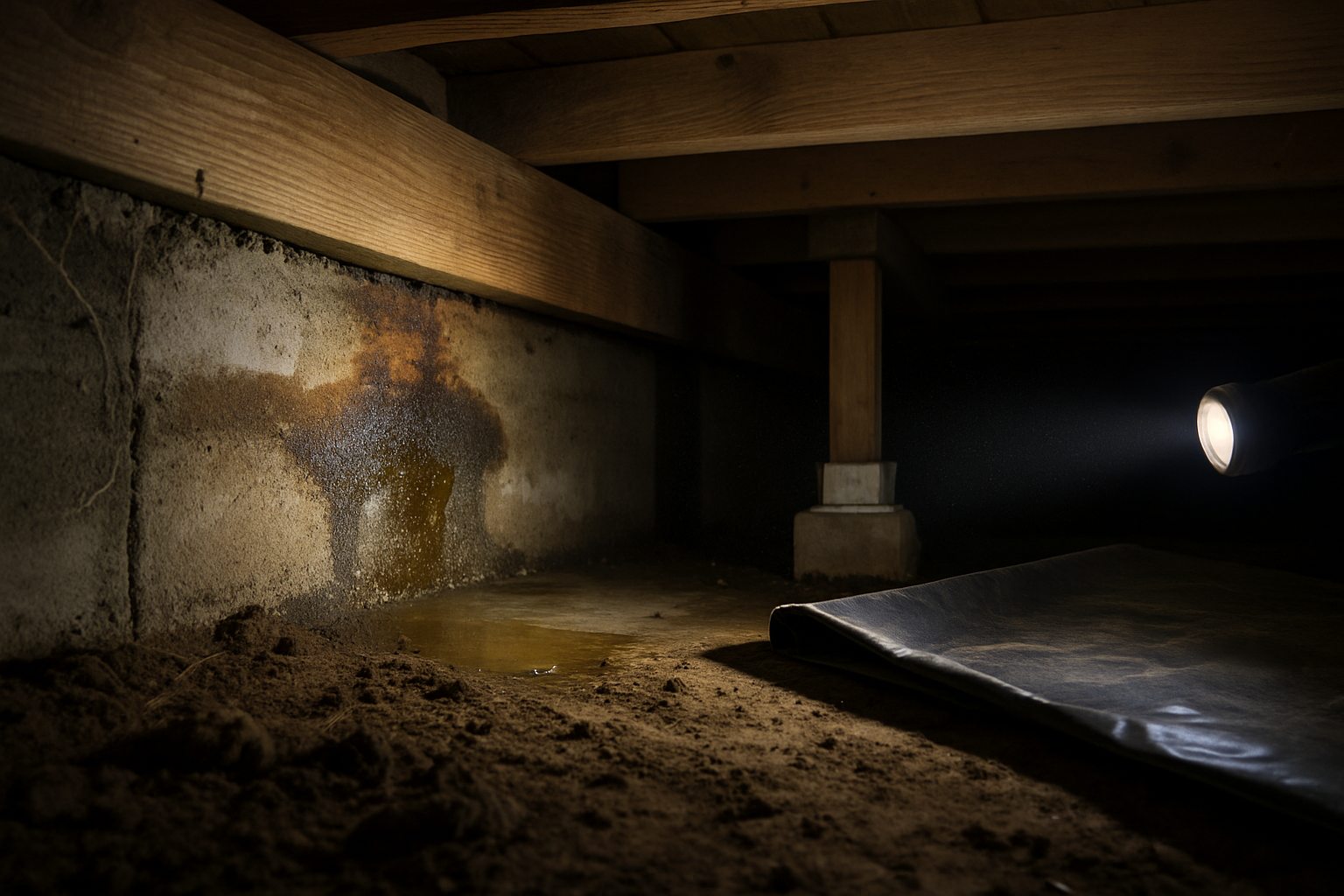
The worst time to learn what your crawl space does in the rain is while it is raining. Go under there in September or early October, when the soil is dry and you can actually read what happened last winter.
Bring a flashlight, a screwdriver, and knee pads. You are looking for evidence, not water:
- Water staining or mineral crust on the inside face of the foundation wall
- Silt lines or dried mud fans near vents, pier footings, or the low corner of the crawl
- Rusted post bases, straps, or hardware, which tell you moisture sits there
- Soft wood at the mudsill and the bottom of posts (push the screwdriver in; if it sinks, that is rot)
- Crushed or disconnected ducts and vapor pipes lying in the dirt
Mark the low spot. Almost every crawl space has one, and that is where standing water will show up first.
While you are at it, note which foundation vents are blocked by soil, shrubs, or a stack of old lumber. Blocked vents are one of the main reasons a crawl space stops drying out between storms.
2. Understand Why Berkeley Housing Stock Is Especially Exposed
This is a local problem for a specific reason. The median construction year in Berkeley is 1944, and roughly 46% of homes were built before 1940.
That means raised foundations, vented crawl spaces, half-height basements, and garages sitting at or barely above sidewalk grade. Those details were normal practice at the time, and most of them still work fine, but they put untreated wood close to damp soil and concrete.
Then add the marine layer. Fog and overcast keep the shaded north and west sides of a house damp for days after the rain stops, and crawl space air under those sides barely moves.
Dry rot in the East Bay is usually not caused by a dramatic flood. It is caused by wood that never gets a full drying cycle between storms, week after week from November through March. That slow version does more structural damage than the one big storm everybody worries about, and it is the reason a flatland Berkeley bungalow and an Oakland hills house need different attention below the floor.
3. Put a Ground Cover Vapor Barrier Over Bare Soil
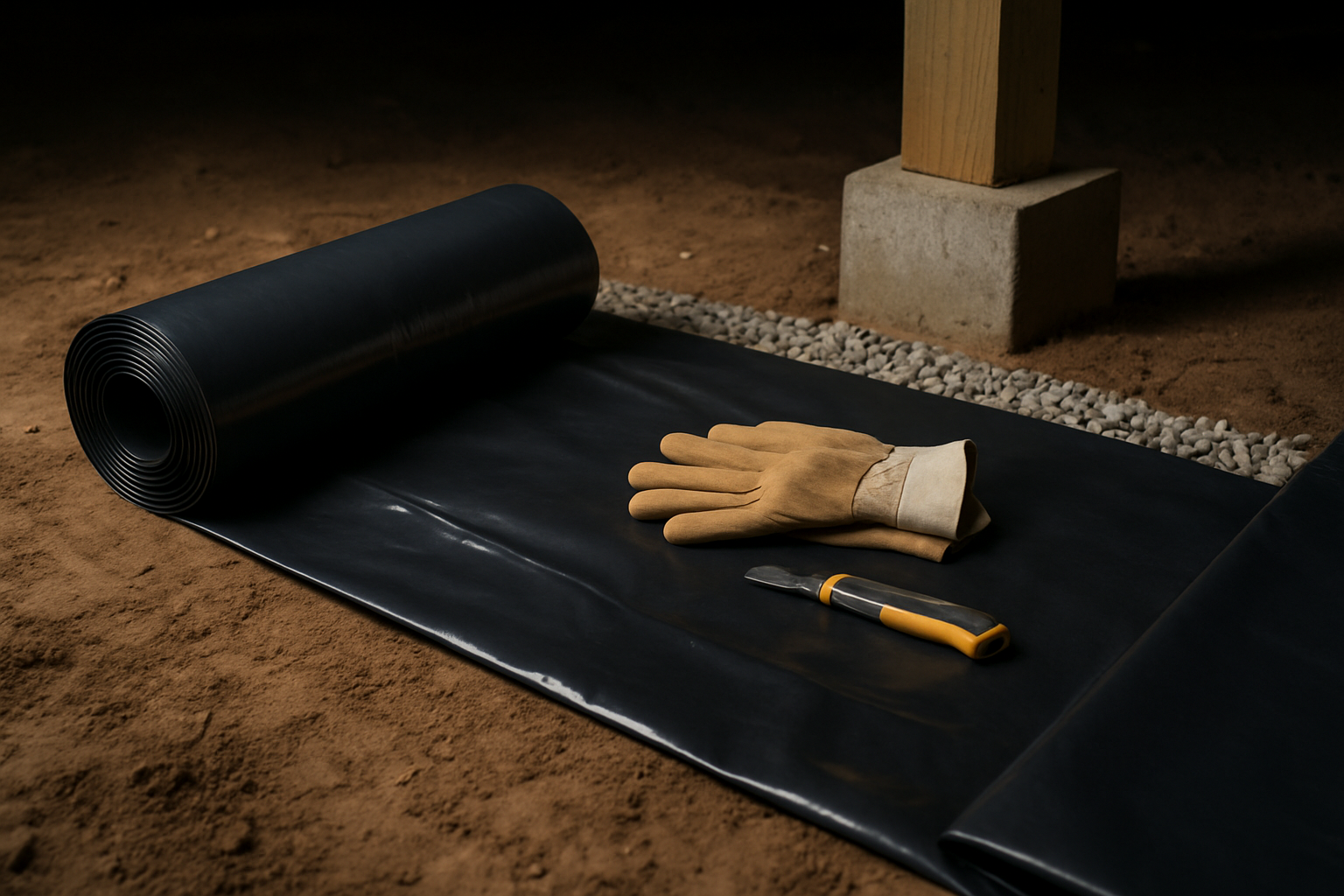
If the crawl space floor is bare dirt, that soil is pumping moisture into the framing all winter. A ground cover vapor barrier is the single cheapest change most older East Bay homes can make down there.
What to know when you are picking material:
- Thickness matters for durability more than for vapor performance. Thin sheeting tears the first time somebody crawls over it to service a duct.
- Reinforced or string-reinforced poly holds up better in a crawl space that gets regular access.
- Lap the seams generously and run the sheet up to the foundation wall rather than stopping short.
- Weight the edges with gravel or treated furring so the sheet does not lift and bunch.
A ground cover does not fix drainage. If water is actively running into the crawl space, the sheet just gives it a slick surface to spread across. Solve the water path first, then cover the soil.
We stock ground cover sheeting, gravel, and the treated stock to hold it down, and it is worth measuring your crawl footprint before you come in so you buy the right roll size once.
4. Use Pressure-Treated Stock Anywhere Wood Meets Concrete
This is the part of the checklist that saves real money. Anything in contact with concrete or exposed to ground moisture belongs in pressure-treated stock. Concrete wicks moisture, and untreated Douglas fir sitting on it will fail long before the rest of the framing does.
The usual first casualties in an older Berkeley or West Oakland house:
- Mudsills sitting directly on a foundation wall or slab
- Bottom plates in a garage or converted basement wall
- Garage door jamb legs, which sit in the exact spot where driveway water pools
- Sleepers and blocking laid on a slab under finished flooring
- Cripple wall bases in a partial-height crawl
Use the right retention level for the job. Ground contact rated treated lumber is a different product from above-ground treated stock, and swapping one for the other is a common and expensive mistake.
We supply the material and the guidance on which grade fits which condition. We do not do the installation, so plan on your framer or a licensed contractor for the actual work, particularly on anything structural like a mudsill replacement.
5. Match Your Fasteners to a Damp Crawl Space
Fasteners are where people quietly undo good material choices. Standard coated screws corrode fast in a vented crawl space that stays humid for months, and modern treated lumber chemistry is hard on cheap metal.
What holds up below the floor:
- Hot-dip galvanized fasteners and connectors for general treated lumber work
- Stainless steel where moisture is constant, near the bay, or where you cannot get back in to inspect
- Connectors and fasteners from the same corrosion family, since mixing metals accelerates the problem
- Galvanized or stainless post bases and straps, not whatever is already down there rusting
One homeowner told us she came in trying to wrap up a small project and left with a better plan than she walked in with. That is most of what the fastener counter is for.
As a customer wrote in a recent review, “he took the time to understand my project and guided me to the right solution.” Bring a photo of the existing hardware and the treated stock you are using, and the right answer takes about two minutes.
Below-the-Floor Material Reference
A quick reference for common crawl space and garage conditions in older East Bay homes.
| Condition | What to Use | Why It Fails Otherwise |
|---|---|---|
| Mudsill on foundation wall | Ground contact pressure-treated lumber | Concrete wicks moisture into untreated wood year round |
| Bottom plate on garage slab | Ground contact treated stock | Slab stays damp for days after each storm |
| Garage door jamb leg | Treated stock, sealed end cuts | Sits in the exact spot driveway water pools |
| Sleepers or blocking on slab | Treated stock over vapor barrier | Trapped moisture with no drying path |
| Bare crawl space soil | Reinforced poly ground cover, lapped seams | Soil moisture keeps framing damp all winter |
| Any fastener in the crawl | Hot-dip galvanized or stainless | Standard coatings corrode fast in humid air |
6. Treat the Garage and Its Low Threshold as Its Own Problem
Garages get ignored until the day water is two inches deep and the boxes are wet. In flatland Berkeley and West Oakland, the usual suspects are predictable.
Check these three before the first atmospheric river:
- The garage door bottom seal. Old rubber goes hard and stops touching the slab across the middle of the opening.
- The side service door threshold. Many sit less than an inch above the driveway, and the driveway often slopes toward the house.
- The driveway itself. Watch where water runs during the first light rain, not during the storm you were worried about.
This is a different question from sealing conditioned living space. Weatherstripping keeps out drafts and wind-driven rain; here you are keeping water from crossing a slab at grade.
The City of Berkeley offers residents and businesses a limited number of free sandbags during storm season at the Corporation Yard, 1326 Allston Way, on weekdays with ID or a business card. Quantities are capped and disposal is your responsibility, so treat sandbags as a stopgap while you sort out the real drainage path. For water arriving from above, our piece on roof drainage fixes before the first storm covers the other half of the equation.
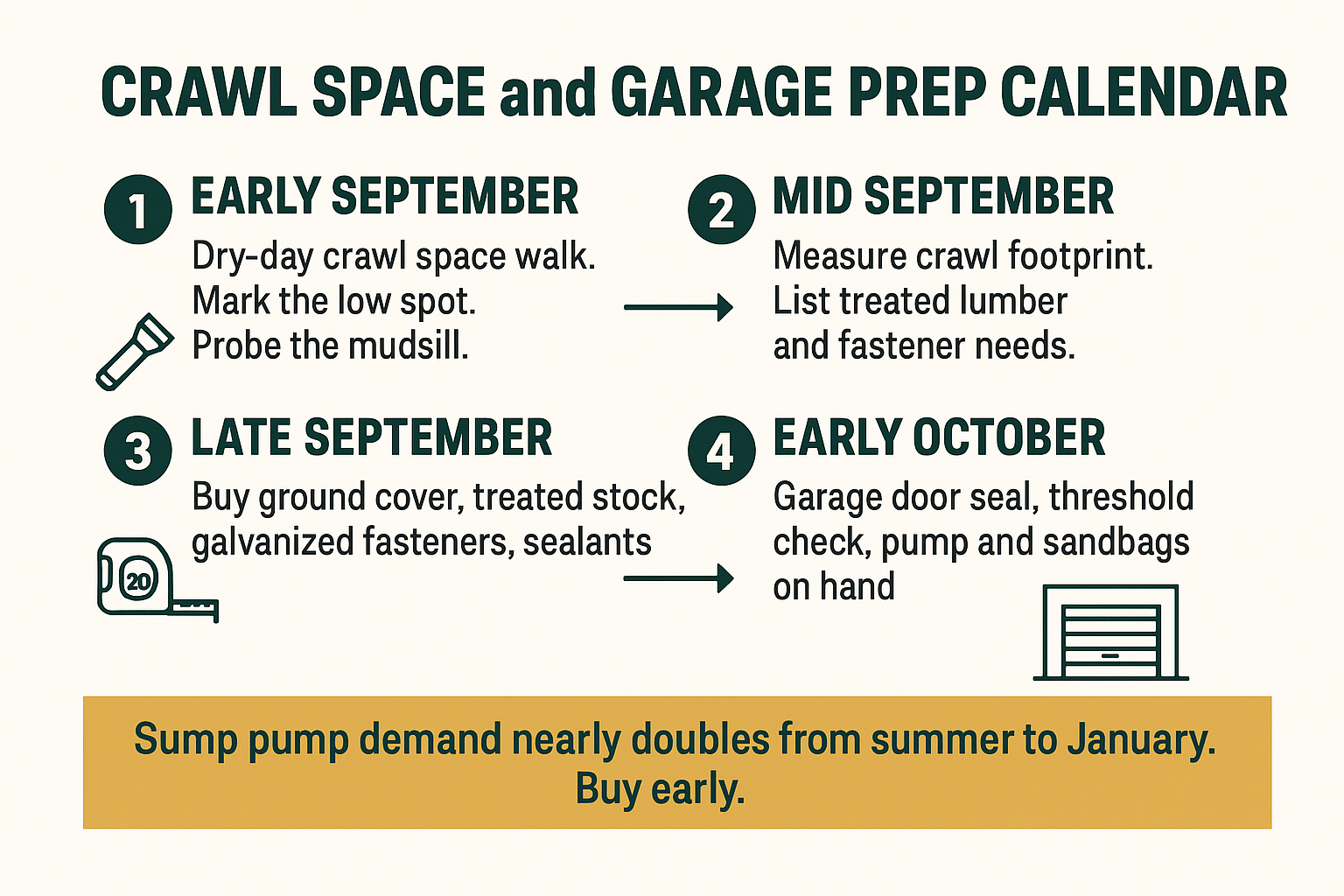
Your September to October Materials Calendar
Most people shop after the water shows up. Here is the sequence that keeps you ahead of it.
7. Buy the Pump and the Sheeting Before January, Not After
Regional search data shows sump pump interest nearly doubling from summer to January. That tells you exactly when people go shopping, which is after the water arrives, when supply is thin and everybody is calling the same day.
Do your materials pass in September and early October instead. Fasteners, ground cover sheeting, treated lumber, and sealants should already be in the garage before the first real storm lands.
One timing note worth knowing: Oakland’s wet-weather grading moratorium runs October 15 through April 15, so any ground work tied to moving water away from a foundation has a hard front-end deadline. Our hillside slope work guide goes into that in detail.
Costs vary widely depending on crawl size, pump capacity, and how much treated stock you need, so treat any number you see online as a starting point rather than a quote. If you want the rest of the house covered, our East Bay El Niño prep overview works from the roof down, and the windows and doors piece handles the openings.
Frequently Asked Questions About Crawl Space and Garage Storm Prep
Should I close my foundation vents in winter to keep water out?
Generally no. Vented crawl spaces in older Berkeley homes rely on air movement to dry out between storms, and closing vents usually traps moisture instead of blocking it. If water is entering through a vent, the fix is grading and drainage outside the vent, not sealing it shut.
How do I know if crawl space wood is rotted or just damp?
Push a screwdriver into the mudsill, post bases, and joist ends. Damp wood resists; rotted wood gives way and crumbles. If the tip sinks in easily anywhere near a bearing point, stop guessing and get a licensed contractor or structural pest inspector under there before winter.
Is a vapor barrier the same as waterproofing?
No. A ground cover vapor barrier slows moisture rising out of the soil. It does nothing about water actively flowing in from a downspout, a driveway, or a slope. Handle the water path first, then cover the soil.
Can I use regular deck screws on treated lumber in a crawl space?
Not a good idea. Modern treated lumber chemistry corrodes standard coatings quickly, and a humid crawl space speeds that up. Use hot-dip galvanized as a baseline and stainless where you cannot easily inspect it later.
Does a strong El Niño guarantee a wet winter in Berkeley?
It does not. Northern California rainfall tracks El Niño much more loosely than Southern California does. What you can plan around is the timing of storm season, which is why September prep makes sense regardless of the seasonal total.
Bring Us the Half-Solved Problem
Most people walk into the yard with a project that is half figured out, and that is fine. Our two Berkeley locations are staffed by people who have watched storm seasons roll through these same neighborhoods since 1946, and they will tell you plainly which treated stock and which fastener fit your crawl space or garage.
The Lumberyard and Hardware store is at 642 Hearst Avenue, 510-841-0511, and the Windows and Doors showroom is at 1831 Second Street, 510-649-4400. Come by with a photo and a rough measurement whenever you are ready, and nobody will push you to buy anything on the spot.