Direct Answer: Seal your roof and flashing, clear gutters and downspouts, and address drainage before November. Flood-zone and hillside properties need additional steps based on their specific exposure.
In June 2026, NOAA officially declared El Niño conditions present — and current models give 99-100% odds it holds through winter, with a 63% chance of a very strong event during the November-through-January window. That would put this winter among the strongest El Niño events recorded since 1950.
But here’s what that actually means for the East Bay: Northern California’s rainfall doesn’t follow Southern California’s script. We don’t always get dramatically above-average totals. What we do get are storm clusters — a few heavy systems stacked close together — and those are exactly what expose every weakness in a roof, a drainage system, or a foundation seal.
This isn’t about panic. It’s about doing the work in September and October that prevents a $15,000 repair in February. The sections below walk through the three areas that matter most, with a simple decision path based on your property type.
Keep Water Out: Roof, Flashing, and Seals
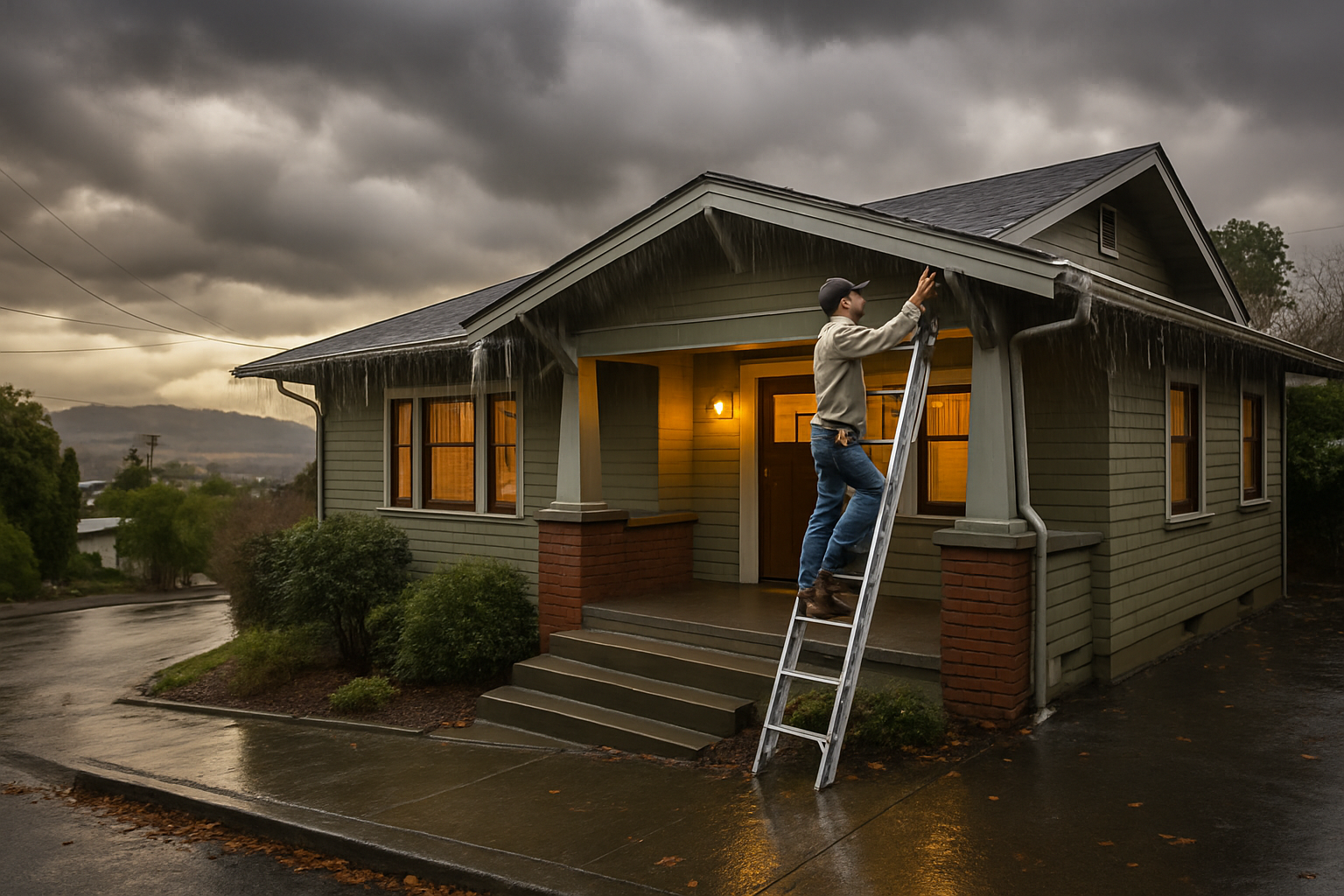
The roof is the obvious starting point, but most people check it wrong. Walking the perimeter and looking up isn’t enough — what fails in a real storm is almost always flashing, not the field of the roof itself.
Flashing is the metal or membrane material that seals transitions: where the roof meets a chimney, a parapet wall, a skylight curb, or a vertical siding surface. These joints move with temperature and age. A gap of a few millimeters at a chimney base or a rusted step-flashing seam at a dormer is invisible from the ground and catastrophic in a sustained rain event.
Before November, do or commission the following:
- Walk the attic after any light rain and look for daylight or moisture staining
- Check all roof penetrations — vents, skylights, HVAC curbs — for cracked sealant
- Inspect valley flashing for debris dams that hold standing water
- Look at any low-slope or flat roof sections for standing water after irrigation — if water pools, it will leak under load
- Check exterior door and window head flashing, especially on older Bay Area homes where pan flashing was never installed
On exterior doors, worn or missing weatherstripping is a fast leak path that homeowners routinely miss. If your door sweeps are compressed and no longer make contact with the threshold, replacement weather stripping for exterior doors is a straightforward fix that costs under $50 in materials and takes an afternoon. Windows on west and north exposures deserve the same check — degraded glazing seals and failed frame caulk are common on homes built before 2000.
Move Water Away: Gutters, Downspouts, and Site Drainage
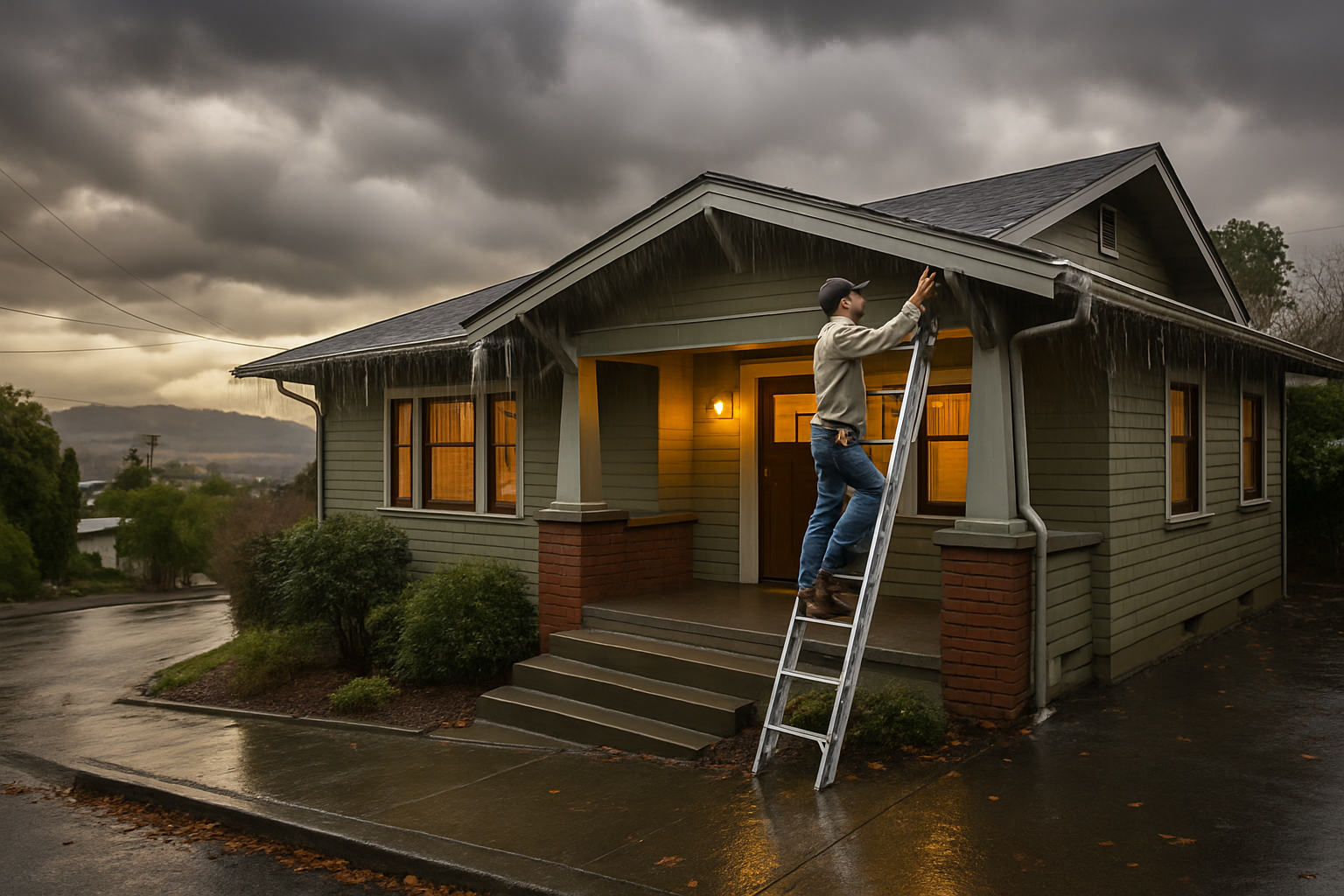
A well-sealed roof still fails if the drainage system can’t move water away from the structure fast enough. Most East Bay homes have 4-inch gutters installed decades ago, sized for average rainfall — not a fast-moving atmospheric river that drops two inches in six hours.
Clean gutters are non-negotiable before the first storm. But the bigger issue is often where the downspouts terminate. If they discharge against the foundation, onto a flat concrete pad, or into a planter bed with no outlet, you’re moving water from the roof to the foundation wall — which is not an improvement.
For slope lots specifically, site drainage is the priority. Oakland and Berkeley hillside properties in neighborhoods like Montclair, Claremont, and the Elmwood edges have chronic drainage challenges because the soil is often shallow over hardpan or bedrock. When saturation hits, water doesn’t absorb — it sheets.
Specific steps by property type:
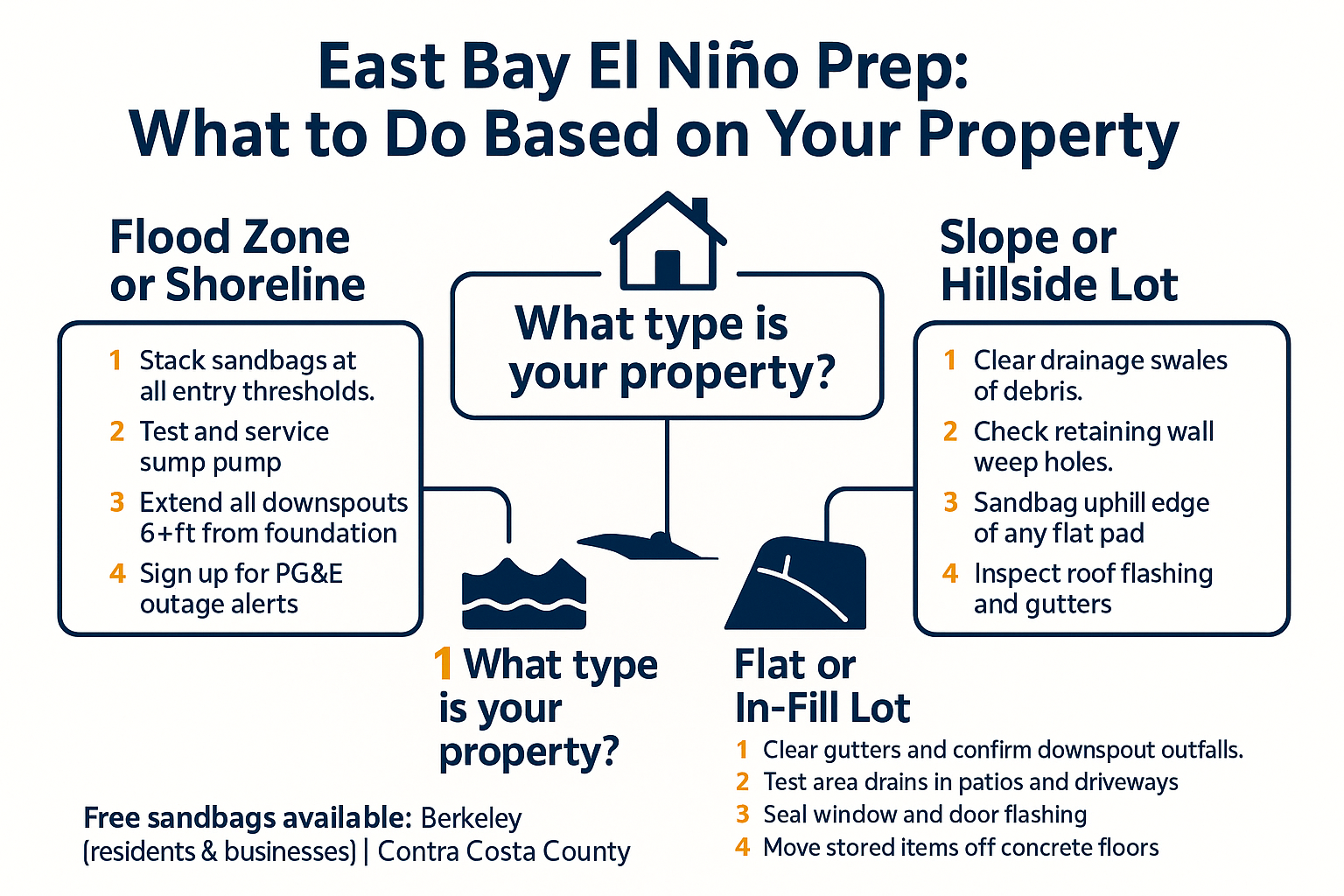
Flat or in-fill lots:
– Confirm all downspouts extend at least 6 feet from the foundation
– Check area drains in patios and driveways are clear and functional
– Inspect any below-grade garage entries or window wells for drainage capacity
Slope lots:
– Trace the natural drainage swales on your property and clear them of debris
– Check retaining wall weep holes — blocked weeps cause hydrostatic pressure that shifts walls
– Consider sandbag placement at the uphill edge of any flat pad or garage entry
Flood-zone or low-lying addresses (parts of West Oakland, the Estuary area, Bay Farm Island in Alameda):
– Sandbag at threshold entries and below-grade openings
– If you have a sump pump, test it now — run it through a full cycle and confirm the float switch trips correctly
– Make sure the sump discharge runs well clear of the foundation
Berkeley offers free seasonal sandbags for residents and businesses — worth picking up before the first advisory hits. Contra Costa County provides them for unincorporated residents as well. Don’t wait until a storm watch is posted; by then, the pickup lines are long.
Storm Prep Decision Path by Property Type
This decision path maps the three most common East Bay property situations to their highest-priority prep steps before winter hits.
Protect Wet-Prone Spaces and Prepare for Outages
Once you’ve addressed the exterior, the interior has its own checklist — particularly for any space at or below grade.
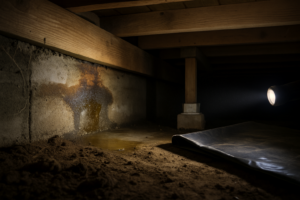
Crawl spaces and basements are where El Niño damage often shows up weeks after a storm, not during it. Water wicks through foundation walls slowly. If you don’t have a vapor barrier installed over the crawl space soil, heavy saturation events will spike interior humidity and start attacking floor joists and subfloor sheathing from below.
A few practical steps that cost almost nothing:
- Move stored boxes, lumber, or materials off concrete floors onto pallets or shelving — even six inches of clearance prevents a lot of damage if minor seepage occurs
- Check that your water heater, electrical panel, and HVAC air handler are not sitting in a zone that could see standing water
- If you have a sump pit, confirm the pump discharge line isn’t frozen or blocked, and keep a battery backup unit on hand — pumps are useless in a power outage without one
On the outage side: PG&E recommends signing up for outage alerts at pge.com before storm season. East Bay hills neighborhoods have overhead transmission lines that go down in wind events, and multi-day outages in storms like the 2017 and 2023 atmospheric rivers were common in Oakland and Berkeley hillside zones.
A basic outage kit isn’t complicated: flashlights with fresh batteries, a manual can opener, a portable phone charger kept charged, and a few days of water storage. If you have well water, note that your pump won’t run without power. And if you have a gas fireplace or generator, confirm it was serviced in the last 12 months.
Storm Prep Checklist by Priority and Cost
The table below breaks out common prep tasks by effort level and rough material cost. Labor is separate if you hire out.
| Task | Priority | Rough Material Cost |
|---|---|---|
| Clean gutters and downspouts | High — do first | $0–$30 DIY supplies |
| Inspect and re-seal roof flashing | High — before Oct | $20–$80 in caulk/sealant |
| Replace door weatherstripping and sweeps | High | $30–$80 per door |
| Extend downspout outfalls from foundation | High | $15–$40 per downspout |
| Pick up free sandbags (Berkeley/Contra Costa) | High for flood/slope lots | $0 — free from city |
| Test sump pump and add battery backup | High for below-grade spaces | $80–$200 for backup unit |
| Install crawl space vapor barrier (if missing) | Medium | $150–$400 in materials |
| Assemble outage kit with backup charging | Medium | $50–$120 |
What Builders and Contractors Should Be Doing Right Now
If you’re managing active jobsites in the East Bay this fall, El Niño prep isn’t just a homeowner conversation — it’s a scheduling and materials conversation.
Framing that’s exposed heading into November carries real moisture risk. OSB and engineered wood products are especially sensitive to repeated wet-dry cycles before sheathing is covered. If your schedule has rough framing exposed through October, wrapping with housewrap before the first rain event is worth the half-day it takes.
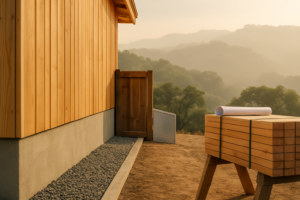
Deck builds are another exposure point. If you’re spec’ing or installing decking for a project that won’t be completed before winter, material storage matters. Composite decking materials like TimberTech and Trex handle jobsite moisture better than raw wood, but they still shouldn’t be stacked on wet soil with no airflow. And if you’re working through the wood vs. composite decision with a client right now, winter performance is a legitimate part of that conversation.
For window and door rough openings that won’t be filled immediately: protect the opening with a proper pan membrane, not just a tarp stapled over the hole. Water that gets into an unprotected rough opening during a storm event can cause subfloor and rim joist damage that’s expensive to diagnose and repair after the fact. If you need guidance on how to measure rough openings for windows before ordering replacements, it’s worth doing that accurately now so lead times don’t push you into the rainy season without product on hand.
Frequently Asked Questions About El Niño Prep for East Bay Homes
Does El Niño actually mean more rain in the Bay Area?
Not necessarily in terms of total inches. El Niño tends to produce more frequent and intense storm clusters in Northern California, but seasonal totals don’t always run above average here the way they do in Southern California. What matters for the East Bay is the storm clustering — two or three back-to-back atmospheric rivers in January can saturate soil and overwhelm drainage systems even in a year that ends up at average total rainfall.
When should I start storm prep — is October too late?
September is ideal, October is fine, November is cutting it close. Most roofing and drainage contractors in the East Bay get booked fast once the first storm advisory hits. If you want to hire out any inspection or repair work, start making calls in September. If you’re doing it yourself, the gutter cleaning and flashing check can realistically happen in October — just don’t wait for rain to remind you.
Where do I get free sandbags in Berkeley or the East Bay?
Berkeley provides free sandbags for both residents and businesses — check the city’s Public Works page for current pickup locations, as they shift seasonally. Contra Costa County offers free sandbags for unincorporated county residents. Oakland residents should check the city’s emergency management page for current availability. Pick them up before a storm watch is issued — supply goes fast once advisories post.
My house is on a slope in the Oakland or Berkeley hills. What’s my biggest risk?
Drainage failure and erosion are the primary risks on slope lots. When soil saturates quickly — which happens fast on shallow East Bay hillside soils — water sheets across the surface rather than absorbing. Your priorities are clearing drainage swales, checking retaining wall weep holes for blockage, and making sure any flat pads or garage entries have sandbag coverage at the uphill edge. Roof and flashing inspection still applies, but drainage is the first thing to address.
Should I be worried about power outages this winter?
Yes — especially in the hills. Oakland and Berkeley hillside neighborhoods have seen multi-day outages in past major storm events. Sign up for PG&E outage alerts now at pge.com so you get advance notice. If you have a sump pump, a battery backup unit is not optional — a pump without power during the heaviest rain is useless. Keep a portable charger fully charged and review your household’s plan for a 48-72 hour outage.
What materials should I have on hand before storm season?
For most East Bay homes, the short list is: roofing sealant or flashing tape for any small repairs you find, replacement weatherstripping for exterior doors, sandbags if your property has any flood or drainage exposure, and a sump pump battery backup if you have below-grade spaces. Contractors with active framing should also have housewrap on hand for any exposed wall sections heading into fall.
Need Storm-Prep Materials for a Specific Property?
Truitt & White has been supplying East Bay builders and homeowners from our Berkeley lumberyard since 1946 — and our staff knows the difference between what a Montclair slope lot needs and what a West Oakland flat lot needs. Stop by the Lumberyard and Hardware at 642 Hearst Avenue in Berkeley, call us at 510-841-0511, or visit truittandwhite.com to see what we stock. We’d rather spend ten minutes helping you get the right materials now than hear about a problem in February.