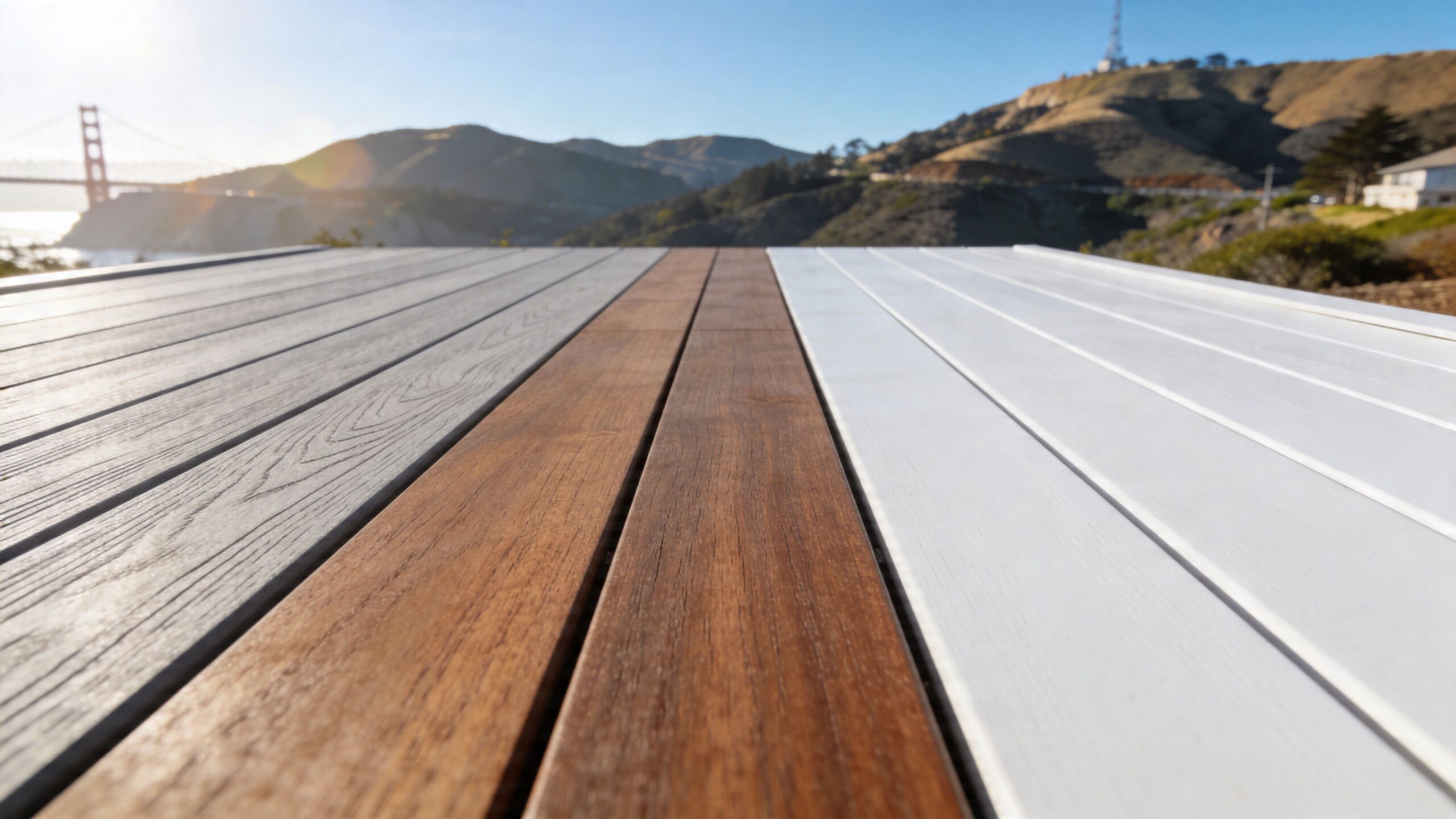
Quick Answer
For a full-sun California deck, the safest picks are usually PVC or capped composite if low maintenance and fade resistance matter most, and Ipe or other dense tropical hardwoods if you want natural wood and can stay on top of maintenance. In the Bay Area, heat, UV exposure, fog, and daily temperature swings all matter, not just sun.
A lot of people start this search after walking onto a deck that’s too hot to use, too faded to like, or already moving more than expected. In Berkeley, Oakland, San Francisco, and the East Bay hills, full sun creates one problem, but the Bay Area adds another: cool damp mornings and hot afternoons on the same boards.
Why Full Sun Changes Everything for Bay Area Decks

A homeowner in Orinda can step onto a deck at 4 p.m. and feel stored heat coming off every board. A few miles west, a deck near the water may start the morning wet with fog, then bake in direct sun by lunch. That Bay Area swing changes how decking looks, feels, and moves over time.
For the best decking material for full sun california, UV exposure is only part of the job. The harder part is handling surface heat, color fade, and constant expansion and contraction from cool marine moisture followed by dry afternoon sun. Those are the conditions that lead to callbacks.
UV damage shows up before structural problems do
The first complaint is usually cosmetic. Boards lighten, darker colors wash out, and softer woods start to look tired before anything is technically failing. In full exposure, that same sun also dries surface fibers, opens the grain, and makes checking and splintering more likely on lower-density lumber.
Bay Area decks also get punished by reflected heat. Stucco walls, large windows, concrete patios, and pool surrounds can push surface temperatures higher than homeowners expect from the air temperature alone. For homes in fire-prone zones, material selection can overlap with code and assembly requirements, which is worth reviewing with Berkeley WUI rules and fire-rated lumber explained.
Practical rule: A board sample that looks good in a showroom does not tell you how it will behave on a west-facing deck with no shade and reflected afternoon heat.
Barefoot comfort is real, and Bay Area buyers notice it fast
Heat is one of the fastest ways to turn a nice-looking deck into a deck nobody wants to use.
Surface temperature matters, but so does how a board feels underfoot after hours of exposure. Smooth capped synthetics can be easier to clean and hold color well, yet some clients still prefer the feel of real wood in bare feet, even when the wood needs more upkeep. That trade-off comes up all the time on exposed Bay Area projects.
DeckWise has published a direct-sun comparison of deck surface temperatures that helps illustrate how much material choice can affect heat buildup: Deck Temperature Test: Ipe vs. Composite vs. PVC. Mataverde also discusses how hardwood decking behaves in sun, rain, and humid coastal conditions in its performance guidance for tropical hardwoods: Mataverde decking performance resources. Neither source replaces a site-specific review, but both point to the same real-world issue. Full sun performance is not just about appearance. It is about whether the deck stays comfortable enough to use.
Bay Area temperature swings punish poor material choices
This climate is hard on anything marginal.
A board can be cool and damp at 8 a.m., dry by noon, and hot by late afternoon. If the material has weak dimensional stability, if the fastening schedule is sloppy, or if the spacing does not match the site conditions, movement shows up quickly. Gaps change. Ends lift. Fasteners telegraph. Owners notice.
That risk goes up on:
- Wide-open decks with little or no afternoon shade
- Coastal and fog-belt sites with regular moisture cycling
- Dark deck colors that absorb more heat
- Projects with low maintenance expectations where annual oiling or refinishing will not happen
The wrong choice rarely fails in one dramatic way. It gets hotter than expected, fades unevenly, moves more than the owner likes, and starts looking old too soon. In the Bay Area, that combination matters as much as rated durability.
Synthetic Decking Contenders PVC and Composite
A west-facing Bay Area deck can feel fine at 10 a.m. and punishing by late afternoon. That is where synthetic decking usually enters the conversation. Homeowners want lower maintenance, but the real question is which synthetic board stays usable in full sun and still looks acceptable after years of UV, fog, and daily temperature swing.
| Material | Sun and fade performance | Heat behavior | Maintenance | Best fit |
|---|---|---|---|---|
| PVC | Very strong in full sun | Often a better choice for barefoot comfort, especially in lighter colors | Low | Pool decks, roof decks, exposed yards, owners who want minimal upkeep |
| Capped composite | Good to very good, depending on the cap and color | Varies by brand, profile, and color. Dark boards get hot fast | Low | General-use decks where a more wood-like look matters |
| Ipe and tropical hardwoods | Strong natural durability | Better underfoot texture for some owners, but still warm in direct sun | Moderate to high | Premium natural wood projects |
| Softwoods like cedar or redwood | More vulnerable in harsh exposure | Can start comfortable, then weather and move faster in full sun | Higher | Better suited to partial shade |

PVC decking
PVC is the cleaner answer for jobs where heat, moisture cycling, and low maintenance all matter. Because it does not contain wood fiber, it avoids some of the swelling and long-term moisture-related issues that can show up in composite cores, especially on coastal sites that dry out in sun and pick up dampness again overnight.
Heat is still part of the decision. No deck board stays cool in full summer exposure. Light-colored PVC boards usually give you a better shot at acceptable barefoot comfort than dark composite, and that difference matters on pool decks, small courtyards, and tight urban backyards with reflected heat off stucco, glass, or outdoor pavers. TimberTech notes that its PVC decking can stay cooler than many competing composite products in similar conditions, particularly in lighter colors (TimberTech AZEK vs. composite decking).
PVC has trade-offs clients notice after install. The board can look more uniform than wood, the surface feel is different, and glare can be an issue in bright exposures. Chair legs and heavy furniture also mark some PVC boards more easily than homeowners expect. Those are not deal breakers, but they should be part of the sales conversation before the deck is built.
Capped composite decking
Capped composite still gets specified on a lot of Bay Area projects because it lands in the middle. Lower maintenance than wood, usually a more familiar appearance than PVC, and a broad range of colors and price points.
The cap matters. Cheap uncapped boards are a poor fit for intense sun, especially if the owner expects the deck to look consistent without ongoing fuss. Better capped composite lines hold color and resist staining far better than early-generation products, but they are not all equal. Board profile, shell quality, color load, and installation details all affect how the deck performs after a few hot seasons.
Surface temperature is where many composite jobs go wrong. A dark composite board can meet the warranty, resist fading, and still be unpleasant at 4 p.m. in Walnut Creek, Lafayette, or an unshaded South Bay yard. I tell clients to treat color as a performance choice, not just a design choice.
For contractors and homeowners comparing product lines locally, Trex decking options are part of the capped composite group often considered for low-maintenance exterior work.
What holds up better in full sun
These choices tend to perform better on demanding Bay Area sites:
- Lighter colors, especially on decks used barefoot
- Fully capped boards, not entry-level uncapped composite
- Boards with a proven cap and stable core
- Good airflow beneath the deck
- Install spacing that matches the manufacturer’s expansion guidance
These choices lead to more complaints:
- Very dark boards in all-day sun
- Budget composite lines with weak caps
- Ignoring reflected heat from windows, walls, and hardscape
- Choosing from a sample rack only, without checking a full board outdoors at different times of day
PVC usually wins the low-maintenance, hottest-exposure argument. Capped composite can still be the right call if the client wants a less synthetic look and accepts the heat trade-off. On Bay Area jobs, that trade-off should be discussed in plain terms before anyone signs off on color.
Natural Wood Options for Intense Sunlight

If the project calls for real wood, the conversation changes fast. In true full-sun California exposure, the serious natural contenders are usually Ipe, Cumaru, and Garapa, not softer, more familiar woods.
Softwoods can look good on day one, but they ask more from the owner and the installer. Full sun accelerates every weakness. Dense tropical hardwoods start with fewer weaknesses to expose.
Ipe and other dense hardwoods
Ipe remains the benchmark natural choice for harsh exposure. It has a Janka hardness rating of 3,684 lbf, which is more than three times higher than Western Red Cedar, and that density is one reason it resists wear and warping under prolonged sun. It also carries a Class A fire rating, which can make it a workable option in many California wildfire-risk areas (LumberPlus guide to full-sun deck materials).
That doesn't mean it's maintenance-free. If you want to preserve the rich brown look, you need regular care. If you don't, it will weather toward gray, which some owners like and others regret after the first season.
Heat behavior and comfort in real use
Natural wood and synthetic boards don't just differ on a thermometer. They feel different in use.
Some hardwoods handle heat well enough to stay more comfortable than many people expect, especially lighter tropicals. Garapa often gets attention for that reason. Ipe can still heat up, but many owners prefer the underfoot feel of wood over PVC or composite.
If a client says "I want real wood," the real follow-up question is "Do you want wood color, or do you want wood material?" Those are not always the same decision.
A few wood options worth discussing carefully
For a natural deck in hard sun, these are the usual conversations:
Ipe
Very dense, long-wearing, and appropriate when the project needs premium natural performance.Cumaru
Another dense tropical hardwood often considered in the same tier of use.Garapa
Lighter in color, often chosen when lower heat absorption matters.Thermally modified wood
Worth considering when dimensional stability matters and the project wants a wood product with a different appearance and sourcing profile.
For readers comparing species and use cases, best wood for deck is a helpful starting point.
Comparing Decking Materials for Full Sun Performance

Choosing the best decking material for full sun california usually comes down to which problem you care about most. No board wins every category. The right answer depends on whether you hate maintenance, hate hot surfaces, or won't give up the look and feel of natural wood.
Heat resistance and barefoot comfort
PVC often wins the raw temperature argument, especially in lighter colors. That's why it gets specified for exposed family decks, pool surrounds, and yards where people walk barefoot.
Ipe and other hardwoods complicate the picture. They may not always post the lowest temperature, but many people prefer how wood feels underfoot. Composite lands in the middle depending on color, cap, and board construction, but darker composite in direct sun is still where many comfort complaints start.
If heat is the top concern, the surrounding surface matters too. On some projects, changing adjacent materials does as much for comfort as changing the deck board. For example, choosing lighter outdoor pavers around the deck can reduce reflected heat hitting the walking surface in late afternoon.
Color stability and UV resistance
Synthetics have the edge here. A good capped composite or PVC line is engineered for long exposure and color retention, so it usually gives the most predictable result over time.
Natural hardwoods age differently. Some owners call that patina. Others call it fading. Neither view is wrong, but the owner should know what will happen before the first board goes down.
Maintenance needs and lifespan
At this point, people often decide.
- PVC asks for basic cleaning and very little cosmetic upkeep.
- Capped composite also stays in the low-maintenance category for most owners.
- Ipe can last a very long time, but appearance maintenance is part of the deal if the goal is to hold original color.
For planning a full deck package, deck building materials list is useful because the board choice is only one part of the assembly. Fasteners, framing, ventilation, and edge details all affect how that deck behaves in sun.
Upfront cost and long-term value
Cost is where buyers can get misled if they only compare boards by the piece. The smarter comparison is callback risk, refinishing effort, replacement cycle, and whether the owner will maintain the material they picked.
A low-maintenance synthetic often makes sense for owners who won't oil wood. A premium hardwood can make more sense when the owner wants real wood and understands the care routine. The wrong choice is usually not the expensive one. It's the one that doesn't match how the deck will be used.
A board isn't "best" because it performs well in a brochure. It's best when it fits the site, the owner's tolerance for maintenance, and the actual sun exposure on that yard.
Sustainability and Sourcing Considerations in the Bay Area
A deck in Walnut Creek does not face the same exposure pattern as one in Pacifica or Mill Valley. In the Bay Area, sun, fog, salt air, and daily temperature swing all affect service life, appearance, and material choice. That is why sourcing questions matter here. Buyers are not only asking how a board performs in full sun, but also whether the product fits the project's broader environmental objectives and local standards.
For wood decking, start with traceability. If the spec includes tropical hardwood, ask for FSC certification and clear chain-of-custody documentation from the supplier. On real jobs, that paperwork matters most when the owner wants hardwood durability but also needs confidence about origin and forestry practices.
Synthetic products need a different set of questions. Ask what the board is made from, how much recycled content it contains, and whether the manufacturer publishes product disclosures that can support California project requirements. Those details come up more often on Bay Area work, especially with architects and owners who care about embodied carbon, indoor-outdoor product chemistry, and regional sourcing standards.
Hybrid assemblies have gained attention because they solve practical jobsite problems. Some teams use synthetic decking in the hottest, highest-exposure zones, then use wood for stairs, benches, skirting, or trim where grain and finish matter more. That approach can help balance barefoot comfort, maintenance expectations, appearance, and sourcing priorities without forcing the whole deck into one material category.
It is also a useful way to respond to Bay Area project constraints:
- Low-upkeep living areas where owners want fewer finish cycles
- Material transparency goals where recycled content or certified wood matters
- Design-driven details where real wood still gives a better visual result
- Jurisdiction-specific requirements where fire performance, durability, and environmental review all affect product selection
Local code requirements vary by city, exposure, and project type. Confirm the details with the building department or design team before ordering material.
For a practical overview of environmentally responsible building materials, that resource is a solid starting point for comparing certified wood, recycled-content products, and other specification factors that matter on Bay Area projects.
Frequently Asked Questions About Full Sun Decking
What decking gets the hottest in full sun?
Darker boards usually cause the most complaints, especially darker composite and softwood surfaces with no shade. Material matters, but color matters a lot too. If the deck will be used barefoot, stay cautious with dark tones no matter what category you choose.
Is PVC always the best choice for a hot California deck?
Not always. PVC often performs very well for low maintenance and lower surface temperature, but some people don't like the look or feel as much as wood. If the owner is sensitive to underfoot feel, sample boards in direct sun are worth checking before ordering.
Is composite better than wood for Bay Area decks?
It depends on what "better" means on that project. Composite is usually easier to live with if the owner wants less upkeep and more predictable color stability. Dense hardwood is often the better fit if the owner wants natural material, accepts maintenance, and cares more about wood feel than maintenance convenience.
Can I use redwood or cedar in a full-sun backyard?
You can, but that doesn't make them the strongest choice for harsh exposure. In full sun, softer woods generally need more maintenance and can show weathering sooner than synthetic boards or dense tropical hardwoods. They're usually easier to recommend in partial shade than in wide-open exposure.
Does deck color really change how hot it feels?
Yes. This is one of the most important choices in the whole package. A lighter board in the same product family can be much more usable in afternoon sun than a darker one.
What matters more, the decking board or the installation?
Both. Good material installed poorly still causes movement, noise, gapping complaints, and early wear. In Bay Area conditions, spacing, fastening, airflow, and moisture acclimation matter because boards don't live in one temperature or humidity condition all day.
Are tropical hardwoods too much maintenance for most homeowners?
For some owners, yes. The issue isn't whether the wood is durable. It usually is. The main question is whether the owner will clean and oil it often enough to keep the original color. If the answer is no, they should be comfortable with the weathered look or choose something else.
How do I choose between Ipe, composite, and PVC?
Start with three questions. Do you want real wood or just a wood look? Do you want to do maintenance or avoid it? And will people walk on this barefoot in full sun? Those answers narrow the field fast.
Do I need to think about fire rating for a deck in the East Bay hills?
Yes, especially in areas with wildfire-related requirements or WUI concerns. The exact rule depends on location and project conditions, so confirm that with your local building department or design team. It shouldn't be an afterthought once materials have already been selected.
What should I bring when I come in to compare decking?
Bring photos of the yard, note the deck orientation, and describe how much sun it gets in the afternoon. If you know whether the deck is near the water, exposed to fog, or used barefoot, say that too. Those details matter more than is often realized when narrowing down a board.
If you're sorting out the best decking material for full sun california and want to compare real options for a Bay Area project, stop by Truitt and White at the lumberyard and hardware store, 642 Hearst Ave, Berkeley, CA 94710, call (510) 841-0511, or reach out through info@truittandwhite.com. For decking materials, product guidance, fasteners, and related jobsite needs, the Hearst Avenue location is the right place to start.
Sources
TimberTech. "Deck Material Options." 2026. https://www.timbertech.com/ideas/deck-material-options/
LA Decks. "Cool Decking Options for Southern California Homes." 2026. https://la-decks.com/blog/cool-decking-options-for-southern-california-homes/
LumberPlus. "Best Deck Material for Full Sun." 2026. https://lumberplus.com/best-deck-material-for-full-sun/
Woodland Deck. "What Type of Decking Stays Coolest in Direct Sun." 2026. https://woodlanddeck.com/what-type-of-decking-stays-coolest-in-direct-sun/