Quick Answer
TL;DR: 1000 grit sandpaper is an ultra-fine abrasive used for polishing and final smoothing, not heavy material removal. It’s most useful for refining clear coats on wood and auto finishes, polishing metal, and prepping a surface for the final topcoat when you need a clean, controlled finish.
If you're standing over a door slab, trim piece, or coated panel wondering whether 1000 grit sandpaper is the right next step, you're already in the finishing stage. At that point, the wrong paper, wrong pressure, or wrong method can leave scratches, clog the sheet, or dull a surface that was almost ready.
In the Bay Area, a lot of finishing work happens on painted millwork, custom doors, window components, and furniture-grade wood. 1000 grit sandpaper has a place in that workflow, but only if you use it for what it's meant to do.
What Exactly Is 1000 Grit Sandpaper?
1000 grit sandpaper is a finishing abrasive. It’s for refining a surface that’s already been leveled and smoothed with coarser grits, not for stripping, shaping, or flattening rough stock.
The number matters because it tells you how fine the abrasive is. Under the CAMI grit system, 1000 grit is considered ultrafine, with particles averaging about 18 micrometers in diameter, and higher grit numbers indicate smaller, more uniform grains for higher surface smoothness (Wikipedia sandpaper reference).

That’s why this grit works well when you're trying to knock down dust nibs in cured finish, soften the scratch pattern left by 600 or 800, or get a surface ready for polish or final coating. If you try to use it to remove runs, flatten bad brush marks, or fix uneven substrate prep, you'll waste time and usually gum up the paper.
A few practical uses where 1000 grit makes sense:
- Clear-coated woodwork where the finish is already built and cured
- Primed or painted trim that needs final refinement before the next coat
- Automotive-style clear coats when you’re de-nibbing or reducing texture
- Metal polishing prep where you want a finer scratch pattern before compound
Practical rule: If the surface still has visible defects you can feel with a fingernail, 1000 grit is probably too fine to be your starting point.
On wood and finish products, this grit is about control. It cuts lightly, leaves a tighter scratch pattern, and gives you a better shot at a uniform sheen. For related finish prep materials, the painting solutions page is a useful reference point for matching abrasives to coatings.
How to Use 1000 Grit for a Perfect Finish
When 1000 grit works, it works because the surface is already close. The paper is there to refine, not rescue.
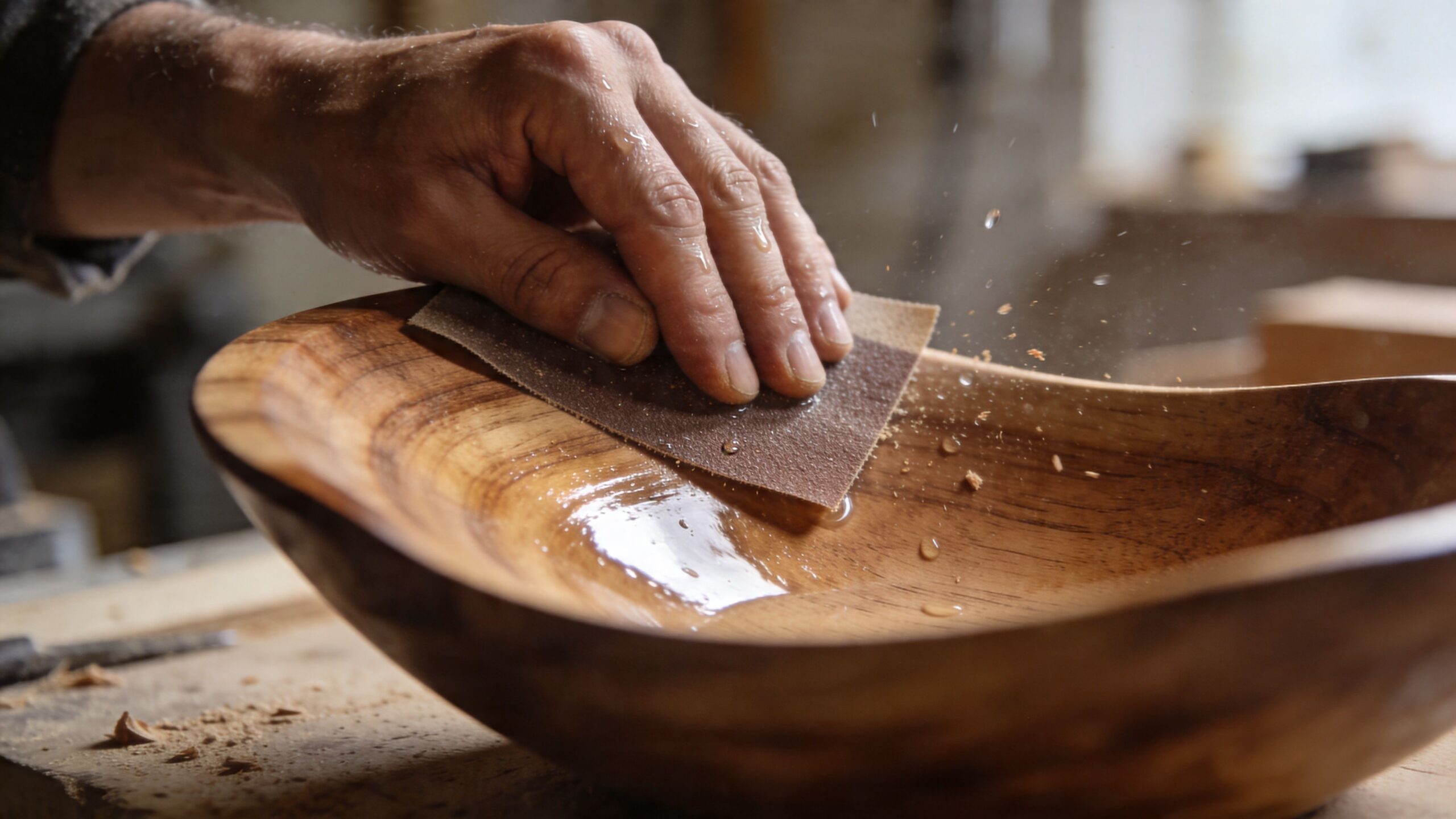
A reliable approach is to keep pressure light, keep the surface clean, and stop as soon as the scratch pattern is even. With wet sanding, using water as lubricant under low pressure of 2 to 4 PSI can achieve Ra values below 5 μm on hardwoods and primers, and it can extend paper life by up to 50% compared to dry sanding on resinous finishes (Grainger sandpaper grit chart).

Wood finishing
On wood, 1000 grit is usually for the finish film, not bare wood. Think cured lacquer, polyurethane, primer, or sealer on cabinet parts, interior doors, or detailed trim.
Use it wet if the finish allows it. Fold the sheet, back it with a soft pad by hand, or use a very light machine setup on flat areas. You're trying to remove tiny nibs and even out texture without cutting through edges.
Good technique looks like this:
- Start after proper prep: Use 1000 grit only after lower grits have already done the leveling.
- Keep it lubricated: Water helps carry away residue and keeps the abrasive from loading.
- Watch edges first: Corners, profiles, and outside edges burn through before the field does.
A finish that looks dull and uniform after sanding is usually in good shape for the next step. A finish with shiny low spots still needs more leveling, but not always with 1000 grit.
If you're also working through paint prep on surrounding surfaces, this guide on how to prep walls for painting for a pro finish is a practical companion.
Automotive clear coats
For clear coat work, 1000 grit is aggressive enough to refine some defects, but it can still leave a visible scratch pattern that usually needs follow-up polishing or finer sanding. It’s common for de-nibbing isolated specks, addressing light texture, or beginning a correction sequence on harder finishes.
Keep the pad flat. Don’t chase one defect with fingertip pressure. That creates a trench around the spot and makes the repair stand out under gloss.
Three habits matter most:
- Mask edges and body lines: Clear is thinnest there.
- Use short inspection cycles: Sand a little, wipe, inspect, repeat.
- Don’t let slurry build up: If the residue gets pasty, rinse and refresh.
Metal polishing
On metal, 1000 grit often serves as a transition grit before compound or finer polishing media. It can clean up the scratch pattern left by coarser abrasives and move the surface closer to a reflective finish.
Hand sanding usually gives better control on metal trim, hardware, or small parts. Use straight, even strokes and change direction from the previous grit so you can see when the earlier scratches are gone.
Wet Sanding vs Dry Sanding With Fine Grits
With 1000 grit sandpaper, wet sanding usually gives the cleaner finish. Dry sanding is quicker to set up, easier to do on the fly, and sometimes better when water would create problems around certain materials or jobsite conditions.

When wet sanding makes more sense
Wet sanding keeps the abrasive cutting longer because water carries away the fine residue that would otherwise pack into the paper. It also reduces airborne dust and helps the sheet glide across cured finishes.
Use it when you're working on:
- Clear coats and cured paint: Better finish quality and less loading
- Primed trim and sealed wood: More control and a tighter scratch pattern
- Polish-ready surfaces: Easier to see a uniform sanding field
For readers working on vehicle finishes, this guide on how to wet sand clear coat is a solid outside reference for process detail.
When dry sanding still has a place
Dry sanding is convenient when you want fast setup, easier spot work, or dust extraction with a machine. It’s also useful when you need to see powder removal clearly on primers or when introducing water would complicate cleanup.
The trade-off is paper loading. Fine grit clogs faster dry, especially on soft or resin-heavy finishes, and once it loads, it stops cutting evenly.
If the paper feels slick and starts dragging instead of cutting, stop. Loaded 1000 grit doesn’t refine the surface. It scuffs it.
A simple way to decide
| Method | Better for | Main drawback |
|---|---|---|
| Wet sanding | Final finish refinement, clear coats, polished surfaces | More cleanup |
| Dry sanding | Quick touch-ups, machine sanding with extraction, spot work | Faster clogging |
Choosing the Right Sanding Tools and Backing
The backing matters almost as much as the abrasive. Fine grit on a bad pad leaves pressure marks, flat spots on profiles, or swirl patterns that show up the second light hits the finish.

Hand sanding tools
For hand work, use a soft sanding block, foam pad, or flexible backing that matches the shape of the surface. Bare fingers create uneven pressure. That’s fine on tiny spot repairs, but not on broad finish work.
A good hand setup is the safer choice for:
- Profiles and moldings
- Edges near glass or hardware
- Door and window parts with detailed contours
Machine sanding tools
On flat panels, a random orbital or dual-action sander can work well with 1000 grit if the machine is set up for finish work, not stock removal. The key is a soft interface pad between the backing plate and abrasive.
That pad cushions the cut and helps the paper follow slight contour changes without digging. If you're using quality finish tools, the Festool products overview is a useful place to compare gear suited to this kind of controlled sanding.
Use the machine’s weight. Don’t add your arm weight on top of it. Fine-grit sanding goes wrong fast when pressure stacks up.
Where 1000 Grit Fits in Your Sanding Sequence
A lot of sanding problems come from skipping the middle. People jump from a coarse grit straight to 1000 and expect the fine paper to erase a deep scratch pattern. It won’t.
1000 grit sandpaper belongs late in the sequence. On finishing work, a common progression is to level with lower grits first, refine that scratch pattern with intermediate grits, then move to 1000 when the surface already looks and feels close.
A practical sequence often looks like this:
- 220 to 400 grit for initial smoothing or defect removal on finish layers
- 600 to 800 grit for refinement and scratch cleanup
- 1000 grit for final smoothing before polish or topcoat
- 1200 and up if the finish system calls for even finer polishing steps
If you're used to thinking in stages, the same logic shows up in floor work too. This article on how to install hardwood flooring is a good reminder that every clean result starts with proper sequence, not shortcuts.
One more trade-off. Going finer only helps if the previous grit scratches are gone. If they’re still there, 1000 grit just makes them shinier and harder to fix later.
Frequently Asked Questions About Fine-Grit Sanding
Can I reuse 1000 grit sandpaper?
Yes, sometimes. If the sheet still cuts cleanly and isn’t loaded with finish residue, you can keep using it for light work. Once it starts skating, smearing, or leaving inconsistent marks, it’s done for finish-quality sanding.
What’s better in fine grits, aluminum oxide or silicon carbide?
For very fine finishing, many users prefer silicon carbide because it cuts sharply and works especially well in wet sanding. Aluminum oxide still has its place, but for delicate finish refinement, silicon carbide is often the smoother-feeling option.
How do I know when I’m done sanding with 1000 grit?
Look for an even, consistent surface with no isolated shiny dots, ridges, or leftover scratches from the earlier grit. On a clear or painted surface, the sheen should turn uniformly dull before polish or the next finish step.
Why does my 1000 grit paper clog so fast?
Usually because the surface is too soft, the finish isn’t cured enough, or you’re sanding dry when the material wants lubrication. Too much pressure also drives residue into the sheet and kills the cut early.
Don’t blame the grit first. Check cure time, pressure, and whether the job should be wet sanded.
Is there a big difference between sandpaper brands?
There can be. Better paper has more consistent abrasive, better backing, and more predictable cut. In fine grits, that consistency shows up as fewer random scratches and less frustration.
Can I start with 1000 grit on bare wood?
Usually no. It’s too fine for initial wood prep and tends to polish the surface rather than correct it. Bare wood typically needs earlier sanding stages before a finish grit like 1000 makes any sense.
What grit should come before and after 1000?
That depends on the defect and finish, but 1000 usually follows 600 or 800 and may be followed by 1200 or polishing compound. If you want a broader look at sandpaper grit progression, that breakdown is helpful for seeing how each grit fits into the larger sequence.
Find 1000 Grit Sandpaper and Expert Advice in Berkeley
If you're sorting out a finishing sequence, trying to decide between wet and dry sanding, or matching abrasives to a door, trim, or window-related project, it helps to talk it through with someone who works with these materials every day. 1000 grit sandpaper is a small part of the job, but using the right sheet, backing, and method can save a lot of rework.
For local project help, the Berkeley hardware store team at Truitt & White can help you sort out sanding supplies, tools, and practical next steps for your finish work.
Sources
Source Name. "Sandpaper." 2026. https://en.wikipedia.org/wiki/Sandpaper
Source Name. "Sandpaper Grit Chart." 2026. https://www.grainger.com/know-how/equipment/kh-video-sandpaper-grit-chart
For sanding supplies, finishing materials, and practical guidance on your project, visit Truitt and White. For hardware and jobsite materials, call (510) 841-0511 or stop by 642 Hearst Ave, Berkeley, CA 94710. For windows and doors questions, call (510) 649-4400 or visit 1831 Second Street, Berkeley, CA 94710. You can also reach out through info@truittandwhite.com.