You're standing in the yard or at the cut list, and the question sounds simple enough: what is the difference between hardwood and softwood? On an actual job, it usually comes up when you're balancing appearance, durability, lead time, and what the client is willing to pay for. A framer asking for studs is solving a different problem than a finish carpenter matching trim, and neither one is helped by the old shortcut that hardwood is hard and softwood is soft.
That shortcut causes a lot of bad material decisions. Some softwoods are exactly what you want for structure, exterior use, or painted finish work. Some hardwoods earn their keep because they wear better, stain better, or hold up in places where dents and abuse are part of the daily routine.
In a Berkeley or East Bay project, the practical question isn't academic. It affects what's available, what moves through the shop cleanly, what needs more labor, and what gives the owner the result they expect years later. If you work around flooring decisions, Flacks Flooring expertise on wood types is a useful companion read because flooring is one of the clearest places where species choice matters more than category.
Answering the Hardwood vs Softwood Question on the Jobsite
The clean answer is this: hardwood and softwood are different tree groups first, and different building materials second. That matters because the label alone doesn't tell you how a board will perform under foot traffic, weather, fasteners, or a saw blade.
A contractor usually needs four answers, not one:
- Where is it going. Framing, flooring, cabinetry, siding, decking, trim, or doors all ask different things of the wood.
- How will it be finished. Painted stock and stained stock don't reward the same species.
- How much abuse will it take. Kids, pets, tools, carts, sun, and moisture all change the call.
- How fast do you need it. Some materials are easier to source consistently than others.
The mistake is choosing by label alone. If someone says they want hardwood because it's stronger, that may point them in the wrong direction for structural work. If they reject softwood because it sounds cheap, they may miss the right species for siding, framing, or even certain flooring applications.
Practical rule: Start with the use case, then narrow by species, grade, moisture exposure, and finish. Category comes before none of those.
On the jobsite, that approach saves change orders and callback headaches. It also makes client conversations easier, because you can explain why one wood works better for framing while another makes more sense for visible surfaces.
The Botanical Origins of Wood's Properties
The answer to what is the difference between hardwood and softwood starts with botany. Hardwoods come from angiosperms, which are typically broad-leafed deciduous trees. Softwoods come from gymnosperms, which are usually conifers with needles and cones, as explained in this hardwood and softwood overview from Duffield Timber.

That source also notes that softwoods make up about 80% of all timber used today because they grow faster and are more widely available. In practical terms, most construction-grade lumber is softwood. That's why species like pine, spruce, fir, and cedar show up so often in framing, sheathing, and general building work, while oak, maple, mahogany, teak, and walnut are usually saved for finish applications.
Why the tree type changes the board
The tree structure affects the wood structure. Hardwoods have a more complex cellular makeup that includes pores, sometimes called vessels, which move water through the tree. Softwoods rely mainly on tracheids, which create a more uniform internal structure.
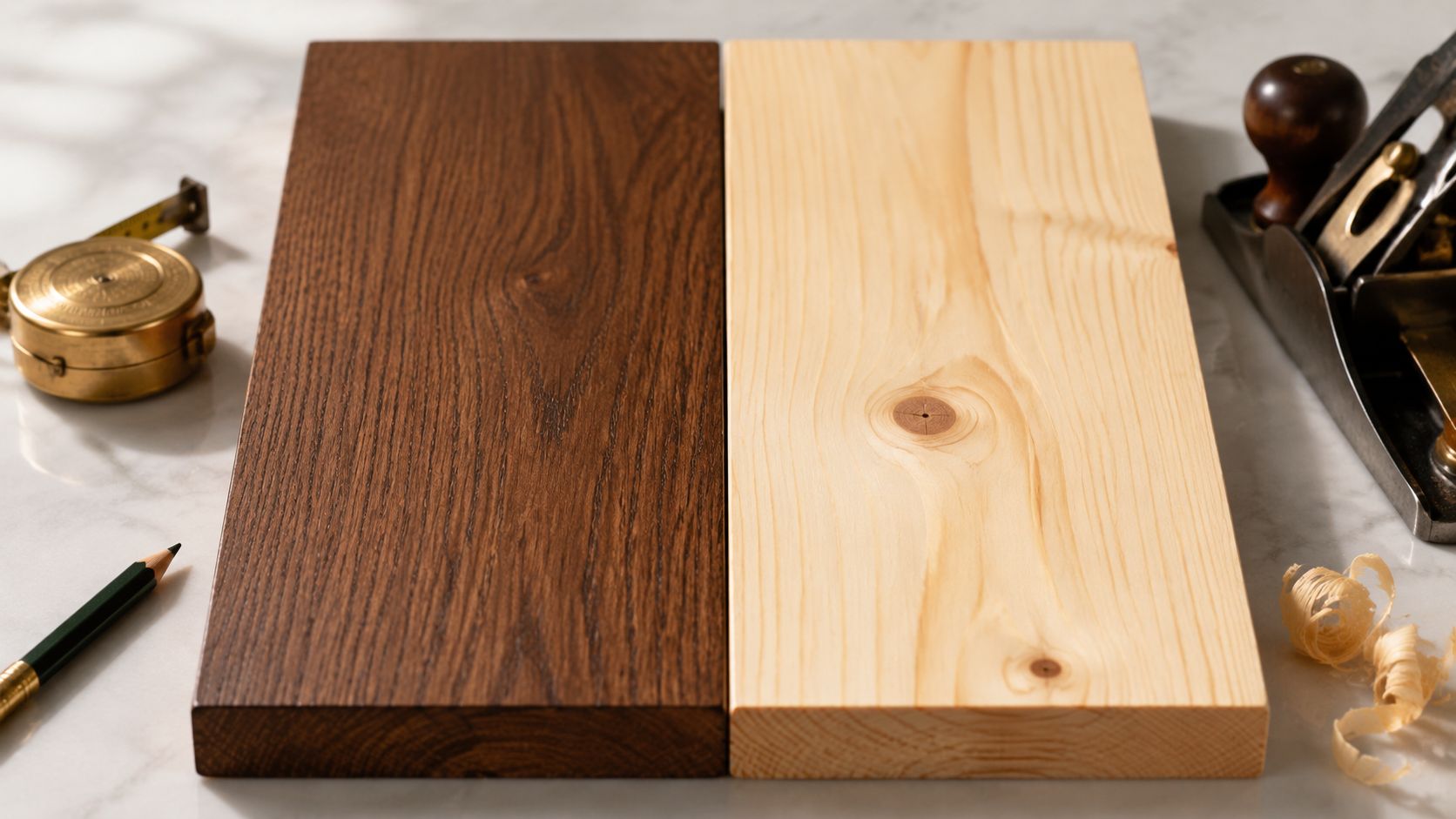
You don't need a microscope to see the effect. You see it when a hardwood board shows a more distinct grain pattern, or when a softwood cuts more uniformly and predictably in common construction work.
A simple way to think about it is this:
- Hardwoods often have more visible character and can feel denser.
- Softwoods often feel more uniform, lighter, and easier to machine.
That's part of the reason contractors often like softwoods for large-scale building tasks and hardwoods for visible, wear-heavy finish work.
Why the names confuse people
The names are historical, not a guarantee of feel under your thumb or performance under load. If you're selecting material for doors or windows, this guide to oak vs pine vs mahogany for doors and windows is a useful example of how species-level choices matter more than the broad label.
The category tells you what kind of tree it came from. It doesn't tell you everything you need to know about strength, dent resistance, stability, or service life.
That's where builders get into trouble. They stop at the label when they should keep going into species, use, and exposure.
Comparing Key Performance Attributes for Builders
On a bid, the category matters less than the performance. That's where contractors need a side-by-side view.
| Attribute | Hardwood (General) | Softwood (General) |
|---|---|---|
| Density and weight | Typically denser and heavier | Typically lighter |
| Hardness and dent resistance | Often better for wear-heavy surfaces | Often more prone to denting |
| Workability | Can be slower to cut, shape, and fasten | Usually easier to cut and install |
| Cost | Generally higher | Generally lower |
| Typical use | Flooring, cabinetry, furniture, finish work | Framing, sheathing, siding, decking, general construction |

Hardness and dent resistance
If you want a measurable benchmark, the industry uses the Janka hardness test. Northcastle Hardwoods' explanation of hardwood vs softwood lumber gives a few useful examples: white oak is about 1,360 lbf, white ash about 1,320 lbf, loblolly pine about 690 lbf, and western red cedar about 350 lbf. That same source notes that balsa is a hardwood but extremely soft.
That's why category alone can mislead you. If the job calls for dent resistance, use tested performance and actual species data, not the word hardwood stamped onto the conversation.
Shop-floor takeaway: For flooring, stair parts, and other high-contact surfaces, ask how easily the wood will mark up. That question is usually more important than whether it came from a deciduous tree or a conifer.
Weight and handling
Hardwoods often feel more substantial because many of them are denser. That can be an advantage in flooring, cabinetry parts, and architectural details where mass and wear matter. It can also mean more labor in milling, fastening, and handling.
Softwoods usually win where crews need speed. They're often easier to carry, easier on blades, and simpler to trim or adjust in the field. For production framing and general carpentry, that matters every day.
Workability and fastening
Differences between wood types can hide considerable labor. Dense hardwoods can burn on tools, split if fasteners are forced, and take more time to prep cleanly. Softwoods are usually more forgiving, especially when crews are moving fast.
That doesn't make softwood better across the board. It makes it better for tasks where easy cutting and efficient installation are part of the value.
If exterior exposure is part of the decision, treatment matters too. This treated lumber guide is worth reviewing because treatment can change how a softwood performs in outdoor conditions.
Durability and exceptions
The general rule is familiar. Many hardwoods are denser and more wear-resistant. But builders should always leave room for exceptions.
A softwood species may still be the right call if it has the durability, stability, or field performance the application needs. A hardwood species may still be a poor fit if it dents easily, moves too much for the use, or adds cost without solving the actual problem.
Common Species and Their Best Use Cases
Species is where the conversation becomes useful. Saying hardwood or softwood gets you into the right aisle. Saying oak, maple, cedar, redwood, or Douglas fir gets you to the right product.

Softwood species builders use every day
Douglas fir has long been a practical workhorse in residential construction. Builders reach for it in framing, timbers, some siding applications, and other structural uses where predictable strength and availability matter. It machines well and fits the kind of work where speed and reliability count.
Cedar shows up where moisture and appearance are both part of the brief. Exterior trim, siding, fencing, and certain outdoor projects all benefit from a species that's commonly chosen for outdoor exposure and easier handling.
Redwood holds a strong place in Bay Area work because it suits visible exterior applications where appearance matters along with weather performance. You see it in decking, exterior trim, and siding conversations for that reason.
A quick way to sort common softwood uses:
- Douglas fir for structural lumber, timbers, and some finish situations where a strong paint-grade or utility wood is needed
- Cedar for siding, trim, fencing, and outdoor work where lighter weight helps
- Redwood for decking and exterior finish work where look and service conditions both matter
If you're weighing exterior boards, this guide to the best wood for a deck helps narrow the choice by application instead of by label.
Hardwood species for visible, wear-heavy work
Oak earns its spot where hardness, character, and long-term wear matter. Flooring, cabinetry, stair components, and architectural millwork are common fits because oak gives a durable surface and a familiar grain.
Maple tends to come up when a cleaner, tighter appearance is wanted. It's common in cabinetry, built-ins, flooring, and shop-style interior work where a smoother look matters.
Walnut is usually a design-driven decision. It's selected for custom cabinetry, furniture, accent millwork, and other places where color and finish carry more weight than production speed.
A contractor usually buys softwood for the structure and hardwood for the touch points. The structure has to stand. The touch points have to age well.
What works and what usually doesn't
Hardwood in hidden framing is usually money spent where nobody benefits. Softwood in a hard-used stained floor can leave an owner disappointed if they expected a more resistant surface. Cedar may be a smart exterior trim choice, but not every softwood belongs in every weather-exposed assembly without the right detailing and finish.
Good wood selection is less about status and more about matching species to the abuse it will see.
How to Choose the Right Wood for Your Project
The right way to answer what is the difference between hardwood and softwood on a real project is to stop asking which category is better. Ask which material performs better for the job in front of you.

Lowe's buying guide on hardwood vs softwood makes that point clearly: selection should focus on performance for the end use, not just botanical category. The same guide notes that balsa is a hardwood but very soft, while Douglas fir is a softwood durable enough for flooring, siding, and timbers. It also notes that softwoods are generally less expensive and easier to work with, while some hardwoods justify the added cost because of their wear resistance.
Structural framing and general building
For framing, sheathing, and most structural lumber packages, softwood is usually the practical answer. It's the material most crews are set up to use, and it matches the needs of large-scale construction work where availability, handling, and speed matter.
Hardwood generally doesn't make sense here unless a specific design or engineering condition calls for something unusual. For most residential and light commercial jobs, framing stock needs to be dependable and workable, not decorative.
Finish carpentry and cabinetry
The answer changes when people see and touch the wood every day. Cabinet faces, stair treads, feature shelving, built-ins, and stain-grade trim often justify hardwood because surface quality and wear count more in these locations.
Paint-grade trim is a different conversation. A well-selected softwood can be perfectly appropriate, especially when the finish hides species character and the goal is clean lines with manageable installation labor.
Flooring and high-contact surfaces
Flooring is where shortcuts usually fail. Traffic, dents, pets, rolling furniture, and maintenance all show up quickly. If the client wants a floor that resists visible wear better, hardwood species often deserve the extra attention.
For clients comparing flooring, furniture, and interior appearance together, it can help to explore hardwood furniture styles because it shows how hardwood choices affect longevity and look across other visible parts of the home as well.
Exterior work
Outdoors, the category still isn't enough. You need to think about moisture, sun, finish schedule, treatment, and detailing. Some softwoods are strong exterior candidates. Some hardwoods are chosen outdoors too, but only when the species and assembly fit the conditions.
Use this field checklist before you order:
- Ask about exposure. Full sun, splash-back, coastal moisture, and shade all change the service conditions.
- Decide on finish early. Painted, stained, oiled, or left to weather naturally leads to different species choices.
- Match labor to material. Dense, premium stock can add installation time. Don't ignore that in the bid.
- Think about replacement cycles. A cheaper board that needs earlier replacement may not be the cheaper decision.
Sustainability Sourcing and Bay Area Availability
Material choice isn't only about performance anymore. Builders also have to think about supply continuity, certification requirements, and what can be sourced responsibly without slowing a job down.

The forestry guidance in this discussion of timber terms and sourcing points to an important distinction: fast growth and plantation forestry make softwoods the main feedstock for construction-scale supply, while some hardwoods can be scarcer. For Bay Area builders, that affects embodied carbon conversations, lead times, and certification-driven procurement.
What that means in purchasing
Softwoods fit the pace of construction supply more easily because they're tied to large-scale building demand. Hardwoods can require more select sourcing, especially when the project calls for a particular appearance or certified material trail.
That doesn't mean hardwood is off the table. It means you should plan earlier when appearance-grade species, custom profiles, or certification standards are part of the spec.
Local availability and project planning
In the Bay Area, material decisions often run into weather exposure, design review, and owners who care where products came from. That makes sourcing part of the specification, not just the purchasing step.
If sustainability is part of the brief, this eco-friendly lumber guide for the East Bay gives useful context for discussing greener lumber choices with clients and design teams.
Lead time can change the right answer. A species that looks ideal on paper may not be the practical choice if it disrupts the schedule or complicates certification requirements.
The right purchase balances performance, appearance, and what you can get when the crew needs it.
Budgeting and Working With Your Wood Choice
Cost usually follows growth, availability, and labor. This summary on wood growth and pricing differences notes that softwood trees can mature in about 10 to 20 years, while hardwood trees may take 25 to 100 years, which is a primary reason hardwood often comes with a higher cost and greater density. That same source ties softwood to jobs where cost and workability matter, while hardwood tends to fit premium applications where durability justifies the spend.
That tracks with what crews see in the field. Softwood is usually easier to cut, carry, trim, and fasten. Hardwood often demands more patience, sharper tooling, and more care around fastening and finishing.
A few practical habits help:
- Pre-drill dense hardwoods when splitting is a risk or when you need cleaner fastening.
- Protect softwood surfaces early if they're exposed to dents during construction.
- Match expectations to finish so a client doesn't choose a softer species and expect it to behave like a harder wear surface.
- Price labor with the material because a board that takes longer to machine and install changes the job cost even if the takeoff is the same.
If you're comparing yard stock, grades, and service levels against big-box assumptions, this breakdown of why lumber from the yard costs more than Home Depot is worth reading.
In the end, what is the difference between hardwood and softwood matters because it shapes the whole project. Not just the board itself, but the budget, the install, the finish, and how the work holds up after turnover.
If you're sorting through framing lumber, decking, treated stock, or species choices for a finish package, Truitt and White can help you compare the practical trade-offs before you place the order. Contractors, remodelers, architects, and serious homeowners can visit the lumberyard and hardware store at 642 Hearst Ave in Berkeley, call (510) 841-0511, or use the windows and doors showroom at 1831 Second Street for product selection related to window and door projects.