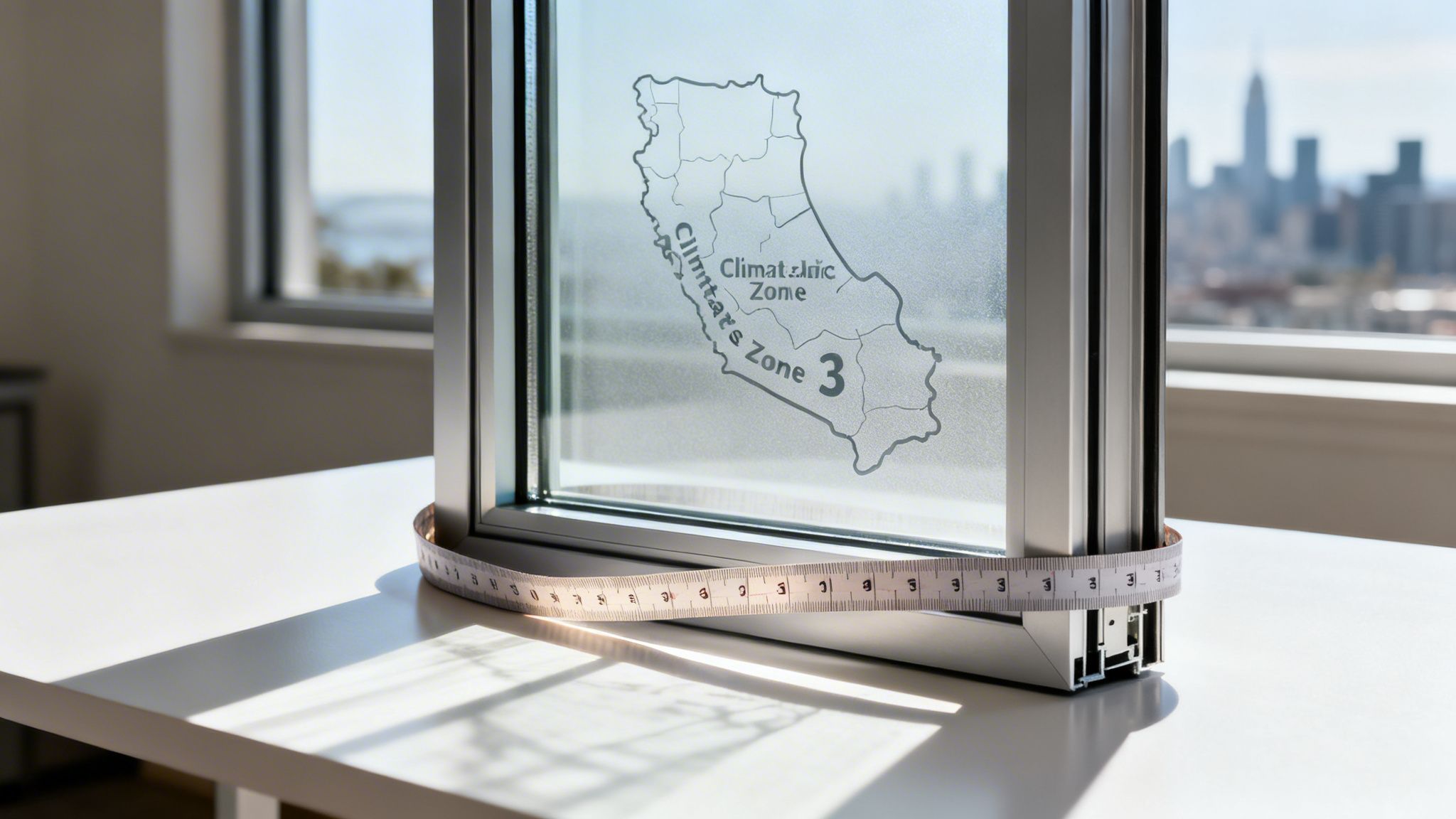
For builders, remodelers, and architects in the Bay Area, a significant change is on the horizon for window specifications. Starting January 1, 2026, the new California Energy Code brings stricter rules for projects in Climate Zone 3—which includes most of the inner Bay Area, such as Berkeley, Oakland, and San Francisco.
The key number you need to know is the new prescriptive window requirement: a U-Factor of 0.27 or lower. This guide provides a straightforward breakdown of the updated Title 24 standards, helping ensure your projects pass plan check smoothly.

Getting Ready for the 2026 Title 24 Window Rules in the Bay Area
The upcoming 2026 California Energy Code (officially the 2025 Title 24, Part 6 update) marks a major step towards creating more energy-efficient buildings. For contractors and designers, understanding the new window rules for Climate Zone 3 is about more than compliance—it's about building better, more comfortable homes that clients value.
These changes impact new construction, additions, and any renovation large enough to trigger the code. The state’s goal is to reduce energy consumption, which aligns with the sustainability priorities common in communities like Berkeley and across the East Bay.
What This Guide Covers for Bay Area Professionals
This guide translates complex code language into clear, actionable advice for your projects. We will cover the essential information you need to stay on track and on budget under the new rules.
Here’s what you’ll learn:
- The New U-Factor Requirement: We’ll explain the prescriptive U-Factor ≤ 0.27 rule and why it's critical for our moderate Bay Area climate.
- Prescriptive vs. Performance Paths: Learn how to choose between the straightforward Prescriptive path and the more flexible Performance path for compliance.
- Common Compliance Mistakes to Avoid: Discover how to prevent costly errors that often appear during plan checks and inspections.
- Choosing Compliant Bay Area Windows and Doors: Get practical guidance on selecting products that guarantee you will meet the new standards.
Mastering these rules now helps you avoid project delays, manage costs, and strengthen your reputation as an expert in modern, energy-efficient building. For a broader look at energy-focused upgrades, you may also find our Bay Area guide to energy-saving renovations helpful.
Understanding Climate Zone 3 Window Requirements for Bay Area Builders
If you build in the Bay Area, you are working in Climate Zone 3. California is divided into 16 distinct climate zones because its geography is incredibly diverse, ranging from foggy coastlines to hot deserts. A one-size-fits-all energy code would be impractical.

Each zone has unique requirements based on its local weather, ensuring building standards are effective. A window ideal for an inland project would be a poor choice for a coastal build. You can explore how different regions are managed by checking California's permit compliance guides.
Why Climate Zone 3 is a Balancing Act for Window Performance
Climate Zone 3 covers the heart of the Bay Area, including communities like Berkeley, Oakland, and San Francisco. Our climate is moderate compared to the state's extremes, without the intense summer heat of the Central Valley or the freezing winters of the Sierras.
Because of this balance, the California Energy Code 2026 rules for Climate Zone 3 focus on preventing heat loss during our mild but cool winters. The code also addresses our warm, sunny days, making solar heat management a secondary concern for comfort.
Key Takeaway: For projects in Climate Zone 3, the code's primary goal is to keep warmth inside the building. This is precisely why the new, stricter U-Factor requirement is the most important change for local builders and architects to master.
This approach is different from other zones:
- Hot Desert Zones (e.g., Zone 15): The main goal is blocking intense solar heat, so these zones have strict SHGC requirements.
- Cold Mountain Zones (e.g., Zone 16): The priority is maximum insulation, demanding the lowest U-Factors to stop heat from escaping.
Understanding this logic helps you explain window choices to clients. It’s not just about a permit; it’s about building a home perfectly tuned for the Bay Area's climate. As a trusted lumberyard near Oakland, we help you find the right Berkeley building materials to meet these specific needs.
Title 24 Window Requirements: U-Factor and SHGC
To get your window plans approved under the 2026 California energy code for Climate Zone 3, you must understand two critical numbers: U-Factor and Solar Heat Gain Coefficient (SHGC). Building departments in Berkeley, Oakland, and across the East Bay will check these ratings on the NFRC label.
The 2026 Title 24 update requires a prescriptive U-Factor of 0.27 or lower for Climate Zone 3 windows. Think of U-Factor as an insulation rating; a lower number means the window is better at keeping heated air inside.
What Is U-Factor and Why It Matters for Bay Area Windows and Doors
U-Factor measures how much heat escapes through the entire window assembly—glass, frame, and spacers. Since Climate Zone 3 has notable heating needs, the new 0.27 U-Factor threshold is all about reducing energy leaks. A window with a 0.30 U-Factor, once acceptable, will no longer pass under the prescriptive path.
Achieving a 0.27 U-Factor requires a combination of key components:
- Frame Material: Thermally broken aluminum, fiberglass, wood, and high-quality vinyl perform much better than standard aluminum.
- Glazing Package: Triple-pane glass is the new standard for high insulation, easily outperforming typical dual-pane units.
- Low-E Coatings: These invisible metallic layers reflect heat back into the room, dramatically lowering the U-Factor.
- Gas Fills: Filling the space between panes with Argon or Krypton gas slows heat transfer more effectively than air.
You can no longer assume any dual-pane window will comply. It's the right mix of these features that ensures you meet the code. For more on how these parts affect home comfort, read our guide on what Bay Area homeowners should know about Title 24.
The Role of SHGC in Climate Zone 3
While the prescriptive path focuses on U-Factor, SHGC remains critical for comfort and the performance compliance path. SHGC measures how much of the sun's heat a window lets into a home. A lower SHGC means less solar heat gain, which is key for sunny afternoons.
Why SHGC Still Matters: Even without a strict prescriptive requirement, choosing a window with a moderate to low SHGC (e.g., 0.25 to 0.40) is a smart move in the Bay Area. It prevents west-facing rooms from overheating, reducing A/C costs.
As you consider window options, remember that other products like specialized UV protection window treatments can also help. The team at our Berkeley lumberyard helps builders select energy-efficient windows in the Bay Area that balance U-Factor and SHGC for year-round performance.
Choosing Your Path: Prescriptive vs. Performance Compliance
To meet the 2026 California energy code for Climate Zone 3, Title 24 offers two compliance routes: the straightforward Prescriptive Path or the more flexible Performance Path. This decision shapes your design, product choices, and budget for any new build, addition, or major remodel in the Bay Area.
Choosing the right path early on saves you from frustrating redesigns and costly delays. Each has its own rules, benefits, and tradeoffs.
The Prescriptive Path: A Simple Checklist for Title 24 Window Requirements
Think of the Prescriptive Path as a simple checklist from the California Energy Commission. If your project meets every requirement for Climate Zone 3, you automatically comply.
For windows, the rules are strict:
- U-Factor: Every window must have a U-Factor of 0.27 or lower. No exceptions.
- Total Glazing Area: Your total window and glass door area cannot exceed 20% of the home's conditioned floor space.
This path is easy to document but offers little flexibility. If you plan a wall of glass or a design that exceeds these limits, the Prescriptive Path will not work.
The Performance Path: Flexible Design with Energy Modeling
The Performance Path offers the design freedom that architects and modern home builders love. Instead of a rigid checklist, this approach uses energy modeling software to evaluate your building's total annual energy use.
This "whole-building" method allows for smart trade-offs. For example, you can use windows with a U-Factor slightly above 0.27 if you compensate by adding higher-rated wall insulation or installing a more efficient HVAC system.
This decision tree helps visualize when to choose one path over the other.

If your design goals don't fit prescriptive limits, the Performance Path is your route to approval.
Key Insight: The Performance Path is essential for designs with large glass areas, like an ADU with bifold doors. While it requires hiring an energy consultant, the flexibility is often priceless for achieving ambitious architectural goals.
Success with this method depends on early collaboration between your architect, energy consultant, and window supplier. As a trusted lumberyard near Oakland, we provide the detailed NFRC data needed for accurate modeling. Our window replacement cost estimator can also help with early budget planning.
Avoiding Common Title 24 Window Compliance Mistakes
A failed plan check or a red tag during final inspection can bring a project to a halt, causing costly delays and frustrated clients. With the new 2026 California energy code for Climate Zone 3, the rules are tighter, and the stakes are higher for projects in Berkeley, Oakland, and across the Bay Area.
The biggest mistakes often come from old habits. What worked a few years ago is no longer a reliable guide for meeting today’s Title 24 window requirements.
Mistake 1: Assuming All Dual-Pane Windows Comply
This is a common and expensive error. Many builders still assume any modern dual-pane window will meet the new 0.27 U-Factor requirement, but that is no longer a safe bet.
Today’s code evaluates the entire window assembly. To be safe, your windows need specific features:
- High-Performance Frames: Use thermally broken aluminum, fiberglass, high-quality vinyl, or wood.
- Advanced Glazing: Look for advanced low-E coatings and argon gas fill. Triple-pane glazing is an even safer choice.
Always verify the full assembly's NFRC rating before you order Bay Area windows and doors. A wrong assumption can lead to purchasing thousands of dollars in non-compliant products.
Mistake 2: Overlooking the 20% Glazing Limit
This is another common trip-up on the Prescriptive Path. Your total glass area (fenestration) cannot exceed 20% of the home's conditioned floor area. For modern designs with large window walls, it’s easy to exceed this limit.
If your glazing area goes over 20%, you are automatically pushed onto the Performance Path. Ignoring this rule is a guaranteed rejection at plan check.
Mistake 3: Forgetting Key Documentation
Your paperwork is everything. Ensure the NFRC labels on the windows match the ratings on your compliance forms (CF1R). Building inspectors check these labels, which must remain on the windows until after final inspection.
Also, be aware of when the code applies. For major renovations in Climate Zone 3, window replacements must comply with Title 24 energy requirements if 75 square feet or more of window area is replaced. For more on this, you can check out details on Title 24 energy requirements.
Contractor Tip: When upgrading to high-performance windows, double-check your rough openings. Triple-pane units are often thicker, so coordinate with your framer to avoid surprises.
A general guide to building code violations can provide broader context. Ultimately, a solid pre-inspection routine is your best defense. You can learn more about creating a solid routine in our article on window inspection checklists.
Your Partner for Guaranteed Climate Zone 3 Compliance
Navigating the 2026 California Energy Code can feel overwhelming. At Truitt & White, we are more than just a supplier of Bay Area windows and doors; we are your dedicated resource for getting the details right the first time.
Our approach is built on builder-focused consultation, not retail sales. We specialize in the specific Title 24 window requirements for Climate Zone 3, covering projects in Berkeley, Oakland, and San Francisco.
Builder-Focused Consultation, Not Retail Sales
We are a true partner to the trades. Our process integrates with your project from the start. We provide the data, expertise, and support to ensure your window package is compliant, cost-effective, and a perfect match for your design.
We work with your architect and energy consultant to specify compliant windows before you submit for permits. This proactive approach saves you time, money, and the headache of last-minute changes.
Our consultation services include:
- Early Design Collaboration: We review plans to flag potential issues with the 20% glazing limit or tough U-Factor targets.
- Product Performance Analysis: We help you compare technical data from brands like Marvin, Andersen, and Milgard to find the best balance of performance and budget.
- Compliance Path Guidance: We help you select products for the Prescriptive or Performance path and provide all necessary NFRC documentation.
Local Expertise in Climate Zone 3
For nearly 80 years, Truitt & White has been the go-to Berkeley building materials supplier. We work exclusively in the Bay Area, giving us an unmatched understanding of how Climate Zone 3 requirements play out on local job sites.
This local focus means we provide practical advice tailored to your project. Whether it’s a new custom home, an ADU, or a major remodel, we help you select energy-efficient windows in the Bay Area that meet the strict U-Factor ≤ 0.27 requirement. You can learn more about why Truitt & White is the best choice for windows and doors in the Bay Area.
Don't leave compliance to chance. Partner with a team that knows the code, the products, and the local building departments.
FAQs: Your Questions About the 2026 Window Rules Answered
The new 2026 window rules are a hot topic, and we've been getting many questions from builders, architects, and homeowners across the Bay Area. Here are clear answers to the most common questions about the California Energy Code 2026 updates for Climate Zone 3.
What Is the Biggest Window Change in the 2026 California Energy Code for Climate Zone 3?
The biggest change is the new mandatory prescriptive U-Factor, which is now a strict 0.27 or lower. In the past, builders could use windows in the 0.30 range. This new, lower number tightens insulation standards to boost energy efficiency, making product selection more critical than ever.
Do I Need to Worry About SHGC for Windows in Berkeley or Oakland?
If you use the simple prescriptive path in Climate Zone 3, the code doesn't set a mandatory SHGC value. However, a lower SHGC is always a smart choice to reduce unwanted heat gain during our warm summers. This improves comfort and can be a huge asset if you opt for the performance compliance path.
Can I Still Use Aluminum Frame Windows in the Bay Area Under the New Code?
Yes, but only if they are thermally broken aluminum frames. Standard aluminum conducts heat and cannot meet the tough 0.27 U-Factor. High-performance aluminum, along with fiberglass, wood, and specific vinyl windows, have the advanced frame technology needed to hit the new numbers.
How Do I Prove My New Windows Are Compliant With Title 24?
Official proof comes from the NFRC label that manufacturers are required to put on every new window. This label must show a U-Factor of 0.27 or less for the prescriptive path. It is crucial to leave these labels on the windows until the final building inspection is complete.
Does This Code Apply to Remodels or Just New Homes?
The code applies to new construction, additions, and remodels. For renovations, the Title 24 window requirements are triggered when you replace 75 square feet or more of window area in an existing home. Our team at the Truitt & White showroom can help you find the best Berkeley building materials for your job.
Partner with the experts who know Bay Area building codes inside and out. For builder-focused consultation on your next project, visit Truitt & White at our Berkeley showroom.
Visit our Berkeley showroom for expert guidance.