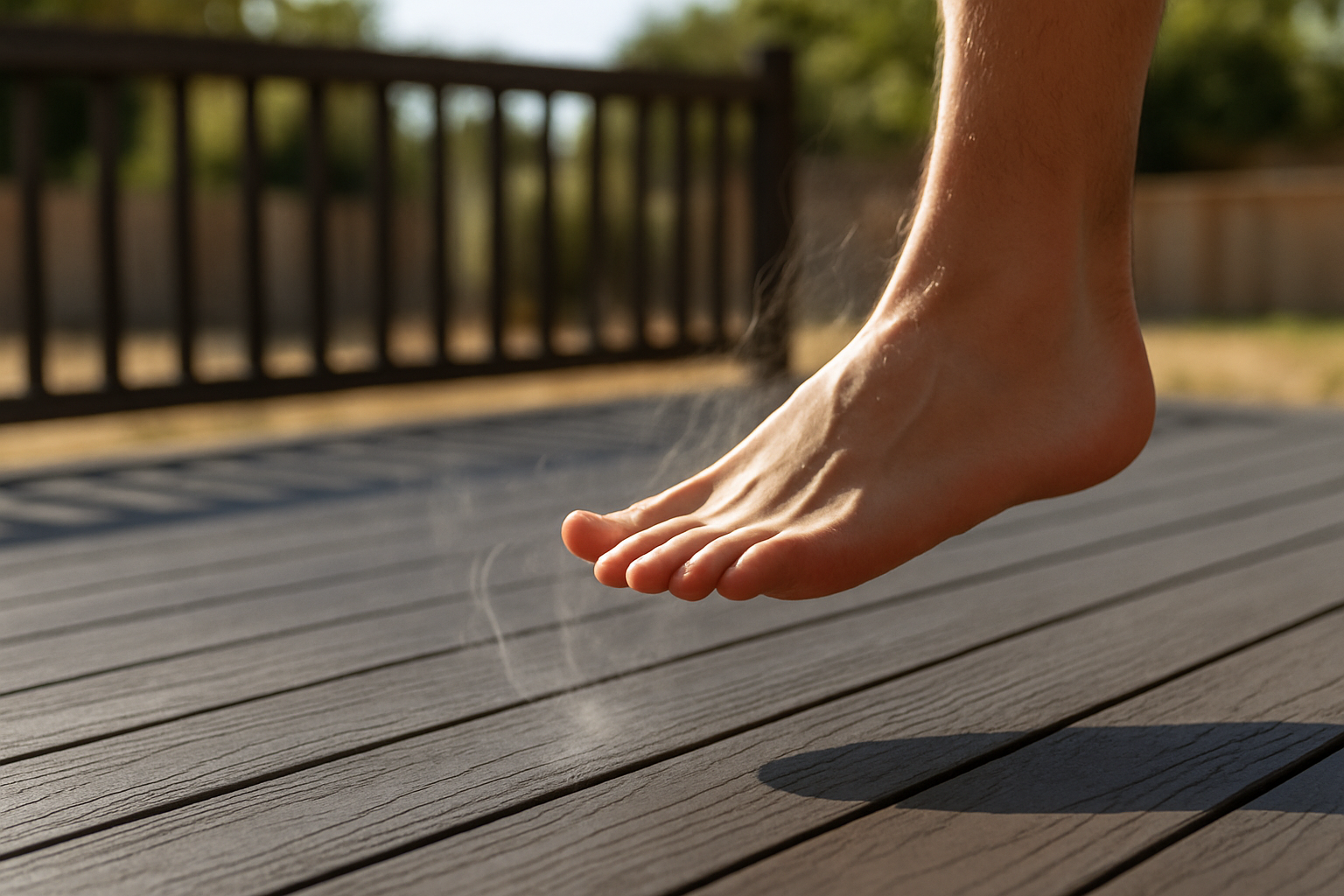
Direct Answer: Composite decking absorbs and holds heat from direct sun, sometimes reaching 130-145°F on a Bay Area afternoon. Choosing lighter board colors, heat-mitigating product lines, or thermally modified wood can significantly reduce surface temperatures.
It shows up in contractor forums and homeowner reviews with striking regularity. A family installs composite decking expecting the low-maintenance, no-splinter experience they were promised, and by June the surface is too hot for bare feet. By August, nobody is using the deck after noon.
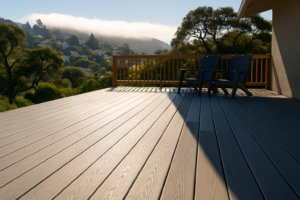
This is not a fringe complaint or user error. Composite boards absorb and retain heat from direct sun significantly more than bare wood, and the effect is sharpest on south- and west-facing decks where afternoon exposure runs longest. In the Bay Area, that means a west-facing deck in Albany or flat Berkeley can see surface temperatures in the 130-145°F range on a clear summer afternoon, even when the ambient air temperature is sitting in the upper 70s.
The marine layer burns off by noon in a lot of East Bay neighborhoods, leaving four or more hours of direct radiation with no canopy relief. Understanding how that microclimate interacts with your material choice is the most important thing you can do before the boards go down.
Why Composite Gets So Hot and What the Manufacturers Say
Composite decking is made from a blend of wood fiber and plastic, and that plastic content is what drives the heat problem. Plastic has higher thermal mass than wood, meaning it absorbs radiant energy quickly and releases it slowly. The result is a board that stays hot long after the sun shifts.
Trex is explicit about this in its own product documentation. The company warns that even its heat-mitigating products can still get hot on sunny days and advises avoiding extended skin contact, particularly for children. That is a manufacturer-level disclaimer worth reading before the board choice is made, not after the install is done.
The California Energy Commission does not regulate deck surface temperatures, so there is no code backstop here. The decision is entirely on the buyer. And the factors that drive how hot a specific board gets come down to three things:
- Board color: Darker boards in charcoal, deep gray, and warm brown absorb more radiant energy than lighter tans and naturals
- Product line: Some manufacturers offer proprietary surface technologies that reduce peak temperatures compared to standard composite, though they do not eliminate thermal mass entirely
- Site orientation: South- and west-facing decks in fog-light neighborhoods are the highest-risk configurations
For more on how Bay Area microclimates affect this decision from the start, the article on how Bay Area fog and sun change the wood vs. composite decision lays out the orientation math clearly.
The Most Controllable Variable: Board Color
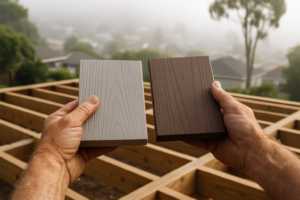
Color is the single most practical lever available at the point of purchase. A lighter board in a heat-mitigating product line is a meaningfully different outcome than a dark board in a standard line. The combination of both choices, light color plus heat-mitigating surface technology, is what makes the biggest dent.
That does not mean every dark composite board is a poor choice. A north-facing deck in a fog-heavy neighborhood like the Outer Sunset, or a shaded lot in the Oakland hills with afternoon tree cover, may never reach temperatures that create a barefoot problem. The point is that heat retention is a site-specific decision, not a product-category decision.
Buyers who choose a board color based on aesthetics alone, without thinking through how many hours of direct sun that surface will see in July, often end up with exactly the outcome they were trying to avoid. The conversation about orientation and color should happen before the order is placed, not during a callback in August.
For a detailed look at how Trex and TimberTech compare on this and other performance dimensions before you commit, the guide on how to choose a composite decking brand before you buy in the East Bay covers the decision from a contractor’s perspective.
Composite vs. Alternatives: Heat Retention at a Glance
This table compares the general heat behavior of the most common decking materials under direct Bay Area summer sun. Use it as a starting framework, not an absolute ranking, since site orientation and color selection shift the numbers significantly.
| Material | Relative Heat Retention | Best Fit for High-Sun Sites |
|---|---|---|
| Standard composite (dark color) | High, peak temps 130-145°F possible | No, poor choice for south/west-facing |
| Composite with heat-mitigating tech (light color) | Moderate, reduced but not eliminated | Conditional, depends on orientation |
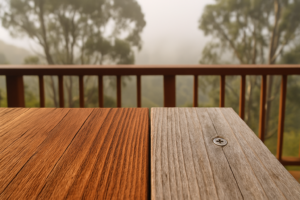
| Thermory thermally modified wood | Low, wood has lower thermal mass | Yes, runs cooler underfoot |
| MOSO Bamboo Thermo | Low to moderate | Yes, worth evaluating for high-sun decks |
| Redwood (clear grades) | Low, natural wood stays cooler | Yes, performs well, requires maintenance |
When to Rethink Composite and Consider an Alternative
This infographic walks through the three site conditions that most often push a project toward thermally modified wood or bamboo instead of composite.
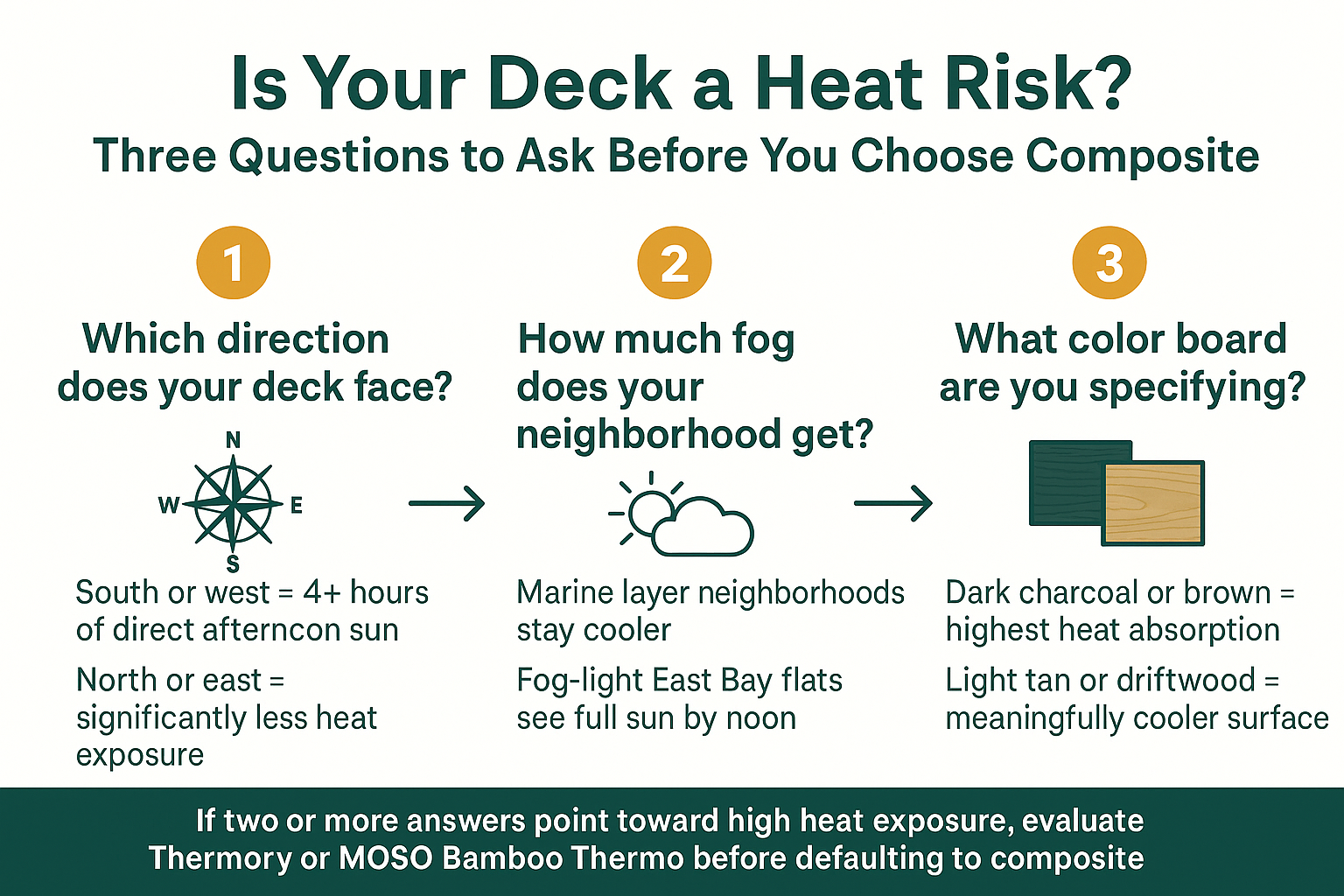
When Composite Is the Wrong Answer and What to Specify Instead
If heat is the primary objection to a project, there are two alternatives worth evaluating before defaulting to redwood or pressure-treated lumber.
Thermory is a thermally modified ash or pine product that has been heat-treated at high temperatures to remove moisture and residual sugars. That process produces a wood that is dimensionally stable, decay resistant, and genuinely runs cooler underfoot because natural wood has lower thermal mass than composite. It also carries a look that many clients prefer over composite profiles. We carry Thermory at our Hearst Avenue lumberyard, and it comes up regularly in conversations where heat was the reason composite got ruled out.
MOSO Bamboo Thermo is the other alternative worth putting side by side with Thermory before a final call is made. It behaves similarly in terms of heat retention and offers its own durability profile. The article on whether MOSO Bamboo Thermo is worth it for a Bay Area project gets into the specifics.
For context on how Thermory stacks up against cedar and composite on overall performance, the piece on whether Thermory decking actually outperforms cedar and composite gives a direct comparison. And if redwood is back on the table, redwood decking grades explained is a good starting point before specifying a grade.
One More Thing: Confirm Full System Availability Before You Order
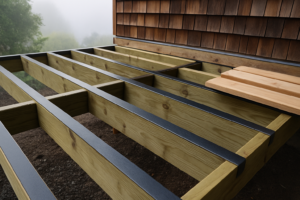
This comes up often with experienced contractors: the composite boards arrive on schedule, but the hidden fastener clips or fascia board stock for that specific product line are on backorder. The decking sits on site and the installation cannot start.
It is worth building a full system availability check into every composite order. That means confirming clips, fascia stock, and railing components at the time of the material order, not assuming a partial delivery will be followed quickly by the rest.
That conversation is easy to have at the counter or over the phone before the order goes in. It is a much harder conversation to have when a crew is standing on a framed deck with boards but no fastener system.
Frequently Asked Questions About Composite Decking Heat in the Bay Area
How hot can composite decking actually get in the Bay Area?
On a clear summer afternoon, a dark composite board on a south- or west-facing deck in an East Bay neighborhood like Albany or flat Berkeley can reach 130-145°F, even when the air temperature is only in the upper 70s. The marine layer burns off by noon in many of these neighborhoods, and the deck absorbs full radiation for hours. North-facing or heavily shaded decks are a different story.
Do heat-mitigating composite products actually work?
They reduce peak surface temperatures compared to standard composite, and some independent tests show meaningful differences. But they do not eliminate the thermal mass effect entirely. Even the manufacturers say so in their own product documentation. A light-colored board in a heat-mitigating line is the best composite option for high-sun sites, but if heat is your main concern, thermally modified wood or bamboo thermo will outperform any composite on that specific measure.
Is thermally modified wood harder to maintain than composite?
It requires more ongoing attention than composite, but less than untreated wood. Thermory and similar modified-wood products still benefit from periodic cleaning and an oil finish to maintain their appearance. Composite is genuinely lower-maintenance on that dimension. The tradeoff is that composite brings the heat retention problem that modified wood largely avoids.
Should I worry about fastener clip availability when I order composite?
Yes, and it is worth asking explicitly at the time of order. Hidden fastener clips, fascia boards, and railing components are often ordered separately from the decking boards themselves and can have different lead times. Contractors who have run into this problem say the fix is simple: confirm full system availability before the order is placed, not after the boards arrive on site.
What if I already have composite installed and it is too hot?
A few practical options: adding a shade structure or pergola reduces direct radiation and makes the biggest difference. Light-colored outdoor rugs in high-traffic areas help on a smaller scale. Reflective coatings marketed for composite are available but offer limited results. If the deck is due for replacement, that is the point to reconsider the board material and color choice.
Ready to Pick the Right Board Before It Goes Down?
If you are specifying decking for a south- or west-facing project in Berkeley, Oakland, or anywhere in the East Bay, it is worth talking through orientation, color, and material options before the order goes in. Our team at the Hearst Avenue lumberyard has seen what works on local jobsites and can help you compare composite, Thermory, and MOSO Bamboo Thermo side by side with your specific site in mind. Call us at 510-841-0511, or visit us at 642 Hearst Avenue in Berkeley to look at samples in person.