Direct Answer: Oakland prohibits grading from October 15 through April 15. Any slope stabilization, drainage work, or retaining wall repair on a hillside lot needs to be planned, permitted, and finished before that deadline.
If you own or build on a hillside lot in Berkeley or Oakland, October 15 is a date that should already be on your calendar. That’s when Oakland’s grading moratorium kicks in — and it doesn’t lift until April 15. Any slope grading, drainage redesign, or significant earthwork that isn’t complete by then has to wait through an entire wet season.
El Niño winters get most of the attention when people talk about landslide risk, but the California Geological Survey is clear: slides happen in El Niño, La Niña, and neutral years alike. What triggers them is saturated soil and back-to-back storms — exactly the kind of weather pattern the Bay Area sees every few years regardless of what the Pacific is doing. Berkeley’s and Oakland’s own hazard plans both flag rainfall-triggered landslides as significant local risks.
The problem most hillside owners run into isn’t ignorance of the risk — it’s timing. Contractor lead times for grading and French drain work are long. Quotes gathered in July give you time to permit, schedule, and finish. Panic calls in November don’t.
Why October 15 Is the Real Deadline — Not the First Storm
Oakland’s grading ordinance prohibits new grading, cut-and-fill operations, and drainage redesign on residential and hillside sites from October 15 through April 15. The intent is to prevent disturbed soil from being exposed to winter rain before it can stabilize. Violating the moratorium can result in stop-work orders and required remediation.
Contra Costa County has its own requirements. Larger excavation or fill work in unincorporated areas may require a drainage plan, and some projects trigger geotechnical review. If your property sits near the Berkeley-Oakland hills or along an unincorporated East Bay ridge, verify permit requirements with your jurisdiction before breaking ground — the rules vary by location and project scale.
A few permit triggers worth knowing before you start:
- Oakland requires a grading permit when work involves a change in site elevation or slope drainage — even on residential lots
- Berkeley has separate permit requirements for work in designated landslide or liquefaction hazard zones
- Contra Costa may require a drainage plan for projects above a certain cut or fill volume
- Licensed contractors handling structural slope work should pull the permits — this is not a self-certification situation
When in doubt, call your city’s building or public works department directly. The permit process is the slow part, not the work itself.
The Practical Product Set for Hillside Storm Prep
Not every slope problem requires a grading permit. There’s a range of defensive work that property owners and contractors can do before October 15 that doesn’t involve moving significant amounts of earth — and that work matters just as much for keeping a hillside stable through a wet winter.
Erosion control fabric and straw wattles are the first line of defense on disturbed or bare slopes. Wattles — those cylinders of compressed straw or wood fiber staked into the ground — slow surface runoff and trap sediment before it migrates downhill. Erosion fabric holds disturbed soil in place and gives newly seeded areas time to establish root systems before the rains arrive.
Sandbags are still the most practical emergency-response tool for redirecting sheet flow away from structures and foundations. They’re not a permanent fix, but deployed correctly before a storm they can keep water from pooling against a wall or flowing through a garage.
On the drainage side, two things deserve attention before October:
- Downspout extensions and relocation — roof water discharged too close to a slope or retaining wall adds to soil saturation fast. Extending downspouts to discharge well away from the wall face is one of the most cost-effective changes you can make.
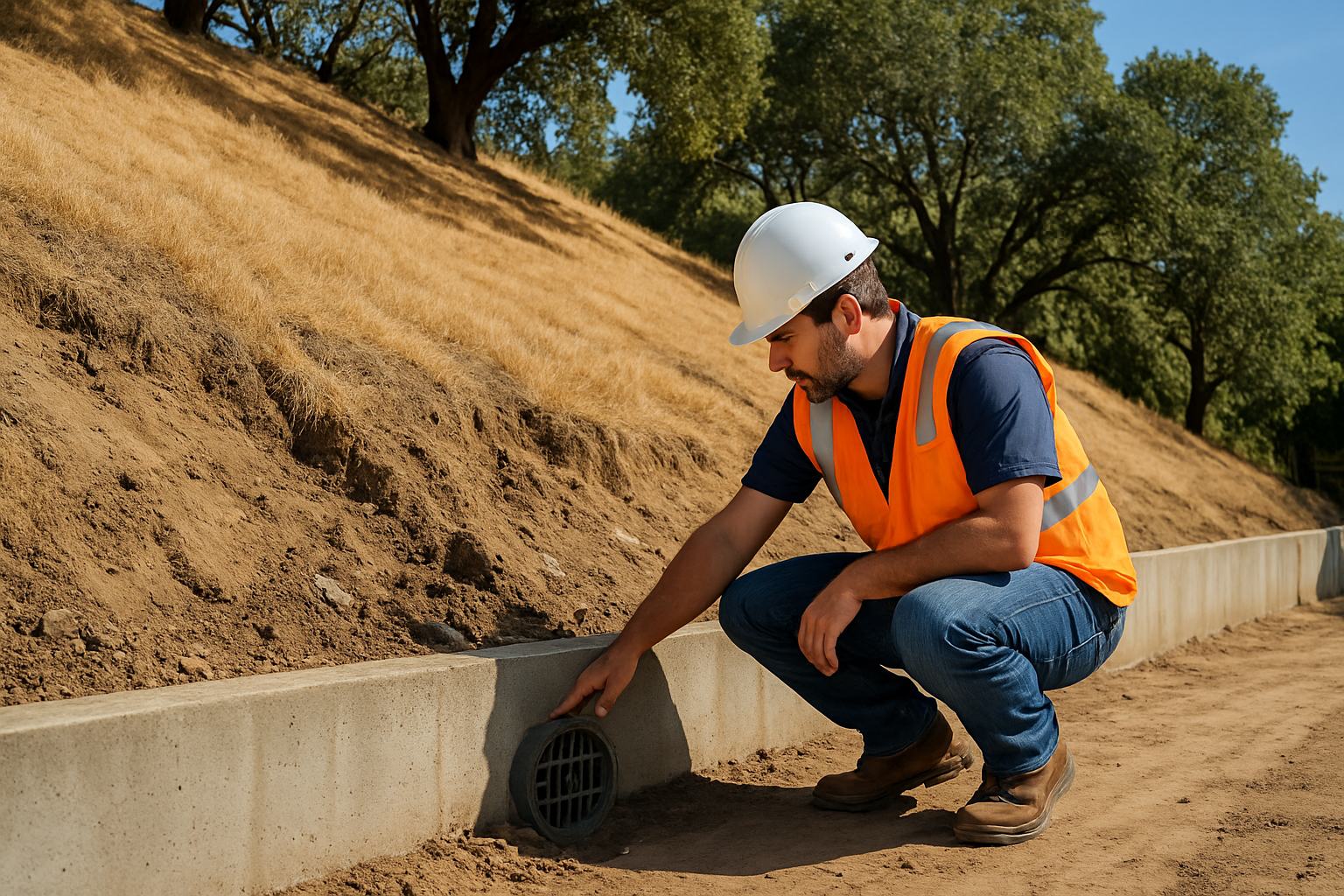
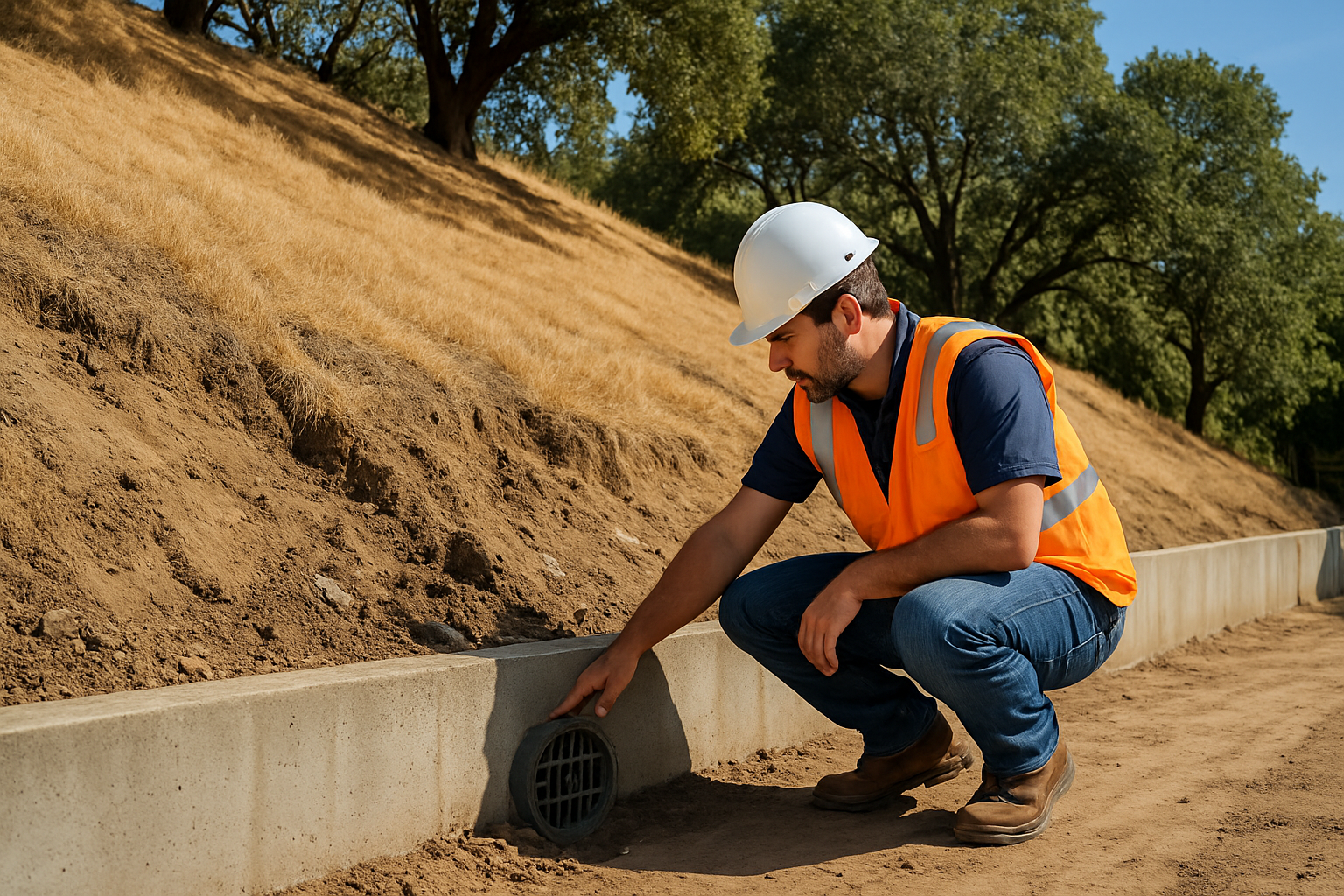
- Retaining wall drainage checks — weep holes and French drain outlets behind retaining walls need to be clear and functional. A blocked outlet turns a wall designed to handle normal soil pressure into one absorbing hydrostatic pressure instead. That’s how walls fail.
Keeping runoff discharge well away from retaining walls is the single most repeated piece of advice from contractors working on East Bay hillside failures. It sounds obvious, but it’s consistently overlooked until a wall shows movement.
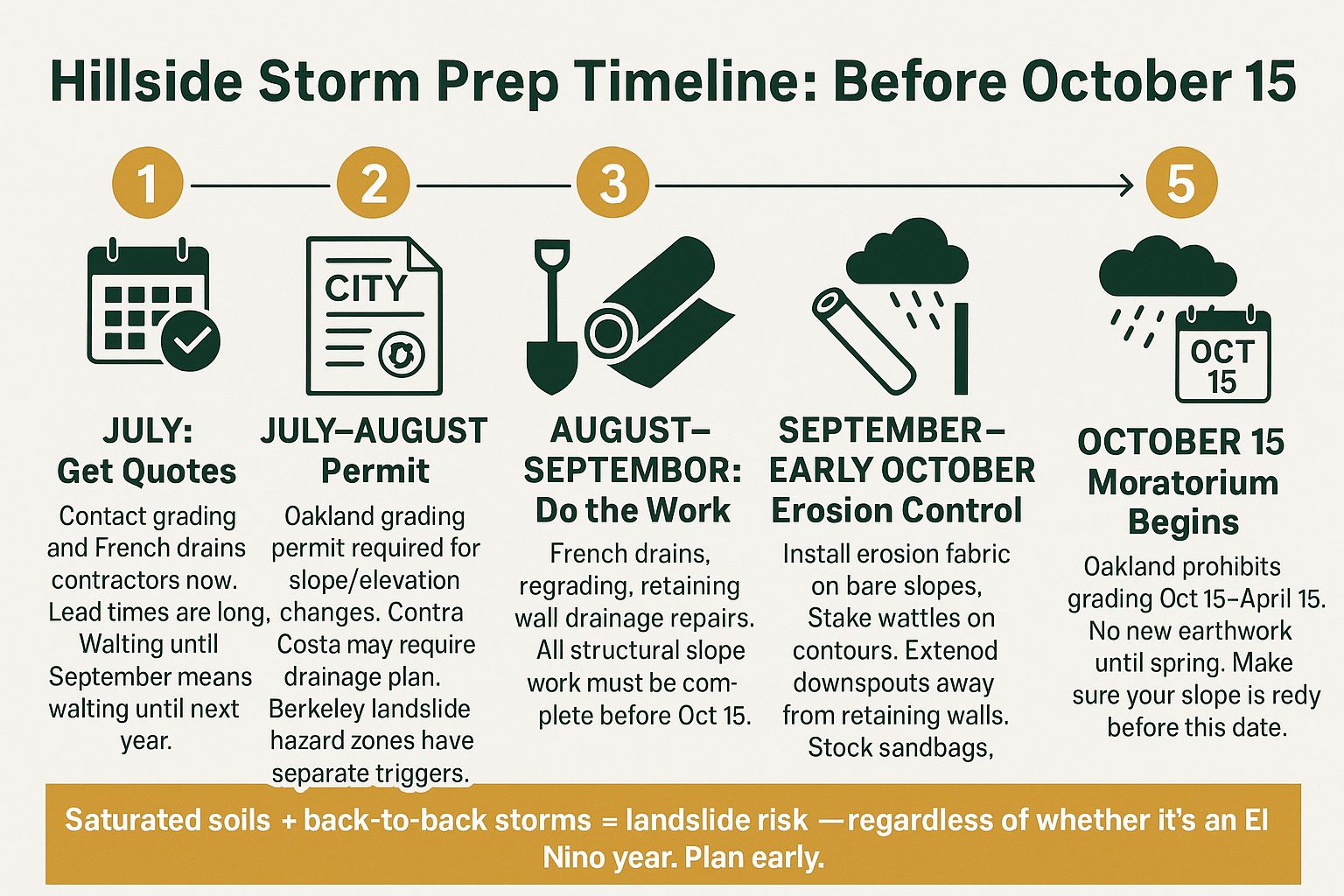
Hillside Storm Prep: What to Do Before October 15
This timeline shows the key tasks, permit steps, and material decisions hillside property owners should work through between now and the October 15 grading moratorium deadline.
What the French Drain and Grading Work Actually Involves
For contractors and owners who haven’t done hillside drainage work before, it helps to understand what you’re actually approving before the job starts.
A French drain is a gravel-filled trench with a perforated pipe that intercepts groundwater or surface runoff and redirects it to a safe discharge point — ideally well downslope and away from structures. On a hillside lot, French drains are typically installed upslope of a retaining wall, along the building’s foundation perimeter, or across a slope to intercept water moving through the soil before it reaches a wall or structure.
Regrading addresses surface drainage — reshaping the land so that water moves away from structures rather than toward them. Minor regrading around a foundation can sometimes be done without a permit, but any work that changes slope angles or redirects significant drainage flow in Oakland typically triggers the permit requirement. The line between minor and permit-required is genuinely unclear in some situations, which is another reason to call the building department rather than assume.
Expect licensed contractors to ask for a site visit before quoting. Slope work is highly site-specific — soil type, slope angle, existing drainage patterns, and proximity to structures all affect both the scope and the cost. Bay Area hillside grading and drainage projects can vary widely in price depending on access, soil conditions, and whether a geotechnical report is needed. Getting two or three contractor quotes is worth the time, and doing it in summer rather than fall gives you actual leverage on scheduling.
Hillside Prep Work: Permit Requirements and Timing at a Glance
This table summarizes general permit considerations by task type for common hillside prep work in the East Bay. Always verify current requirements with your local building or public works department before starting.
| Task | Permit Typically Required? | Best Completion Window |
|---|---|---|
| Grading / regrading slope | Yes — Oakland grading permit; verify in Berkeley and Contra Costa | Complete by October 1 to allow margin before Oct 15 |
| French drain installation | Depends on scope; often yes if connected to regrading | August–September |
| Retaining wall drainage repair (weep holes, pipe clearing) | Typically no for maintenance; yes for reconstruction | September–early October |
| Downspout extension / relocation | Typically no | September–early October |
| Erosion fabric and wattle installation | Typically no | September–early October |
| Sandbag deployment | No | As needed before storms |
Summer Is the Action Window — Not Fall
The single biggest mistake hillside property owners make is treating storm prep as a fall task. By the time October rolls around, grading contractors are booked, permit processing has a backlog, and the moratorium is two weeks away.
If your hillside property has any of these conditions, the time to act is now:
- Bare or sparsely vegetated slopes from recent work, drought, or fire
- A retaining wall that hasn’t had its drainage outlets inspected in more than two years
- Downspouts that discharge within a few feet of a slope edge or retaining wall
- Visible cracking, tilting, or efflorescence on a retaining wall face
- A slope that showed surface erosion or rill formation last winter
For context on how East Bay homes should prepare for a strong El Niño winter, the preparation window is always longer than it feels. The same principle applies here: the October 15 moratorium doesn’t move, and storm seasons don’t wait for contractors to catch up.
Contractor availability in the Bay Area typically tightens in late August and September as other hillside owners start making calls. Getting quotes in July puts you ahead of that compression.
Frequently Asked Questions About Hillside Storm Prep
Does Oakland’s grading moratorium apply to every hillside property, or just large ones?
The moratorium applies broadly to grading activity in Oakland regardless of lot size. The trigger isn’t the size of the property — it’s whether work involves changing site elevation, slope, or drainage routing. Small residential lots in the hills are subject to the same October 15 through April 15 prohibition as larger projects. If you’re unsure whether your planned work qualifies as grading under Oakland’s ordinance, call the Oakland Building Services Division directly before you start.
Can I install erosion fabric or wattles myself, or does that require a contractor?
Erosion fabric and wattle installation on your own residential property is generally something a capable homeowner can handle without a permit or licensed contractor. The products aren’t complicated — proper staking technique and correct placement on the slope contour matter more than specialized skills. That said, if the slope in question is steep, unstable, or part of a larger drainage problem, getting a contractor’s eyes on it first is worth the cost of a site visit.
What’s the difference between a French drain and a surface drainage fix?
A French drain addresses subsurface water — it intercepts groundwater moving through the soil and redirects it before it can saturate the area behind a wall or under a foundation. Surface drainage fixes, like regrading or swale installation, deal with water that’s moving across the top of the ground. Many hillside properties need both. A contractor doing a proper site assessment should be able to tell you which problem you’re actually dealing with.
How do I know if my retaining wall’s drainage is failing before the rains start?
The clearest signs are blocked or dry weep holes (water should discharge from them during and after rain), efflorescence — that white chalky residue — on the wall face, cracking along the wall or the cap, and any visible tilting or bulging. If a wall that used to have active weep holes during rain now shows nothing, the drainage behind it may be clogged. That’s worth getting looked at before a wet season.
Is El Niño the main driver of landslide risk in the East Bay, or are there other factors?
El Niño gets the most attention because it’s associated with above-normal precipitation, but the California Geological Survey is clear that landslides occur in any year when rainfall is sufficient to saturate the soil. Back-to-back storms with short recovery intervals are often more damaging than a single large event, because the soil never gets a chance to drain between events. Berkeley’s and Oakland’s hazard plans identify this pattern — not El Niño specifically — as the primary landslide trigger.
Getting the Materials Together Before the Window Closes
If your slope work is planned or already underway, Truitt & White’s Berkeley lumberyard stocks erosion-control fabric, wattles, sandbags, and drainage materials — and the staff there understands the local permit landscape well enough to point you toward the right resources when a project needs a licensed contractor or a city permit office rather than just a material run. Stop by the Hearst Avenue location, call 510-841-0511, or visit truittandwhite.com to check availability and get guidance on what your specific project actually needs.