Quick Answer
For a Bay Area deck, wood vs composite decking comes down to maintenance, appearance, and site conditions. Wood gives you a more natural look and easier customization. Composite usually costs more up front, but it needs far less upkeep and handles damp conditions well. If your project gets full sun, this guide to decking for full sun in California is also worth reading.
If you're planning a deck in Berkeley, Oakland, San Francisco, or the East Bay hills, the material choice affects more than appearance. Fog, salt air, hard afternoon sun, leaf litter, slope access, and seismic detailing all change how a deck lives over time.
This is also no longer a fringe decision. In 2016, composite decking held about 16% of the $7 billion annual deck market, according to Travelers, and that share has likely grown as more homeowners look for lower-maintenance materials. For Bay Area builders, that means clients increasingly expect a real comparison, not a reflex recommendation.
Core Differences in Appearance and Feel
The first decision is usually visual. A Berkeley Craftsman, a hillside modern in Oakland, and a rear-yard family deck in San Francisco don't all want the same thing underfoot.
| Factor | Wood Decking | Composite Decking |
|---|---|---|
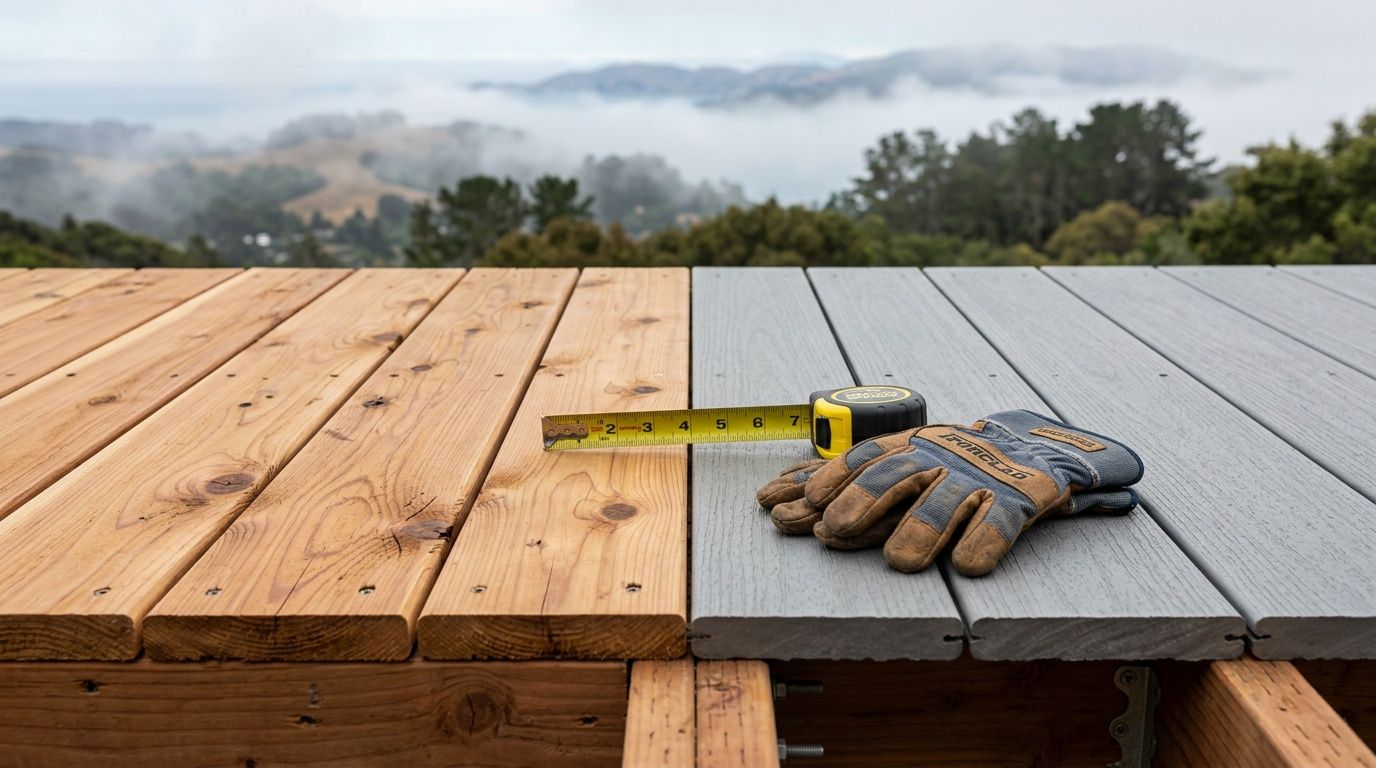
| Look | Natural grain variation and character | More uniform color and pattern |
| Feel | Traditional texture, can be sanded or refinished | Consistent surface, often smoother underfoot |
| Color flexibility | Can be stained or changed later | Color is largely fixed once installed |
| Heat in sun | Often feels cooler than composite | Can retain more heat in direct sun |
| Aging pattern | Weathers naturally, may check or fade | Tends to keep a more consistent appearance |
| Repair approach | Individual boards can often be sanded or replaced | Board replacement is usually the cleanest fix |

What wood still does better visually
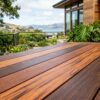
Wood still wins if the project depends on authentic grain, natural variation, and a finish that can be tuned on site. Redwood, cedar, and hardwoods all age differently, and that variability is exactly why some architects and homeowners want them.
For older homes, especially where the deck is visible from the street or tied to existing trim and siding, wood usually looks more authentic. If you're weighing species, this guide to the best wood for a deck helps narrow the field.
Practical rule: If the client talks first about patina, grain, and matching the house, start with wood. If they talk first about weekend upkeep, start with composite.
Where composite has caught up
Composite used to look obviously manufactured. Current lines are better than they were, and the better products avoid the plastic shine that gave older boards a bad name.
They still don't fool everyone. But on clean-lined modern projects, that consistency can work in their favor. If you're comparing broader decking material options and trying to sort appearance from performance, it helps to look at them side by side before choosing a color family.
Foot feel, texture, and temperature
A sample board is essential to discern the differences. Wood and composite don't just look different. They feel different when wet, in bare feet, and after a hot afternoon.
In the inner East Bay, sun exposure can push surface temperature into the foreground fast. Some newer composite products are designed to reduce heat absorption, but in general, dark boards in direct sun deserve a conversation before anyone commits. Wood often feels more forgiving in that setting, though it brings its own issues once it starts drying, checking, or splintering.
Bay Area style matters more than brochures do
The Bay Area has a lot of houses where the deck isn't an accessory. It's a visible part of the architecture. On a period home, a deck that looks too uniform can feel out of place. On a modern addition with steel railing and large glass openings, a crisp composite board can fit just fine.
Neither material is automatically the right visual answer. The right answer is the one that still looks right after weather, traffic, and a few seasons of neglect.
Performance in Bay Area Microclimates
A deck in the Sunset District doesn't live the same life as one in the Berkeley hills. Fog, marine moisture, tree cover, and long dry heat cycles all show up in the boards eventually.

Fog, shade, and damp exposure
In damp locations, composite usually makes life easier. It resists rot well and doesn't ask for the same finishing cycle that wood does, which matters on shaded decks that stay wet longer after rain or marine layer moisture.
Wood can still perform well in these conditions, but only if the detailing is right and the owner stays on maintenance. Debris trapped between boards, poor airflow, and missed sealing schedules shorten the life of a wood deck much faster in foggy pockets than they do inland. Seasonal prep matters, and these winter-ready building materials for the Bay Area considerations often apply to exposed decks too.
On coastal and near-coastal jobs, drainage and ventilation mistakes do more damage than the material label.
Sun, movement, and surface behavior
In hotter inland pockets, wood and composite fail differently. Wood fades, dries out, and can crack or splinter if the finish schedule slips. Composite tends to hold its appearance better, but expansion, board spacing, and heat buildup need attention during layout.
Installer discipline matters. Composite isn't maintenance-free in the sense people sometimes mean. It still needs correct gapping, clean framing, and product-specific fastening if you want it to stay flat and presentable.
Seismic conditions and long-term structural behavior
For Bay Area projects, the structure under the boards matters as much as the boards themselves. According to The Custom Deck Guys, material performance in wet, seismic-prone climates is critical. Hardwoods such as Ipe have superior tensile strength, which suits earthquake zones, while composites tend to maintain their structural integrity better over time in damp conditions.
That trade-off is real. Dense hardwoods feel solid and reassuring, but that doesn't remove the need for careful fastening, proper substructure, and code review. Composites can be a very practical choice in a damp microclimate, but they still need installation that accounts for movement and manufacturer requirements.
Wet traction and daily use
Wet traction doesn't get enough attention at the sales counter. In the Bay Area, decks often get morning moisture even when it hasn't rained. Surface texture, leaf drop, and mildew buildup matter more than people expect.
Wood can become rougher and splinter as it ages, but it can also be cleaned and refinished. Composite surfaces stay more consistent, though some profiles and conditions can still get slick if the deck is shaded and poorly ventilated. That's not a reason to avoid either one. It's a reason to think about orientation, nearby planting, and cleaning access before the first board goes down.
Analyzing the Full Lifecycle Cost
The upfront price tag doesn't answer the primary question. The actual concern is what the deck costs to own once the project is built and the years start adding up.

Upfront price versus ongoing expense
Composite generally costs more to buy than pressure-treated pine. Fiberon notes that composite decking can cost 15 to 20% more upfront than pressure-treated pine, while wood deck maintenance typically runs $450 to $850 annually and composite maintenance is typically $5 to $15 per year, which can let composite pay for itself in 2 to 3 years through maintenance savings in some cases. They also note that some analyses place the payback window at 5 to 7 years, depending on variables such as labor rates and initial investment, in their wood vs composite deck comparison.
For Bay Area owners, labor is often what changes the conversation. A material that needs routine staining, sealing, and occasional board replacement may look cheaper on paper than it does after a few maintenance cycles.
Where wood still makes financial sense
Wood still pencils out for some jobs. If the deck is part of a shorter-term hold, if the client values the natural look enough to accept upkeep, or if selective repair and refinishing are important, wood can still be the right answer.
It also helps when the design calls for custom field adjustments, curved transitions, or site-built detailing that would be more cumbersome with composite. There's real value in workability, especially on remodels where conditions don't stay neat and square.
What contractors should explain clearly
The hard part isn't quoting the deck. It's setting expectations accurately.
- Wood requires a maintenance plan. If the owner won't follow one, wood usually looks tired sooner.
- Composite shifts the spending pattern. More cost comes early, less later.
- Long-term ownership matters. The longer the client expects to stay, the stronger the case for lower-maintenance materials tends to become.
- Resale isn't one-dimensional. Some buyers respond to natural wood. Others respond to not having another exterior chore waiting for them.
If the client is comparing quotes only on install day, they're missing half the cost.
For builders trying to frame that discussion authentically, this article on stable lumber prices in 2025 and whether it's a smart time to build or remodel is useful context on how material timing shapes decisions.
Installation Details for Contractors
On site, wood vs composite decking isn't just a material preference. It changes framing, fastening, waste, sequencing, and how forgiving the deck is when the house isn't perfectly square.
Framing and deflection
Wood has higher initial compressive strength in some species, especially dense hardwoods. But according to BTN Decks, high-quality composites can offer better long-term stiffness and may allow 16-inch on-center joist spacing where some wood installations may need 12-inch spacing to manage deflection.
That doesn't mean every composite line can be treated the same. Always check the board spec, not the category label. Span tables, stair applications, and picture-frame details can all change the answer.
Fasteners and layout discipline
Wood is more forgiving in the field. Face-screwing is straightforward, repairs are familiar, and slight inconsistencies in board character don't usually read as installation defects.
Composite asks for a cleaner process. Hidden clip systems can look sharp, but they lock you into the manufacturer's sequence and tolerance. If the framing wanders, composite often shows it faster than wood.
| Factor | Wood Decking (e.g., Redwood, Ipe) | Composite Decking (e.g., Trex, TimberTech) |
|---|---|---|
| Joist sensitivity | More forgiving visually | More likely to show uneven framing |
| Fastening style | Face-screws are common and simple | Hidden clips are common, sometimes product-specific |
| Field trimming | Easier to shape and adjust on site | Needs cleaner cuts and tighter planning |
| Board replacement | Often simpler, especially with exposed fasteners | Can be more involved with clip systems |
| Finish options | Can be sanded, stained, or refinished | Finish is factory set |
Use case fits in the Bay Area
A historically sensitive Berkeley Craftsman usually leans wood. The authentic grain, stain flexibility, and repairability fit the project better than a uniform synthetic look.
A rental or high-use family deck in Oakland often leans composite. Less maintenance, fewer callbacks about splinters or finish wear, and a more predictable appearance over time all help.
For a modern rebuild in the hills, the answer depends on exposure and design intent. If the deck is prominent and gets hard weather, composite can be a practical call. If the architecture depends on natural material expression, wood may still be worth the extra upkeep.
If you're sorting spans and substructure early, a deck joist spacing calculator is a useful starting point before ordering material. Truitt & White stocks both wood and composite decking along with structural lumber, fasteners, and hardware from the Berkeley lumberyard, which makes it easier to keep the framing and finish material conversation in one place.
Decision Guide Which Decking to Choose
Most projects become clearer once you stop asking which material is better in general and start asking what the deck has to do.

Choose wood when the house wants wood
Wood makes sense when the deck is tied closely to the architecture. Period homes, visible front elevations, and projects where stain color may need adjustment later all point in that direction.
It also makes sense for owners who will maintain it. That's the dividing line. Wood rewards attention. It doesn't reward neglect.
Choose composite when ownership needs simplicity
Composite fits households that don't want annual upkeep hanging over them. It also fits decks with hard sun, repeated wetting, or heavy everyday use where consistency matters more than natural variation.
That can be especially useful on rental properties, family decks, and remodels where the owner wants the outdoor space to be durable without becoming another regular maintenance item.
A good deck choice matches the owner's habits as much as the climate.
Five counter questions that help settle the choice
- Do you care more about natural character or low upkeep? If the answer is natural character, wood stays in the conversation. If the answer is low upkeep, composite moves ahead quickly.
- Will the deck sit in full sun? If yes, talk through board color and surface heat before selecting composite.
- Is the house historic, traditional, or highly design-driven? Wood often looks more at home on traditional architecture.
- Will anyone want to change the finish later? Wood gives you that option. Composite usually doesn't.
- Is resale part of the thinking? In premium markets, Deck and Fence Contracting notes that well-maintained wood can appeal through its natural aesthetic, while composite's low-maintenance reputation can also be a strong selling point.
Questions that come up late, but should come up early
Fire rating, sustainability, repairability, and code compliance all belong in the early discussion. Product lines vary, and hillside or interface-zone projects may have requirements that narrow the field quickly. For code, permitting, and Title 24-adjacent product questions, the right move is to confirm requirements with the builder, design professional, manufacturer documentation, and the local building department.
Deep scratches are another practical issue. Wood can often be sanded and refinished. Composite usually calls for cleaning, living with minor marks, or replacing the board if damage is obvious.
Frequently Asked Questions About Decking Materials
Does composite decking always cost more than wood?
Usually, yes at the start, especially compared with pressure-treated pine. But upfront price isn't the whole story. Composite often makes more sense for owners who want to avoid ongoing maintenance.
Which one holds up better in Bay Area damp weather?
Composite usually has the easier time in damp, shaded, or foggy conditions because it resists rot better and doesn't need the same finish maintenance cycle. Wood can still do well, but it needs good detailing, airflow, and regular upkeep.
Can I change the color later if I get tired of it?
Wood gives you more flexibility. You can sand, stain, or refinish it later. Composite is much more of a fixed-color decision, so sample review matters before ordering.
Which material is better for a Berkeley Craftsman or older home?
Wood is often the cleaner fit for older homes where natural grain and stain choice matter. Composite can work, but it usually looks more at home on contemporary designs or on projects where maintenance is the main concern.
Is composite decking slippery when it's wet?
It can be, depending on the surface texture, shade, debris, and mildew conditions. Wood can also become slick or rough over time. The better approach is to consider drainage, ventilation, cleaning access, and board texture before installation.
What should I ask about code and fire requirements?
Ask for the exact product data, not a generic answer by material type. Requirements can vary by product and location, so it's smart to confirm details with your contractor, manufacturer documentation, and local building department.
Talk to Our Decking Experts
The right answer on wood vs composite decking depends on the house, the exposure, and how the owner plans to live with the deck after it's built. If you're sorting through samples, framing questions, or trying to match a Bay Area project to the right material, it helps to put the boards side by side and talk it through with someone who handles these choices every day.
Visit Truitt and White at the Lumberyard and Hardware store, 642 Hearst Ave, Berkeley, CA 94710, or call (510) 841-0511 to discuss decking materials, structural lumber, fasteners, and jobsite needs. For general questions, you can also reach out through info@truittandwhite.com.