Quick Answer
A good timbertech decking dealer bay area choice isn’t just the one with boards on a rack. Vet the supplier for inventory depth, realistic lead times, warranty knowledge, coordinated delivery, and the ability to bundle framing, fasteners, and decking into one order. Start by reviewing available TimberTech product options before you compare suppliers.
If you're lining up a deck job right now, the supplier you pick will affect schedule, callbacks, and how many loose ends your crew has to chase. That matters more with composite and PVC decking, where one bad order, one missing accessory, or one vague answer on installation can slow a project down fast.
In the timbertech decking dealer bay area market, demand for durable decking is strong. The broader market is projected to reach $10.01 billion globally by 2031, with North America accounting for 36.0% of demand (Growjo, 2026). That kind of adoption is good for product availability, but it also means you need to separate serious yards from sellers that only look prepared on paper.
What Defines a High-Quality Decking Supplier

A strong supplier helps you build the whole job, not just sell deck boards. If you're vetting a new yard, look at how they handle the parts of the job that usually create problems. Availability, accessory coordination, and field knowledge tell you more than a display wall ever will.
Contractors who also handle adjacent site work usually see this clearly. If you're planning deck tie-ins with stairs, landings, or adjacent hardscaping solutions, the supplier has to think in assemblies, not isolated SKUs.
Inventory depth and lead time discipline
Ask what they stock, what they special order, and how they separate the two in the quote. If a yard gets fuzzy on that point, expect surprises later.
A dependable supplier should be able to tell you which TimberTech lines, colors, lengths, fascia, and railing components are regularly available, and which items need a lead-time check. That sounds basic, but it's where a lot of jobs drift off schedule.
Use their answer to judge whether they understand contractor workflow:
- Decking plus framing together: Can they package decking, treated framing, hardware, and fasteners in one release?
- Accessory completeness: Do they routinely check hidden fasteners, screws, fascia, and railing parts against the board count?
- Delivery clarity: Can they give you a realistic delivery window instead of a vague promise?
Practical rule: If the salesperson only talks about board color and never asks about framing, fastening method, or delivery sequence, keep looking.
A supplier that supports pros should also make it easy to build a material list before ordering. That's where a detailed deck building materials list becomes useful, especially when you're pricing alternates or trying to avoid a second trip for missing hardware.
Technical knowledge and warranty support
Composite and PVC products aren't forgiving of sloppy guidance. You need counter staff who understand gapping, fastening systems, fascia behavior, and where installers get into trouble.
What matters is not whether they can repeat marketing language. What matters is whether they can answer practical questions cleanly:
- Installation details: Can they explain when hidden fasteners make sense and when face fastening is the better call?
- Application fit: Do they know when a PVC line is the safer choice for moisture exposure?
- Problem response: If there’s a damaged board or mismatch issue, who owns the follow-up?
A lot of big-box sourcing falls short. They may process an order, but they often don't help you sort out the difference between a product problem, a handling problem, and an installation problem.
Contractor support that saves actual time
The right supplier reduces friction before your crew gets on site. The wrong one gives you more admin work after the truck leaves.
A contractor-ready yard should be able to support:
| What you ask for | Why it matters |
|---|---|
| Combined material orders | Fewer split deliveries and fewer chances to miss a component |
| Jobsite delivery coordination | Helps match crew schedule and access conditions |
| Sample access | Speeds up owner approval and keeps color decisions from stalling the build |
| Return and claim process | Protects you when a job changes or material arrives wrong |
A supplier earns trust when the order arrives complete, tagged clearly, and ready for the sequence your crew will build.
How to Evaluate Showrooms and Physical Decking Samples

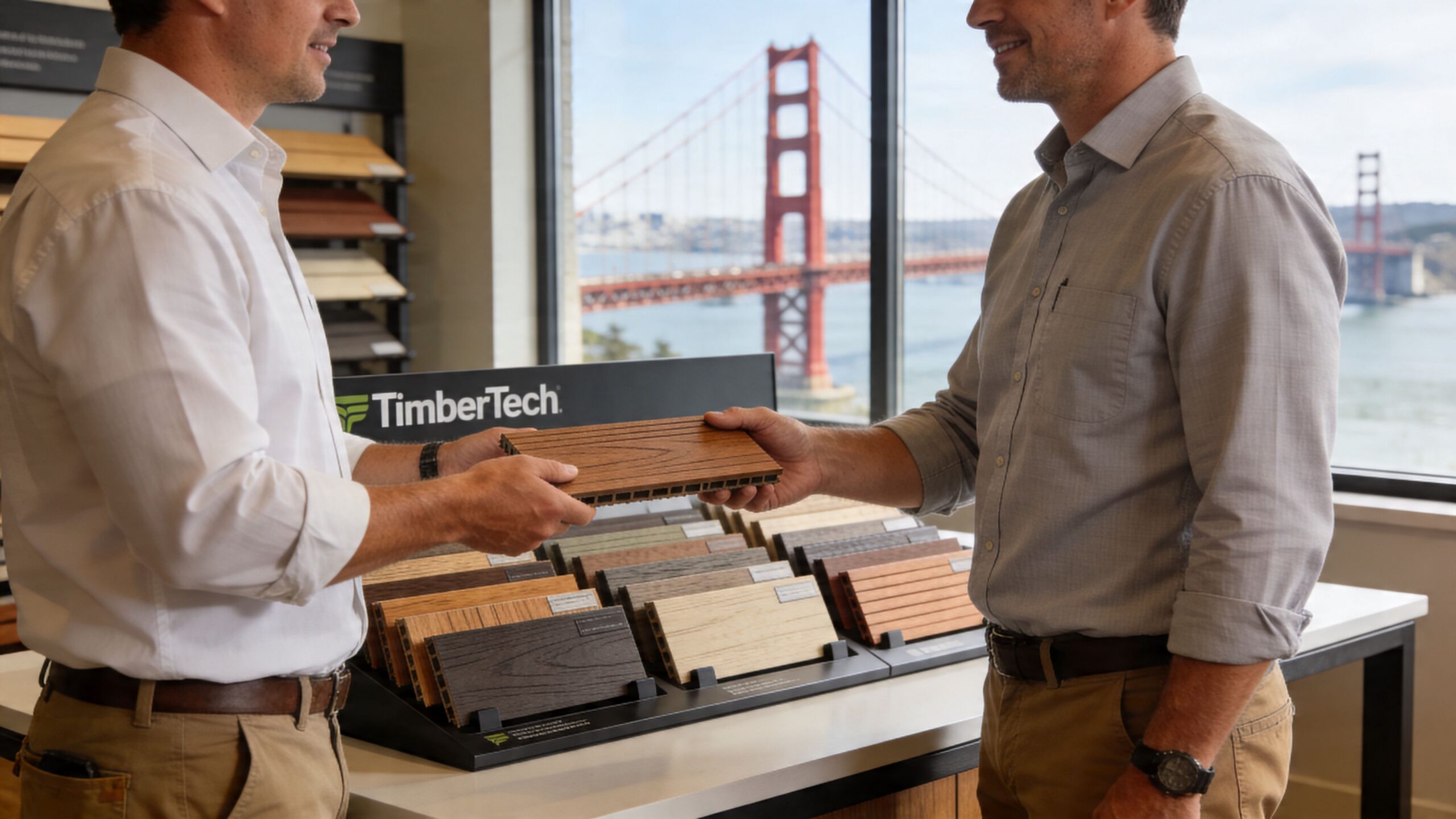
A showroom tells you two things fast. It shows whether the dealer takes product knowledge seriously, and it shows whether they understand how contractors and clients make decisions.
The first thing I look for is whether the samples are current, clean, and organized by line instead of dumped together by color. If the display is confusing inside the building, the order desk usually isn't much better.
Look past the display wall
You don't need a fancy showroom. You need one that helps you compare products in a useful way.
Check the samples for:
- Color consistency: Look at multiple pieces from the same line, not one small chip.
- Surface texture: Run your hand across the face and edge. Texture affects appearance, traction, and how clients react to the board.
- Profile clarity: Ask to see grooved boards, solid boards, fascia, and matching trim components together.
- Lighting response: View samples near daylight if possible. Bay Area light changes a lot between fog, shade, and afternoon sun.
A lot of homeowner indecision comes from choosing off a tiny sample under showroom lighting. A good dealer helps you avoid that by showing full-size pieces or larger displays.
Bring the sample outside if the yard allows it. Morning gray and late afternoon sun can make the same board read differently.
There’s a useful discussion about visual trust and product presentation in Seeing Is Building. The point applies here. People approve materials faster when they can see what they're buying in realistic conditions.
Judge the staff by the questions they ask you
The best showroom visit feels a little like a preflight check. The rep should ask where the deck sits, what the exposure looks like, what profile you're using, and whether you're matching existing framing or railing details.
If all they ask is, "What color do you want?" you're not dealing with a contractor-focused operation.
Here’s what a solid conversation sounds like:
- Site use: Is this full sun, partial shade, or a damp exposure?
- Assembly: Are you resurfacing or building new framing?
- Edges and trim: Do you need fascia, picture framing, stair nosing, or skirting details?
- Approval path: Is the decision being made by a homeowner, architect, or project manager?
Touch the boards like you're checking material, not decor
Composite and PVC boards shouldn't be treated like paint swatches. Pick them up. Look at the edge treatment. Check whether the finish feels consistent across the face.
You’re not trying to predict long-term performance from a sample alone. You’re checking whether the supplier gives you enough information to make a clean spec decision without guessing.
Key Questions for a TimberTech Decking Dealer Bay Area

When I’m checking a new supplier, I don’t ask broad questions like "Do you carry TimberTech?" That only tells me whether they can place an order. It doesn't tell me whether they can support a job.
Use direct questions that force a direct answer.
Ask about what they stock and what they have to chase
Start with availability. Not the catalog. The actual supply chain.
Ask:
- Which lines and colors do you regularly stock?
- What usually has to be special ordered?
- If I need fascia and railing to match, do you verify that before release?
Those questions tell you whether the dealer is managing deck packages or just selling boards one line item at a time.
Ask how they handle performance and compliance details
For dealer-sourced projects, post-install inspection under ASTM D7032 verifies less than 0.5% water absorption, and Class A fire ratings under ASTM E84 matter in California wildland-urban interface areas (CleanBuilders, 2026). You don't need the dealer to be your code official, but you do need them to know what documentation and product data you'll likely need.
A good counter conversation includes questions like:
- Can you provide the technical bulletins and product data for the exact line I'm ordering?
- Which product in the TimberTech range makes the most sense for a higher-moisture exposure?
- How do you handle a warranty issue if I have a product concern after delivery?
Don't ask the yard to interpret your permit set. Ask whether they can supply the right technical documents and product information for your submittal and install planning.
If you're comparing materials more broadly, a reference point like best wood for deck can help frame when a composite or PVC product makes more sense than a wood assembly on a given job.
Ask the questions that expose service gaps
These are the questions that usually separate a pro yard from a casual seller:
| Question | What the answer should tell you |
|---|---|
| Can you bundle decking, framing, fasteners, and hardware? | Whether they can support the whole job |
| How do you handle damaged or defective material? | Whether they have a real claim process |
| Do you coordinate delivery for staged jobs? | Whether they understand site logistics |
| Can I get samples my client can sign off on? | Whether they help move approvals along |
You don't need polished answers. You need clear ones.
Why Local Lumberyards Like Truitt & White Excel for Pros

For contractors, the biggest advantage of a local lumberyard isn't nostalgia. It's coordination. When the decking order, framing package, hardware, and jobsite supplies can move through one channel, the job gets easier to manage.
That matters in the Bay Area, where access, staging, and schedule changes are normal. A local yard can usually respond to those realities better than an online-only seller, and with more practical support than a big-box aisle built for general retail traffic.
Bundled orders beat fragmented purchasing
A local yard works better when the deck isn't a stand-alone purchase. Most jobs also need framing stock, connectors, fasteners, flashing, and a few items no one remembers until the crew is already moving.
Contractors often find that local lumberyards can offer 10 to 20% volume discounts, and bundling lumber and decking materials can reduce overall logistics costs by 15 to 20% compared with fragmented purchasing (LBM Reports, 2025; derived from Ashby Lumber data). The exact numbers vary by order and market, but the practical benefit is straightforward. Fewer vendors usually means fewer mistakes.
One truck, one coordinated order, and one point of contact usually beats chasing separate deliveries from three sellers.
Local support is better when the job changes midstream
Deck jobs change. Homeowners change rail details. Architects revise edge conditions. A stair count shifts after field verification. When that happens, a nearby full-service yard is usually easier to work with than an online cart and a support email.
A contractor-focused operation also tends to understand regional conditions better. In the East Bay and around San Francisco, that includes moisture exposure, hillside sites, access issues, and the need to coordinate material decisions with California code requirements. That’s part of why many pros still prefer an established local yard over a cheaper-looking online quote.
For builders who need a broader materials partner, quality lumber in the East Bay matters just as much as the decking line itself. The deck rarely succeeds because of one product. It succeeds because the package was put together correctly.
Frequently Asked Questions
How do I compare a local yard with a big-box store for TimberTech?
Ask each one the same practical questions about stock, accessories, lead times, delivery coordination, and returns. The difference usually shows up in how complete and specific the answers are.
Can I get contractor pricing on TimberTech decking?
In many cases, yes. Pricing varies by product line, order size, and what else you’re bundling with the job, so it’s worth asking directly instead of assuming retail pricing is your only option.
Should I buy decking online if I already know the product I want?
Sometimes that works for a simple reorder. For a full deck package, online purchasing can leave you coordinating accessories, delivery timing, and problem resolution on your own.
What should I bring when I visit a dealer?
Bring plans if you have them, plus dimensions, photos, and any details on railing, fascia, or stairs. If the owner is still sorting out budget expectations, a general planning reference like this guide on the average price to build a deck can help frame the conversation, but your actual material quote needs to come from the supplier handling your project.
Do I need a showroom visit if I already picked a color online?
Yes, if the finish matters to the client. Screen color is useful for narrowing choices, but final approval should happen from physical samples viewed in real light.
Can a lumberyard help with Title 24 and code questions?
A good yard can help with product selection guidance and technical documents. For code interpretation, permit requirements, and project-specific compliance, check with your designer, contractor, or local building department.
Call to Action
A missed delivery window can burn half a day of labor. That is usually where a supplier proves whether they are helping your business or adding another problem to manage.
If you are comparing yards for a Bay Area deck job, pick the one that can handle more than boards. The better timbertech decking dealer bay area partner can quote the decking package with framing, fasteners, railing, and jobsite delivery in one order, then answer the phone when something changes. That matters more to a working contractor than a low headline price from a big-box store or an online cart that leaves you chasing accessories and delivery updates yourself.
If you want to price out a project or confirm material availability, reach out to Truitt & White. The Lumberyard and Hardware team is at 642 Hearst Ave, Berkeley, CA 94710, and you can call (510) 841-0511. For window and door needs, the showroom is at 1831 Second Street, Berkeley, CA 94710, at (510) 649-4400. You can also email info@truittandwhite.com.
Sources
These references support the product, brand, and dealer context used in this article. I favor sources that help a contractor verify manufacturer details, code-related claims, and local supplier positioning before opening a new account.
Growjo. "TimberTech Limited company profile and market projection reference." 2026. https://growjo.com/company/TimberTech_Limited
CleanBuilders. "TimberTech decking brand information including ASTM D7032 and ASTM E84 reference points." 2026. https://www.cleanbuilders.com/brands/decking-timbertech
Ashby Lumber. "TimberTech/AZEK brand page and contractor pricing context referenced in LBM Reports summary." 2025. https://www.ashbylumber.com/brands-timbertech-azek/