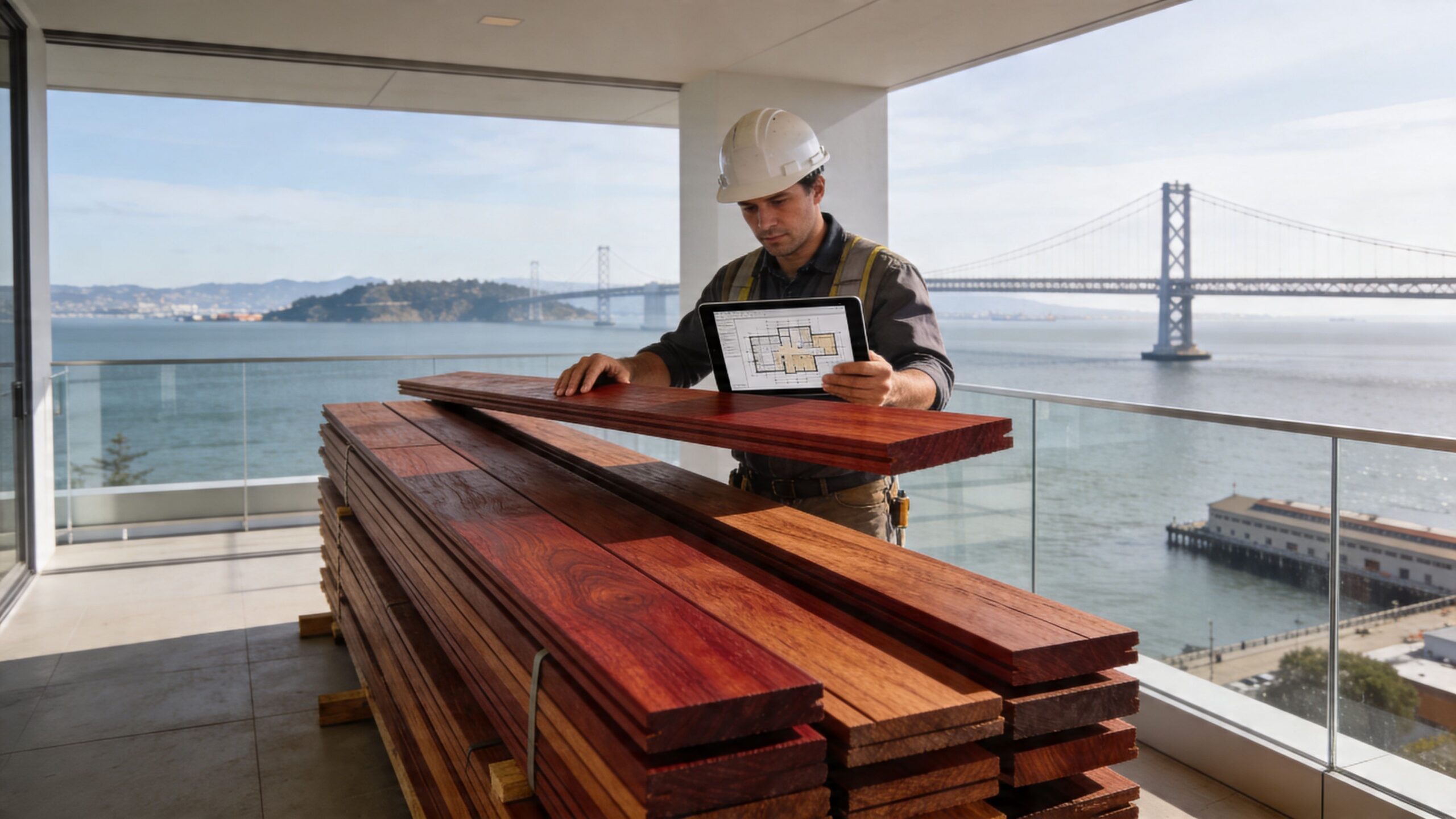
Quick Answer
A good fijian mahogany decking supplier does more than quote board footage. They should be able to verify legal sourcing, provide clear grade and moisture information, discuss Bay Area delivery realities, and answer practical code and installation questions so your deck performs the way the client expects.
If you're pricing a high-end deck right now, you're probably sorting through two problems at once. You need a hardwood that looks right for the job, and you need a supplier who can prove the material is what they say it is.
That second part matters more with Fijian mahogany than most buyers realize. A clean sample board means very little if the order arrives wet, mixed grade, poorly milled, or without the documentation your project team needs.
Why Choose Fijian Mahogany for Bay Area Decks
A homeowner in Oakland approves a warm reddish-brown sample on Monday. By Friday, you are checking exposure, sprinkler overspray, canyon wind, and whether the deck edge falls inside a tougher wildfire review path. This typifies a Bay Area decision. Species choice has to work on paper, on the truck, and five years after handoff.
Fijian mahogany stays in the conversation because it gives contractors a premium hardwood look without some of the jobsite punishment that comes with denser tropical species. It machines cleanly, finishes well, and tends to be more predictable under changing coastal and inland conditions than many clients expect from an exotic hardwood.

What contractors usually like about it
The appeal starts with workability. Fijian mahogany usually has a straight, uniform grain and a cleaner machining profile than many harder exotics, so crews spend less time fighting burn marks, chipped edges, and excessive tool wear. On a custom deck with visible picture framing, stairs, and fascia details, that matters.
It also looks expensive without needing a heroic amount of milling or finishing work to get there. Clients see the color first. Contractors notice the easier cutting, cleaner fastening, and more forgiving install pace.
That does not make it soft or disposable. It is still a premium hardwood, and it still needs proper spacing, fastening, and moisture control.
Why it fits Bay Area projects
Bay Area decks live in mixed conditions. Morning fog in the Sunset, dry afternoon heat in Walnut Creek, salt air near the water, and sharp seasonal swings in the hills all put movement and finish retention to the test. Fijian mahogany makes sense on projects where the client wants real wood, but the crew also wants a species that is less punishing to fabricate and install than the hardest tropical options.
I also like it for clients who care about appearance over time, not just day-one color. Finished boards hold the warm mahogany tone that sells the project. Left unfinished, the deck can weather to gray in a way that usually looks intentional rather than blotchy, as long as the layout sheds water and the maintenance expectations are clear from the start.
Show both samples. One freshly milled, one weathered.
That single step prevents a lot of callback conversations.
For Bay Area contractors, there is another practical factor. Local supply and service matter more than they do with commodity decking. If a board arrives with milling issues or the job needs a few replacement lengths to finish a stair run, a supplier you can reach in person is worth more than a slightly lower online number. If your client is still comparing species, this guide to what type of wood holds up best on a California deck gives a useful side-by-side view of where mahogany fits and where another material may be the better call.
What it does not solve on its own
Fijian mahogany is a good decking species. It is not a fix for poor deck design.
It will not overcome trapped moisture, flat framing, weak ventilation, or rushed acclimation. It also does not remove code questions that come up in parts of the Bay Area, especially on rebuilds and hillside work where WUI requirements, interface details, and inspection scrutiny can shape material decisions around the deck assembly, not just the deck board.
That is why supplier quality matters as much as species selection. Good material still performs badly if it shows up too wet, inconsistently milled, or mismatched from the sample set. On a premium job, the win is not just choosing Fijian mahogany. The win is getting the right stock, in the right condition, delivered on a schedule the crew can use.
Verifying Sustainable and Legal Supply Chains
A Bay Area deck order can look fine on paper right up to the day the truck shows up with mixed lengths, unclear species labeling, and no clean documentation for the file. That is usually not a milling problem. It starts upstream.
With Fijian mahogany, supply-chain verification is part of buying the material, not a paperwork exercise after the fact. Contractors working in high-expectation markets like Marin, Berkeley, Oakland, and the Peninsula need to know what they are getting, who handled it, and whether the supplier can support the claim if an architect, owner, or inspector asks questions later.
What a legitimate supply chain should show
Fijian mahogany is tied to a plantation-based system with government oversight, not a loose chain of mixed tropical hardwood sourcing. Fiji's forestry framework includes the Mahogany Industries Development Act 2010 and the Mahogany Branding and Licensing Act endorsed by Cabinet in 2011, administered through the Mahogany Industry Council and Fiji Hardwood Corporation Limited (Fiji Ministry of Forestry, 2024).
That matters for one reason. A credible supplier should be able to place the boards inside that system without hesitation.
Ask who imported the shipment. Ask which mill processed it. Ask what documents stay with the material from exporter to distributor. If the answer drifts into generic language like "island mahogany" or "South Pacific hardwood," treat that as a risk signal, especially if the job has design review, HOA scrutiny, or a client who wants sustainability claims documented in writing.
What to verify before you release a deposit
The cleanest way to handle this is to request documents before the order is locked, not after the material is already on the water.
Use questions like these:
- What exporter, plantation source, or licensed supply channel is tied to this batch
- What import, branding, or chain-of-custody documents can you share
- Is the product identified specifically as Fijian mahogany on the paperwork
- Can the supplier match the sample set to the actual unit being sold
- If replacement boards are needed later, can they supply the same grade and milling profile
Those questions do two jobs. They confirm legality and they expose whether the supplier controls inventory, or is brokering boards they have never seen.
A supplier who resists basic documentation requests usually creates problems somewhere else too.
Why Bay Area contractors should treat this as a logistics issue
Legal sourcing and schedule control are tied together. If the chain is unclear, the order is more likely to depend on a one-off container, relabeled stock, or a distributor with no local replacement path. That is how a premium deck package turns into crew downtime and change-order friction.
As noted earlier, Fiji has a long-established mahogany program. That gives buyers a real framework to verify against. It does not guarantee that every California seller is buying carefully or stocking consistently. The practical test is local. Can the supplier show the paperwork, confirm what is in the yard, and support a small follow-up order without starting the sourcing process over?
For contractors comparing certification language across species, this guide to eco-friendly lumber options in the East Bay is a useful reference because it puts environmental claims next to the purchasing questions that affect real jobs.
How to Qualify a Fijian Mahogany Decking Supplier
Many purchasing errors typically result from this approach. Contractors spend time comparing species, then choose the supplier based on whoever answered email first or posted the nicest photos.
That shortcut costs jobs. A real fijian mahogany decking supplier needs to qualify on paperwork, stock condition, local knowledge, and follow-through.

Start with the questions that expose weak suppliers
In Berkeley and Oakland, 40% of new deck projects are estimated to fall under WUI-related regulations, and a 2025 USDA report cited in industry analysis noted that only 15% of Fijian mahogany imports to the U.S. carry verified sustainable certifications like FSC (Conrad Forest Products analysis and cited 2025 data).
That doesn't mean you avoid the species. It means you don't assume the supplier has already done the verification for you.
Ask these questions directly:
- Can you provide documentation for sustainable certification if the project requires it
- Can you show documentation related to WUI use if the job is in a regulated zone
- Is this shipment heartwood-only decking grade, or is sapwood mixed in
- How was the material stored before sale
- What dimensions and profiles are in stock versus special order
- Can you replace damaged or out-of-spec boards without stopping the job
Supplier qualification checklist
| Qualification Area | What to Ask |
|---|---|
| Documentation | What origin, import, and certification records can you provide with this batch? |
| Grade control | Is the decking heartwood-only, and what defects are excluded from premium grade? |
| Moisture condition | Was it kiln dried, and can you confirm the target moisture range for delivery? |
| Inventory depth | Do you have enough matching stock for the full takeoff, plus waste and future repairs? |
| Milling quality | Are the boards consistently surfaced, profiled, and end-trimmed? |
| Bay Area code awareness | Can you discuss WUI questions and direct us to the right approval path for our jurisdiction? |
| Delivery support | Can you stage, protect, and schedule delivery for a tight urban jobsite? |
| Claims handling | What's the process if boards arrive damaged, twisted, or outside agreed grade? |
Look at the yard, not just the website
Photos won't tell you how the wood is stored. Go look if you can. If not, ask for current photos of the actual lot, not catalog shots.
You want to know:
Whether units are covered properly
Sun-baked top layers and wet bottom layers create headaches before install even starts.Whether lengths are mixed intelligently
Random length can be useful. It can also wreck layout efficiency if the bundle is sloppy.Whether the staff understands the material
Ask one install question. The answer usually tells you whether you're talking to a lumber desk or a call center.
If a supplier can't talk through fastening, moisture, or field handling, they probably shouldn't be supplying exterior hardwood.
Local knowledge matters more than people admit
A faceless online distributor may get wood to the port. That isn't the same as supporting a deck job in the East Bay. You need somebody who understands access limits, permit timing, weather exposure, and replacement logistics after delivery.
One local option contractors use for hardwood and decking discussions is choosing the right lumber supplier for your next project, which is useful because it focuses on the practical side of supplier fit rather than generic sales claims. That kind of local support is where yard relationships still beat anonymous e-commerce.
Managing Your Order from Sample to Final Price
A lot of order problems start because the sample and the shipment were never tied together. The sample looked clean. The delivered unit was mixed color, loose on moisture, and full of boards the crew had to sort out on site.

Start with physical samples
Don't buy premium hardwood from digital photos alone. Get actual boards or at least representative cut samples.
Check color range, grain character, surface texture, and machining quality. On a high-visibility deck, a small shift in tone may be fine. Wild variation across the whole unit usually isn't.
Tie the quote to a clear material description
Your quote should identify more than species and quantity. It should spell out grade, profile, nominal and actual dimensions if relevant, moisture condition if provided, and whether end-matching or special milling is included.
This is also where experienced buyers keep the freight conversation separate from the material conversation. If those numbers get blended too early, it's harder to compare suppliers fairly.
Inspect the order before the crew touches it
When the shipment lands, inspect before it gets scattered around the site.
Look for:
Milling consistency
Edges, grooves, and faces should be uniform enough that your reveal layout won't drift.Visible moisture problems
Watch for fresh movement, sticker stain, or obvious surface checking that suggests rough storage.Grade drift
A premium deck order shouldn't come padded with boards you'll only use in hidden cuts.
Get agreement in writing on what happens if the unit arrives outside the described grade. That's easier before delivery than after half the deck is installed.
Talk about price the right way
With premium hardwood, price isn't just material cost. It's yield, freight, breakage risk, replacement speed, and how much labor your crew burns sorting the load.
That means the cheapest quote is often the most expensive order. Ask for a full landed picture, realistic timing, and a clear process for shortage or damage claims. If the supplier can't give you that, the quote isn't complete.
Planning Jobsite Delivery and Logistics in the Bay Area
A hardwood order can be perfectly sourced and still go sideways on delivery day. Bay Area jobs are full of narrow streets, steep approaches, blocked curb zones, and tight unload windows.
Match the delivery plan to the neighborhood
Berkeley and Oakland jobs often have limited staging space. San Francisco sites add access and parking pressure. If the truck arrives before the crew is ready, or with no place to drop safely, the day starts behind.
Give the yard more than an address. Give gate notes, slope conditions, preferred truck size if access is tight, and where the material can sit without forcing the crew to move it twice.
Protect the wood before and after unload
Hardwood decking shouldn't show up wrapped in a way that traps water, and it shouldn't be dropped where irrigation, runoff, or direct ground contact can affect it. Confirm how the bundle is packaged and whether the jobsite has dry, ventilated storage ready.
For teams coordinating multiple stops or complex route sequencing, tools like this roundup of best mapping software can help dispatch and field crews tighten delivery windows. That's especially useful when a deck package has to land between other trades and limited street access.
Local delivery support beats generic freight on urban jobs
National freight can move material. It usually won't help much when the site needs a tighter arrival window, a smaller truck, or a call to the superintendent because the street is temporarily blocked.
That's where a local yard's delivery operation matters. If you're coordinating an exterior package in the East Bay, construction materials delivery details the kind of local support that keeps materials from becoming a scheduling problem the minute they leave the yard.
Preparing for Installation and Long-Term Care
A premium hardwood deck can still turn into a callback if the crew installs wet boards, rushes fastening, or leaves the stack sitting in trapped moisture for a week before layout. Fijian mahogany is forgiving compared with some harder tropical species, but it still rewards disciplined prep.

Start with stock that matches exterior use
Before a single board goes down, confirm the shipment is dried and stored for exterior decking work, not just pulled from a mixed hardwood rack. As noted earlier, supplier guidance for this material calls for kiln-dried stock in an exterior-ready moisture range, installed over properly spaced framing. The practical takeaway is simple. If the boards arrive too wet, expect movement, open joints, and more end checking after the first dry cycle.
Bay Area conditions make this step more important, not less. A load headed to a foggy San Francisco site behaves differently from one going to a hotter inland yard in Walnut Creek or Lafayette. Let the material acclimate under cover with airflow, then spot-check the bundle instead of assuming the whole lift is consistent.
Installation details that prevent avoidable problems
Good results come from a handful of habits the crew can control every day:
Pre-drill near board ends and edges
Fijian mahogany machines cleanly, but pre-drilling still lowers the chance of splitting and keeps the fastener pattern cleaner.Hold framing to the specified spacing
Do not stretch joist spacing because the board feels stiff during install. Decking that looks solid on day one can feel different after seasonal movement and regular foot traffic.Sort before layout
Blend color and grain changes across the field instead of installing straight from the top of the unit. That matters on higher-end Bay Area jobs where clients notice board-to-board variation right away.Control the stack at the site
Keep boards off the ground, shaded, and covered in a way that allows ventilation. Plastic wrapped tight over damp material causes its own problems.
On WUI-adjacent projects, installation planning should also include the assembly, not just the decking species. Confirm the full deck build-up, finish choices, and local interpretation with the design team or building department before the crew starts fastening boards.
Long-term care depends on moisture control more than species marketing
Owners usually ask whether Fijian mahogany is "low maintenance." The honest answer is that it needs normal wood-deck care and a realistic finish plan. If they want to hold the richer brown tone, they need cleaning and re-oiling on a schedule that matches exposure. If they are comfortable with natural weathering, the maintenance burden shifts more toward washing, inspection, and correcting drainage issues before they become decay issues.
I tell clients the same thing I tell crews. Water management decides a lot of the service life. End grain exposure, trapped leaf debris, poor airflow under the deck, and splashback at doors will shorten the life of almost any hardwood installation. This guide on how to prevent wood rot is useful for owners and junior supervisors because it focuses on the conditions that cause failure.
For a broad homeowner-friendly benchmark, this article on how long a wood deck typically lasts gives a reasonable starting point. Actual lifespan still comes down to design, exposure, finish maintenance, and whether the installer respected the material from delivery through final fastening.
Frequently Asked Questions About Fijian Mahogany
Is Fijian mahogany a good choice for a deck in Berkeley or Oakland?
Yes, if the material is properly sourced, stored, and installed. It works well on projects where the client wants real hardwood character without stepping into an extremely difficult-to-machine species. The supplier matters as much as the species.
How do I know a fijian mahogany decking supplier is legitimate?
Ask for origin and certification documentation, grade details, and moisture information tied to the actual shipment. A legitimate supplier should also be able to discuss delivery condition, replacement policy, and local project constraints without dodging the questions.
Does Fijian mahogany need a lot of maintenance?
It needs normal wood-deck maintenance, not neglect. If the client wants to preserve the warmer color, they'll need a finish plan and regular upkeep. If they accept natural weathering, maintenance becomes more about cleaning and monitoring than color preservation.
Can I use it on a project in a WUI zone?
Possibly, but don't assume. Ask for product-specific documentation and check with the local building department or design professional for the exact project requirements. WUI questions should be handled early, before material is ordered.
Should I buy online or from a local yard?
Online can work for commodity purchases. Premium hardwood decking is less forgiving. A local supplier is usually more useful when you need current stock information, Bay Area delivery coordination, and a real person to call if the order lands short or out of spec.
What should I inspect when the decking arrives?
Check grade consistency, milling quality, visible moisture issues, and whether the delivered bundle matches the quoted material. Don't let the crew spread the order all over the site before someone signs off on the condition.
Can Fijian mahogany be custom milled?
In some cases, yes. That depends on available stock, profile requirements, and lead time. Ask early if you need anything outside standard decking dimensions or matching accessories, because custom work changes scheduling.
If you're comparing options for a fijian mahogany decking supplier in Berkeley, Oakland, San Francisco, or the East Bay, Truitt & White is one local place to have that conversation in practical terms. For decking and building materials, contact the Lumberyard and Hardware at (510) 841-0511 or visit 642 Hearst Ave, Berkeley, CA 94710. You can also reach out through truittandwhite.com or email info@truittandwhite.com.
Sources
Nova USA Wood. "Fijian Mahogany Product Sheet." 2026. https://www.novausawood.com/PDFs/Fijian-Mahogany-Product-Sheet.pdf
Food and Agriculture Organization of the United Nations. "Fiji Mahogany." https://www.fao.org/4/y7207e/y7207e06.htm
Fiji Ministry of Forestry. "Mahogany Industry review and regulatory framework update." 2024. https://www.forestry.gov.fj/pressdetail.php?id=124
Conrad Forest Products. "Genuine Fijian Mahogany from Conrad is Beautiful, Durable and Above All Else Sustainable." https://www.conradfp.com/post/genuine-fijian-mahogany-from-conrad-is-beautiful-durable-and-above-all-else-sustainable