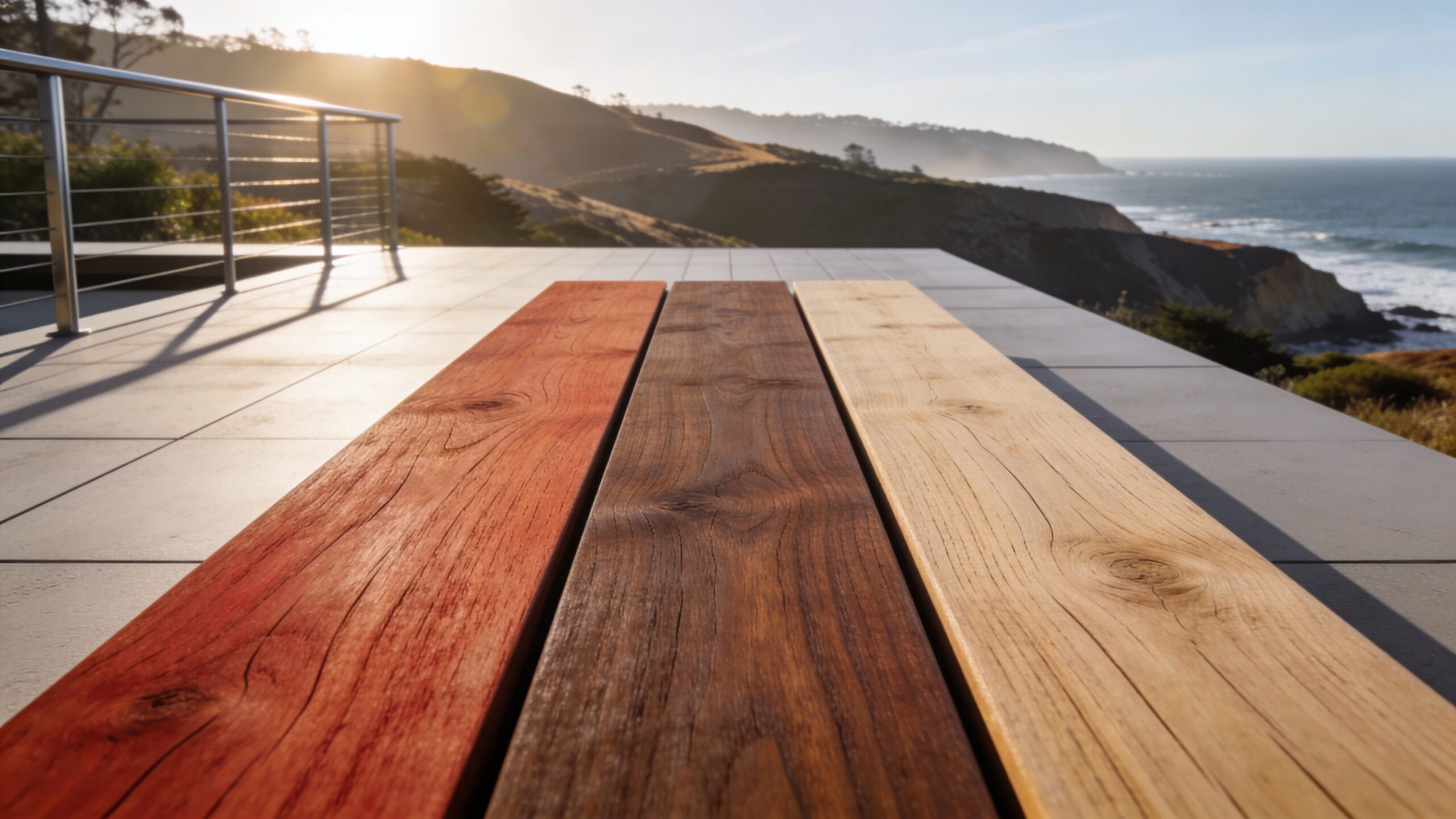
In California, the top-performing natural wood choices for decks are heart redwood, tropical hardwoods like IPE and Batu, and thermally modified wood. Each resists moisture and rot differently. Redwood is a time-tested regional option with natural tannin resistance. Tropical hardwoods offer exceptional density and longevity. The best choice depends on your site conditions, maintenance tolerance, and local permitting requirements.
A lot of builders ask this question when they are already deep into a job. The plans are moving, the client wants a natural wood deck, and now the material has to survive Bay Area weather instead of just looking good on a sample board.
If you want the short answer, Ipe holds up the longest, heart redwood remains the most practical regional wood choice, and thermally modified wood can make sense on select projects where moisture movement is the main concern. The right answer depends on where the deck sits, how much maintenance the owner will do, and whether local fire rules affect the job.
Why California Is Not One-Size-Fits-All for Decks
A deck in San Francisco does not live the same life as a deck in inland Oakland. Fog, long dry spells, sharp sun exposure, and salt air all change how wood moves, checks, and weathers.
The Bay Area makes this even more complicated. A shaded Berkeley yard can stay damp longer than the homeowner thinks. A hillside deck in the East Bay can face stronger sun, hotter temperatures, and stricter fire review.
Bay Area microclimates change the answer
The national advice you see online is often too broad. It may be fine for a generic backyard in a mild climate, but it does not help much when you are choosing boards for a coastal lot, a canyon exposure, or a home near a Wildland-Urban Interface zone.
Three site conditions matter most:
- Moisture exposure: Fog, marine air, and poor drainage increase the risk of decay and movement.
- Sun and heat: Full exposure dries boards hard, which can make lower-grade or less stable lumber crack and twist faster.
- Permitting and fire concerns: In parts of Berkeley and Oakland hills, approvals can depend on how the decking material performs under fire requirements.
If you are sourcing material locally, a yard that understands East Bay conditions matters as much as the species itself. This guide on quality lumber in the East Bay is useful if you are trying to match wood choice to site exposure instead of buying on price alone.
Tip: The best deck wood is not the one with the strongest sales pitch. It is the one that fits the jobsite, the budget, and the owner’s maintenance habits.
Approvals matter as much as durability
Some projects fail at the selection stage because people ask only what lasts longest. That is not enough in California. The better question is, what type of wood holds up best on a California deck and still makes sense for this property?
For a flat backyard in a protected neighborhood, you have more room to choose for appearance and budget. For a hillside remodel in a higher fire-risk area, material choice may need to clear more review before anyone places an order.
The Top Three Wood Decking Categories for Bay Area Homes
Builders in the Bay Area usually end up comparing three natural wood paths. They are not equal, and they should not be sold as if they are.

| Wood category | Where it fits best | Main trade-off |
|---|---|---|
| Heart redwood | Classic Bay Area residential decks | Needs regular care to keep color and performance up |
| Tropical hardwoods | High-demand decks where lifespan and fire performance matter | Higher upfront cost and harder installation |
| Thermally modified wood | Projects focused on improved stability and lower moisture uptake | Product choice and detailing matter a lot |
Heart redwood
Heart redwood has been a Bay Area standard for a reason. It works with the local climate, it finishes well, and it gives clients the warm natural look many of them expect.
California redwood heartwood grades last 15 to 20 years and outperform many other softwoods because of 23% greater strength and strong natural decay resistance, according to this outdoor wood comparison. For many builders, redwood is still the default starting point when the client wants real wood without moving into tropical hardwood pricing.
Tropical hardwoods
This group includes Ipe and other very dense hardwood decking options. These woods are chosen when the job calls for long service life, strong rot resistance, and a more premium feel underfoot.
They are not forgiving materials. Fastener choice, pre-drilling, board spacing, and movement planning all matter more than they do with softer woods.
If the client is still deciding between wood and low-maintenance synthetics, it helps to review broader decking made easy options including Trex. That keeps the conversation honest. Some buyers really want wood, and some just think they do.
Thermally modified wood
Thermally modified wood is the newer conversation. Heat treatment changes how the wood handles moisture, so it can be a smart fit for damp or shaded conditions where movement control matters.
It is not a miracle material. Good detailing, ventilation, and finish decisions still matter. But for the right Bay Area site, it is a serious option worth discussing.
Key takeaway: If the project calls for natural wood, most serious Bay Area comparisons come down to redwood, tropical hardwoods, and thermally modified boards.
Comparing Deck Woods Head-to-Head for Bay Area Conditions
The cleanest way to choose is to compare woods by what fails on Bay Area decks. Not by brochure language.

Durability and service life
If the question is pure lifespan, Ipe is the leader. Ipe averages 40 to 50 years, with some installations lasting up to 75 years when properly installed, and it carries a Class A fire-spread rating according to this decking durability reference.
That matters in California, especially where hot inland exposures and fire risk are part of the job. The same source notes Ipe has a Janka hardness rating of 3,680, which is far beyond softer domestic species.
Redwood sits in the practical middle. It does not compete with Ipe on lifespan, but it does compete well on workability, appearance, and regional fit.
Thermally modified wood belongs in the conversation when moisture control matters most, but the long-term Bay Area-specific comparison data is still thinner than many builders want. The category shows promise, but it requires more careful evaluation project by project.
Maintenance and weathering
Every wood deck weathers. The question is how it ages and what the owner expects to do about it.
- Redwood: Takes stain and penetrating oil well. If left natural, it weathers toward gray. Many owners like that look, but they should decide early.
- Ipe and similar hardwoods: Weather to silver if left alone. If the owner wants the deep brown color, they need periodic oiling.
- Thermally modified wood: Usually appeals to owners who want a cleaner, more modern look and improved stability, but finish schedules still need to be planned.
Ipe’s density reduces maintenance needs to occasional oiling every 1 to 2 years, and the same source notes a lower total cost of ownership over 20 years when replacements and labor are factored in, despite the higher upfront cost of $8 to $12 per linear foot versus pine at $2 to $4 in that comparison. That is a useful lens for high-end jobs where the owner plans to stay put.
Fire, rot, and insect resistance
Broad internet advice usually falls apart here.
Ipe performs well because of its density and fire rating. In higher-risk areas, that can push it ahead quickly. The same source notes California wildfires have scorched over 4.3 million acres since 2000, which explains why fire-rated material selection matters so much on some East Bay projects.
Redwood brings natural resistance to decay and insects without chemical treatment. That makes it attractive for owners who want a regional wood with a cleaner environmental story and easier field work.
Thermally modified wood can help with moisture-related performance, but contractors still need to verify the exact product, assembly, and code fit before treating it as interchangeable with hardwoods.
For decks exposed to persistent dampness, drainage and airflow matter as much as species. This primer on how to prevent wood rot is worth reviewing before final detailing.
Cost and field handling
Not every deck needs the longest-lasting wood. Some need the smartest balance.
Here is the practical field view:
- Choose redwood when you want a strong Bay Area fit, easier cutting and fastening, and a natural wood deck that does not fight the installer.
- Choose Ipe when lifespan, density, and code-related fire performance carry more weight than labor speed or upfront board cost.
- Choose thermally modified wood when the owner values movement control, a different look, and is open to a less traditional product path.
Redwood is easier on blades, easier on crews, and easier to adapt on custom layouts. Tropical hardwoods are tougher in every sense. They ask more from the installer and from the estimate.
The Truth About Pressure-Treated Deck Boards in the Bay Area
Pressure-treated lumber still has a place on a deck. It is just not the place many homeowners think.
For framing, posts, and structural members, pressure-treated stock is often the right call. For the finished walking surface on a Bay Area residential deck, it usually is not.
Good for framing, weak for the finish surface
Pressure-treated pine decking boards often start showing checking and warping within a few years where moisture swings are common, while redwood holds better dimensional stability and can last 20 to 30 years with proper care, as noted in this Bay Area deck wood guide. That matches what contractors see in the field.
The problem is not strength alone. It is movement, appearance, and the way treated boards dry out over time.
Why clients notice the difference fast
A homeowner may accept pressure-treated framing because they never see most of it. They notice deck boards every day.
Common complaints show up fast:
- Surface checking: The boards crack and open as they dry.
- Warping and twist: Sun and moisture swings pull boards out of plane.
- Lower visual quality: Even when structurally sound, the surface rarely looks like a premium finished deck.
If you need a quick technical refresher before spec’ing framing versus finish boards, this overview of what pressure-treated wood is lays out where it fits.
Pressure-treated pine is a framing material first. On Bay Area finish decks, it is usually a compromise that owners regret.
How to Choose the Right Deck Wood for Your Project
The right material choice usually comes from three decisions. Site, maintenance, and budget. Miss one of them and the deck may still get built, but it will not age the way the client expects.

Start with the site, not the sample
A board sample on a counter tells you almost nothing about the job itself. Ask where the deck sits.
A foggy Berkeley yard with tree cover asks for a different strategy than a hot, exposed Oakland backyard. If the home sits near a WUI area, material choice may narrow fast.
Look at these conditions first:
- Sun exposure: Full sun punishes softer, less stable boards.
- Moisture pattern: Fog, sprinklers, poor drainage, and shade increase risk.
- Airflow: Tight skirting and low clearance can shorten deck life.
- Code context: Fire review can shift the whole material conversation.
Be honest about maintenance tolerance
A lot of bad deck choices come from optimistic promises. Owners say they will oil or seal the deck regularly. Then life gets busy.
Ask the owner one direct question. Do you want to maintain color, or do you only care that the deck remains sound?
- If they want warm natural color, redwood and Ipe both need finish planning.
- If they are fine with a silvered weathered look, some woods become easier to live with.
- If they want less visible movement in a damp setting, thermally modified wood may be worth a closer look.
For clients who care about sourcing and lower-impact material choices, this guide to eco-friendly lumber in the East Bay helps frame the conversation.
Look at total cost, not just the order total
The cheapest board on bid day can be the expensive one later. Replacement labor, shortened service life, callbacks, and finish failure all count.
Ipe shows this clearly. Its upfront cost is higher, but its service life and lower replacement cycle can justify that on long-hold properties. Redwood often wins where the owner wants a lower initial spend without dropping into a visibly lower-grade result.
If you are weighing specific species and product lines, a good decking materials guide helps narrow what is practical for the project instead of comparing every product on the market. Truitt & White also stocks multiple deck material categories, so builders can compare species, grades, and fastening approaches in one place rather than guessing from online listings.
The right deck wood is the one that still makes sense after you account for site exposure, finish schedule, installation labor, and likely replacement timing.
Essential Fasteners and Finishes for a Long-Lasting Deck
A solid species choice can still fail if the hardware and finish are wrong. Good deck jobs separate from callback jobs here.
Fasteners need to match the wood
Use corrosion-resistant fasteners, especially with redwood and in coastal air. Tannin-rich woods and wet conditions can leave ugly staining fast if the hardware is not compatible.
For dense hardwoods like Ipe, plan on pre-drilling or using fastening systems made for hardwood decking. Trying to force a generic screw schedule into a dense tropical hardwood job wastes time and can damage boards.
Finishes should soak in, not sit on top
Film-forming finishes often look good early and fail badly later. They can peel, chip, and turn routine maintenance into a stripping job.
Penetrating oils are usually the more practical choice for natural wood decks in the Bay Area. They fade more gracefully and are easier to maintain.
If a homeowner is preparing an older deck before refinishing, this guide on how to prepare your deck for staining gives a useful step-by-step overview of prep issues that affect finish performance.
A few finish rules hold up well in the field:
- Clean first: Dirt and old residue block absorption.
- Test the look: Some woods change color more than owners expect after oiling.
- Set expectations early: A natural wood deck either gets maintained for color or it weathers on purpose.
Frequently Asked Questions About Bay Area Decking
What type of wood holds up best on a California deck?
For pure lifespan, Ipe is the strongest natural wood choice in this guide. For many Bay Area homes, heart redwood remains the most balanced choice because it fits local conditions, installs more easily, and still delivers good long-term performance.
Is redwood or pressure-treated pine better for Bay Area deck boards?
Redwood is usually the better finish-decking choice in the Bay Area. Pressure-treated pine still makes sense for framing, but it is more likely to check, warp, and look rough as an exposed walking surface.
Does Bay Area fog change what wood I should use?
Yes. Fog and slow drying can shorten the life of less stable or less decay-resistant boards. On shaded sites in Berkeley or San Francisco, wood selection, drainage, and ventilation all matter more than they do on a dry inland yard.
Do I need a fire-rated deck material in Berkeley or Oakland hills?
Sometimes, yes. If the project sits in or near a higher fire-risk area, check local review requirements before finalizing the spec. Fire performance can narrow your options quickly, especially on hillside projects.
Is thermally modified wood better than redwood?
Not automatically. Thermally modified wood can be a smart choice where moisture movement is the main concern, but redwood still has strong advantages in familiarity, availability, and local track record.
What is the best finish for a natural wood deck?
For most Bay Area wood decks, penetrating oils are more practical than thick film-forming coatings. They are easier to maintain and less likely to peel when the deck goes through wet and dry cycles.
How should I maintain a deck around a pool?
Pool decks need regular cleaning because water, debris, and surface buildup can make boards slippery and rough faster. If that is part of your project, this practical guide to maintaining your deck, especially around a pool is a helpful reference.
Do the 2026 California Energy Code and Title 24 window requirements affect deck wood choice?
Not directly. The California 2025 Title 24 Energy Code, effective January 1, 2026, focuses on building energy performance, so terms like Bay Area windows and doors, Title 24 window requirements, and energy-efficient windows in the Bay Area matter for enclosure design, not deck board species.
What about Climate Zone 3 requirements and U-Factor rules?
Those apply to fenestration and building envelope work, not decking. If you are handling an addition or ADU at the same time, Climate Zone 3 windows and the U-Factor ≤ 0.27 requirement belong in your window package review, not your decking spec.
Do 20 percent glazing limits under prescriptive compliance affect Bay Area building materials for decks?
No. The 20% glazing issue is part of window and door compliance under prescriptive energy rules. It does not control what wood you use for a deck, though it may affect the larger remodel package if you are also changing openings and selecting Bay Area windows and doors.
If you are choosing deck wood for a Berkeley, Oakland, San Francisco, or East Bay project, visit Truitt and White for material guidance tied to real Bay Area site conditions, not generic national advice.