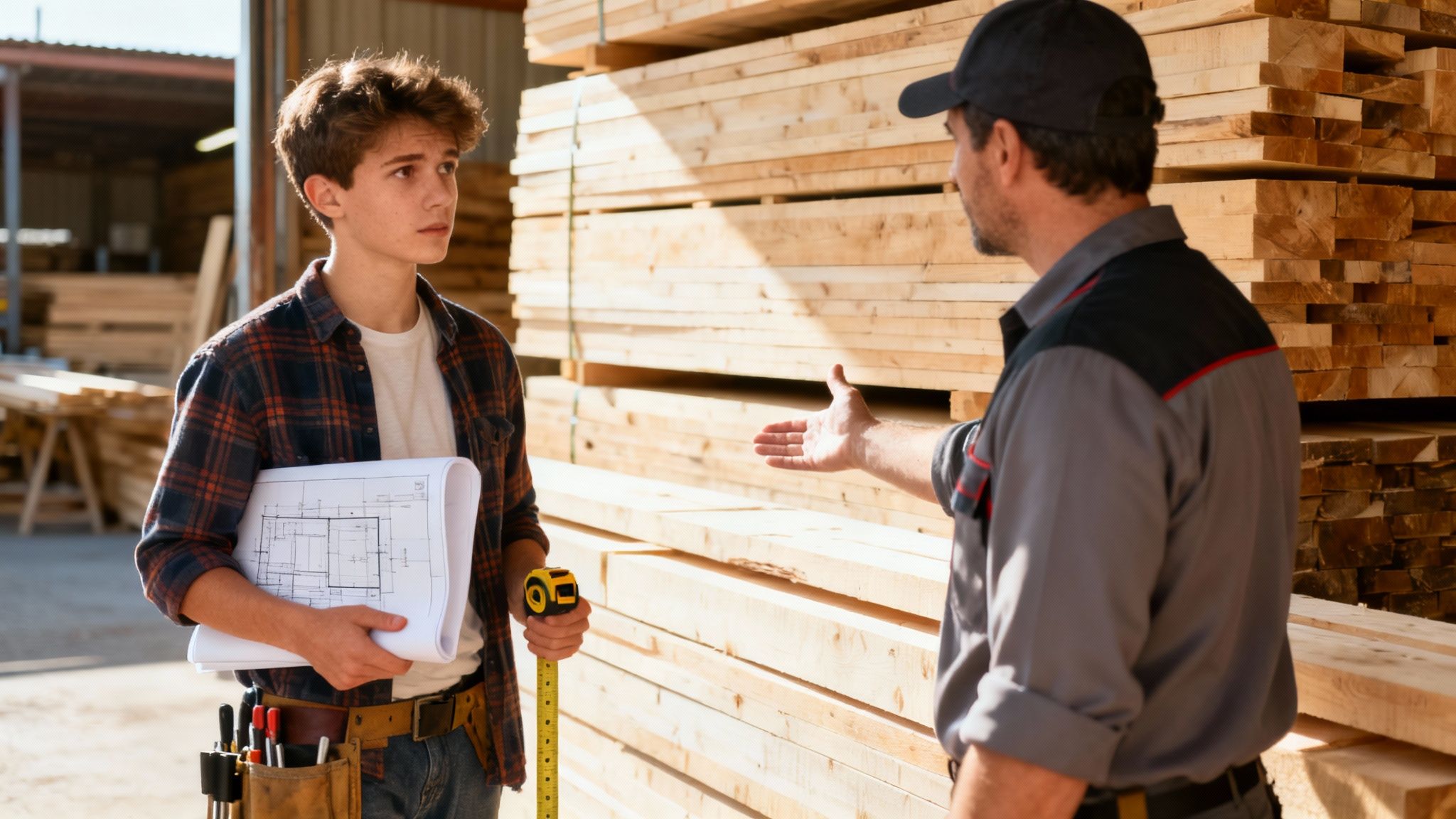
Yes, feeling lost at a lumber yard is completely normal, especially for a DIYer. If you've ever felt overwhelmed walking into one, you are not alone. Unlike big-box stores designed for casual browsing, a real lumber yard is set up for pros, which can feel intimidating for a first-timer.
Many first-time lumber buyers report feeling confused or even "talked down to" at traditional yards. The biggest complaints are often the lack of posted prices, unclear terminology, and intimidating counter experiences. This confusion often drives customers back to big-box stores, even when they'd prefer to support a local business.
Why Lumber Yards Can Seem Confusing
Stepping into a traditional lumber yard can feel like you've entered a private club where you don't know the secret handshake. These places are less like a retail store and more like a professional workshop. They are built for speed and efficiency, not for leisurely browsing.
The first thing that throws people off is the lack of clear signage and prices on the wood. This isn't meant to be secretive; it's because lumber is a commodity, and prices can shift daily or weekly. Tagging every single board isn't practical, so pros know to simply ask for the day's price at the counter.
Built for Professionals, Not the Public
Then there's the language. You’ll hear staff and contractors using terms like "board feet," "nominal dimensions," and specific lumber grades. These are the precise terms contractors need to accurately order thousands of dollars worth of material for a job.
A common misstep DIYers make is assuming they need to know all the specs before walking in. This pressure causes many people to leave without asking for help. A good lumber yard will have staff ready to guide you, no matter your experience level.
The physical layout can also be a puzzle. Materials are stacked and organized by type and species, not by project. This logic makes sense when a forklift needs to grab a massive bundle of Berkeley building materials for a contractor, which is the yard's primary business. For example:
- Framing lumber is often in huge, open stacks for quick loading.
- Specialty hardwoods might be in a protected area to stay in pristine condition.
- Plywood and sheet goods are typically stored together in large, covered racks.
If you’re a homeowner in Oakland looking for a few boards, this system can seem chaotic. But understanding that the yard is designed for a different type of customer is the first step. You can learn more about what makes a local Bay Area lumber yard unique to feel more prepared for your visit.
How a Professional Lumber Yard Is Organized
While a professional lumber yard might seem chaotic at first, there's a method to the madness. The layout is all about efficiency. Unlike a big-box store with aisles labeled "Decking," a pro yard groups materials by their core characteristics.
The entire space is organized for function and access. High-volume materials, like framing lumber, are kept in large, open-air stacks. This lets forklifts get in and out quickly to load massive orders for projects across the Bay Area.
Navigating the Different Zones
Most lumber yards are split into a few distinct areas. Knowing what to expect can help you build a mental map before you arrive.
- The Main Yard: This is where you'll find bulk construction materials like Douglas fir for framing, redwood, and cedar. It's built for heavy equipment.
- Covered Sheds: Anything that needs to stay out of the Bay Area's fog and rain, like plywood and OSB, is kept in covered racks.
- Specialty and Finish Woods: Finer hardwoods and trim are stored indoors to prevent warping or damage.
- The Hardware Counter: This is mission control. Here you’ll find fasteners, tools, and expert staff to help you place your order.
This diagram shows the two main paths a DIYer can take when it’s time to buy materials.
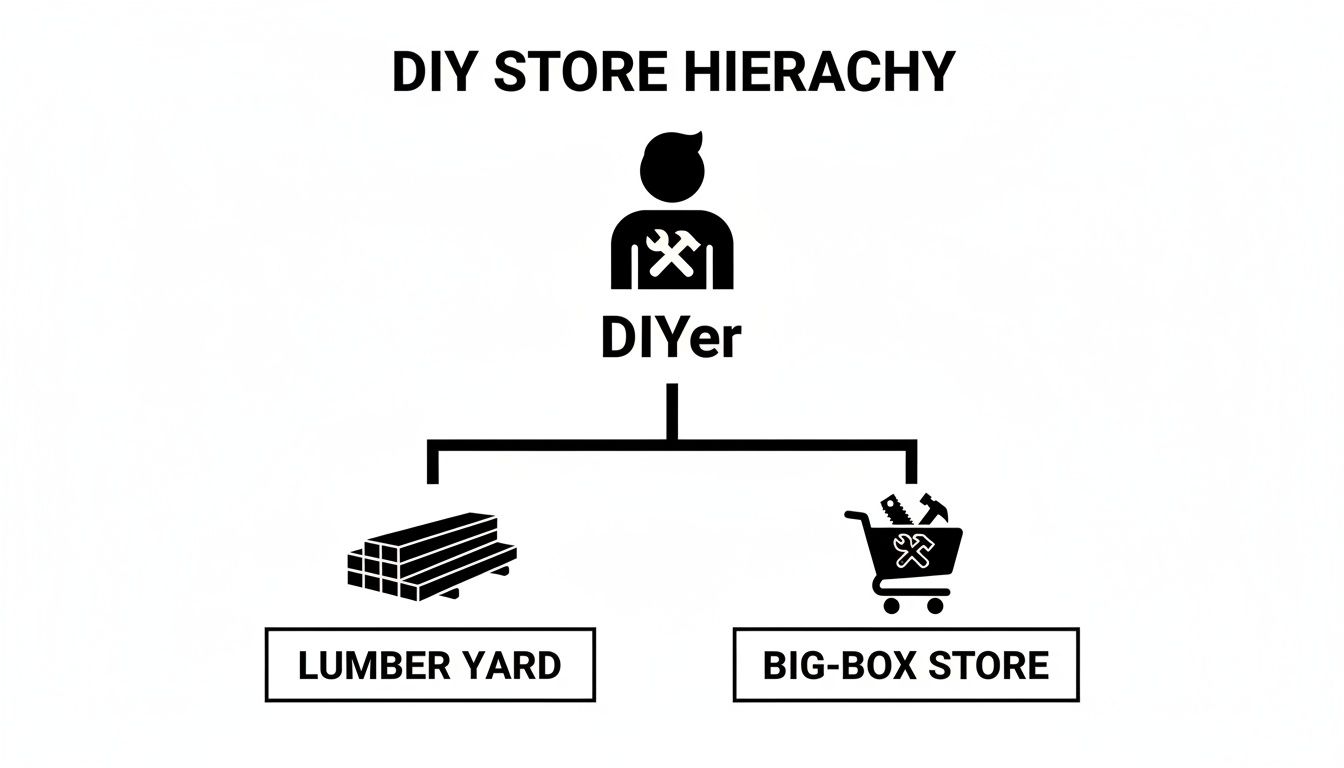
While both options get you to your goal, they are fundamentally different environments designed for different purposes.
The Logic of Grouping Materials
A lumber yard categorizes wood in a way that makes sense for professionals ordering in bulk. It’s less like a grocery store and more like a warehouse library.
The most important thing to remember is that materials are grouped by what they are, not what they're for. You won't find a "bookshelf" section, but you will find stacks of pine or oak boards sorted by grade.
The table below breaks down this organizational difference for a few common project materials. It’s a handy cheat sheet that shows you how to adjust your thinking from a retail mindset to a yard mindset.
Finding Your Materials a Lumber Yard vs Big-Box Store Comparison
| Project Material | Where to Find It in a Big-Box Store | Where to Find It in a Lumber Yard |
|---|---|---|
| Boards for a Deck | In the "Decking" aisle, next to composite boards and railings. | In the pressure-treated section or among redwood/cedar stacks. |
| Wood for a Raised Garden Bed | Possibly in a "Gardening" or "Fencing" section. | With the other untreated redwood or cedar boards, sorted by dimension. |
| Plywood for a Subfloor | In the "Plywood & Sheet Goods" aisle, possibly near flooring. | In a covered shed with all other sheet goods, sorted by thickness/grade. |
| Trim for a Window | In the "Moulding & Trim" aisle. | Indoors with other finish-grade lumber, sorted by wood species/profile. |
In a lumber yard, the product's identity—its species, size, and treatment—is what matters. Everything is sorted by these core traits.
For example, all pressure-treated wood will be in one area. Likewise, you'll find lumber sorted by:
- Species: All Douglas fir will be together, separate from the redwood.
- Dimensions: Within each species, boards are stacked by size (2x4s, 2x6s, etc.).
- Treatment: Pressure-treated or fire-retardant lumber gets its own section.
Once you grasp this logic, you can head to a yard in Berkeley or Oakland knowing how to find what you need. Instead of searching for a project, you’ll be looking for a specific material.
Cracking the Code: Essential Lumber Yard Lingo
One of the biggest reasons walking into a lumber yard feels intimidating is the language barrier. Pros use a shorthand to talk about wood. But learning just a few key terms will give you the confidence to explain what you need.
Think of it like ordering coffee. You don't just ask for "coffee"; you specify a latte or cold brew. Knowing the right terms for lumber helps our team grab the perfect materials for your project.
Nominal vs. Actual Dimensions: The 2×4 Mystery
The first concept that trips up most beginners is the difference between nominal and actual sizes. A "two-by-four" (a 2×4) is not actually two inches by four inches. Those are its nominal dimensions—the rough size before it was dried and smoothed.
After milling, its actual size is closer to 1.5 inches by 3.5 inches. This is the standard for all dimensional lumber. Knowing this can save you frustration when your project measurements don't line up.
Decoding Lumber Grades and Finishes
Not all wood is created equal. Lumber is sorted into different grades based on its appearance and strength. For most DIY projects, you'll likely use "#2 & Btr" (Number 2 and Better), which is a great, cost-effective choice for general construction.
You'll also see terms that describe the wood's surface finish:
- S4S (Surfaced Four Sides): This means the board has been smoothed on all four sides. It’s ready for projects like shelving or trim.
- Rough Sawn: This lumber has a more textured, rugged surface. It’s perfect for rustic designs.
- Board Foot: This is a unit of volume, not length, calculated as (Thickness in inches x Width in inches x Length in feet) / 12. You'll hear this term more with hardwoods.
Getting familiar with different cuts, like understanding how quarter sawn lumber is milled, can also make your selection process much easier.
Your Project in Lumber Terms: Let's say you're building a bookshelf. Instead of asking for "wood for a bookshelf," you could say, "I need four S4S pine boards that are actually ¾-inch thick and 8 inches wide." That clarity points our team in the right direction.
While these terms are helpful, you don't need to memorize a textbook. At a friendly yard like Truitt & White, our team is always ready to translate your goals. To learn more, check out our guide on understanding framing lumber grades.
Your Pre-Visit Checklist for a Successful Trip
Walking into a lumber yard unprepared can be overwhelming. But with a little prep, your trip can be smooth and efficient. Getting organized beforehand saves time and gives you the confidence to ask the right questions.
It’s all about turning your idea into a clear plan. This simple checklist will help you have a productive conversation with the staff, whether you're in Berkeley, Oakland, or anywhere in the Bay Area.
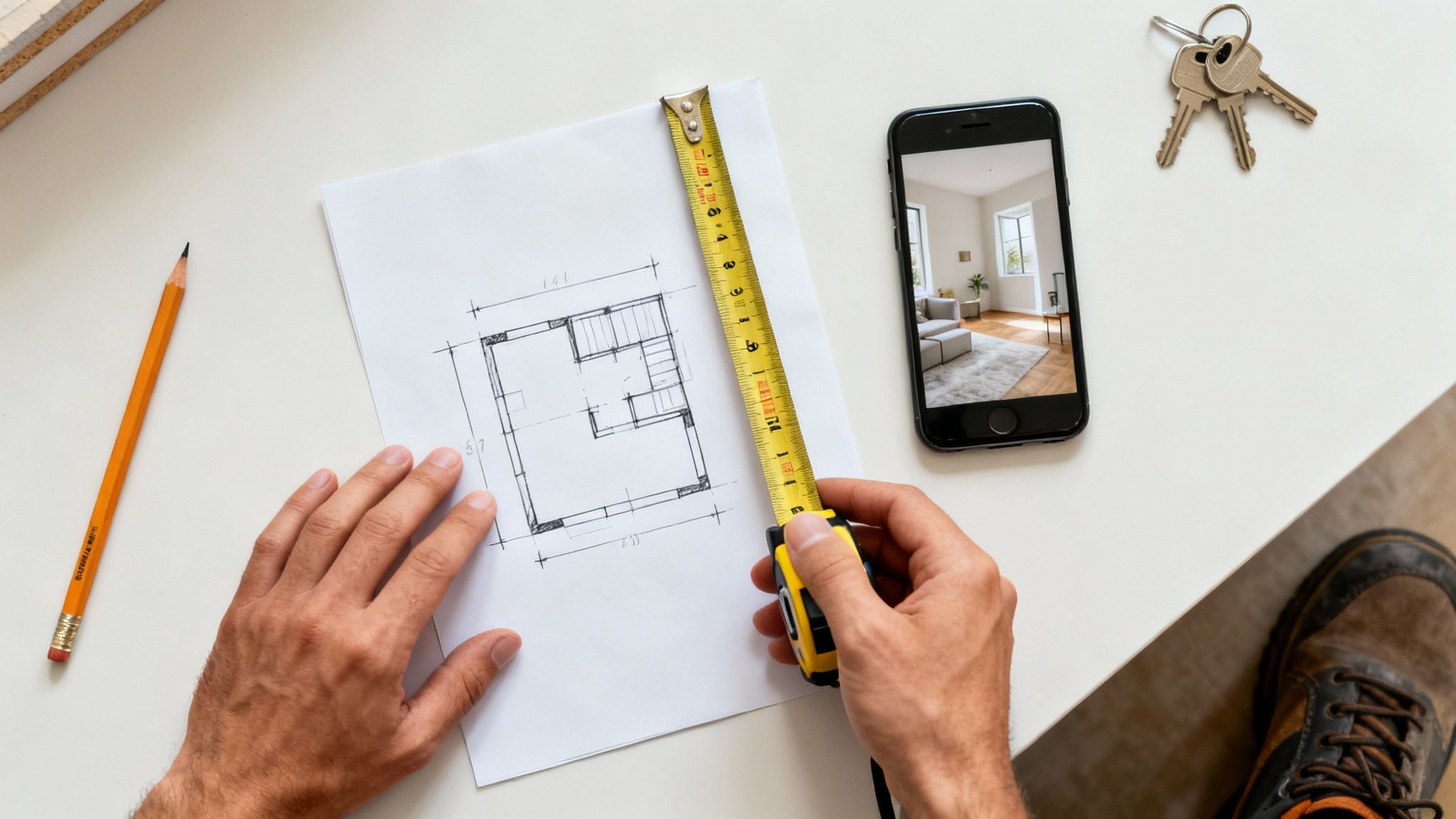
Gather Your Project Details
Before you leave, pull together all the essential info about your project. This is the single most important thing you can do. Even a rough sketch and some basic numbers are a huge help.
A common mistake is thinking you need to know all the technical jargon before you show up. A lot of DIYers get intimidated and leave without asking for help. We want you to have a better experience.
Here’s what you should have in hand:
- Project Plans or a Sketch: A simple drawing on paper works wonders. It gives the staff a visual of what you’re building.
- Accurate Measurements: Measure twice, buy once. Write down the length, width, and height for every piece of wood you'll need.
- Photos of the Project Area: A few pictures on your phone provide priceless context, especially if you’re matching existing materials.
Having these items on hand turns a vague request into a specific goal. Instead of saying, "I need some wood for a shelf," you can show your drawing and say, "I need boards to build this 4-foot-wide shelf." It's a game-changer.
Plan Your Logistics and Safety
Beyond your project specs, a few logistical checks will make your trip easier. A simple phone call can save you time and frustration.
Before you leave the house, make sure to:
- Call Ahead to Check Stock: If you need a specific type of wood, like redwood for a Bay Area garden project, call to ensure it's available.
- Understand Loading Policies: Ask how loading works. Most yards, including Truitt & White, have staff to help you load heavy materials safely.
- Wear Appropriate Gear: A lumber yard is an active work zone. Always wear sturdy, closed-toe shoes.
By preparing ahead, you set yourself up for a successful visit. To make things even easier, download this handy building materials list template to organize your shopping list.
How to Find a DIY-Friendly Lumber Yard in the Bay Area
Not every lumber yard is set up for the weekend warrior. The trick is to find one that welcomes DIY customers and is happy to meet you at your experience level. So, how do you spot the right local partner for your project?
A friendly, patient counter staff is your best clue. When you ask a question, you should feel helped, not judged. A willingness to answer questions without making you feel like a rookie is the hallmark of a DIY-friendly yard.
Look for Signs of a Welcoming Environment
Beyond a great team, look for other signs that a lumber yard serves everyone. Clear signage, well-organized materials, and a clean, safe yard are all green flags. You want a place that feels like a community resource, not an exclusive club.
One of the biggest frustrations for DIYers is pricing. While lumber costs fluctuate, a customer-focused yard is transparent. The best ones will post weekly pricing for common materials to help you budget with confidence.
A truly DIY-friendly lumber yard invests in its customers' success. They know that a homeowner who builds a planter box today might return to build a deck tomorrow.
What to Do Instead of Leaving
Choose a lumber yard that welcomes beginners. Look for one that posts weekly pricing, allows you to ask questions without judgment, and helps you find the right material for your job. Some even offer guides or staff walkthroughs to explain the basics.
Here’s what to look for:
- Willingness to Translate: The staff should take your project idea and help you turn it into a specific materials list.
- No Minimum Orders: You should feel just as welcome buying one board as you would a full truckload.
- Educational Resources: Some yards offer online guides, project templates, or have staff happy to offer practical advice.
At Truitt & White, we are proud to be that friendly neighborhood yard for the Bay Area. We are dedicated to serving every customer, from contractors to first-time builders in Berkeley and Oakland. You can learn more about our commitment to providing quality lumber for the East Bay.
Why Bay Area DIYers Build with Truitt & White
Walking into a professional lumber yard can feel intimidating, but it doesn't have to be. At Truitt & White, DIYers are always welcome. We have spent decades bridging the gap between pro-grade materials and the passionate DIY community in the Bay Area.
We know that feeling lost often comes from a lack of clear information. That’s why we post our prices for common lumber weekly—no secrets, no guesswork. It’s a straightforward way to give you the transparency you need to budget with confidence.
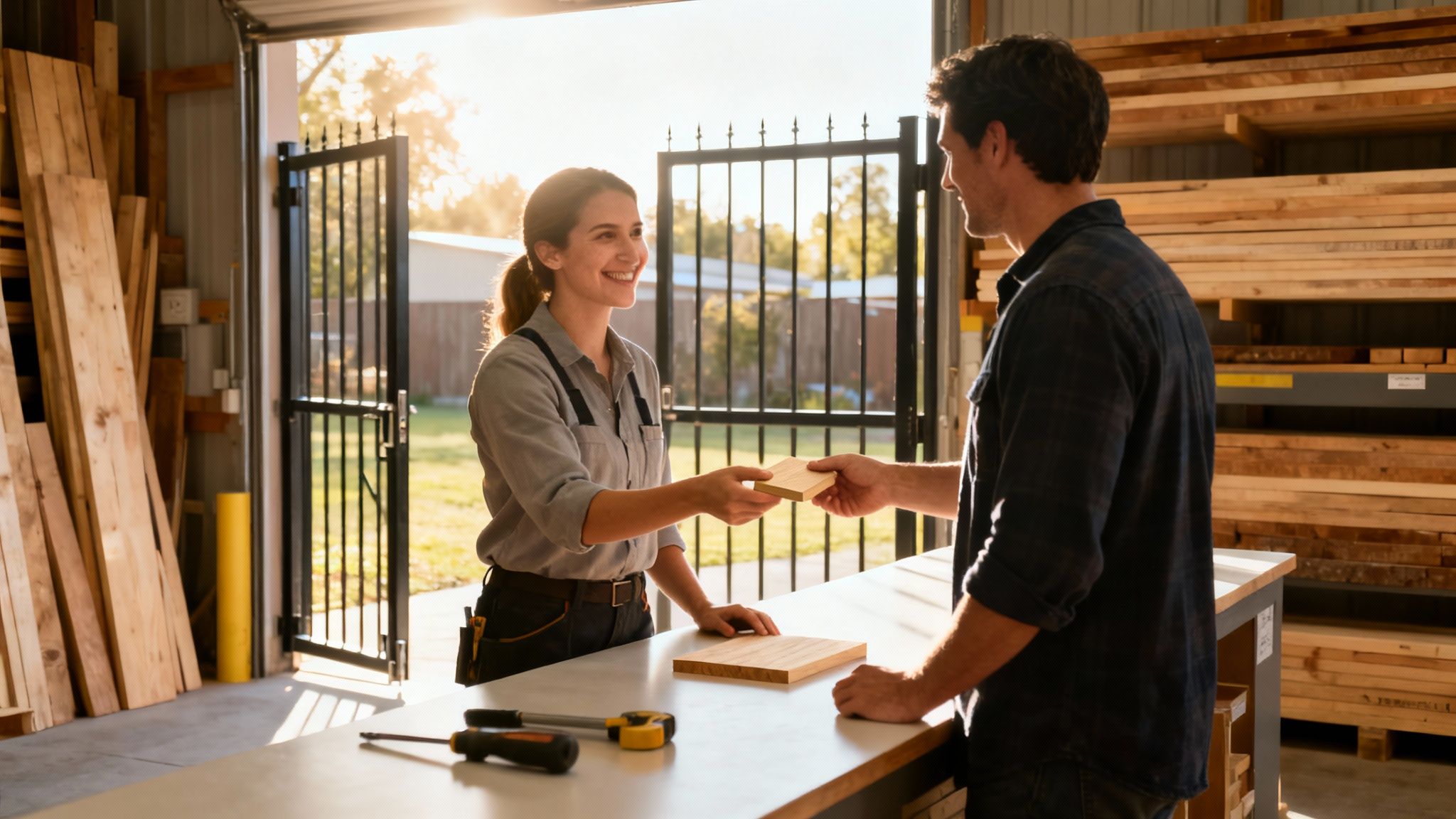
Your Project Partner in Berkeley
You don’t need to be an expert to get expert service here. Our staff is fantastic at taking your ideas—even if scribbled on a napkin—and turning them into a practical, jargon-free materials list. Our team is trained to support all experience levels, not just pros.
We’re committed to making sure you never feel talked down to. Whether you're building a bookshelf or a shed, we'll walk you through it without the jargon.
Located in Berkeley and serving the East Bay, Truitt & White is the friendly neighborhood yard where DIYers don’t need to “know it all” before showing up.
Stop by our yard at 642 Hearst Ave or explore our online resources to start your next project with confidence. Learn more about what makes Truitt & White the best choice for Bay Area DIYers and see the difference for yourself.
Frequently Asked Questions (FAQs)
Can I really just buy one or two boards?
Yes, absolutely. While we handle large orders for contractors, we're just as happy to help you find a single perfect board for a small project. At Truitt & White, no project is too small to get our full attention.
Do I have to load the lumber into my car myself?
Not at all. Professional yards like ours are equipped with forklifts and staff ready to help you load heavy materials safely. Just ask about our loading process when you arrive.
What if I don't know the exact name of the wood I need?
No problem, this is very common. Bring a photo of what you're trying to match or a description of your project. Tell us you're building an outdoor planter box, and our crew will help you find the right material for the job.
Is a lumber yard actually cheaper than a big-box store?
Our prices are very competitive, especially on higher-quality materials. The real value comes from the superior quality of the wood, the massive selection, and the expert guidance you receive, which saves you money by preventing costly mistakes.
Is it okay to ask for help figuring out my project list?
Definitely. It’s one of the biggest reasons to shop at a local yard like ours. Our team is fantastic at helping you create an efficient materials list from your plans to keep waste to a minimum.
Ready to start your next project with total confidence? The expert team at Truitt & White is here to help you navigate our Berkeley lumber yard and find the perfect materials. Visit our Berkeley showroom for expert advice.