Direct Answer: Roof water that isn’t directed away from your foundation causes most interior storm damage. Check your flashings, gutters, and downspout discharge points before the rains arrive.
Most Bay Area homeowners think about their roof once a year — usually the morning after the first storm when there’s a wet spot on the ceiling. But the damage that shows up inside almost never started inside. It started at the roofline, six months earlier, when no one was looking.
The November 2024 atmospheric river hit the East Bay hard and fast. Soils that had dried out over summer became fully saturated within 48 hours, and back-to-back storms gave them no time to recover. What failed on most properties wasn’t the roof membrane itself — it was the drainage system around it. Blocked gutters, short downspouts, and discharge points aimed straight at foundations did more damage than the rain totals ever suggested they would.
This guide walks through a practical roofline-down inspection sequence — roof penetrations first, then gutters, then where the water actually ends up. Contractors and serious homeowners can use it to find the weak points before the first storm of the season does the finding for you.
Start at the Top: Penetrations, Flashings, and Skylights
Every inspection should begin at the highest point on the roof and work down. That means looking at anything that breaks the roof plane — pipe boots, plumbing vents, HVAC penetrations, skylights, and chimneys. These are where water finds its way in, and they’re almost always where interior leaks originate.
Flashings are the sheet metal or rubberized membrane pieces that seal the transition between a penetration and the roofing material around it. They fail in predictable ways: the caulk cracks, the metal lifts at a corner, or a collar loosens after years of thermal expansion and contraction. In the Bay Area’s fog-heavy climate, that moisture cycle is more aggressive than in drier inland climates — materials expand and contract more often, and organic debris accumulates faster.
Before the season starts, look for:
- Caulk that is cracked, pulled away, or missing entirely around pipe boots and stack vents
- Lifted or separated metal at chimney step flashings and counter-flashings
- Skylight frames where the sealant bead has dried and cracked
- Any area where roofing material appears buckled, lifted, or visibly separated from a transition
If you’re on a flat or low-slope roof — common on commercial buildings along San Pablo Avenue and on older Berkeley bungalows with built-up additions — also check that roof drains and scuppers are clear of debris and that the drain collar is still sealed to the membrane. A plugged roof drain on a flat commercial roof can pond six inches of water in a matter of hours.
Gutters and Roof Drains: Where Clogs Become Damage
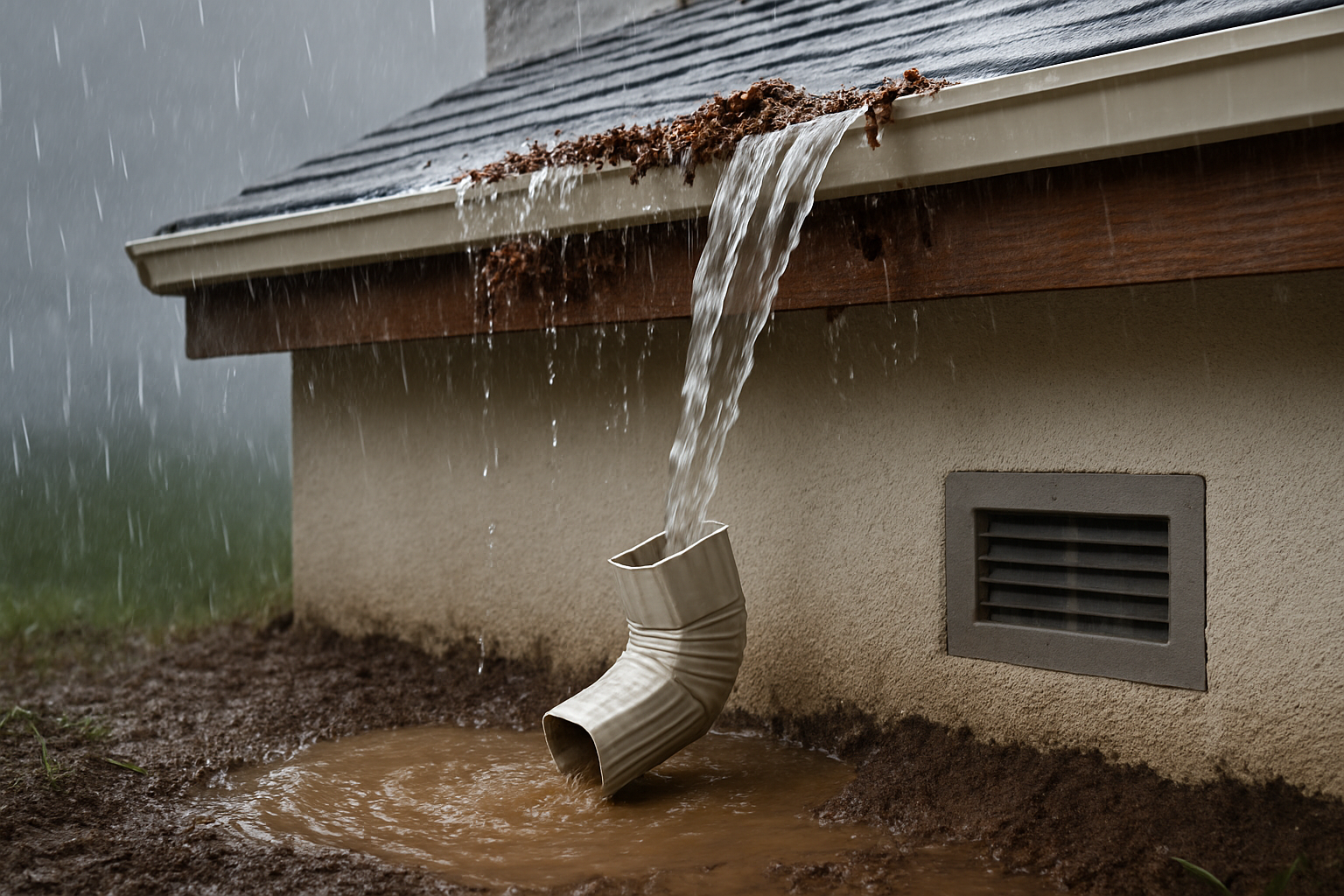
Gutters do one job: move water off the roof and away from the structure. When they’re blocked or pitched wrong, that job defaults to the fascia board, the soffit, and eventually the wall framing behind it.
In Berkeley and Oakland, the big culprits are oak leaf debris and pine needles — both of which compact into a dense mat that sheds water over the edge rather than letting it drain. A gutter that looks clean from the ground can still be running at ten percent capacity because the outlet at the downspout is blocked solid.
What to check on gutters before the season:
- Clear all debris from gutter channels, paying particular attention to the section directly above the downspout inlet
- Check that gutters are pitched toward downspouts — standing water in the gutter after a dry week is a sign the pitch is off
- Look for gutter seams that have separated, especially at corners and end caps — these leak directly onto fascia boards
- Inspect the fascia behind the gutter for soft spots, discoloration, or visible rot
- On metal gutters, look for rust pitting near seams
For small commercial buildings — think rear service entrances on Telegraph Avenue or Adeline — flat-roof drains and internal drain pipes deserve the same attention as residential gutters. A commercial roof drain that backs up can overflow into the ceiling cavity before anyone realizes there’s a problem.
If your gutters are original to a home built before the 1980s, they may be undersized for current rainfall intensity. Bay Area precipitation events have become more compressed — meaning the same annual rainfall total arrives in fewer, harder storms. Undersized gutters that handled light coastal rain fine in 1970 may now overflow regularly during atmospheric rivers.
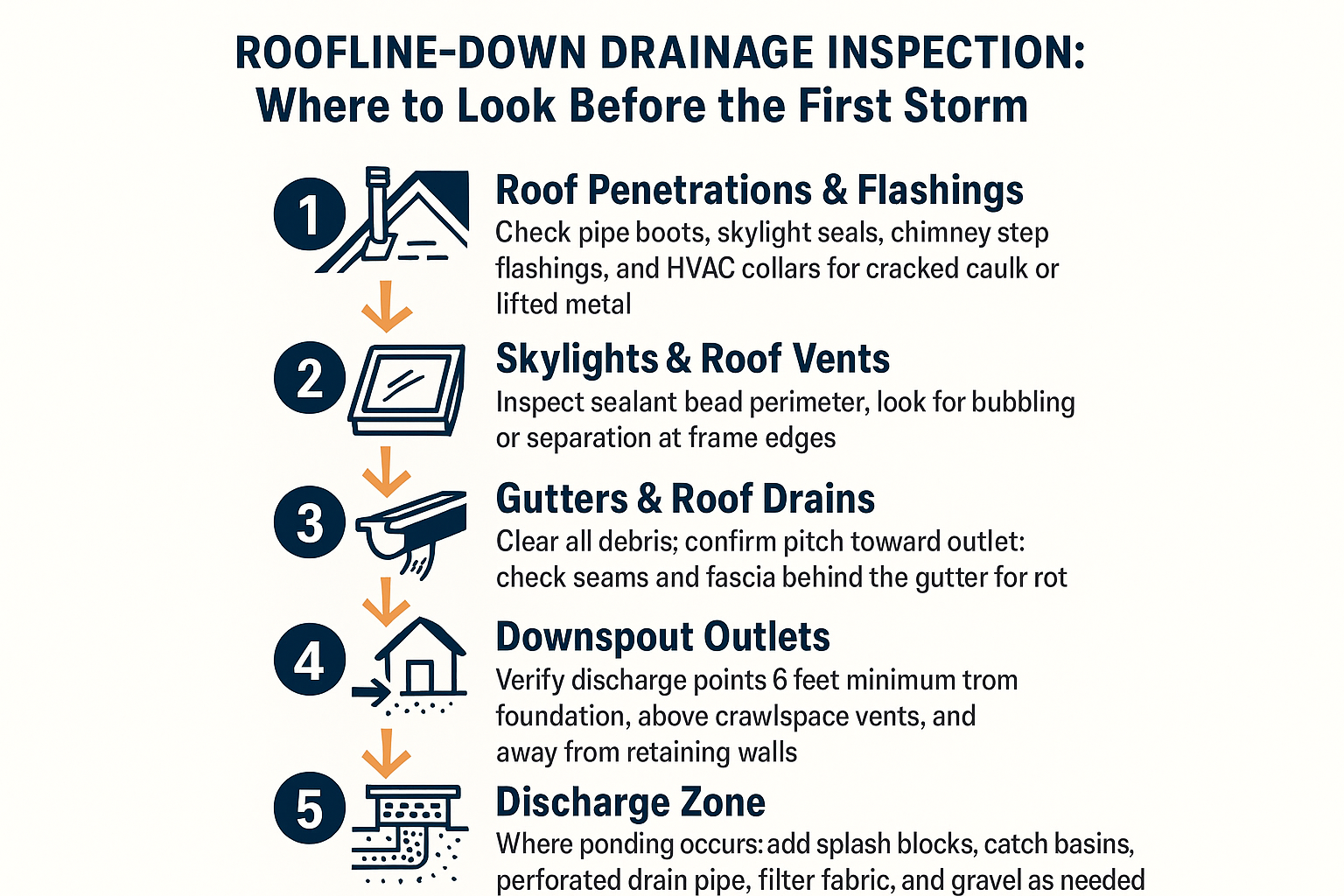
The Roofline-Down Inspection Sequence
This sequence covers the full drainage chain from roof penetrations to discharge point — use it as a pre-season checklist.
Where the Water Lands: Downspout Discharge and Foundation Risk
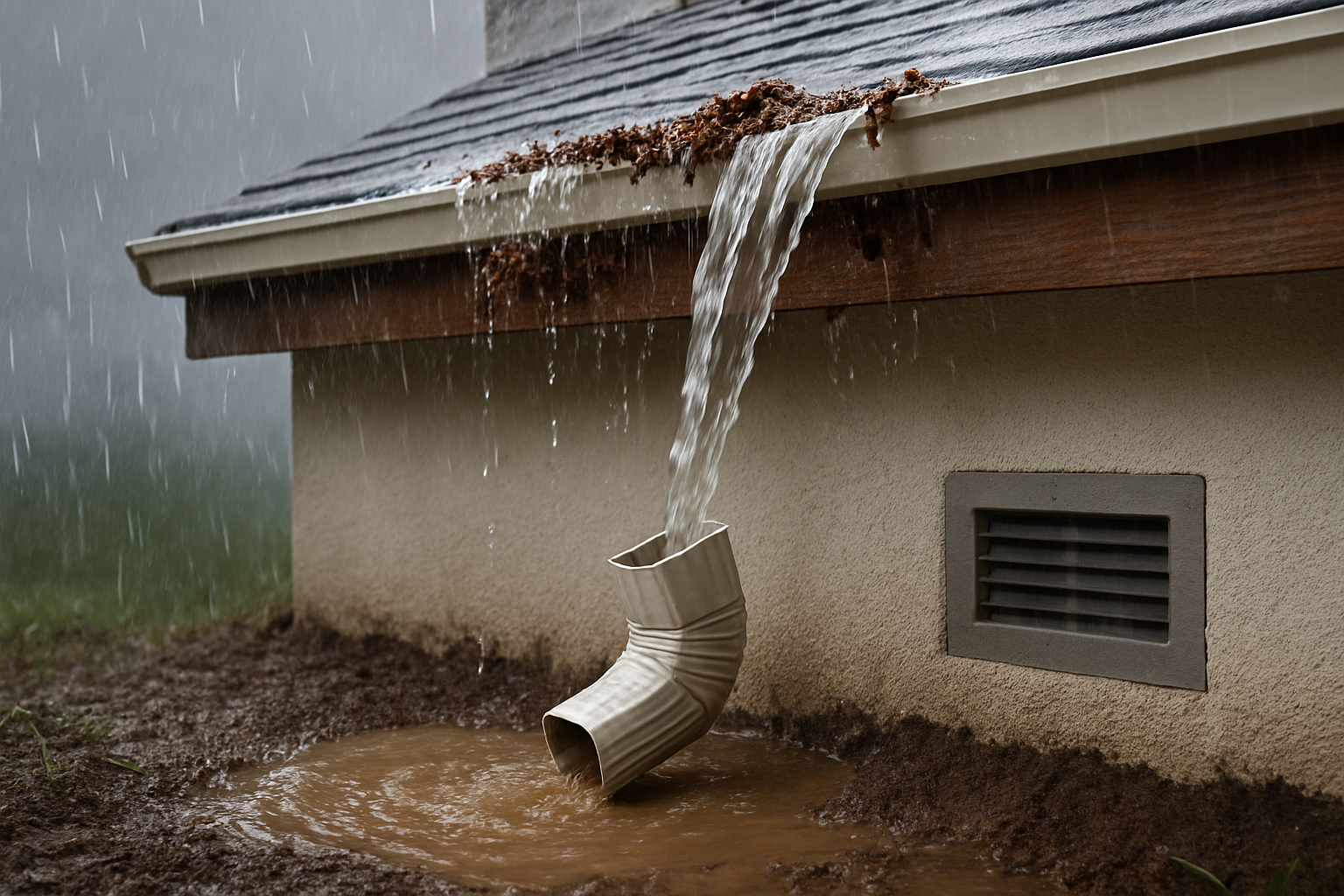
Most roof drainage problems don’t show up at the roof — they show up at the foundation. A downspout that discharges two feet from the foundation, aimed at a crawlspace vent, is doing almost as much damage as no downspout at all.
The general guidance from building professionals is that downspouts should discharge at least six feet from the foundation. But in practice, many older East Bay homes have downspouts that terminate at the splash block directly against the foundation wall. After a saturated storm sequence like November 2024, that means water is moving toward the foundation rather than away from it.
Specific locations to watch for ponding and seepage:
- Low door thresholds — especially rear service doors and side entries where grade has settled over time
- Crawlspace vents — water pooling near a foundation vent moves into the crawl space and creates moisture problems that persist for months
- Retaining walls — discharge aimed at the uphill face of a retaining wall accelerates hydrostatic pressure and speeds up wall failure
- Patios and hardscape with no slope away from the structure — sheet water with nowhere to go finds the path of least resistance, which is often a gap in the foundation sill
Where simple discharge relocation isn’t enough — where the grade works against you or there’s no good surface outlet — the fix steps up to a proper drainage assembly. That typically means a catch basin at the downspout termination point, a run of perforated drain pipe wrapped in filter fabric to prevent soil infiltration, and a gravel surround to maintain flow even when soils are saturated. These are not complicated installs, but they require the right materials sized for the actual runoff volume.
For hillside properties in the Oakland and Berkeley hills — where slope drainage and soil movement are already active concerns — check out our related guide on Hillside Property and El Niño: Slope Work to Finish Before October 15 for context on what happens when surface drainage gets overwhelmed on sloped lots.
Drainage Problem, Root Cause, and Field Fix
These are the most common roof drainage failures we see on Bay Area residential and light commercial projects — matched to the fix that actually addresses the source, not just the symptom.
| Problem | Likely Root Cause | Field Fix |
|---|---|---|
| Interior water stain near roofline | Failed flashing or cracked caulk at penetration | Reseal or replace pipe boot / step flashing; repoint chimney if applicable |
| Gutter overflows during rain | Blocked outlet, undersized gutter, or incorrect pitch | Clear outlet; re-pitch gutter; upsize if needed for current storm intensity |
| Water pools at foundation after rain | Downspout discharges too close to structure | Extend downspout min. 6 ft; add splash block or redirect to catch basin |
| Crawlspace moisture after storms | Discharge point near foundation vent or low grade | Relocate discharge; add catch basin + perforated pipe + filter fabric |
| Retaining wall showing cracks or lean | Hydrostatic pressure from poor uphill drainage | Redirect surface drainage; consider French drain uphill of wall |
| Flat roof ponding between drains | Blocked roof drain or membrane settled low | Clear drain; check membrane pitch; reseal drain collar if separated |
What Back-to-Back Storms Actually Do to Bay Area Soils
A single storm rarely causes structural drainage failures. The risk pattern the Bay Area actually faces is sequential storms — one event saturates the soil, and the next one arrives before any drainage recovery has happened.
When soil hits field capacity, it stops absorbing. Surface water has nowhere to go except sideways — toward foundations, into crawlspace vents, down retaining wall faces, and into any low point in the yard. This is exactly what happened in November 2024. The first atmospheric river soaked the East Bay, and the second one — arriving just days later — ran almost entirely as surface flow because the ground couldn’t take any more.
According to the California Department of Water Resources, atmospheric river sequences account for a disproportionate share of flood damage in California — the state sees most of its annual precipitation arrive in just a handful of storm events. That concentration is what makes drainage capacity the real variable, not any individual storm forecast.
For Bay Area homeowners and contractors, this means sizing drainage systems for back-to-back events, not for a single design storm. A catch basin that handles a typical winter rain but overflows on day two of an atmospheric river sequence isn’t doing its job. If your system has borderline capacity, the question isn’t whether it will fail — it’s which storm number it fails on.
For anyone thinking about how exterior materials hold up through this kind of seasonal stress, our guide on How East Bay Homes Should Prepare for the 2026-27 El Niño Winter covers the broader picture beyond just drainage.
Frequently Asked Questions About Roof Drainage and Storm Prep
How far does a downspout need to discharge from the foundation?
The commonly cited minimum is six feet from the foundation wall, but that assumes reasonably flat grade and soil that drains well. On clay-heavy lots — which are common across the East Bay — or on any property where the grade pitches back toward the structure, six feet may not be enough. A catch basin and perforated pipe run are a better solution in those situations.
What materials do I need to build a basic catch basin and drain run?
A standard assembly includes a catch basin (plastic or concrete box with a debris-collecting sump), a run of 4-inch perforated drain pipe, filter fabric wrapped around the pipe to prevent soil from clogging the perforations, and a gravel surround to maintain flow capacity. The pipe runs to a daylight outlet or connects to an existing storm drain where local code allows. The Hearst Avenue lumberyard carries these components, and staff can help you figure out the right sizing based on your roof area and run length.
Do commercial buildings need the same pre-season drainage check?
Yes — and flat-roof commercial buildings actually have higher stakes because roof drains and scuppers handle large surface areas with very little slope to assist drainage. A single blocked roof drain on a flat commercial building can pond several inches of water before it shows any exterior sign. Rear service doors with settled thresholds are another common entry point. The same roofline-down inspection logic applies: start at the drain, check the collar seal, clear the debris trap, and confirm the scupper openings are unobstructed.
My gutter overflows even right after I clean it. What’s wrong?
Two likely causes: the gutter is pitched incorrectly toward the wrong end, or it’s undersized for the roof area it’s draining. A gutter that was fine for older, lighter Bay Area rain events may now overflow during compressed atmospheric river storms that deliver the same annual total in far fewer hours. Check the pitch first — there should be a visible drop toward the downspout. If pitch is correct and it still overflows, the gutter profile itself may need to be upsized.
Can I tell if my crawlspace is getting water from storm runoff?
The signs are usually visible: efflorescence (white mineral staining) on the foundation wall interior, rust on any metal straps or hardware in the crawlspace, or a persistent musty smell that worsens after storms. Soft subfloor material directly above the crawlspace is a later-stage indicator. If you see any of these, trace the source back to the discharge points closest to that section of the foundation before looking further.
Is filter fabric actually necessary around perforated pipe?
Yes, and skipping it is the most common reason drain runs fail within a few years. Without filter fabric, fine soil particles migrate into the perforations and gradually seal the pipe from the inside. The system looks functional until it isn’t — usually during the worst storm of the season. Filter fabric is not expensive, and it’s the difference between a drain run that lasts a decade and one that clogs by year three.
Get the Materials for the Full Drainage Chain in One Stop
From gutter hardware and downspout extensions to catch basins, perforated pipe, filter fabric, and drainage gravel — the Truitt & White lumberyard at 642 Hearst Avenue in Berkeley carries what you need to fix a drainage problem from roofline to discharge point. The staff there have been helping East Bay contractors and homeowners spec the right setup for nearly 80 years, and they can work through your specific runoff situation with you before you start buying materials. Give the Hearst Avenue location a call at 510-841-0511, or visit truittandwhite.com to get a sense of what’s in stock before you make the trip.