Direct Answer: Combined U.S. tariffs on Canadian softwood lumber now exceed 45%, pushing framing lumber prices up roughly 30% since late 2025. Bay Area project budgets built on 2024 pricing are likely understated.
If you’re currently pricing a framing project, an ADU, or a remodel in the Bay Area, you’ve probably noticed that lumber quotes don’t look like they did a year ago. That’s not a local supply problem — it’s the result of a significant shift in U.S. trade policy that directly affects what framing lumber costs at every yard in California.
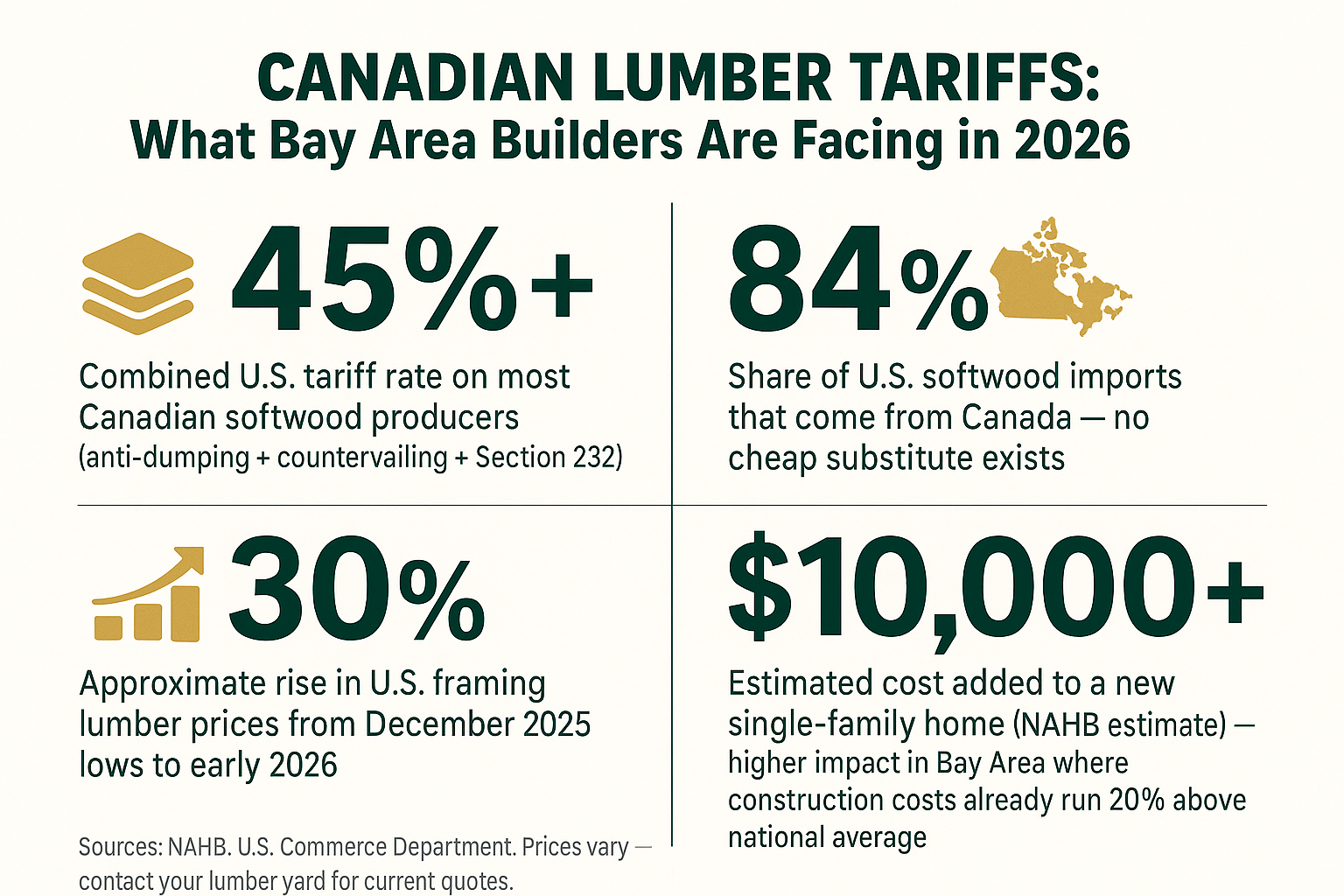
Canadian softwood lumber accounts for roughly 84 percent of all softwood imported into the United States. When combined U.S. import duties on Canadian producers surpassed 45 percent in late 2025, the downstream effect on framing lumber prices was fast and measurable. By early 2026, U.S. lumber prices had climbed roughly 30 percent off their December 2025 lows.
This article explains what’s actually happening, why there’s no quick substitute to fill the gap, and what it means for how you plan and budget a Bay Area project right now.
How the Tariff Stack Reached 45 Percent
The U.S.–Canada softwood lumber dispute isn’t new. It has run almost continuously since 1982, cycling through rounds of duties, legal challenges, and negotiated pauses. The current round stacked two separate duty types on top of each other:
- Anti-dumping and countervailing duties — currently around 35 percent on most Canadian producers, based on Commerce Department findings that Canadian lumber is subsidized by provincial timber pricing policies
- Section 232 tariff — an additional 10 percent added in late 2025 on national security grounds, applied broadly to imported softwood
The combined effect: a Canadian 2×4 that cleared the border at one price in mid-2024 now carries a substantially higher landed cost before it reaches a U.S. distributor or yard.
Preliminary duty rates were revised slightly downward in April 2026, but the overall tariff structure remains in place. The U.S. International Trade Commission tracks these proceedings and publishes updates as Commerce Department reviews progress — but anyone waiting for a quick resolution should understand this dispute has outlasted multiple administrations.
For Bay Area contractors, the practical result is that material budgets built on late-2024 lumber pricing are likely understated by a meaningful margin.
Why There’s No Easy Substitute for Canadian Softwood
When any major import source gets more expensive, the natural question is: what fills the gap? For Canadian softwood, the honest answer is that nothing fills it cleanly or cheaply.
Canada’s geographic proximity and its established supply chain into West Coast yards mean Canadian lumber has historically cleared the U.S. border at significantly lower cost than the next-best alternatives from Germany, Sweden, or Brazil. Those countries’ products carry longer shipping distances, different species mixes, and their own cost structures. There is no waiting pool of cheaper softwood ready to absorb the volume Canada has historically supplied.
U.S. domestic sawmill capacity is a real part of the picture, but it can’t scale overnight. Mills operate on long lead times for equipment investment and log supply. Canadian softwood imports fell 24 percent year-over-year in Q1 2026 — and U.S. production hasn’t made up the difference in kind. That gap shows up as tighter availability at the retail level, particularly for certain framing dimensions.
For projects in Berkeley, Oakland, and the broader East Bay, this means two things:
- Pricing is less predictable than it was two or three years ago
- Lead times on specific dimensions — particularly wider framing stock like 2x10s and 2x12s — can stretch at the retail level when demand spikes
For anyone building with engineered wood products, the tariff picture is slightly different since LVL and I-joist pricing depends on a broader set of inputs — if you’re weighing those options, What Is Engineered Wood, and When Should You Use It Instead of Lumber? covers the tradeoffs in practical terms.
The Tariff Impact at a Glance
This overview shows how the duty structure stacks, what’s happened to prices, and what Bay Area builders are doing to manage the exposure.
What This Means for Bay Area Project Budgets Right Now
The National Association of Home Builders has estimated that the combined tariff duties have added at least $10,000 to the cost of a new single-family home nationally. In the Bay Area, where construction costs already run 20 to 40 percent above the national average, that figure lands harder.
For contractors and homeowners actively pricing projects in 2026, here’s where the real exposure sits:
Fixed-price contracts are the most vulnerable. If you signed a fixed-price contract using lumber estimates from late 2024 or early 2025, the gap between your budgeted lumber costs and current market pricing is real. Mid-project lumber price swings on a fixed contract come out of margin — or out of the owner’s contingency.
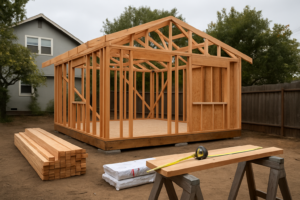
ADU projects carry specific risk. ADUs typically involve a concentrated framing package with a hard budget ceiling. A 10 to 15 percent swing in lumber cost on a structure that might require 10,000–15,000 board feet of framing stock is a line item problem, not a rounding error.
Industry advisors are recommending a 5–10 percent contingency buffer specifically for lumber and metals given current tariff uncertainty. That’s not alarmist — it’s practical math given where duty rates sit today.
For projects that involve both framing and exterior materials like decking, Redwood vs. Composite vs. Modified Wood: A Bay Area Deck Breakdown is worth reading alongside this — tariff exposure differs by material category, and some exterior decking options are less affected than dimensional framing lumber.
How Different Project Types Are Exposed to Lumber Price Volatility
Not every project carries the same tariff risk. This table outlines how exposure varies by job type and contract structure.
| Project Type | Framing Lumber Exposure | Key Risk Factor |
|---|---|---|
| New single-family home | High — full framing package | Large lumber volume amplifies per-unit price swings |
| ADU (detached) | High — concentrated framing budget | Fixed ADU budgets have limited absorption room |
| Room addition / remodel | Medium — partial framing scope | Mid-project re-quotes if schedule extends |
| Deck build | Low to medium — depends on substructure material | Pressure-treated framing affected; decking boards less so |
| Window / door replacement | Low — minimal structural framing | Less direct tariff exposure; labor and product costs dominate |
Timing Your Material Orders in a Volatile Market
One practical edge that Bay Area contractors can work with right now: order timing matters more than it has in years.
As Canadian softwood imports have pulled back, U.S. distributors and retail yards are managing tighter availability on certain dimensions. A contractor who locks in framing lumber six to eight weeks before the job starts is in a better position — both on price and on availability — than one who orders two weeks before the pour.
This matters especially in Berkeley and Oakland, where permit expiration dates and contractor scheduling windows don’t flex easily. If your permit clocks out in four months and you’re counting on a specific framing dimension that’s running long on lead time, that’s a scheduling problem, not just a cost problem.
A few practical habits worth building into your current estimating process:
- Get a current quote from your yard before finalizing any bid — pricing from six months ago is not a reliable baseline right now
- Ask about current availability on the specific dimensions you need, not just general stock levels
- Build a 5–10 percent lumber contingency into any fixed-price estimate until duty rates stabilize
- Consider whether engineered alternatives (LVL headers, I-joists for long spans) offer more price predictability for specific elements of the job
For projects in Oakland hillside zones or Berkeley WUI areas, framing material choices also intersect with fire-rated lumber requirements — The Advanced Guide to Fire Rated Lumber in Berkeley covers that compliance layer separately.
Frequently Asked Questions About Lumber Tariffs and Bay Area Project Costs
Are lumber prices going to come back down once the tariffs are resolved?
Possibly, but don’t count on a timeline. The U.S.–Canada softwood lumber dispute has been active in some form since 1982. Duty rates were revised slightly downward in April 2026, but the core tariff structure remains in place. Planning your budget around current pricing — with a contingency buffer — is more reliable than waiting for a resolution that has historically taken years, not months.
How much has framing lumber actually gone up in price?
U.S. framing lumber prices rose roughly 30 percent off their December 2025 lows by early 2026, according to market data tied to Canadian import volumes and tariff timing. The actual price you’ll see depends on dimension, species, and current yard inventory. Get a current quote — that’s the only number that matters for your specific job.
Does the NAHB $10,000 estimate apply to Bay Area projects?
The $10,000 figure from the National Association of Home Builders is a national average estimate for a new single-family home. Bay Area construction costs already run 20–40 percent above national averages, so the dollar impact on a local project is likely higher — not because lumber is priced differently here, but because the scope and quantity of materials on a Bay Area build tend to be larger. For remodels and ADUs, the exposure is proportional to the framing scope.
What about decking materials — are those affected too?
It depends on the product. Pressure-treated lumber used for deck substructure (joists, posts, beams) is affected because it’s typically softwood framing stock. Composite decking products like TimberTech and Trex have different cost drivers and aren’t directly tied to Canadian softwood tariffs. Redwood and thermally modified wood products follow their own supply chains. If your deck project uses a wood substructure, that framing component is where the tariff exposure sits.
Should I try to buy lumber now and store it to lock in pricing?
That strategy works better in theory than in practice for most residential projects. Storing framing lumber properly requires dry, covered space — and improper storage leads to warping, checking, and moisture problems that cost more to deal with than the savings. For contractors, ordering against a confirmed job start date with appropriate lead time is generally a better approach than speculative purchasing.
Does any of this affect engineered wood products like LVL or I-joists?
Engineered wood products use softwood fiber as a raw material input, so there’s some indirect cost pressure. But LVL, I-joists, and glulam are manufactured domestically at multiple facilities and their pricing isn’t tied as directly to Canadian import volumes as dimensional framing lumber is. For certain applications — long headers, floor systems, ridge beams — engineered products can offer more pricing predictability right now alongside their structural advantages. What Is Engineered Wood, and When Should You Use It Instead of Lumber? covers when that tradeoff makes sense.
Getting a Current Quote Before Your Next Bid
Lumber pricing in 2026 moves faster than it did two or three years ago, and a quote from last quarter isn’t a safe baseline for a job you’re estimating today. The team at Truitt & White — at the Lumberyard and Hardware on Hearst Avenue in Berkeley — can give you current pricing on framing lumber, let you know what’s in stock, and flag any lead time issues on specific dimensions before they become scheduling problems. Call the lumberyard direct at 510-841-0511, or visit truittandwhite.com to learn more about what we carry.