Direct Answer: Engineered wood is lumber that’s been manufactured from wood fibers, veneers, or strands bonded together under pressure. It’s stronger and more dimensionally stable than solid sawn lumber, especially for beams, long-span floors, and headers.
If you’ve priced out a beam for a header recently, someone has probably handed you a spec sheet for an LVL instead of a solid Douglas fir. And if you’re framing a floor system on an ADU in Berkeley or Oakland, your architect may have called for TJI joists without explaining why they cost more than dimensional lumber.
Engineered wood is showing up in more Bay Area remodels and new builds every year — but the term covers several very different products that solve very different problems. A lot of homeowners assume ‘engineered’ means synthetic or lower quality. That’s not accurate, and getting it wrong can lead to over-built headers, under-performing floors, or a correction notice from a Berkeley plan checker.
This article breaks down the three types of engineered wood you’re most likely to encounter on a residential project, explains what problem each one actually solves, and gives you the information you need to make a smart call before you spec or purchase.
The Three Engineered Wood Products That Show Up on Most Bay Area Jobs
Engineered wood is a broad category. For residential framing — which is where most contractors and homeowners run into it — there are three products worth knowing in depth.
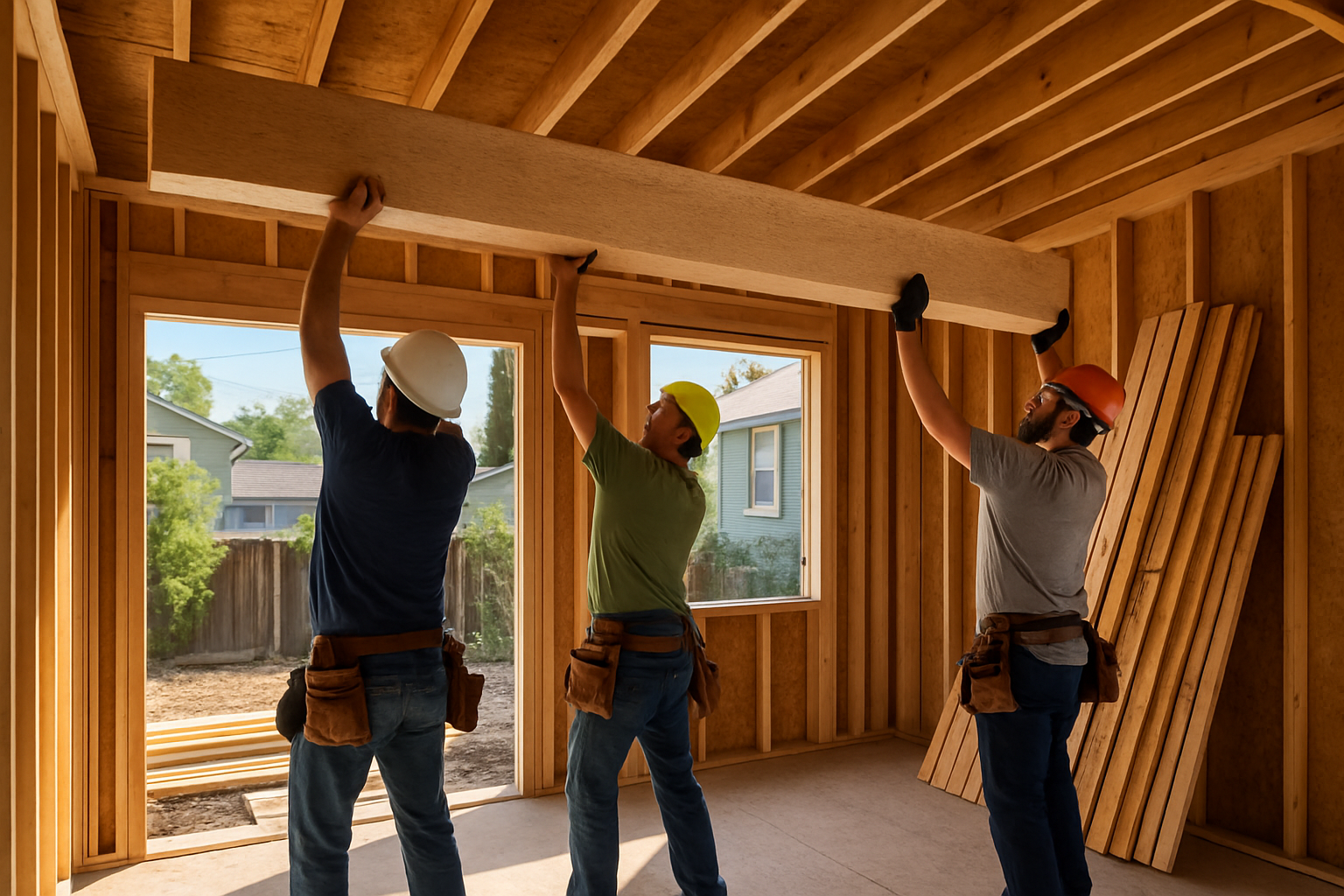
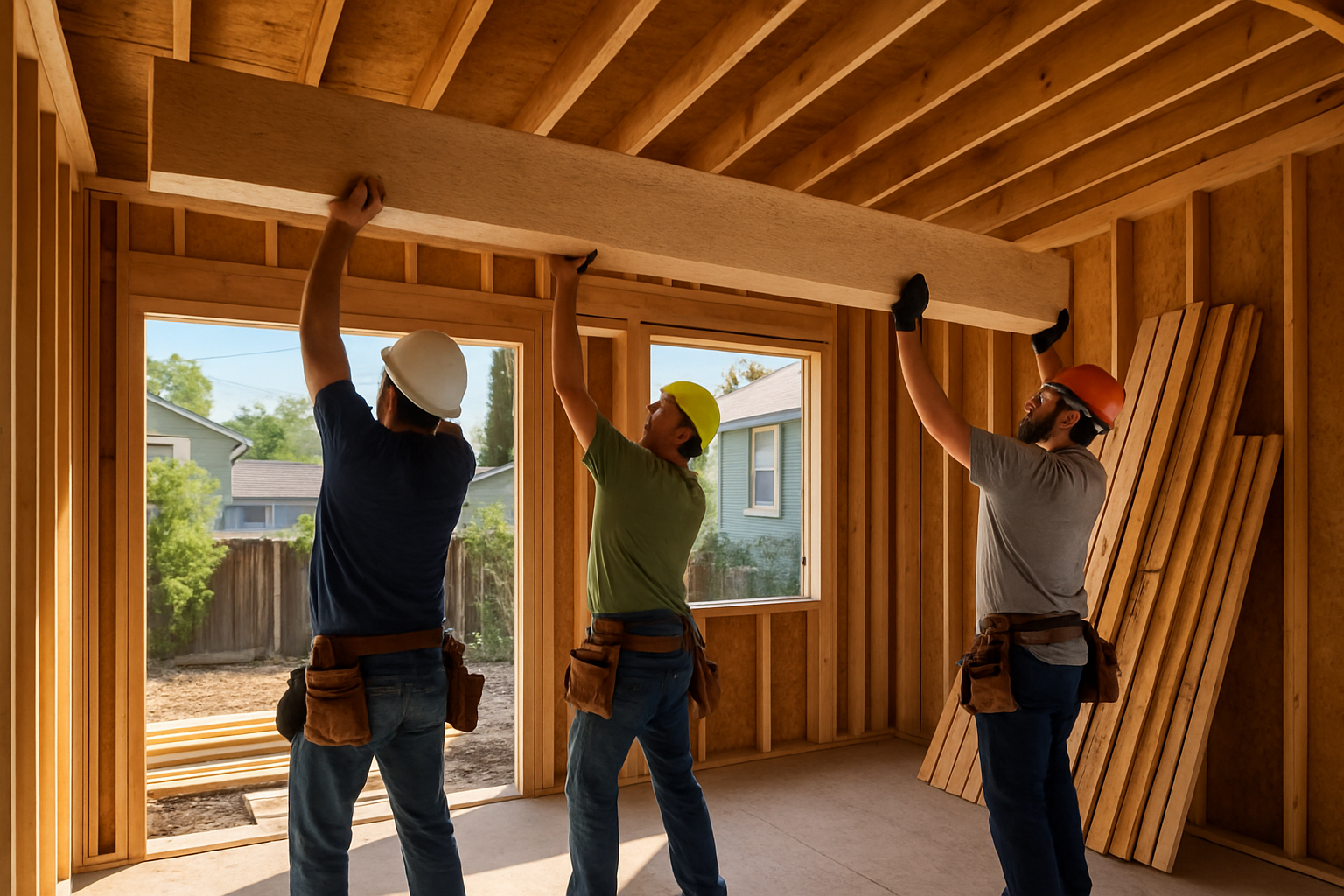
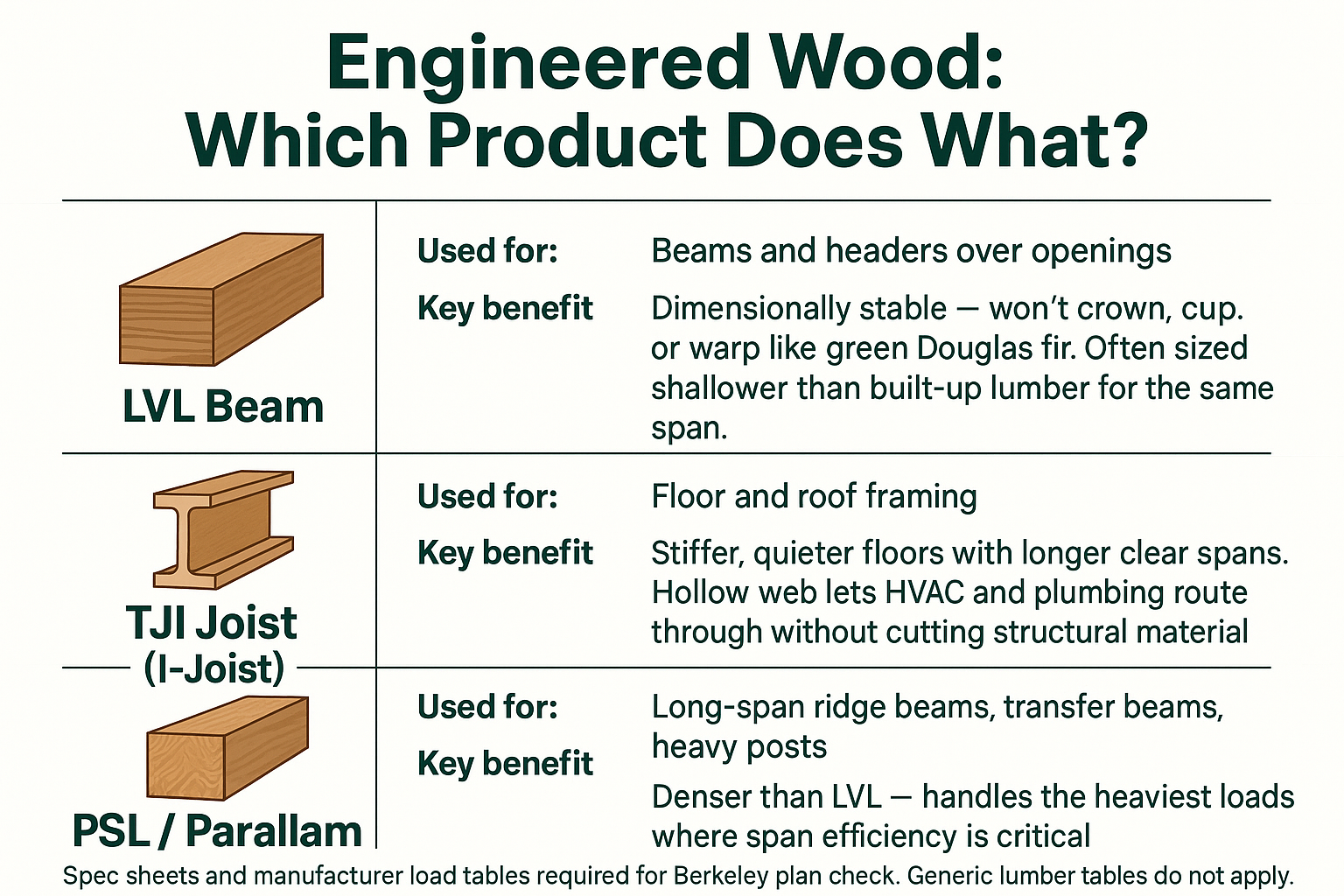
LVL (Laminated Veneer Lumber) is the product most people mean when they say ‘engineered beam.’ It’s made from thin wood veneers bonded with adhesive under heat and pressure, with the grain running parallel. The result is a beam that’s denser, stronger, and more predictable than a comparably sized piece of solid sawn lumber. LVL is used primarily for beams and headers — anywhere you’re carrying a load over an opening.
TJI joists (sometimes called I-joists or TJIs, after the Weyerhaeuser brand) are the I-shaped members you see in floor and roof framing. They have an engineered wood flange on top and bottom connected by an oriented strand board web. They’re not beams — they’re spanning members designed to carry floor or roof loads over long distances without the deflection you’d get from dimensional lumber.
Parallel Strand Lumber (PSL), sold under the brand name Parallam, is made from long strands of wood fiber running parallel and bonded under pressure. It’s denser than LVL and is used where spans are long and loads are heavy — think ridge beams, transfer beams, and posts in open floor plans. You won’t encounter it on every job, but when you need it, nothing else does what it does.
Each of these products exists because it solves a specific structural problem better than solid lumber at that application.
Why Dimensional Consistency Is the Real Argument for Engineered Beams
Old-growth Douglas fir was dense, dry, and stable. The second-growth lumber coming out of mills today is younger wood — it has more moisture content when it leaves the mill, and it moves. Crown, twist, and warp after installation are common, especially in Bay Area conditions where coastal moisture keeps framing from drying evenly.
For a contractor managing a tight schedule between framing, rough inspection, and drywall, that movement is a real problem. A green Douglas fir header can cup or twist after it’s in the wall, which creates issues at the drywall stage and can affect door and window rough openings.
An LVL beam doesn’t do that. The lamination process creates a product manufactured to consistent dimensions that won’t shrink or cup the way green solid lumber will over time. On an ADU build in Berkeley or Oakland — where the sequence from framing to insulation to drywall often happens in a compressed window — that predictability has genuine schedule value.
There’s also a structural benefit that matters for compact floor plans. LVL headers can often be sized shallower than a built-up lumber alternative for the same span, which preserves ceiling height and keeps the framing cavity available for insulation. For ADU projects where interior square footage is already limited, that’s not a minor detail.
LVL vs. TJI vs. PSL: What Each Product Does
This breakdown shows which engineered wood product fits which application — and the key structural benefit each one offers over solid sawn lumber.
TJI Joists: What They Cost More and Why That Usually Pays Back
TJI joists are one of the most common questions we hear from contractors and homeowners pricing out a floor system. The honest answer is that yes, they carry a cost premium over dimensional lumber — but for most floor applications, that premium doesn’t last long once the mechanical rough-in crew shows up.
Here’s what drives the performance:
- Longer clear spans with less deflection than solid lumber of comparable depth, which matters on open floor plans
- Stiffer floors — less bounce and flex underfoot, which is a real quality-of-life difference in finished living spaces
- Quieter over time — solid lumber floors squeak as lumber moves; TJIs are more stable
- Hollow web means HVAC ducts, plumbing runs, and electrical can route through the joist without cutting structural material
That last point is where the labor math changes. On a solid lumber floor system, a plumber or HVAC sub has to drill through joists to route their work — and there are strict rules about where and how deep you can notch or bore dimensional lumber without weakening the member. With TJI joists, the knock-outs in the web are designed for mechanical penetrations. Routing is faster, cleaner, and doesn’t require engineer sign-off for standard runs.
In general market terms, TJI joists typically run meaningfully higher per linear foot than dimensional lumber equivalents — but Bay Area contractors who’ve done the comparison often find the total installed cost is closer than the material price difference suggests. Talk to the lumber sales team at the Hearst Avenue location for current pricing on your specific span and load conditions; material costs shift with the market.
Engineered Wood vs. Solid Lumber: A Practical Comparison
This table covers the practical differences that affect real project decisions — not every technical specification, just the ones that show up on jobsites.
| Factor | Engineered Wood (LVL / TJI) | Solid Dimensional Lumber |
|---|---|---|
| Dimensional stability | High — manufactured to consistent size, won’t crown or warp | Variable — second-growth lumber moves as it dries |
| Span capability | Longer clear spans for equivalent depth | Shorter spans; larger members needed for same span |
| Mechanical routing | TJI web designed for penetrations | Notching and boring rules restrict routing |
| Plan check documentation | Manufacturer span tables and spec sheets required | Standard lumber tables apply |
| Cost per linear foot | Higher than dimensional lumber | Lower upfront material cost |
| Best applications | Headers, beams, floor systems, long spans | Wall framing, shorter spans, blocking, general framing |
What Berkeley Plan Check Actually Wants to See
Berkeley building inspectors are experienced with engineered wood in residential construction — it’s common enough here that it doesn’t raise eyebrows. But there’s one place contractors regularly run into trouble: documentation at plan check.
LVL beams and TJI joists are sized using manufacturer-specific span tables, not the generic lumber span tables in older references or the ones built into residential code handbooks. Weyerhaeuser’s TJI tables are different from generic I-joist tables. LP’s LVL tables are different from iLevel’s. And the load conditions that determine sizing — tributary width, live load, dead load, span — need to match your actual project, not a generic example.
A contractor who shows up to a Berkeley plan check with an LVL beam sized off the wrong table — or with no documentation at all — will get a correction notice. It’s not a technicality; the plan checker is specifically looking for the manufacturer load tables and the product spec sheet that confirms what was actually specified.
The practical takeaway: when you’re purchasing engineered wood for a permitted project, ask for the spec sheets and span tables at the time of purchase. Those documents are not optional paperwork. For hillside projects in the Berkeley or Oakland hills — many of which fall in WUI fire zones with additional code requirements — documentation requirements are even more critical. The Advanced Guide to Fire Rated Lumber in Berkeley covers the WUI overlap in more detail if your project is in a high fire hazard severity zone.
The Misconception About ‘Engineered’ Meaning Lower Quality
We hear this regularly: a homeowner assumes that because something is manufactured rather than sawn from a log, it must be a step down. For structural applications, the opposite is closer to the truth.
The lamination and manufacturing process in LVL and LSL products typically produces something stronger and more predictable than an equivalent size in solid sawn lumber — especially for long-span applications. Solid sawn lumber has natural defects: knots, checks, grain variation. An LVL beam is manufactured to minimize those variables. The adhesive bond and pressure process creates a member that performs consistently across its entire length.
For ADU projects in Berkeley and Oakland — where floor plans are often compact and every inch of span efficiency matters — specifying an engineered beam instead of a built-up lumber header can reduce header depth, preserve ceiling height, and improve the thermal performance of the framing cavity. A shallower header means more room for insulation in the rough opening area, which matters when you’re trying to hit California Title 24 energy requirements.
For anyone comparing framing material options for a deck or exterior structure project, our breakdown of how Bay Area conditions affect material choices gets into the climate-driven factors that don’t show up in a national spec sheet.
Frequently Asked Questions About Engineered Wood
Can I use an LVL beam outdoors — for a deck beam or pergola post?
Standard LVL is not rated for exposed exterior use. The adhesives and veneers in most LVL products are not designed for repeated wetting and drying cycles, and the plies can delaminate over time if moisture gets in. There are exterior-rated or pressure-treated engineered products, but you need to confirm the exposure rating before specifying. For exterior structural applications, ask specifically about the exposure classification on the product you’re considering.
What’s the difference between LVL and LSL? I see both terms and don’t know when to use which.
LVL (Laminated Veneer Lumber) uses thin full-length veneers with grain running parallel — it’s the go-to for long beams and headers where bending strength is the priority. LSL (Laminated Strand Lumber) uses shorter wood strands, which makes it more dimensionally stable but with somewhat lower bending strength. LSL is commonly used for rim boards, door and window headers in shorter spans, and stud applications. For a beam carrying a significant load over a wide opening, LVL is usually the right call. Your lumber supplier can help you confirm sizing based on your actual span and load.
Do TJI joists require special hangers or connectors, or do standard joist hangers work?
TJI joists require TJI-specific hangers — standard joist hangers designed for dimensional lumber won’t fit correctly and won’t provide the load rating the connection needs. Simpson Strong-Tie and other hardware manufacturers make hangers specifically sized and rated for TJI flanges. This is worth getting right before rough framing, because the wrong hanger can generate a correction at framing inspection.
How do I know what size LVL beam I need for my header?
LVL headers are sized using the manufacturer’s span tables, which account for the beam’s depth, width, span, and the load it’s carrying (based on what’s above it — one floor, two floors, a roof). There’s no universal rule of thumb that applies across all situations. The safest approach is to bring your span, tributary width, and load conditions to your lumber supplier and work from the actual manufacturer tables. For permitted projects, your plans will need to show the beam designation and the load table it was sized from.
Is engineered wood more fire-resistant than solid lumber?
Not inherently. Standard LVL and TJI products are not fire-rated materials. In fact, the thin web on a TJI joist can burn through faster than a solid lumber member of equivalent depth — which is why fire codes have specific requirements for protecting TJI floor systems in certain occupancy types. If your project is in a WUI fire zone in the Oakland or Berkeley hills, fire resistance is a separate compliance question from structural performance, and you’ll want to address it specifically.
Where can I get the spec sheets and span tables for engineered wood products?
Manufacturers like Weyerhaeuser (TJI), LP Building Products, and iLevel publish their span tables online — but the versions tied to specific product lines and load conditions can be hard to navigate without context. When you purchase engineered wood from a knowledgeable supplier, the staff can pull the relevant documentation for your specific product. That’s not a small thing — having the right spec sheet in hand before plan check saves a correction notice.
Questions About Engineered Wood for Your Bay Area Project?
The lumber sales team at Truitt & White’s Hearst Avenue location in Berkeley works with contractors and homeowners on engineered wood specifications regularly — including pulling the manufacturer span tables and spec sheets you’ll need for plan check. If you’re pricing out a floor system, sizing a header, or figuring out whether LVL or built-up lumber makes more sense for your job, give the lumberyard a call at 510-841-0511 or stop by at 642 Hearst Avenue, Berkeley.