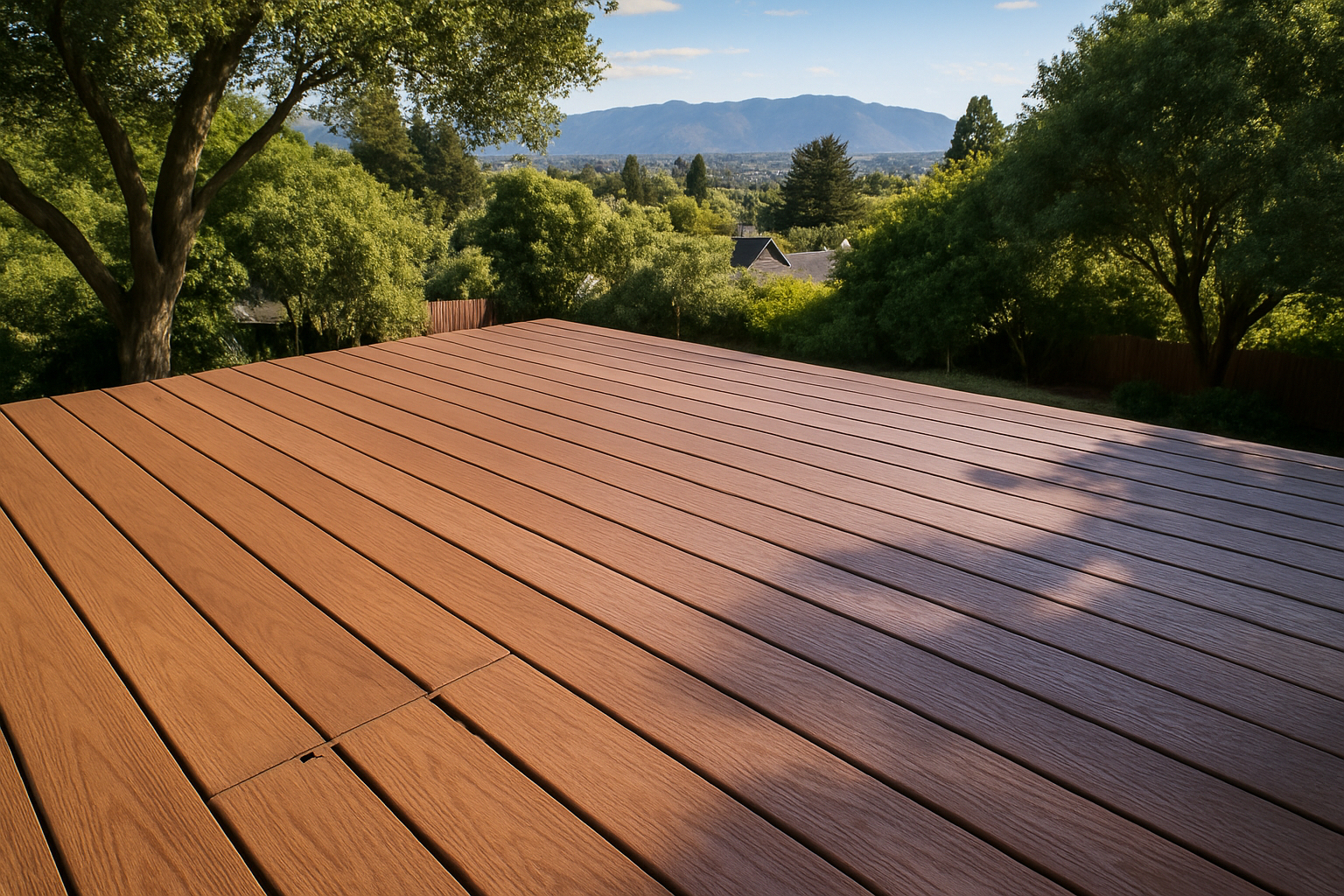
Direct Answer: The right composite decking brand depends on your site — fog-belt Berkeley decks need moisture-resistant capped PVC, while sunny inland locations should prioritize heat-mitigating products and lighter colors.
Most people arrive at composite decking after they’ve already decided wood isn’t the right call — or think they’ve decided that. The question they’re actually trying to answer is a harder one: which composite brand and product line fits their specific site? National brand comparison guides don’t answer that. They list features and price tiers. What they skip is the part that matters most in the East Bay: where your deck sits and what it faces every day.
A fog-belt deck in North Berkeley near the hills sees coastal moisture, shaded morning conditions, and relatively mild temperatures year-round. A south-facing deck in Walnut Creek or the Tri-Valley bakes in afternoon sun for months at a time. Those two sites have genuinely different performance demands, and the right composite choice for one is not automatically the right choice for the other.
This guide is built around that site-first framework — because getting the site conditions right before you pick a brand is what separates an informed purchase from an expensive regret.
Start With Your Site, Not the Brand Catalog
Before you look at a single product spec, answer two questions: How much direct sun does your deck surface receive, and how close are you to coastal moisture or consistent fog?
Those two variables — sun exposure and moisture environment — are what actually drive composite performance differences in the East Bay. Everything else, including brand name and price tier, is secondary to getting those right.
For sites in the fog belt — think North Berkeley, the flats west of Highway 13, parts of Oakland closer to the bay, or anywhere that sees a regular marine layer — moisture resistance and mold resistance are the primary performance factors. For inland and sun-exposed sites — Orinda, Lafayette, Walnut Creek, the sunnier parts of the Oakland hills — heat retention becomes the dominant concern.
Here’s a quick starting-point framework before you talk to anyone about brands:
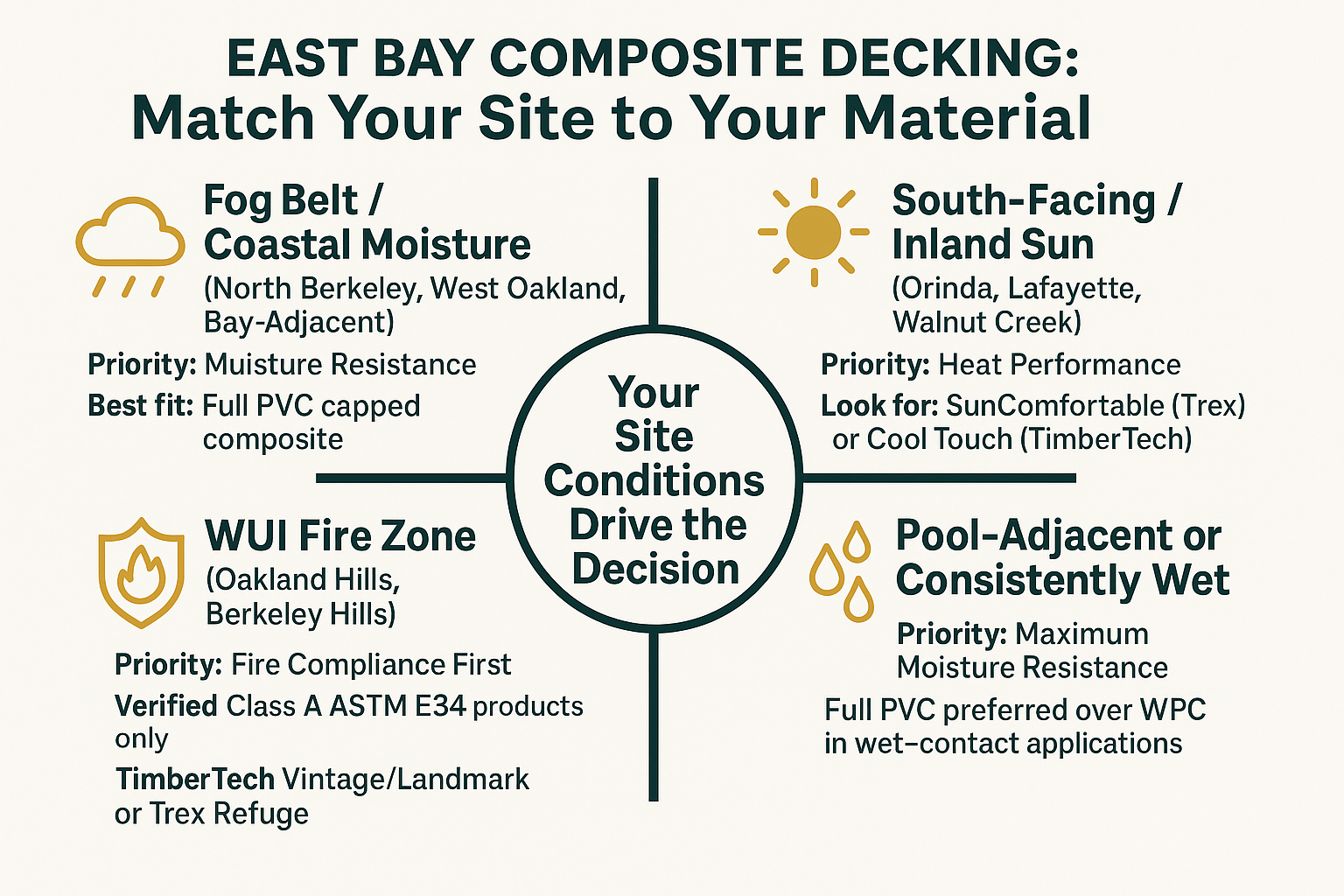
- Fog-belt or shaded site: Prioritize moisture performance. Full PVC capped composite is often the stronger call.
- South-facing or sun-exposed inland site: Prioritize heat performance. Product line and color choice matter significantly.
- WUI fire zone (Oakland hills, Berkeley hills): Fire compliance is a non-negotiable spec requirement before anything else.
- Pool-adjacent or consistently wet area: Full PVC again — wood-plastic composite absorbs moisture over time in these conditions.
For more on how Bay Area microclimates affect this decision at a broader level, this breakdown on fog and sun’s effect on the wood vs. composite decision goes deeper on the climate side.
The Capped vs. Uncapped Question Nobody Asks at the Lumberyard
One of the most consequential decisions in composite decking is one most buyers don’t know to ask about. Capped composite has a protective outer layer — called capstock — bonded to the surface of the board. Uncapped wood-plastic composite does not.
That capstock layer is what gives a composite board most of its stain resistance, fade resistance, and protection against moisture intrusion. Uncapped boards are more vulnerable to mold growth, surface staining from leaves and debris, and color shift over time — particularly in the kind of wet-dry cycling that Bay Area fog zones deliver.
By 2026, capped composite is the standard expectation on most professional installations. If a contractor quote doesn’t specify capped boards, that’s worth asking about directly.
Within capped composite, there’s a further distinction worth understanding:
- Capped Wood-Plastic Composite (WPC): A blend of wood fiber and plastic, with a capped surface layer. Broader price range, more natural feel underfoot, good durability. The most common composite category in the market.
- Full PVC composite: No wood fiber at all. Maximum moisture resistance. Often the better choice for consistently wet areas, pool-adjacent decks, and fog-belt sites where moisture performance is the top priority.
TimberTech‘s Advanced PVC collections fall into the full PVC category. Trex‘s core lineup is WPC-based. Neither is universally better — the site conditions determine which makes more sense.
For a side-by-side look at how composite stacks up against wood and modified wood in Bay Area conditions, the redwood vs. composite vs. modified wood breakdown covers that comparison in detail.
Heat Retention: The Most Common Composite Regret in the East Bay
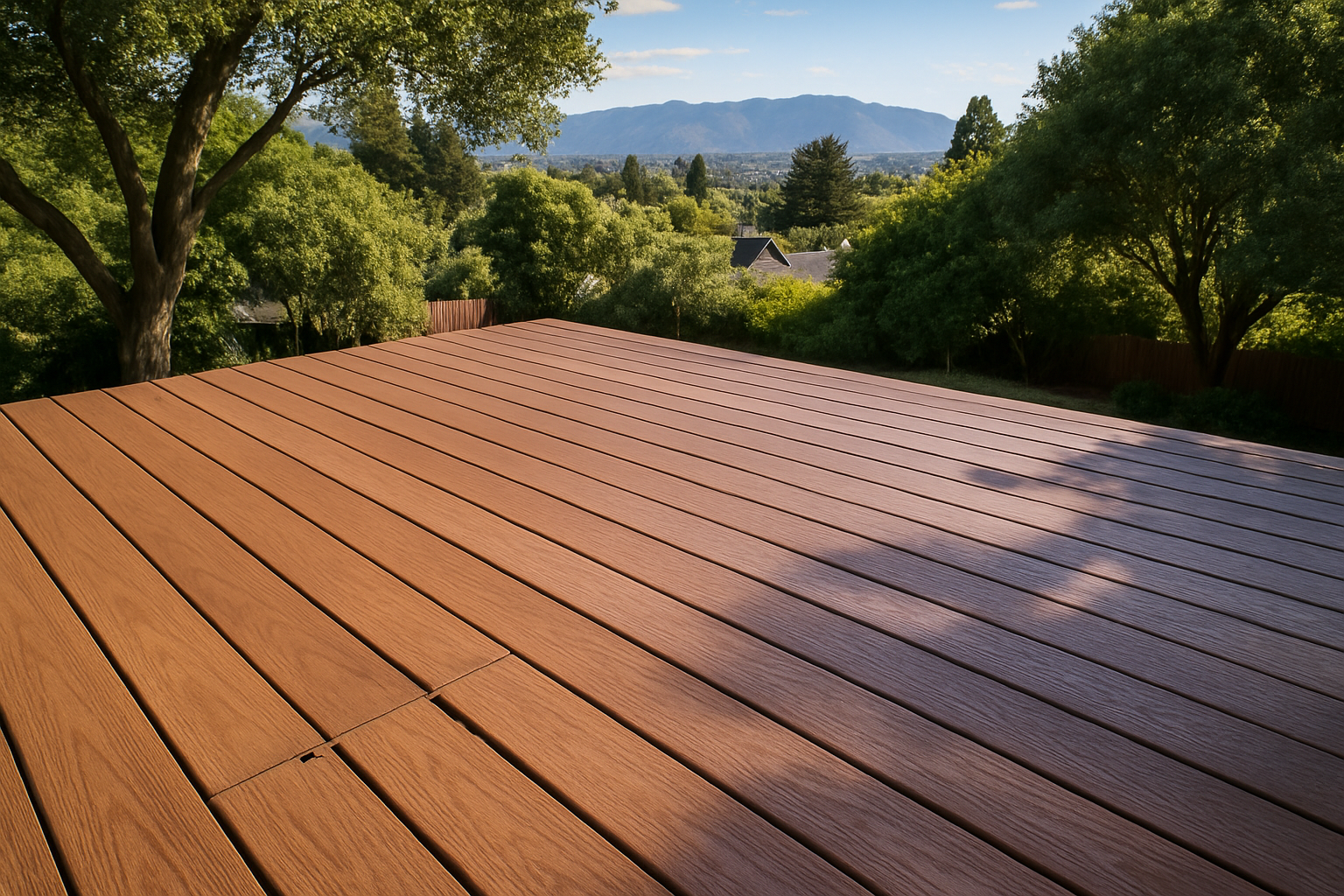
Heat retention is the single most frequently reported regret among Bay Area homeowners who bought composite decking. And it’s almost always mentioned in the same context: a south-facing deck on a warm afternoon, and boards that are genuinely uncomfortable to walk on barefoot.
In sunnier inland East Bay locations — Orinda, Lafayette, parts of Walnut Creek — dark composite boards can reach surface temperatures high enough that extended skin contact should be avoided, particularly for children. This is not a fringe edge case. It’s a real physical property of dark-colored composite surfaces in direct sun.
Both Trex and TimberTech have developed product lines specifically aimed at reducing heat absorption:
- Trex’s SunComfortable technology is engineered into select board lines to reduce surface heat compared to standard composite.
- TimberTech’s Cool Touch Technology, available in select Advanced PVC collections, works on the same principle.
But both manufacturers are clear: even heat-mitigating boards can still get hot in full direct sun. These technologies reduce the problem — they don’t eliminate it.
Color choice matters significantly. Lighter board colors consistently run cooler than dark ones, regardless of brand or product line. A light gray or tan board in the same sun exposure will perform noticeably better underfoot than a dark charcoal or espresso option.
Shade planning is also part of a smart composite deck design — not an afterthought. A pergola, shade sail, or overhanging structure changes the heat equation more than any product specification. If you’re building on a south-facing site in an inland East Bay location, it’s worth thinking about shade structure at the same time as decking material, not after the fact.
East Bay Site Conditions and Composite Decking Priorities
This overview maps the most common East Bay site types to the composite performance factors that matter most for each one.
WUI Fire Zones: Composite Decking Is a Code Compliance Issue Here
If your project is in the Oakland hills, Berkeley hills, or any area mapped as a Wildland-Urban Interface zone, composite decking selection is not just a preference decision. It’s a code compliance decision.
The 2026 California WUI Code requires ignition-resistant materials with a flame spread rating of 25 or under, tested per ASTM E84. Not every composite product meets that threshold — and a general brand reputation for fire resistance is not the same as a documented product listing.
Two product lines have documented WUI-compliant certifications that are worth knowing about:
- TimberTech Vintage and Landmark Advanced PVC collections carry Class A flame spread ratings and are listed as WUI-compliant.
- Trex Refuge, introduced specifically for ignition-resistant applications, is engineered to meet ASTM E84 Class A and IWUIC standards.
When you’re sourcing materials for a WUI-zone project, ask for the specific product listing documentation, not just a general statement from the brand. The product name and the line that carries the rating matters — not every board in a manufacturer’s catalog will qualify.
For more on the fire rating side of materials selection in Berkeley and the East Bay, the advanced guide to fire-rated lumber in Berkeley covers the broader compliance context.
And if you’re working on a hillside property with slope or drainage concerns alongside the deck build, this piece on hillside property preparation covers related site-prep timing.
Composite Decking Performance Comparison by East Bay Site Type
This table summarizes how core performance factors map across the most common East Bay site conditions. Use it as a starting-point reference, not a final spec — specific products vary within each brand and line.
| Site Type | Primary Performance Factor | Recommended Board Category | Notable Products |
|---|---|---|---|
| Fog belt / coastal moisture | Moisture & mold resistance | Capped Full PVC | TimberTech Advanced PVC lines |
| South-facing / inland sun | Heat retention reduction | Capped WPC or PVC with heat tech | Trex (SunComfortable lines), TimberTech (Cool Touch PVC) |
| WUI fire zone | ASTM E84 Class A flame spread | WUI-listed products only | Trex Refuge, TimberTech Vintage / Landmark Advanced PVC |
| Pool-adjacent / consistently wet | Maximum moisture resistance | Capped Full PVC | TimberTech Advanced PVC, higher-tier PVC lines |
| Shaded / moderate conditions | Durability and aesthetics | Capped WPC (broad options) | Multiple lines from both Trex and TimberTech |
The Real Cost Comparison: Why the Board Price Alone Is Misleading
A common mistake when pricing composite against wood — particularly against redwood — is comparing the cost of the boards alone. That comparison almost always makes composite look more expensive than it actually is relative to a complete installed deck.
Contractors who have priced both side by side consistently report the same thing: the full-system cost lands closer together than the per-board price suggests.
Here’s what the honest cost comparison includes on the composite side:
- The boards themselves (the price most buyers compare)
- Hidden fastener systems — grooved-edge composite boards require proprietary fastener clips, not standard face screws
- Joist tape — recommended or required by most manufacturers to protect substructure framing
- Fascia boards — composite fascia to finish the deck perimeter, which adds cost per linear foot
- Trim and railings — matched composite or aluminum railing systems
- Installation labor — the hidden fastener sequence takes more time than face-screwing redwood boards
None of those line items show up in a simple $/board comparison. When you account for all of them, the gap between a mid-grade composite install and a quality redwood build is typically smaller than the raw material price difference implies.
For a more complete breakdown of how these materials compare over the full project scope, the wood vs. composite decking guide covers the full picture — including long-term maintenance costs, which is where composite typically recovers its upfront premium.
Lumber pricing in the East Bay has also been affected by broader supply factors in 2025 and 2026 — if you want context on that, this piece on tariffs and Bay Area project budgets explains what’s been happening.
Frequently Asked Questions About Composite Decking in the East Bay
Is composite decking actually low-maintenance, or is that just marketing?
It’s genuinely lower maintenance than wood — but ‘low maintenance’ doesn’t mean ‘no maintenance.’ You’ll still need to clean composite decks periodically, especially in the Bay Area where leaves, marine layer residue, and bird activity can cause surface staining. Capped composite handles staining significantly better than uncapped boards. An annual cleaning with a composite-approved cleaner is the realistic maintenance baseline for most East Bay decks.
How hot does composite decking actually get in the sun?
Hot enough to matter on south-facing or inland East Bay decks. Dark composite boards in full afternoon sun can reach surface temperatures that make barefoot contact uncomfortable and that both manufacturers and safety guidance recommend avoiding for extended contact, particularly for children. Lighter colors run meaningfully cooler. Heat-mitigating product lines (Trex’s SunComfortable, TimberTech’s Cool Touch) reduce the problem but don’t eliminate it. If your deck faces south and gets significant afternoon sun, color selection and shade planning both belong in your design conversation.
Do I really need WUI-listed composite if my deck is in the Oakland or Berkeley hills?
If your parcel is mapped within a WUI fire zone, yes — it’s a code requirement, not a preference. The 2026 California WUI Code sets a flame spread threshold of 25 or under per ASTM E84. Ask for the specific product documentation on any board you’re considering. A general brand claim about fire resistance is not a substitute for a verified product listing.
What’s the difference between TimberTech and Trex — is one actually better?
Neither is universally better. They’re both reputable manufacturers with strong capped composite lines. The meaningful differences are in specific product performance within each brand: TimberTech’s Advanced PVC line offers full PVC construction, which is often the stronger choice for fog-belt and wet-area sites. Trex’s core lineup is WPC-based, with solid performance across most conditions. For WUI fire zones, both brands now offer documented Class A lines — Trex Refuge and TimberTech Vintage/Landmark Advanced PVC. The right call depends on your site, your budget tier, and which specific product line you’re actually comparing.
Can I use composite decking over an existing wood substructure?
Often yes, but the substructure needs to be in sound condition first, and the joist spacing may need to match the composite manufacturer’s requirements — which vary by product. Most composite brands also recommend or require joist tape to protect wood framing from moisture trapped between the boards and the framing. A contractor familiar with composite installation will assess this during framing review.
Where can I see composite decking samples before I order?
Seeing actual samples in person — ideally outside in your site’s light conditions — is worth the trip before committing to a color and product line. Colors on a screen or a small chip look different at full scale on a deck surface, and the difference between a ‘warm gray’ and a ‘cool gray’ matters when you’re looking at 300 square feet of it.
Ready to Sort Out the Right Product for Your Deck?
If you’re working through a composite decking decision for an East Bay project — whether that’s a fog-belt site in Berkeley, a hillside build in the Oakland hills, or a sun-exposed backyard in the Tri-Valley — the team at Truitt & White’s Hearst Avenue lumberyard can walk through the site conditions with you and show you what’s actually in stock. Call the lumberyard at 510-841-0511 or visit the yard at 642 Hearst Avenue in Berkeley to look at product samples in person before you commit to a board, a color, or a full system.