Direct Answer: Combined AD/CVD duties on most Canadian softwood fell to 24.75% from 35.16% on October 19, 2026. A separate 10% Section 232 tariff remains, leaving a headline border burden near 34.75%.
If you wrote a framing bid in September, the border math behind it changed in October. We have had contractors call the yard asking the same question in different words: does the duty cut mean lumber gets cheaper, and should I rewrite the number I already gave the client?
Here is the short version. On October 19, 2026, the combined antidumping and countervailing duty rate on most Canadian softwood lumber dropped to 24.75% from roughly 35.16%. That is a real change at the border, but it is not a ten point discount on your invoice.
This post covers what actually changed, why the pass-through to a Berkeley or Oakland jobsite is much smaller than the headline, and how we would write bids between now and the next round of results.
What changed with the Canadian softwood lumber duty rate in October 2026
The U.S. Department of Commerce announced final duty rates on October 14, 2026 for companies covered by the seventh administrative reviews of its antidumping and countervailing duty orders on certain softwood lumber products from Canada. The new rates took effect when they published in the Federal Register on October 19, 2026.
For most producers covered by the review, the numbers moved like this:
- Antidumping duty: 10.64%, down from 20.53%
- Countervailing duty: 14.11%, down from 14.63%
- Combined AD/CVD rate: 24.75%, down from 35.16%
Several large mills carry their own rates. Canfor faces a 17.00% dumping duty with the 14.11% all-others countervailing rate for a combined 31.11%. Resolute lands at 13.13% and 12.42% for a combined 25.55%. West Fraser Mills carries 4.71% antidumping and 15.31% countervailing.
More than 200 Canadian producers and exporters are covered by the lower rates, according to trade press reporting on the decision.
The part people miss: a separate 10% Section 232 tariff on imports of softwood timber and lumber stays in place. It came out of a September 29, 2025 proclamation and took effect in October 2025. Stack it on the trade remedy rate and the headline border burden is about 34.75%, not 24.75%. You can read the rate table on the Government of Canada’s softwood lumber page.
Before and after: the October 19 duty picture
This is the rate stack for most Canadian producers covered by the seventh administrative reviews. Company-specific rates differ.
| Duty component | Before October 19, 2026 | On and after October 19, 2026 |
|---|---|---|
| Antidumping duty (most producers) | 20.53% | 10.64% |
| Countervailing duty (most producers) | 14.63% | 14.11% |
| Combined AD/CVD rate | 35.16% | 24.75% |
| Section 232 tariff on softwood timber and lumber | 10% | 10%, unchanged |
| Headline border burden | Higher, built on the 35.16% combined rate | About 34.75% |
Why your invoice will not drop ten points
The common take right now is that a ten point duty cut means ten percent off lumber. That is wrong, and it is worth knowing why before you cut a bid.
First, the duty applies to Canadian softwood crossing the border, not to every board in your package. A lot of what moves through a Bay Area yard is domestic. Douglas fir framing and timbers, California redwood, and fiber cement siding are not Canadian softwood imports and were never carrying these rates.
Second, the 10% Section 232 tariff did not move. Prices on Canadian-origin material are not going back to where they sat before October 2025.
Third, duty relief shows up at the importer of record, on entries filed after the effective date. Material already in inventory came in under the old rate. Mill quote sheets, freight, and demand all sit between that border number and the price on your ticket.
Fourth, this is not settled. An eighth administrative review is already underway, with preliminary results expected somewhere between late 2026 and January 2027. Rates have moved in both directions through these reviews before. We walked through the broader cost picture in our post on what tariffs on Canadian lumber mean for your Bay Area project budget.
Which materials on a Bay Area job are actually exposed
Sorting your package by origin tells you more than watching the duty headline. On a typical East Bay remodel, exposure breaks down roughly like this.
More exposed to Canadian softwood duties:
- SPF dimensional framing and studs sourced from Canadian mills
- Western red cedar siding, bevel siding, and exterior trim, much of which comes out of British Columbia
- Some softwood boards, panels, and shop grades depending on the mill
Less exposed or not exposed at all:
- Douglas fir framing and timbers from Pacific Northwest and California mills
- California redwood for exterior trim, fascia, and decking
- Fiber cement siding and trim, which is not softwood lumber
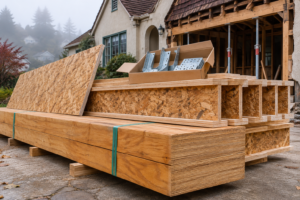
- Most engineered beams, headers, and I-joists, which are manufactured products with their own supply chains
That last point matters on hillside and fog-belt jobs where the beam package is the expensive line. If you are pricing an exposed ridge beam or a flush header for a Berkeley flat, the duty news barely touches it. What drives that cost is span, depth, finish grade, and lead time. We broke down the ordering side in our guide to what goes in an engineered lumber package for a Bay Area remodel.
Sizing always belongs to your engineer or the manufacturer’s sizing software. We supply to the spec you bring us.
Checking a bid against the new rates
A quick sequence for deciding whether the October change should move a number you already quoted.
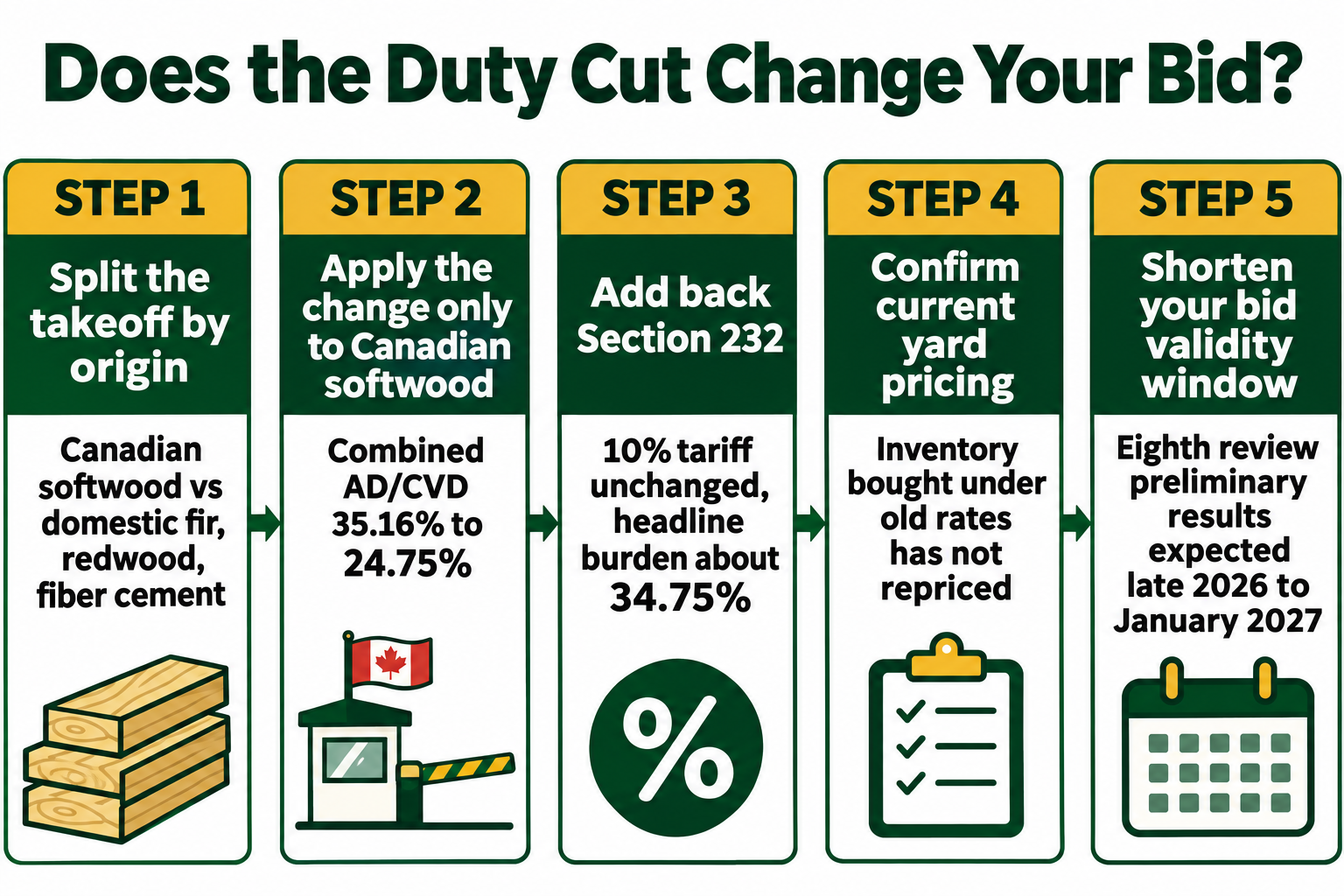
How to write bids until the eighth review lands
On an older Berkeley or Oakland house, the schedule risk is usually worse than the duty risk. Permit timelines, surprise framing conditions behind lath and plaster, and the wet-weather window all move material dates around more than a border rate does.
A few habits that hold up:
- Keep bid validity short on material-heavy scopes. Many contractors we work with use a 14 to 30 day window on framing and siding packages. Set whatever number you can defend.
- Name the material, not just the category. “Cedar bevel siding” and “fiber cement lap siding” behave completely differently when trade policy moves.
- Price the package, then confirm it before the order. Current yard pricing and availability are the only numbers that matter on order day.
- Order exterior material ahead of the rains. Once storms stack up in the East Bay, deliveries and install windows get tight fast.
If you are planning an addition or a backyard unit, build the list before you build the number. Our walkthrough on starting an ADU in Berkeley or Oakland with the material list covers the order a package usually comes together in. And if your scope includes hardwood trim, that is a separate tariff track worth following in our note on watching the October 1 hardwood tariff review.
Frequently Asked Questions About the October 2026 Canadian Lumber Duty Change
Did lumber prices drop on October 19?
Not automatically. The combined AD/CVD rate on most Canadian producers fell to 24.75%, but the separate 10% Section 232 tariff stayed, and the duty only applies to Canadian softwood crossing the border. Domestic fir, redwood, and fiber cement were never carrying those rates, and material already in a yard came in under the old ones.
Does this change the cost of my engineered beams?
Very little. Engineered beams, headers, and I-joists are manufactured products with their own supply chains, and the cost drivers on your quote are span, depth, grade, and lead time. If you are deciding between product types, our comparison of TJI joists and solid lumber for Bay Area floor and deck framing is a better starting point than the duty table.
What about cedar siding on a fog-belt house?
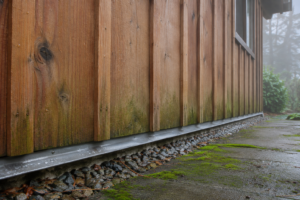
Western red cedar is the category most likely to feel Canadian duty movement, since a lot of it comes from British Columbia. On a flat in the marine layer, we would still make the decision on performance first. The bottom course and the end grain are what fail, so detailing, back-priming, and clearance off grade matter more over twenty years than a few points of border cost.
Should I wait for the eighth review before ordering?
We would not build a schedule around it. Preliminary results are expected somewhere between late 2026 and January 2027, the timing can slip, and rates have moved both directions in past reviews. Delaying exterior work into the wet season usually costs more than any rate change saves.
Where can I confirm the official rates myself?
The rate tables from the seventh administrative reviews are published by the U.S. Department of Commerce in the Federal Register and summarized by Global Affairs Canada. Trade press including ScrapMonster and trade law firms such as Sandler, Travis & Rosenberg have also published breakdowns of both the review results and the Section 232 action.
Pricing a framing, siding, or beam package this season?
Duty headlines are easy to read and hard to apply. If you want to know what the October change does to a specific package on a Berkeley, Oakland, or Peninsula job, bring the takeoff by the Lumberyard and Hardware at 642 Hearst Avenue and we will walk the list with you line by line. Our lumber sales desk is reachable at 510-841-0511, and the full moulding, trim, and siding selection is at truittandwhite.com.