Quick Answer
To plan how to plan a deck bay area correctly, start with the site itself. Check slopes, views, drainage, and existing features, call 811 before digging, confirm local permit rules, and choose materials that fit your climate and fire zone. A practical starting point is this deck planning guide and materials overview.
You’re probably looking at a yard, side lot, or rear elevation and trying to figure out what’s possible before you spend time on drawings or materials. In the Bay Area, that early planning step is more significant than commonly understood because site conditions, city review, fire rules, and structural requirements can shift the job before the first footing is dug.
Knowing how to plan a deck bay area means thinking like a builder from the beginning. You need a workable layout, a permit-ready set of notes, and material choices that make sense for coastal moisture, inland sun, hillside movement, and local code review.
Start with Your Site and Goals

A deck plan that works on paper can fail fast in the yard. Before you sketch railings or pick board colors, walk the site and note grade changes, drainage paths, doors, windows, retaining walls, fences, and the way the yard gets used now.
Underground conflicts come first. Calling 811 is a federally mandated step that prevents 99% of utility strikes annually, according to Farrar Construction’s discussion of custom deck planning in Marin County. Electrical, plumbing, and sewer lines can all force a footing relocation or a complete redesign.
Read the yard before you draw the deck
Start by answering a few plain questions:
- Where will people enter and exit from the house
- Where does water move in winter
- Which side gets wind or hot afternoon sun
- What needs to stay clear, including access paths, basement vents, and utility runs
- Whether the lot is flat, stepped, or sloped
If the yard falls away from the house, don’t assume a simple rectangular platform will be the right answer. On many Berkeley, Oakland, and hillside East Bay lots, a deck becomes part outdoor room and part structural solution.
A rough area study helps at this stage. If you need help with that, use a simple square footage guide for deck planning before you start pricing boards or framing packages.
Practical rule: If you haven’t marked utilities, checked drainage, and measured elevations, you’re not designing yet. You’re guessing.
Decide what the deck needs to do
Function drives size and shape. A quiet landing outside a kitchen door is a different project from a multi-zone deck built for dining, grilling, and evening seating.
The Bay Area planning approach described by Farrar ties design to use first: orient the deck to capture views, match the home’s style, and account for yard space, slopes, patios, pools, and landscaping. That part matters because a deck that ignores circulation usually feels cramped even when it’s physically large.
A simple way to think through layout is by use zones:
- Dining area if the main goal is meals outdoors
- Lounge area if the deck is more about sitting, reading, or gathering
- Service zone for grill access, storage, or stairs
- Buffer areas near doors, railings, and traffic paths so furniture doesn’t choke movement
Lay out a real footprint, not a rough idea
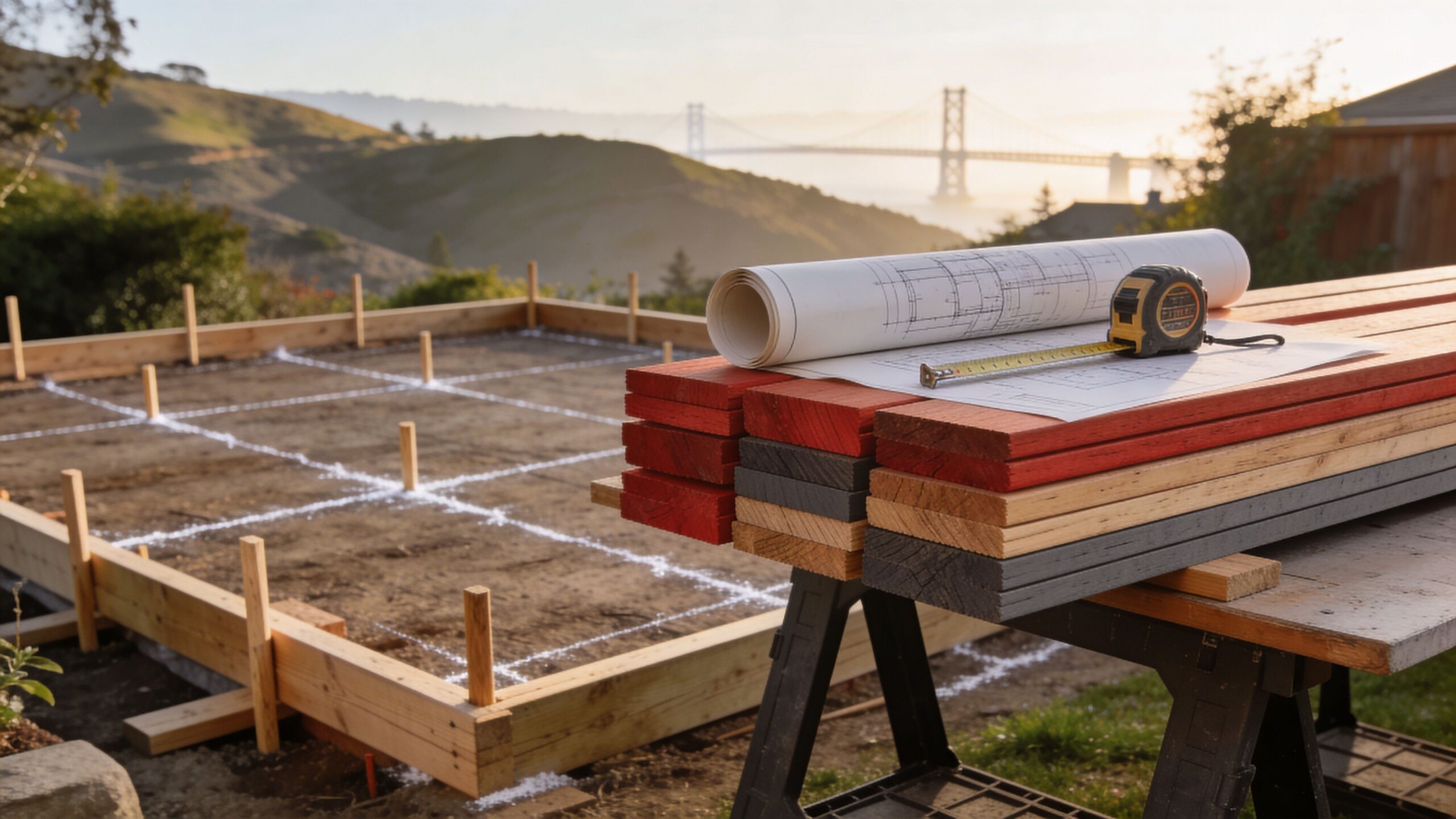
Once the purpose is clear, mark the proposed footprint in the yard. Stakes, batter boards, and string lines make problems visible early. That’s when you notice a stair run conflicts with a gate, or a beam line lands where a utility trench runs.
Professional layouts get squared before any excavation starts. That doesn’t require fancy equipment. It requires discipline.
For deck corners, use the field method that still holds up job after job: establish one line, measure 3 feet along it, measure 4 feet on the perpendicular line, and adjust until the diagonal is exactly 5 feet. That check creates a true right angle and keeps the framing from fighting itself later. The cleaner your layout, the cleaner the joist alignment, railing lines, and decking finish.
How to plan a deck for Bay Area permits and codes

Permits are where a lot of deck projects get bogged down. The problem usually isn’t the city being mysterious. It’s that the plans were started without checking setback, height, review thresholds, or what the building department wants to see on the first submittal.
In the Bay Area, deck review is shaped by California Residential Code Section R507. According to this Bay Area deck code and cost overview, decks over 30 inches above grade require building department approval and must meet property setback rules. In high fire hazard zones common in the East Bay and Marin, the deck surface must come from the State Fire Marshal approved list if ignition-resistant materials are required.
What the city usually wants in the plan set
A workable permit package typically includes these drawings and notes:
| Plan item | What it needs to show |
|---|---|
| Site plan | Property lines, lot dimensions, deck location, setbacks, and nearby features like fences or retaining walls |
| Framing plan | Material sizes, joist spacing, pier locations, and deck attachments |
| Elevation plan | Deck height above grade, finish surface, stair relationship, and guardrail details |
| Structural notes | Design loads and any required engineering or bracing details |
The same source notes that structural plans need enough detail to show framing, pier locations, and guardrail information, with decks designed for a 60 PSF live load. Prescriptive designs also assume 1500 PSF soil-bearing capacity and require minimum footing dimensions in the plan set.
The permit threshold is only the start
The common assumption is that permit review starts and ends with deck height. It doesn’t. Height triggers review, but other conditions can change the path.
Some of the local issues that matter early include:
- Setbacks and buildable area because a compliant structure still has to sit in the right part of the lot
- Planning review when the deck projects into areas the zoning rules restrict
- Engineering for taller or more complex structures
- Fire-zone materials if the site falls in a regulated hazard area
- Guardrail design because safety details belong in the submittal, not after framing starts
The same Bay Area code summary notes that guardrails must be at least 42 inches high, and that decks over certain heights may require additional review or stamped engineering depending on jurisdiction.
A permit reviewer is checking whether the deck fits the lot, carries the load, handles lateral force, and uses the right materials for the site. If any one of those is missing, the comments come back fast.
Bay Area cities don’t review decks exactly the same way
Contractors save time by checking city regulations before finalizing framing plans. Jurisdictions vary. San Francisco has its own review triggers, and some local departments are stricter about planning review, setbacks, or submittal detail than neighboring cities.
That’s especially true in fire-prone hillside areas. If your project touches a Wildland Urban Interface area, review the local requirements early and compare them against the Berkeley WUI rules and fire-rated lumber guidance before you order decking or railing components.
What works well is simple. Submit a clear site plan, a clear framing plan, and an elevation drawing that matches the yard. What doesn’t work is a loose sketch with missing setbacks, no footing information, and materials left “TBD.”
Designing for Function and Local Style

Once the site and code limits are clear, the design gets easier. Good deck design isn’t about adding features until the drawing looks full. It’s about making the space work from the door threshold to the far rail.
Break the deck into use zones
Most successful decks read as a few connected spaces instead of one big blank platform. Even a modest footprint can feel better if the furniture plan is settled before the framing is ordered.
Think in terms of practical placement:
- Dining near the kitchen door so carrying food doesn’t turn into a long walk
- Lounge seating at the view edge where traffic won’t cut through it
- Grill space with breathing room away from pinch points and door swings
- Stairs where people naturally move, not wherever there happened to be room left
When the zones are set first, the framing can support the use. Beam placement, stair direction, board orientation, and railing breaks all start to make sense.
Square layout still matters more than people think
The cleanest-looking decks usually start with careful string layout, not expensive finish materials. The San Francisco deck guidance explains the 3-4-5 method plainly: measure 3 feet along one string line, 4 feet along the perpendicular, and the diagonal should be 5 feet to confirm a right angle, as shown in the San Francisco residential deck guidance.
That one field check affects more than appearance. It helps keep joists aligned, distributes load correctly, and prevents the kind of cumulative framing error that shows up later as crooked fascia, awkward stairs, or decking that has to be forced into line.
On the jobsite: If the layout is out of square at the beginning, every finish trade sees it at the end.
Match the house, not the trend
A deck should feel attached to the house in more than one sense. A low modern home usually wants a different railing profile, board width, and stair expression than a Craftsman or older shingle-sided house.
Keep the visual decisions tied to structure and maintenance:
- Modern homes usually handle cleaner rail lines and simpler fascia details well
- Traditional homes often look better with warmer wood tones and a less stark guardrail pattern
- Tight urban lots benefit from simpler shapes that preserve movement space
- View lots usually justify more attention to orientation and seated sightlines
If you’re sorting out plan review along with design choices, this practical guide to mastering the building permit process is useful for understanding how drawings and approvals connect.
Choosing Deck Materials for the Bay Area Climate

Material choice decides how the deck ages. In the Bay Area, that means thinking about fog, salt air, wet winters, inland heat, and fire-zone compliance at the same time.
The easy mistake is choosing decking by appearance alone. The better approach is to choose a system that fits the site, the maintenance tolerance, and the code path.
Wood and composite don’t fail the same way
Wood still makes sense on many projects. It has a natural look, can work well on traditional homes, and gives you repair flexibility. But moisture exposure, movement, and maintenance are real considerations, especially in coastal or shaded conditions.
Composite and other alternative boards usually make more sense when the owner wants a more consistent surface and less upkeep. They can also simplify compliance in places where fire performance matters.
Here’s the trade-off in practical terms:
| Material type | Where it tends to work well | Common watchouts |
|---|---|---|
| Natural wood | Traditional homes, projects where appearance of real grain matters | Movement, weathering, finish maintenance |
| Composite decking | High-exposure decks, lower-maintenance expectations, some fire-zone applications | Heat under direct sun, product-specific fastening and framing requirements |
| Thermally modified or specialty products | Projects balancing appearance, performance, and code needs | Availability, lead times, and exact listing requirements |
Fire zones change the conversation
For parts of the East Bay, the fire question isn’t optional. According to TimberTech’s deck planning article, 70% of the East Bay is located in high fire hazard zones, and post-2024 CAL FIRE ordinances mandate ignition-resistant decking with a flame spread under 25 per ASTM E84 testing. The same source notes a 300% rise in adoption of alternatives such as thermally modified wood and composites that meet those standards.
That means a material that works perfectly on a flat, sheltered Berkeley yard may not be the right answer for a hillside Oakland project in a regulated fire area. Product listing, flame spread classification, and the local interpretation of approved materials all need to be checked before ordering.
If the deck gets full sun most of the day, compare surfaces carefully with a guide focused on decking materials for full sun in California. Heat, expansion, and finish durability matter just as much as color.
Why a local supplier matters on deck jobs
Deck projects go sideways when the framing package, hardware, surface boards, and code notes are all sourced in pieces from different places. A local yard can help line up the structural lumber, engineered wood, fasteners, and decking so the plan and the material list agree.
That’s where Truitt & White fits practically for Bay Area contractors and serious homeowners. The Berkeley yard stocks structural lumber, engineered wood products, decking materials, hardware, and jobsite supplies, which helps when a deck package needs to match real field conditions instead of a generic list.
The right material is the one that fits the exposure, the permit path, and the owner’s maintenance habits. If one of those gets ignored, the deck usually shows it within a few seasons.
Creating a Realistic Budget and Timeline
Deck budgets rarely drift because of one dramatic surprise. They drift because too many decisions were left open at the start.
Material type, railing complexity, stair count, site access, engineering needs, and permit comments all affect the final number. That’s why it’s better to build the budget around confirmed decisions instead of trying to back into a design from a rough allowance.
What pushes the budget up or down
The biggest cost drivers are usually tied to complexity:
- Site conditions such as slope, limited access, or awkward excavation
- Structure height because taller decks often need more engineering and bracing
- Material package including framing species, decking surface, hardware, and railing system
- Finish details like picture framing, skirting, lighting prep, and custom stairs
Labor follows complexity. A simple platform with clear access moves very differently than a hillside deck with tight setbacks and hand-carried material.
Build the timeline in the right order
A realistic schedule usually follows this sequence:
- Site measure and concept layout
- Drafting and structural planning
- Permit submission and comments
- Material takeoff and ordering
- Delivery scheduling
- Construction
- Final inspection and punch work
Keep some room in the schedule for revisions. Permit comments can change a footing line, beam size, railing detail, or fire-rated material choice after the first draft. If you order everything before the plans settle, you’re taking on avoidable risk.
Shorter jobs often come from clearer planning, not faster building.
Don’t lock yourself into a finish date before the permit path and material lead times are known. For pricing, product comparison, or a package review, it’s better to talk through the actual scope with a yard or contractor than rely on a generic online figure.
Hiring a Contractor and Sourcing Your Materials
The right contractor for a Bay Area deck isn’t just someone who can frame. You want someone who has dealt with your city, understands hillside or seismic conditions if they apply, and knows how to keep the permit set, field layout, and material order aligned.
Ask direct questions. Have they built decks in your jurisdiction before? Who handles revisions if the city asks for more detail? What parts of the package are prescriptive, and where do they expect engineering input? Those answers tell you a lot.
A contractor should also be comfortable reviewing product specs before ordering. Fire-rated decking, structural connectors, engineered wood, and railing systems need to be chosen as a coordinated assembly, not one item at a time.
For homeowners doing the early screening, this guide on how to choose a contractor helps sort serious candidates from people giving loose estimates without enough project detail.
Material sourcing matters just as much as labor. A dependable supplier helps confirm board lengths, framing stock, hardware compatibility, and special-order timing before the deck is half built. That kind of coordination prevents the usual mid-project problems, especially on custom layouts or sites with access limits.
Frequently Asked Questions About Planning a Deck
Do I need a permit for a deck in the Bay Area?
In many cases, yes. Decks over 30 inches above grade generally require building department approval, and local setback or planning rules may also apply depending on the city and site conditions.
How early should I call 811?
Call before any digging or footing layout starts. Utility locations can change the size, position, and structural approach of the deck, so it’s one of the first planning steps, not a last-minute safety check.
What drawings should I have before I submit?
A solid submittal usually includes a site plan, a framing plan, and elevation information. The city needs enough detail to understand where the deck sits on the lot, how it’s supported, and how safety items like guards are handled.
Is wood or composite better for Bay Area decks?
That depends on exposure, maintenance expectations, and whether the property is in a fire-regulated area. Wood can look great and work well, but composite or other ignition-resistant products often make more sense where moisture, sun, or fire compliance are the bigger concerns.
How do I make sure the deck layout is square?
Use the 3-4-5 method during string layout. Measure 3 feet on one line, 4 feet on the perpendicular line, and adjust until the diagonal is 5 feet.
What usually causes deck planning delays?
Incomplete plans, missed setback issues, utility conflicts, and material decisions made too late are common causes. Delays also happen when the permit set doesn’t match the actual site conditions.
Can I plan the materials first and get the permit later?
You can start looking at materials early, but don’t finalize the order too soon. Permit comments or engineering changes can affect framing, footing size, railing details, and sometimes the deck surface itself.
Let's Get Your Deck Plan Started
If you’re figuring out how to plan a deck bay area, the smartest first move is to get the site conditions, permit path, and material list working together before construction starts. That’s what keeps a deck project buildable instead of just attractive on paper.
A local review of your plans and product options can save a lot of backtracking. Seeing framing stock, decking samples, hardware, and related products in person also makes the decisions easier.
If you want to talk through a deck project, visit Truitt and White. For decking, framing materials, hardware, and jobsite supplies, call the Lumberyard and Hardware at (510) 841-0511 or stop by 642 Hearst Ave, Berkeley, CA 94710. For window and door questions related to adjacent openings or exterior remodel coordination, call (510) 649-4400 or visit 1831 Second Street, Berkeley, CA 94710. You can also reach out through truittandwhite.com or email info@truittandwhite.com.