Quick Answer
Fire-rated lumber in Berkeley usually means fire-retardant-treated lumber, not standard pressure-treated wood. In Berkeley hillside and WUI work, the right FRT product, properly labeled for the application and installed as part of a tested assembly, is often required under Chapter 7A. If the product, rating, or documentation is wrong, inspections can stall fast.
You’re probably here because a plan set says “fire-rated lumber,” the job is in the Berkeley hills, and nobody wants to guess wrong. That’s a fair concern. In Berkeley, code compliance around wildfire exposure often turns on small details like the right FRT stamp, whether the material is rated for exterior exposure, and whether the assembly matches what the inspector expects to see.
This is the advanced guide to fire rated lumber in berkeley for contractors, architects, and remodelers who need practical answers. The main issue isn’t just buying treated wood. It’s knowing when fire-retardant-treated lumber is required, when another ignition-resistant assembly can work, and how to keep the project moving without rework.
What Exactly Is Fire-Rated Lumber?
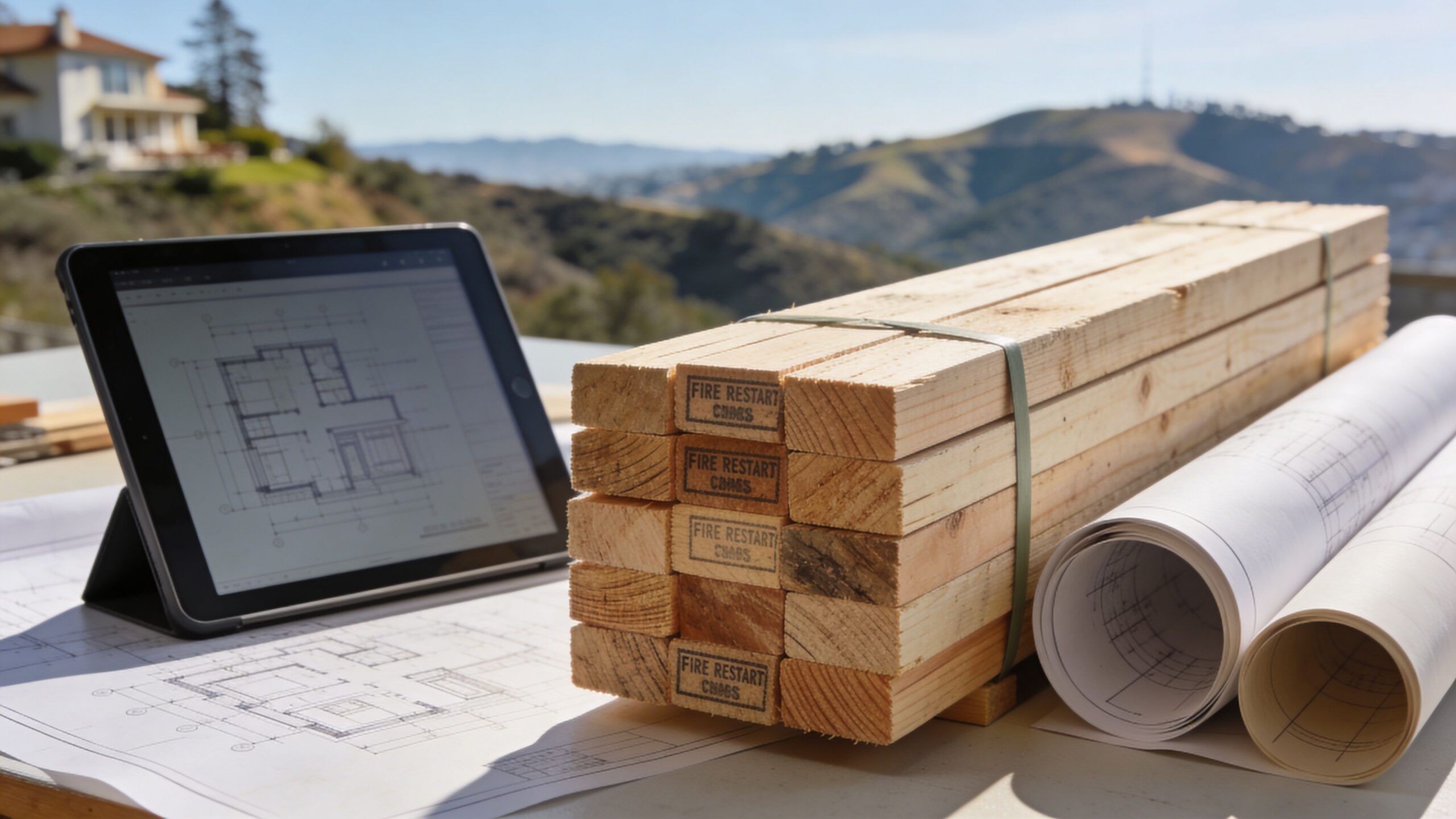
“Fire-rated lumber” gets used loosely in the field. In most Berkeley residential work, the term usually points to fire-retardant-treated lumber, or FRT lumber. That’s wood that has been pressure-impregnated with chemicals intended to slow ignition and flame spread.
Standard pressure-treated lumber is a different product. It’s meant for decay, insects, and ground-contact durability. It is not the same thing as lumber treated for fire performance, and mixing those up is one of the easiest ways to create a submittal problem or fail an inspection.

How the treatment works
The simplest way to think about FRT lumber is this. The wood carries a built-in chemical response that helps interrupt combustion when exposed to heat.
According to Chubb’s fire-hardened residential construction guidance, FRT lumber is tested under ASTM E84 and achieves a Flame Spread Index of 25 or less for a Class A rating. That same source explains that the chemicals decompose endothermically when heated, releasing water vapor and non-combustible gases. In practical terms, that means the treatment helps the wood resist rapid flame travel instead of feeding it.
That same Chubb guidance states that this treatment can reduce flame spread by 70 to 85 percent and delay flashover by 5 to 10 minutes. On a real job, that matters because inspectors and plan reviewers aren’t looking for vague fire resistance claims. They’re looking for materials that fit a tested performance standard.
Practical rule: If the plans call for FRT, don’t substitute standard pressure-treated framing and assume the treatment counts. It doesn’t.
What Class A means on the spec sheet
When you see Class A on an approved product or assembly, you’re not looking at a marketing term. You’re looking at a tested fire performance classification tied to recognized standards.
For builders, the useful takeaway is simple:
- ASTM E84 matters because it measures surface burning characteristics.
- Class A matters because it is the level commonly expected where wildfire exposure and Chapter 7A compliance enter the conversation.
- The listing matters because inspectors want to see the exact product identification, not a verbal assurance from the yard or installer.
A lot of confusion starts when someone reads “fire treated” on a note or invoice and assumes all treated wood qualifies the same way. It doesn’t. You need the treatment type, the use category, and the listing documentation to line up.
Interior-use and exterior-use are not interchangeable
Distinguishing between FRT products is critical in the Bay Area. Some FRT products are intended for protected interior conditions. Others are manufactured and labeled for exterior exposure.
That distinction is critical in Berkeley, where marine air, moisture swings, and hillside exposure can punish the wrong product. If you use interior-rated FRT in an exterior application, you can create a code problem and a durability problem at the same time. The label and evaluation report need to match the installed condition.
Look for these checks before you approve delivery:
| What to verify | Why it matters |
|---|---|
| FRT label on each piece or bundle | Confirms the material is actually fire-retardant-treated |
| Use category for interior or exterior exposure | Prevents the wrong product from being installed outside |
| Class A or required listing language | Helps align the product with plan and code expectations |
| Evaluation report or listing reference | Gives the inspector something concrete to review |
What fire-rated lumber does not do
FRT lumber helps control fire spread. It does not make wood noncombustible. It also does not replace the need for the rest of the assembly to be correct.
If the wall or roof assembly depends on sheathing, underlayment, gypsum, vent screening, or penetration sealing, the lumber alone won’t save the inspection. Fire performance on paper comes from the complete tested assembly, not from one upgraded component dropped into an otherwise ordinary detail.
If the plans are vague, the safest move is to clarify whether they require a fire-retardant-treated product, a tested ignition-resistant assembly, or both. Those are related, but they are not the same instruction.
Decoding Fire Code in Berkeley's WUI Zones
Berkeley jobs get harder once a site falls into wildfire-related requirements. The phrase contractors hear most is “Chapter 7A,” but the actual issue is application. You need to know where the project sits, what part of the structure is exposed, and whether the plans call for a rated assembly, an ignition-resistant material, or a specific listed product.
For hillside work, roof and wall details usually deserve the closest reading. That’s where assumptions lead to delays.

Where FRT commonly shows up
On Berkeley WUI projects, contractors most often run into FRT requirements in these areas:
- Roof sheathing where the assembly must qualify for a Class A roof.
- Exterior wall assemblies that need to achieve a fire-resistance rating as designed.
- Eaves, soffits, and overhang conditions where exposed framing and sheathing are vulnerable.
- Decking and framing near ember-prone zones if the plans or jurisdiction require a qualifying product.
The roof side is especially important. According to this fire safety standards reference, FRT plywood used in Berkeley’s Chapter 7A zones must meet California State Fire Marshal 12-7A-4A for a Class A roof rating and survive ASTM E108 testing, while untreated plywood can ignite in under 5 minutes. The same source states the treatment can reduce peak heat release rate from over 200 kW/m² to under 50 kW/m².
If you want a general primer on panel selection before layering fire code on top, Seattle homeowner's roof sheathing guide gives a useful overview of how sheathing choices differ in practice. It isn’t a Berkeley code resource, but it helps frame the plywood-versus-panel conversation that often comes up during estimating.
The assembly matters more than the buzzword
A common mistake is ordering “fire-rated plywood” and stopping there. The inspector may be looking for a complete roof assembly or wall assembly that includes listed sheathing, underlayment, gypsum, vent protection, and sealed penetrations.
The verified Berkeley-specific guidance in this local WUI rules explainer points to the importance of pairing FRT lumber with the rest of the approved system. On projects in high fire hazard zones, that often means checking not only the lumber spec but also the wall base, vent detailing, sheathing thickness, and ember-resistant transitions.
Don’t send a crew to frame until somebody has matched the plan notes to the actual listed products on site. That’s cheaper than tearing into a completed eave.
Inspection failures usually come from details
Most failed inspections in this category don’t happen because nobody bought treated lumber. They happen because one of the following got missed:
- Wrong exposure rating for the application.
- Missing product stamps or bundle tags when the inspector asks for proof.
- Field cuts left untreated where the manufacturer requires sealing.
- Unapproved substitutions in sheathing or connectors.
- Assembly mismatch between what was drawn and what was built.
Handling details also matter. End cuts, notches, and drilled penetrations can affect how the treated material performs and how the manufacturer expects it to be protected. Fastener compatibility matters too, because treatment chemistry can be hard on the wrong metals over time.
Berkeley’s local reality
In Berkeley, Oakland, and nearby East Bay hill projects, the difficult part isn’t usually finding code language. It’s interpreting how that language applies to one remodel, one addition, one roof rebuild, or one deck replacement with a mix of old and new conditions.
That’s why the practical sequence works better than broad wildfire advice:
- Confirm the property’s fire hazard context and the applicable local requirements.
- Read the plans for exact assembly language, not just the words “fire-rated.”
- Verify the product listing before delivery.
- Keep documentation with the job file so the inspector can review it quickly.
- Walk the exposed conditions before inspection, especially eaves, roof edges, vents, and field-modified members.
If you do that, Chapter 7A becomes manageable. If you don’t, the job starts collecting expensive little problems.
Specifying the Right FRT Lumber for Your Berkeley Project
A Berkeley hillside job can go sideways on one line of the spec. Plans call for fire-rated wood, the yard ships an interior-use FRT panel, and the correction shows up after framing is already in. That is the kind of mistake that burns time, change orders, and inspection dates.
The right specification does more than say "fire-rated." It identifies the exact product type, approved use condition, structural properties, and listing path the plan checker and field inspector expect to see on a Berkeley project. In WUI work, especially on remodels and roof replacements in the hills, vague language usually turns into field interpretation. Field interpretation is expensive.

What to check on the stamp and paperwork
Start with the actual piece, not the invoice description.
The lumber or panel needs a legible stamp or label that ties back to the evaluation report, manufacturer data, and approved application. If the submittal says one thing and the stamp says another, the stamp wins the argument in the field.
Check these items before the material gets distributed around the site:
- Fire-retardant treatment identification on the lumber or panel itself.
- Use designation for exterior or interior/protected use.
- Listing or evaluation report reference that plan review and inspection can trace.
- Species, grade, thickness, and panel designation that still meet the structural schedule.
- Manufacturer installation limits for cuts, exposure, fasteners, and moisture conditions.
On Berkeley work, I also tell crews to match the stamp to the exact location on the plans. Roof sheathing, exposed eave blocking, exterior wall framing, and retrofit infill do not always have the same product requirement, even when the notes use the same shorthand.
Exterior exposure decides a lot of Berkeley specs
The biggest miss is using the wrong FRT for the exposure condition.
In Berkeley's WUI areas, contractors often focus on whether wood is treated and miss whether that treatment is approved for the place it is being installed. Exterior roof and eave conditions, partially protected overhangs, and rebuilds that tie into older framing all need a tighter read. The local code questions behind those decisions are explained in Berkeley WUI rules for fire-rated lumber, and the product-selection side is covered in Berkeley WUI FRT selection.
If the plans do not clearly state interior-use versus exterior-use FRT, stop and get that answered before ordering. Do not let the supplier, framer, and inspector each make a different assumption.
That is a common Berkeley remodel problem. A detail may look simple on paper, but the built condition sits at the edge of exposure, especially at eaves, rakes, detached accessory structures, and roof-to-wall intersections on hillside homes.
Match the product to the assembly, not just the material callout
FRT lumber works only if the specified product still fits the full assembly. That includes structural span, fastening schedule, sheathing type, weather exposure, and the fire classification the detail is trying to satisfy.
A few common specification paths come up over and over:
| Specification path | Best fit | Common failure point |
|---|---|---|
| FRT sheathing or framing within a listed assembly | Roofs, walls, and eave conditions where the plans are clear and the listing is documented | Wrong exposure rating or missing evaluation report |
| Noncombustible substitution | Small scopes where tie-in conditions are simple and redesign is limited | Higher material and labor cost, plus awkward transitions to existing wood framing |
| Coating or field-applied treatment approach | Supplemental protection where the code and design team allow it | Used incorrectly as a substitute for pressure-treated FRT where a listed product is required |
For roof work, sheathing choice still matters structurally and practically, even before the fire-rating question is added. The basic performance trade-offs are laid out well in this Seattle homeowner's roof sheathing guide. On Berkeley projects, that comparison gets one more layer. The chosen panel also has to line up with the required fire-treated product listing and the actual exposure condition.
Retrofit work has real trade-offs
Berkeley remodels rarely start from a clean slate. Existing rafters may stay. A portion of the roof may be rebuilt while adjacent framing remains. The architect may be trying to satisfy wildfire requirements, energy upgrades, and a limited budget at the same time.
That is where careful FRT specification helps. It can keep a wood-framed design viable in places where a blanket switch to noncombustible materials creates harder tie-in details, more redesign, or unwanted thickness changes at the roof and wall assembly. But the treatment type, listing, and use condition have to be right from the start.
Good specifications are plain and exact. Call out the product category, use condition, report reference, and assembly requirement in language the supplier, framer, and inspector can all read the same way. Vague notes like "treated wood as required" leave too much to interpretation, and Berkeley inspections are not forgiving about interpretation.
Installation and Detailing Best Practices
You can order the right FRT lumber and still fail inspection if the installation doesn’t preserve the assembly. The field details matter because fire performance isn’t just about the material. It’s about whether the installed condition still matches the approved intent.
Experienced crews separate themselves by treating FRT like a specified system component, not just another stack of framing.

Jobsite handling that protects the material
Keep the material dry, stacked correctly, and identified. If the stamps disappear under mud, sawdust, and weather before inspection, you’ve created a paperwork problem that didn’t need to exist.
Crew leads should watch for these basics:
- Protect labels and bundle information so there’s still proof at inspection time.
- Store off the ground and covered to avoid unnecessary moisture exposure.
- Separate FRT from standard material so the wrong pieces don’t get framed into required locations.
- Flag any field modifications that trigger manufacturer instructions for sealing or protection.
Fasteners, cuts, and penetrations
Treatment chemistry can be hard on metal. That’s why the connector and fastener side of the install can’t be treated casually. Use corrosion-resistant fasteners and hardware appropriate to the product and manufacturer instructions.
Field cuts deserve the same attention. If a member gets ripped, drilled, or trimmed, the crew should know whether the manufacturer requires end-cut treatment or another protective step. Penetrations through rated or ember-resistant assemblies need to be sealed correctly as part of the overall detail.
For broader planning around wildfire-related improvements, fire-safe upgrades every Bay Area home needs is a useful companion read because it helps connect material choices to the larger fire-hardening picture.
A lot of inspection trouble comes from perfectly good materials installed with ordinary habits. FRT work isn’t ordinary framing.
The wall and roof have to work as assemblies
In Berkeley WUI work, FRT often appears alongside other components that do equal or greater work in the assembly. One verified example is the use of 5/8-inch Type X gypsum sheathing behind siding in a 1-hour fire-rated wall assembly per UL 263, as described in the earlier verified Berkeley fire-hardening guidance. If that gypsum layer, vent detailing, or penetration sealing gets skipped, the fire-retardant framing alone won’t carry the assembly.
That’s also why ember control belongs in the same conversation. Vents, roof-to-wall joints, and similar openings are common weak points. If your framing detail is good but your ember path is open, you still have a vulnerable assembly.
Two field checklists that actually help
Architect and designer checklist
- Call out the exact FRT requirement on plans, including exposure condition if relevant.
- Reference the tested assembly, not just the wood product.
- Specify compatible connectors and fasteners where treatment chemistry is a concern.
- Detail penetrations, vent protection, and transitions so crews aren’t inventing solutions.
- Coordinate energy and fire requirements early when the project includes insulation, glazing, or roof ventilation trade-offs.
Contractor and builder checklist
- Verify the product stamp at delivery before anyone unloads into mixed stock.
- Match the paperwork to the plan notes while there’s still time to reject errors.
- Use the fasteners and connectors required for the treated material.
- Seal field cuts if the manufacturer requires it and keep the product instructions in the site file.
- Walk the job before inspection with attention to eaves, roof edges, exposed framing, and penetrations.
Cost, Sourcing, and Sustainability of FRT Lumber
FRT lumber costs more than ordinary framing stock. That’s expected. The key question isn’t whether the material carries a premium. The key question is whether that premium is smaller than the cost of a failed inspection, a schedule slip, or a tear-out after exterior work is already in place.
On Berkeley hillside jobs, that answer is usually obvious.
What you’re really paying for
You’re paying for code compliance, documented performance, and a clearer path through inspection. You’re also paying for procurement certainty. That matters more than people admit, especially when a project has tight sequencing around framing, sheathing, and dry-in.
The material decision should be weighed against these risks:
- Ordering the wrong treatment category
- Delaying the job while paperwork gets chased down
- Replacing installed material after an inspector rejects it
- Overbuilding with a more expensive assembly than the project requires
That last one gets overlooked. A lot of contractors spend too much because they don’t get a clear answer early enough on whether FRT within a tested assembly will satisfy the requirement.
Sourcing locally helps avoid dumb delays
This category rewards careful sourcing. The supplier needs to understand the difference between pressure-treated and fire-retardant-treated stock, know what paperwork belongs with the order, and help confirm whether the specified material is appropriate for the actual use condition.
That’s one reason local material guidance matters on East Bay work. If your project also has a sustainability angle, your expert guide to eco-friendly lumber in the East Bay is worth reading alongside the fire code discussion. A lot of jobs are trying to balance both.
Sustainability questions come up more in retrofits
Modern Berkeley remodels often combine wildfire compliance with energy upgrades and green building goals. FRT can fit that approach, but only when the project team checks compatibility instead of assuming every treated product plays nicely with every assembly.
Good questions to ask before ordering include:
- Will this FRT product’s use category match the installed exposure?
- Does the specified assembly support the insulation and ventilation approach?
- Will the finish system or coating be compatible with the treatment?
- Do the manufacturer instructions create any warranty limitations?
Those aren’t abstract design questions. They affect submittals, sequencing, and inspection readiness.
Pre-Inspection Checklists for Your Team
If your team wants fewer surprises, build the inspection prep before framing wraps up. Fire-rated lumber issues are usually visible in advance. They don’t need to become same-day arguments.
A good internal review catches product mismatches, missing documentation, and detailing gaps while they’re still cheap to fix.
Checklist for Architects and Designers
Put the exact FRT requirement on the plans. Don’t rely on general notes. Identify the assembly, the exposure condition, and any related connector or protection requirements so the field isn’t left to interpret it.
Keep a matching submittal trail. Product data, listing references, and plan notes should all point to the same assembly logic. For teams already tightening internal review standards, a Bay Area professional's construction quality assurance checklist is a practical way to organize that process.
Use roof details as a checkpoint. A general resource on inspecting commercial building roofs is aimed at a different project type, but it’s still useful for training teams to review penetrations, edges, and transitions systematically.
Checklist for Contractors and Builders
Before inspection, confirm that the material on site still shows the required stamps or that the supporting documentation is immediately available. If an inspector has to wait while the superintendent looks for paperwork in a truck, the inspection has already gone off course.
Then walk the actual build with a short list:
Material verification
Confirm that the installed members and panels in required locations are the specified FRT products.Field modifications
Check ripped edges, notches, drilled holes, and end cuts for any required treatment or manufacturer-directed protection.Hardware review
Make sure connectors and fasteners are appropriate for treated material and haven’t been swapped in the field.Assembly continuity
Look at joints, penetrations, vent areas, and transitions where ember exposure or rating continuity can fail.
The easiest inspection is the one where the superintendent can point to the plan note, the product stamp, and the installed detail without explaining anything twice.
Why this preparation pays off
The point isn’t paperwork for its own sake. The point is keeping the build moving. On WUI projects, one rejected detail can hold up multiple trades.
That’s why the advanced guide to fire rated lumber in berkeley comes down to one habit more than anything else. Treat fire-rated materials as inspection-critical from the first takeoff, not as a finish-line problem.
Frequently Asked Questions About Fire-Rated Lumber
Can I paint or stain fire-rated lumber?
Yes, but only with finishes that are compatible with the treatment. Check the manufacturer guidance for the exact FRT product before applying paint, stain, or any coating. Some finishes can create compatibility issues, and you want that cleared up before the material is installed.
Does FRT lumber lose its effectiveness over time?
When the correct product is specified for the actual use condition, FRT lumber is intended for long-term performance. The biggest mistake is using an interior-use product where exterior exposure is expected. If the exposure rating is wrong, durability and code compliance can both become problems.
Why can't I just use a fire-retardant coating?
A coating and pressure-impregnated FRT lumber are not the same thing. Surface-applied products may add protection in some situations, but they usually aren’t accepted as a substitute where the plans or code require pressure-treated fire-retardant lumber as part of a tested assembly.
Is FRT lumber significantly heavier than standard lumber?
It can be noticeably heavier in the field because of the treatment process. That affects handling, staging, and crew expectations on site. If you’re framing roof areas or raised decks, plan your labor around the actual delivered material instead of assuming it will handle like standard stock.
Do I need special tools or blades to work with FRT lumber?
You don’t need exotic tools, but you do need to respect the material. Good blades matter, and crews should keep tools clean because treatment chemicals can be hard on metal over time. More important than the saw setup is using the correct hardware and following the manufacturer’s instructions for field cuts.
Get Your Berkeley Project Specified Correctly
A Berkeley hillside job can be framed cleanly, then stall at inspection because the submittal says fire-retardant-treated lumber, the stamp on site says something else, and nobody caught the exposure rating before delivery. That is the kind of mistake that burns time and change-order money.
The fix is straightforward. Match the plans, the listed assembly, the treatment rating, and the field conditions before material is released. In Berkeley, that matters most on WUI-adjacent work, ridge and canyon sites, and reroof or rebuild projects where the inspector is looking closely at how the details were specified, not just whether the lumber was treated.
If your team is still sorting out suppliers, submittals, and who can answer code questions before the truck shows up, start with this guide on finding a reliable lumber supplier near you. The right supplier should be able to flag use-condition conflicts, help verify assembly requirements, and keep your paperwork aligned with what gets delivered.
For Berkeley, Oakland, San Francisco, or other East Bay projects, call (510) 841-0511 for lumber, framing materials, decking, hardware, and project guidance, or visit 642 Hearst Ave, Berkeley, CA 94710. For windows, doors, and Title 24-aware product selection guidance, call (510) 649-4400 or visit 1831 Second Street, Berkeley, CA 94710. You can also email info@truittandwhite.com.