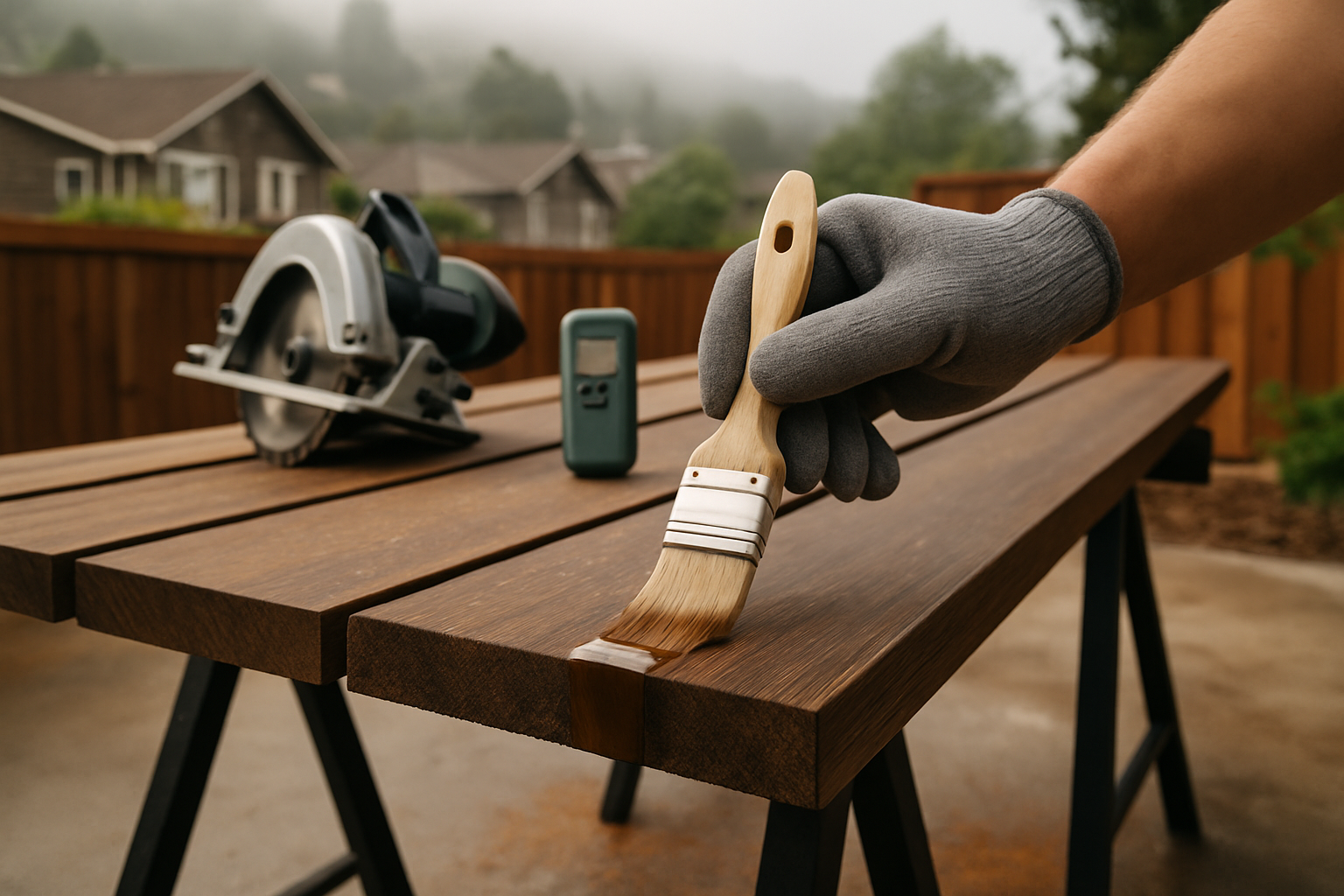
Direct Answer: MOSO bamboo decking holds up when boards are acclimated on site, gapped to match install-day moisture, end sealed at every cut, and set on approved clips over taped joists.
You picked the material. Now comes the part that actually decides how the deck looks in five years.
MOSO bamboo is dense, stable, and it handles Bay Area weather well. But it does not install like redwood, and it does not install like composite. Contractors who treat it like either one end up with cupped boards, dark swollen butt ends, and clips that never seated right.
If you are still weighing materials, start with Is MOSO Bamboo Decking Worth It for a Bay Area Project?. If you have already ordered, this walks through the four details that matter most: acclimation, gapping, end sealing, and fasteners, plus the substructure underneath all of it.
Step 1: Acclimate the boards and actually measure them
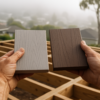
Bamboo decking leaves the factory at a controlled moisture content. It does not stay there after a week on a truck and a few days in a Berkeley side yard under a tarp.
Acclimation means letting the boards come close to the moisture level they will live at on your site. In the East Bay that number moves. Fog-belt neighborhoods near the bay sit damp most of the year, while a hot inland stretch in September can dry things out fast.
How to do it right:
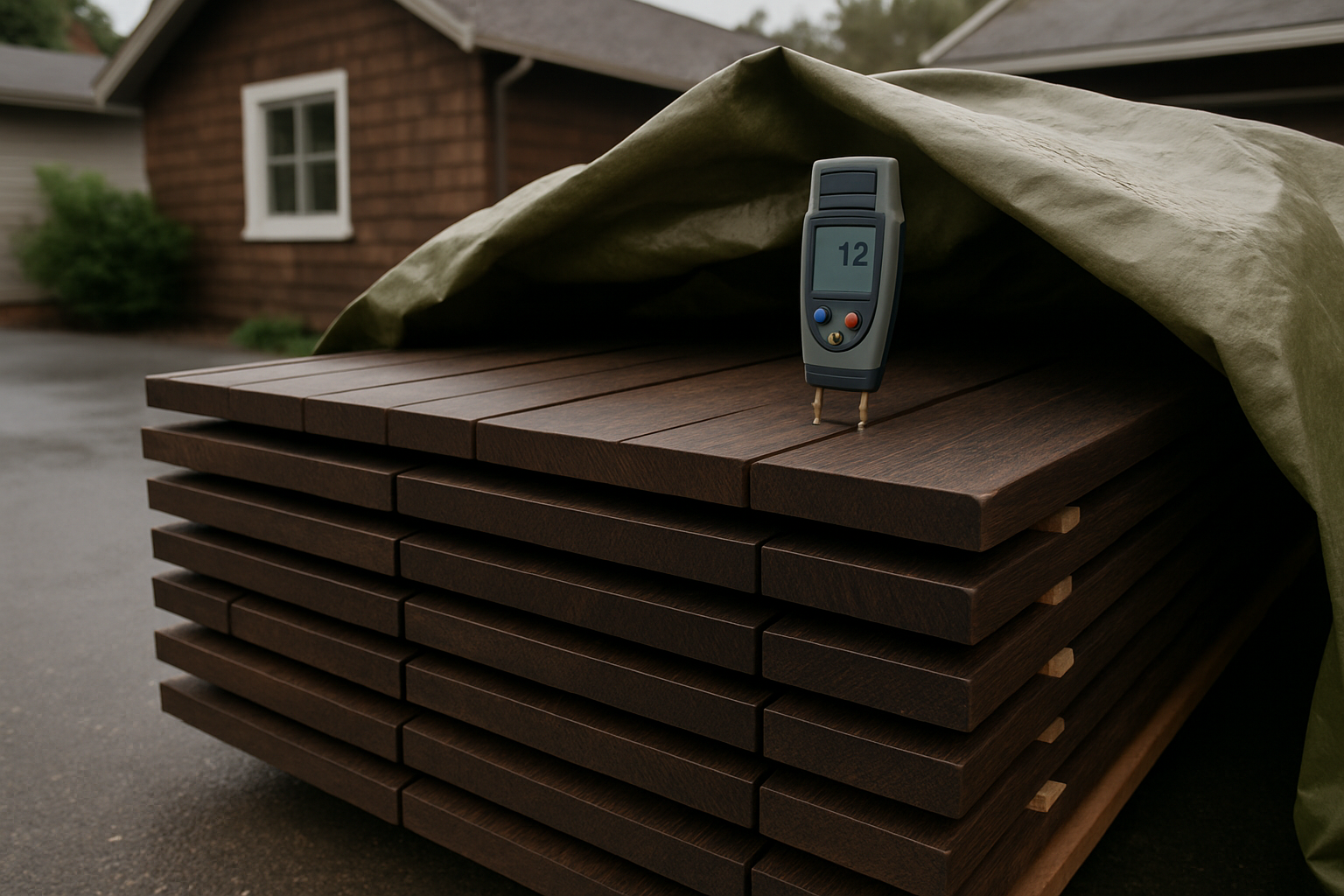
- Sticker the bundle with spacers so air moves on all four sides of every board
- Store it on site, not at the shop across town, and keep it off the dirt
- Cover the top for rain but leave the sides open
- Give it several days at minimum, and check the manufacturer’s current guidance for your conditions
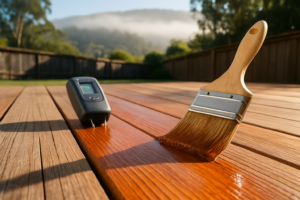
- Read moisture content with a pin meter on at least five boards, including some from the middle of the stack
If your readings vary widely board to board, the bundle is not ready. Installing a mixed stack is how you get one board that opens a wide gap while the one next to it stays tight.
And write the readings down. You will need them in the next step.
Step 2: Get gapping right for Bay Area humidity swings
This is where MOSO bamboo decking installation in the Bay Area differs most from wood. Bamboo is a grass, and it moves differently than a softwood or a tropical hardwood. It also moves differently than a plastic composite board, which expands mostly with heat rather than moisture.
The gap you set is not a style choice. It is math based on where the boards are today versus where they will settle.
Boards installed dry will pick up moisture from marine air and grow. Boards installed damp will give some back during a dry stretch and shrink. Your job is to leave room for whichever direction the boards are headed.
Three gaps to think about, not one:
- Side gap between board faces, usually set automatically by the clip system
- Butt gap where board ends meet over a joist, which is typically wider than the side gap
- Perimeter gap at walls, posts, and any fixed edge
Common side gaps for clipped bamboo systems land around 1/4 inch, with butt and perimeter gaps larger. Confirm the exact figures against the manufacturer’s current install document for your profile and length, because they change by product line and they change by board length.
One more thing that trips people up: longer boards move more in total than short ones. A 6 foot board and a 12 foot board do not get the same end gap.
Install conditions and how they change your gapping
Use your moisture readings to decide where in the manufacturer’s range you land. This is the shorthand we use when a contractor calls from the jobsite.
| Conditions on install day | What the boards will likely do next | Gapping approach |
|---|---|---|
| Damp fog-season week, boards read on the high side | Boards release moisture during the next dry stretch and shrink slightly | Gaps will open over time, so stay at the tighter end of the published range |
| Hot dry inland spell, boards read low | Boards take on marine moisture and grow | Go to the wider end of the published range so there is room to expand |
| Readings vary more than a couple points across the stack | Movement will be uneven board to board | Stop. Re-sticker, wait, and measure again before fastening anything |
| Long board runs, 10 feet and up | Total end movement is greater on longer pieces | Increase butt and perimeter gaps accordingly, not the side gap |
Step 3: Seal every cut end, every time
This is the step that gets skipped most often, on DIY projects and on some contractor installs too.
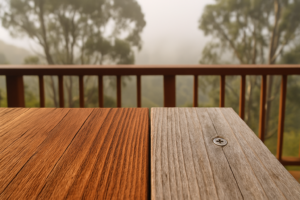
The face of a bamboo board is dense and fairly closed. The end grain is not. Cut a board and you have opened a straw that pulls water straight into the core.
In a fog belt neighborhood, that end grain sits damp for hours every morning through the summer marine layer. Unsealed, it drinks in far more water than the face of the board ever will.
What happens when it gets skipped:
- Dark, blotchy staining that shows up first at butt joints
- End checking, meaning fine splits that open at the cut face and travel back into the board
- Swelling at board ends that closes your carefully planned butt gaps
- Mold and gunk collecting in the tight joint where two ends meet
MOSO supplies an end grain sealer made for their boards, and their published installation guidelines spell out where it goes. The short version: seal every field cut immediately after cutting, before the board is fastened down. That includes mitres, picture frame borders, notches around posts, and any hole you drill for a face screw.
Keep the sealer and a small brush right at the saw station. If it lives in the truck, it will not get used.
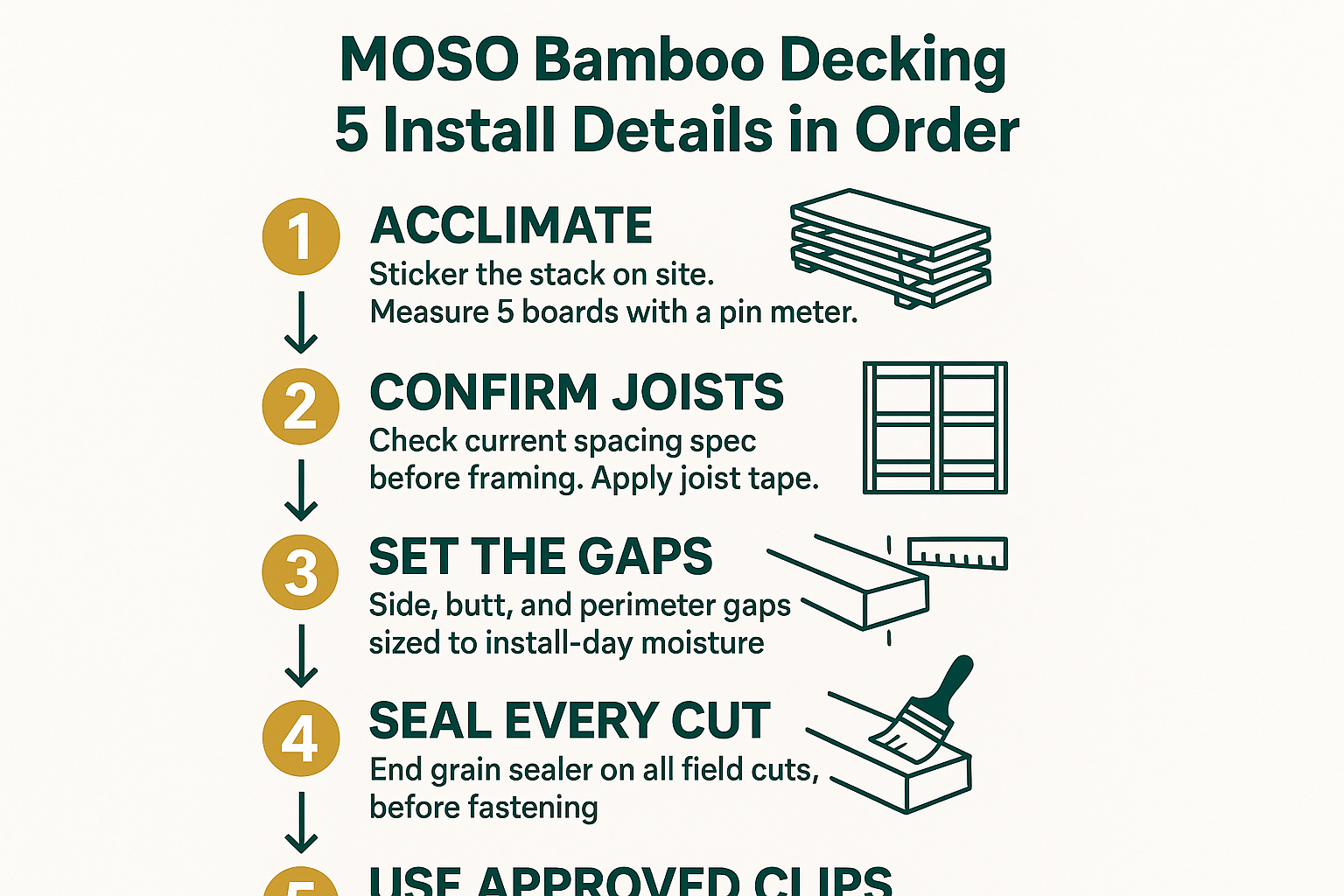
The five details in order
Here is the whole sequence on one page, in the order the work actually happens on site.
Step 4: Use the right clips, not the ones left over from the last job
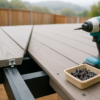
Hidden fastener systems are standard for bamboo decking. The trap is assuming your composite clip system transfers over.
Bamboo is much harder than a composite board. Clips designed to bite into a softer plastic profile may not seat correctly in a bamboo groove, and a clip that does not seat fully will let the board rock and squeak within a season.
What to check before the first board goes down:
- The clip type listed by the manufacturer for your exact board profile
- The clip schedule, meaning how many clips per board and where they land at ends and starts
- Stainless fasteners if you are anywhere near the bay shoreline in Berkeley, Emeryville, or Alameda, where salt air eats plated hardware
- Pre-drilling requirements for any face screws, since bamboo will split or blow out screw heads if you drive them dry
Deviating from the published fastener schedule is also the fastest way to void warranty coverage. If a board fails and the clip spacing does not match the document, that conversation is over before it starts.
This is a real switching problem for crews coming off composite work. If your last three decks were composite installs in the East Bay, read the bamboo instructions cover to cover before you start.
Step 5: Build the substructure for the material above it
Bamboo installs over standard joist framing. But in a climate with real moisture swings, closer spacing pays for itself.
Confirm the manufacturer’s current joist spacing requirement before you frame, not after. Bamboo is stiffer than most composites, and it flexes differently, so spacing that felt fine under a composite board may not be the published spec here. Spacing also tightens for diagonal or herringbone layouts.
Three substructure items worth the extra hour:
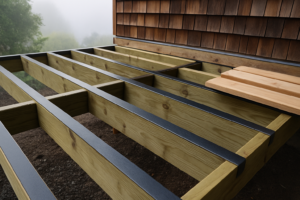
- Joist tape on the top of every joist and beam. Fog cycles keep the wood-to-decking contact point damp for months, and tape is what keeps that water out of the framing and away from fastener holes.
- Airflow underneath. A sealed skirt with no venting traps moisture. Leave the underside breathing.
- The right framing lumber. Get familiar with what the stamps mean in pressure-treated deck framing before you order.
One local note: if the project sits in a mapped fire hazard zone in the Berkeley or Oakland hills, the deck assembly has to satisfy WUI requirements. Confirm the assembly documentation with your building department before ordering material, not after the boards arrive. Berkeley also permits most deck work, so plan inspection timing around your framing sequence. Our deck planning guide covers that sequencing in more detail.
Frequently Asked Questions About MOSO Bamboo Decking Installation
How long do I need to acclimate bamboo decking before installing?
Several days on site at a minimum, stickered and covered, with the sides open to air. The real answer is not a number of days though. It is a moisture reading that has stopped moving across multiple boards in the stack. Check the manufacturer’s current document for your product line.
Can I use my existing composite deck clips with MOSO bamboo?
Usually not, and you should never assume it. Bamboo is far harder than composite, the groove profile is different, and a clip that does not seat properly will cause movement and noise. Using a fastener outside the published schedule can also void warranty coverage.
What actually happens if I skip end sealing?
Not much for the first year. Then you start seeing dark staining at the butt joints, fine splits opening in the end grain, and board ends swelling enough to close the gaps you set. In fog-belt neighborhoods it shows up faster because the end grain rarely gets a chance to dry out fully.
Does gapping change depending on when in the year I install?
Yes. Boards installed during a damp stretch and boards installed during a hot dry spell are starting from different moisture points, so they move in different directions afterward. That is why we push people to measure rather than guess a gap that looked right on the last job.
Is bamboo decking allowed on hillside projects in fire hazard zones?
That depends on the assembly and on how your local jurisdiction reviews it. Bring the product’s compliance documentation to your building department in Oakland or Berkeley and confirm before the order goes in. Getting that answer early is a lot cheaper than getting it at inspection.
Working through a bamboo deck spec?
If you want a second set of eyes on gapping, clip selection, or joist spacing before you order, our lumber sales team at the Hearst Avenue yard in Berkeley has walked plenty of Bay Area crews through their first bamboo install. Truitt & White stocks decking, fasteners, and jobsite supplies, and the Lumberyard and Hardware line is 510-841-0511. You can also look through product details at truittandwhite.com.