Direct Answer: After 5 years, redwood weathers to a gray patina and needs periodic sealing to stay sound. Composite holds its color but can fade or get slippery in shady, damp conditions. Both perform well — but differently.
Most decking decisions get made at the lumberyard — based on upfront cost, appearance, and whatever the contractor recommends that week. But the question that actually matters is what the deck looks like in year five, not year one.
The Bay Area puts decking through a specific kind of punishment. Marine layer, coastal moisture, fog that lingers until noon, and then direct sun on south-facing exposures — it’s not the wet-and-cold Pacific Northwest, but it’s not dry inland California either. That middle ground creates its own set of material challenges.
This article focuses on two things: how redwood and composite decking each age under those conditions, and what maintenance commitments each one actually requires over time. If you want the full side-by-side breakdown from the start, our redwood vs composite decking guide covers selection from the ground up.
What Happens to Redwood in the First 5 Years
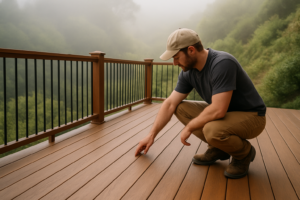
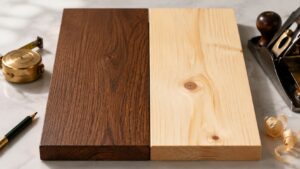
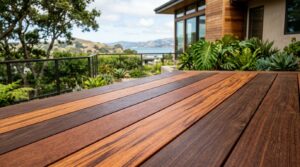
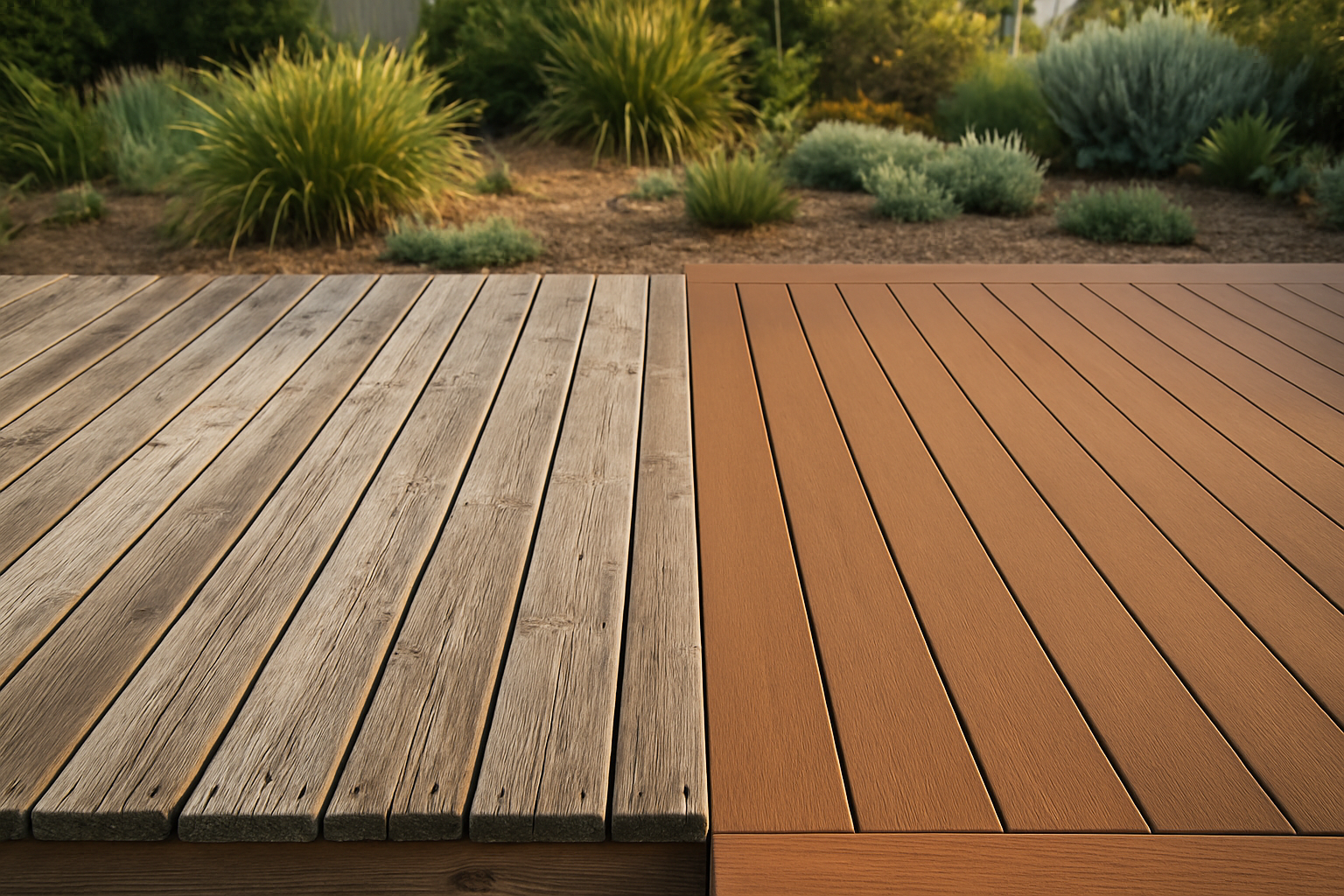
Fresh redwood comes off the truck a warm reddish-brown. Within 6 to 12 months of outdoor exposure in the Bay Area, unsealed redwood starts moving toward a silver-gray patina. That’s not decay — it’s surface oxidation, and plenty of homeowners and contractors actually prefer that look.
The real issue is moisture cycling. Bay Area decks get wet from fog and morning dew most of the year, then dry out in summer. That constant expansion and contraction is what opens up checks (small surface cracks) in the wood over time. By year three or four on an unprotected deck, you’ll see checking on the face of boards, especially in flat-grain cuts.
Sealing redwood on a two-year cycle — sometimes annual in high-exposure locations — keeps that moisture cycling in check and extends the life of the boards significantly. A quality penetrating oil sealer runs roughly $50–$80 per gallon, and a typical 400 square foot deck will take two to three gallons per coat.
What redwood has going for it that most materials don’t: it’s naturally resistant to rot and insects. That tannin content is real, not marketing language. A well-maintained redwood deck in the Bay Area can easily last 25 to 30 years with proper sealing — and even a neglected deck often outlasts expectations if the structure and drainage are sound.
For a closer look at how redwood stacks up against other wood species under California conditions, what type of wood holds up best on a California deck is worth reading before you spec anything.
What Happens to Composite After 5 Years in Bay Area Conditions
Modern composite decking — brands like TimberTech and Trex — is a fundamentally different product from the composite boards sold in the 1990s. The early-generation composites faded badly, stained easily, and some grew mold on the surface within a few years. Current capped composite products are much better.
But capped composite isn’t maintenance-free. In the Bay Area specifically, the two issues that show up around year three to five are:
- Fading — Most capped composites include UV inhibitors, but south-facing decks with full afternoon sun will still show some color shift. Lighter colors show it less. Darker colors — especially popular charcoal and espresso tones — can fade noticeably.
- Algae and mildew growth — Shaded decks in foggy microclimates (think north-facing Berkeley Hills lots, or anything under a tree canopy) develop a slippery biofilm on the surface. This isn’t structural damage, but it’s a safety issue and requires periodic cleaning with a deck wash.
Composite does have a clear long-term advantage: it doesn’t check, split, or require sealing. Once it’s down, your ongoing commitment is washing it once or twice a year with a deck cleaner and a stiff brush. No sanding, no staining, no re-coating.
For projects in full-sun exposures, composite heat retention is worth factoring in. Dark composite boards in direct afternoon sun can reach surface temperatures of 140–160°F — uncomfortable to walk on barefoot. Best decking material for full sun California decks covers this issue in more detail and is a useful reference for south-facing builds.
Redwood vs. Composite: 5-Year Maintenance Snapshot
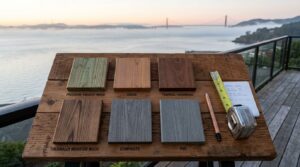
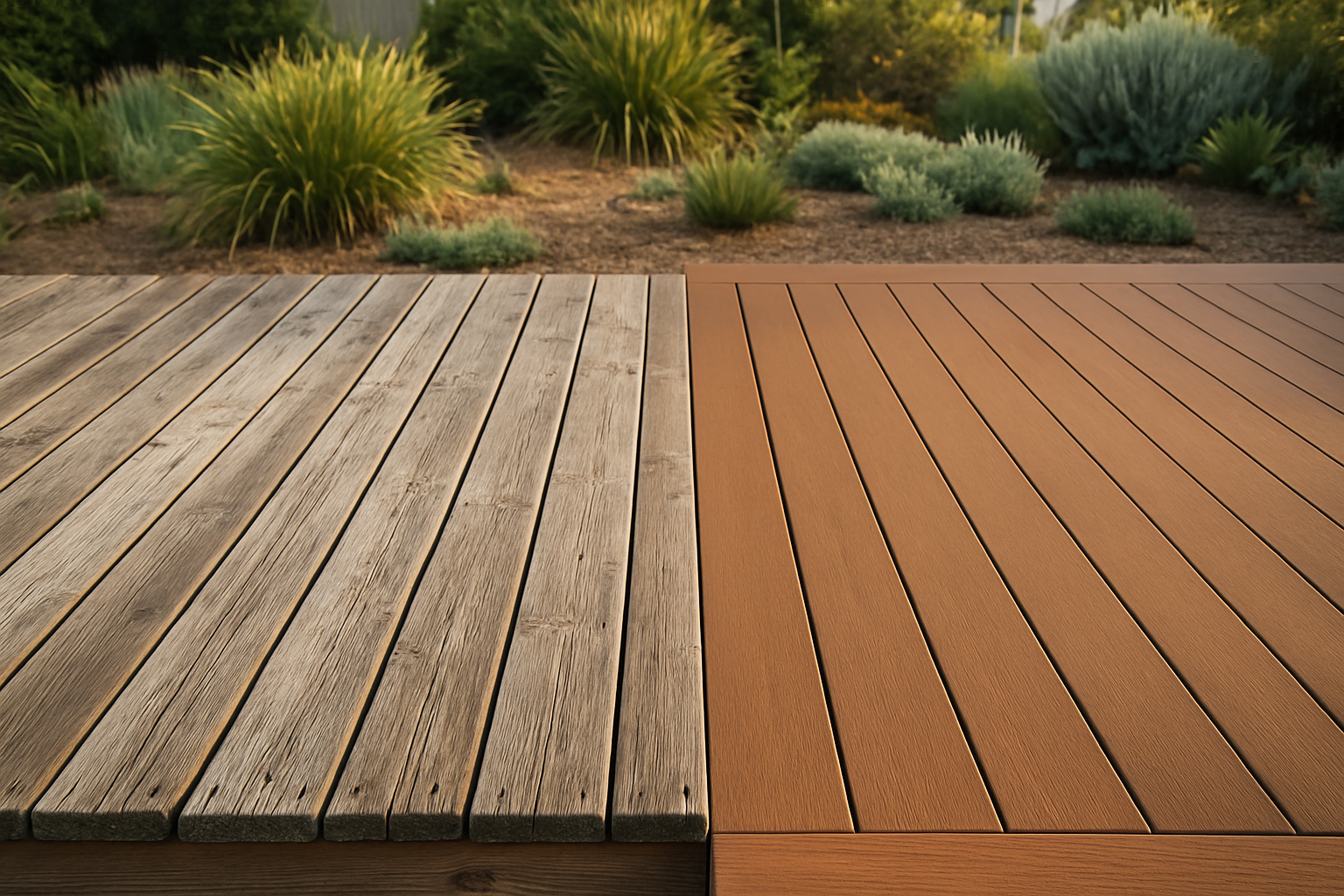
This infographic shows the key maintenance differences between redwood and composite decking across a five-year window in Bay Area conditions.
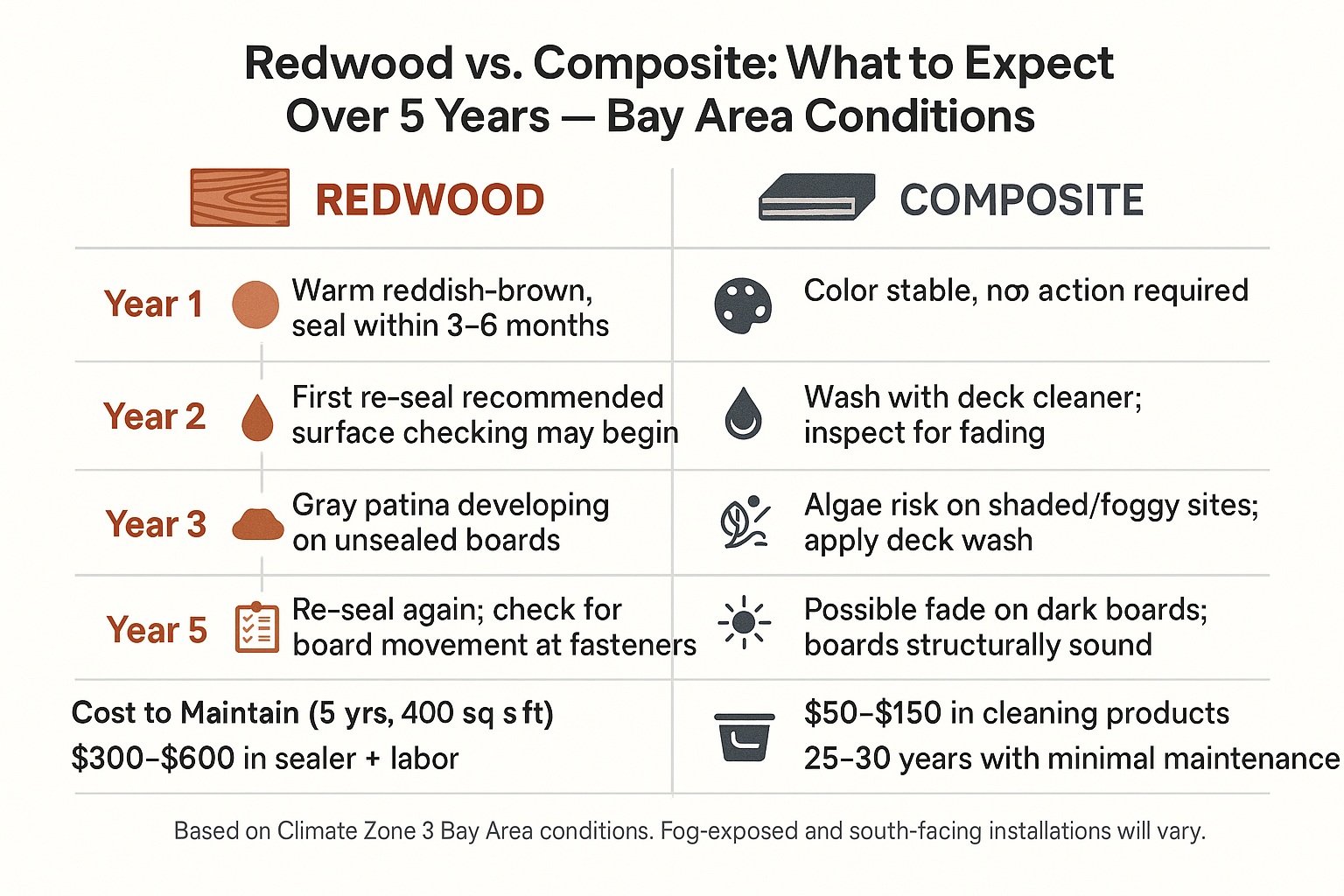
5-Year Comparison: Redwood vs. Composite in Bay Area Conditions
Here’s a direct comparison of how both materials perform across the factors that matter most after the deck is already built.
| Factor | Redwood | Composite (Capped) |
|---|---|---|
| Appearance change | Silver-gray patina if unsealed | Gradual fade, especially dark colors |
| Surface cracking | Surface checks develop | None — won’t split or check |
| Maintenance required | Seal every 1–2 years | Wash 1–2x per year |
| Slip risk | Low (textured surface) | Moderate on shaded/wet sites |
| Heat retention | Moderate | High — dark boards can exceed 150°F |
| 5-year maintenance cost (est.) | $300–$600 | $50–$150 |
| Structural durability | Strong if sealed | Strong, no sealing needed |
| Fire rating | Check WUI zone requirements | Check WUI zone requirements |
The Oakland and Berkeley Hills Factor: WUI Zones Change the Calculus
If the deck is on a hillside property in Oakland or Berkeley — or anywhere that falls within a Wildland-Urban Interface (WUI) fire zone — material selection isn’t just about aesthetics or maintenance. It’s about what the local fire authority will approve.
Both redwood and composite decking can qualify for WUI-compliant deck construction, but the requirements come down to how the deck is built, not just what the boards are made from. Ignition-resistant construction standards apply to the decking surface, the framing below, and how the deck attaches to the structure.
Redwood has natural fire resistance, but “naturally fire-resistant” is not the same as meeting the specific ignition-resistant construction ratings required under California Building Code Chapter 7A. Composite products vary widely — some carry tested fire ratings, others don’t. Always confirm the specific product’s fire rating with your lumber supplier before ordering for a hillside site.
For a detailed breakdown of what fire-rated lumber means in Berkeley’s WUI zones specifically, the advanced guide to fire rated lumber in Berkeley is the most thorough local resource we’ve put together on this topic.
Which One Is Actually the Better Long-Term Choice?
That depends on what kind of owner or contractor you’re dealing with.
If the homeowner wants a natural wood deck and is willing to commit to maintenance every couple of years, redwood is an excellent material for the Bay Area. It performs well in coastal moisture, it ages in a way many people genuinely prefer, and quality clear all-heart redwood is still available from local suppliers with real product knowledge behind it.
If the homeowner wants a deck that stays out of mind for years at a time, capped composite is the easier call. The upfront cost is higher — composite runs roughly $8–$14 per linear foot for quality product, versus $4–$9 per linear foot for construction-grade redwood decking, depending on width and grade. But the long-term maintenance savings are real, and the boards won’t check, warp, or need sanding.
For projects where appearance over time is a top priority, it’s also worth looking at what other high-performance wood options exist. Our decking material comparison guide covers thermally modified wood, MOSO bamboo, and other alternatives that hold up differently under Bay Area conditions — useful if redwood and composite both feel like compromises.
Both materials can last 25 to 30 years on a well-built deck. The five-year mark is really when you start to see which choice fit the site — and the owner — and which one didn’t.
Frequently Asked Questions About Redwood and Composite Decking Aging
Does redwood actually need to be sealed, or can I just let it go gray?
You can let it go gray — that silver patina is a natural weathering process, not damage. But if you skip sealing entirely, moisture cycling will eventually cause surface checks and board movement. In the Bay Area’s fog-heavy climate, sealing every two years keeps the boards structurally stable longer. The gray look is fine; letting the moisture work unchecked for years is where the problems start.
Will composite decking get slippery on a shaded deck in the East Bay?
Yes, it can. North-facing decks or anything under significant tree cover stays damp longer in the morning, and that encourages algae and biofilm growth on composite surfaces. Most capped composites have enough texture to stay reasonably safe, but if the deck stays wet most of the year, plan on washing it with a deck cleaner at least once a year and check the surface texture of the specific product before specifying it for a shaded site.
What does composite decking actually cost compared to redwood right now?
Material costs vary by grade and supplier, but as a rough benchmark: construction-grade redwood decking typically runs $4–$9 per linear foot depending on width and whether it’s clear or knotty. Quality capped composite — TimberTech, Trex — runs $8–$14 per linear foot. That’s a meaningful upfront difference on a 400 square foot deck. Factor in the ongoing sealing costs for redwood and the gap narrows over a 10-year period.
Can I use redwood on a WUI zone deck in the Oakland Hills?
Redwood has natural fire resistance, but that alone doesn’t satisfy California’s ignition-resistant construction requirements under Chapter 7A. Whether redwood qualifies depends on the deck framing, the attachment to the structure, and sometimes the specific ignition-resistant rating required by your local fire authority. Talk to your building department and verify with your supplier before ordering — don’t assume natural fire resistance equals code compliance in a designated WUI zone.
How do I know if my composite decking is fading or if it just looks different when wet?
Wet composite always looks darker and richer than when it’s dry — that’s normal. Actual UV fading shows up as a permanent, uniform lightening of the board color, most visible when you compare a protected section (under a planter or furniture) to an exposed section. If the color difference disappears once the boards dry out, you’re just seeing normal wet-dry variation.
Is it worth refinishing or restoring an old redwood deck, or should I replace the boards?
If the boards are still structurally sound — no soft spots, no significant rot at the ends, fasteners still holding — cleaning and resealing is almost always worth doing before replacing. A good clean with an oxalic acid deck brightener can restore weathered redwood significantly. If you’re seeing soft spots, cupping, or boards that have moved off the joists, that’s when replacement makes more sense than restoration.
Have Questions About Your Specific Deck Project?
The staff at Truitt & White’s Berkeley lumberyard have fielded these questions on real Bay Area projects for decades — they can tell you what’s performed well on a foggy north-facing lot in the Hills versus a sunny south-facing slab in the flats. Stop by the Hearst Avenue location, call 510-841-0511, or visit truittandwhite.com to get the specifics you need before you order.