Quick Answer
In Berkeley’s WUI zones, you usually don’t just need “fire rated lumber.” You need to know whether your project calls for fire-retardant-treated wood, a rated wall assembly, or a noncombustible alternative. Berkeley’s Very High Fire Hazard Severity Zone requires Class A roofing, 1-hour-rated exterior walls, and ignition-resistant materials in key exterior locations, while some wood products must be specifically labeled and approved for fire exposure use. The safest approach is to confirm your property’s zone, check your plans against Chapter 7A and local Berkeley requirements, and buy only materials with the documentation your inspector will expect to see.
You’re on a job in the Berkeley Hills. Framing is moving, the permit set is approved, and then somebody asks the question that stops the whole conversation. “Is this the right fire rated lumber for this address?”
That’s usually when confusion starts. One person means treated framing. Another means a one-hour wall. Someone else assumes pressure-treated lumber will pass because it says “treated” on the tag. If your project sits in a Berkeley WUI area, that mix-up can cost you time, reorders, and inspection delays.
Introduction
A lot of people searching what type of fire rated lumber do i need in berkeley’s wui zones? are dealing with that exact moment. They’re not looking for theory. They need to know what the inspector is likely to care about, what product labels matter, and which materials fit Berkeley’s fire-zone rules.
In practice, the answer is rarely “just buy fire-rated wood.” Berkeley’s wildfire rules work as a system. Roofs, walls, soffits, projections, and perimeter conditions all matter together. If you haven’t already reviewed a local overview of those rules, this Berkeley WUI material guide for fire-safe homes is a useful starting point.
The bigger issue is that people use the term “fire rated lumber” loosely. Code officials usually want something more precise. They may be looking for fire-retardant-treated wood, or they may want proof that your full wall assembly earns a rating when installed exactly as tested. Those are not the same thing.
Understanding Fire Rated and Fire Retardant Treated Lumber

The first thing to sort out is language. Most field problems start because people use one term to describe two different things.
Fire rated is usually an assembly
A fire-rated assembly is a tested combination of materials. Think wall studs, sheathing, gypsum, fasteners, spacing, and exterior finish working together as one system.
If that system has a one-hour rating, the rating belongs to the assembly as installed. It does not automatically transfer to every single board inside it.
Practical rule: A wall can be fire-rated even if the lumber itself is not sold as “fire-rated.” The rating comes from the tested build-up.
That’s why inspectors often ask for cut sheets, listing information, and details from the approved plans. They want to see the complete recipe, not just one ingredient.
Fire-retardant-treated wood is a product
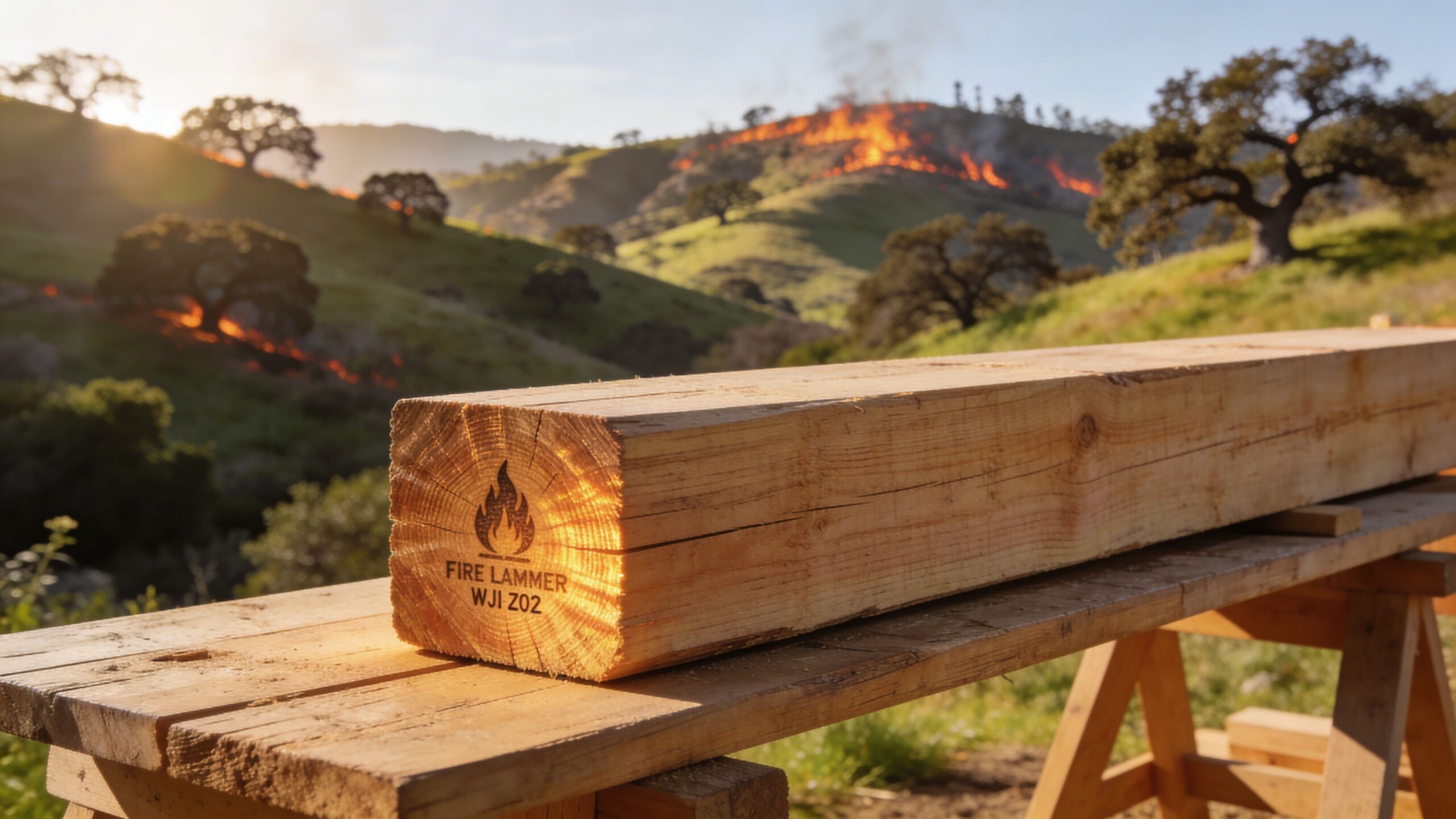
Fire-retardant-treated wood, often shortened to FRT wood or FRT lumber, is wood that has been chemically treated to slow flame spread and reduce smoke development. It’s still wood. It still needs to be used in the right place and in the right way.
Many projects go sideways when lumber is not used in the right place or in the right way. Pressure-treated lumber is designed for decay and insect resistance. It is not the same thing as fire-retardant-treated lumber. If you need a quick refresher on treatment categories, this overview of what treated lumber means helps separate the terms.
Why the label matters
On the yard floor, two products can look nearly identical. The difference is in the stamp, paperwork, and approved use.
When you’re checking a bundle or a piece tag, look for these basics:
- Fire-retardant identification: The product should clearly state that it is fire-retardant-treated wood, not just treated wood.
- Use conditions: Some products are suitable for exterior exposure, while others are limited by how and where they can be used.
- Code documentation: You want matching paperwork that backs up the intended application in your permit set.
- Listing or evaluation path: Berkeley’s accepted materials and assemblies need to tie back to recognized standards or evaluation reports.
A good working analogy is clothing. A rain jacket and a welding jacket are both “protective,” but they solve different problems. FRT lumber slows ignition behavior. A one-hour wall assembly is more like a full protective system built to hold up under a tested fire exposure.
Where contractors usually get tripped up
The mistake isn’t usually bad intent. It’s shorthand.
A contractor says “fire wood” and the buyer orders “treated.” The framer installs it outdoors. Then the inspector asks for the product report and somebody realizes the tag doesn’t match the plans.
Common mix-ups include:
- Ordering pressure-treated instead of FRT lumber
- Assuming any treated panel will satisfy Chapter 7A
- Using a product approved for one condition in a different condition
- Forgetting that the rated wall may depend on gypsum, joint layout, and finish layers
If the plans call for an ignition-resistant or rated condition, don’t buy by nickname. Buy by exact specification.
Berkeley WUI Zone Code Requirements
A Berkeley hillside project can look fine on paper and still stall at inspection because one exterior detail was treated like a generic wildfire item instead of a Berkeley WUI item. That happens with walls, soffits, and fence tie-ins more often than contractors expect.

Start with the address, not the material list
In Berkeley’s Very High Fire Hazard Severity Zone, the first question is not “Which wood product do I like to use?” The first question is “What does this site trigger?”
That distinction matters because Berkeley applies WUI rules to the exterior shell as a system. Roof covering, exterior wall protection, soffits, projections, and some attached site features all affect compliance. Contractors who order lumber before confirming the exact zone and mitigation-area rules are the ones who end up reworking submittals or replacing installed materials.
Roof and wall requirements set the baseline
For new construction in Berkeley’s Very High Fire Hazard Severity Zone, the roof must meet a Class A rating. Wood shakes and shingles are generally prohibited as roof coverings, with limited exceptions tied to partial replacement conditions. Exterior walls in WUI areas must meet a minimum one-hour fire-resistance rating under recognized test standards such as ASTM E119 or UL 263.
The practical takeaway is simple. Berkeley is checking the performance of the exterior condition, not just whether one piece of lumber received a treatment.
A good field comparison is a truck brake system. A better brake pad helps, but the inspection is still about whether the full braking system does the job. WUI review works the same way.
Exterior walls can comply through more than one path
For exterior walls in Berkeley WUI areas, acceptable approaches can include noncombustible materials, ignition-resistant materials, fire-retardant-treated wood, or heavy timber, as described in local Berkeley WUI guidance tied to the California Wildland Urban Interface Code (Truitt & White, “WUI Zone Construction Made Easy”).
That means “what type of fire rated lumber do I need?” is sometimes the wrong starting question. The choices are usually:
- Fire-retardant-treated wood where the approved use matches the location
- Heavy timber where that path is allowed
- Standard framing inside a tested one-hour wall assembly
- A noncombustible exterior finish where exposed wood creates a compliance problem
This is one of Berkeley’s easy-to-miss code nuances. A contractor may be right about the framing and still be wrong about the exposed exterior condition.
The fence connection rule is one of the local trip points
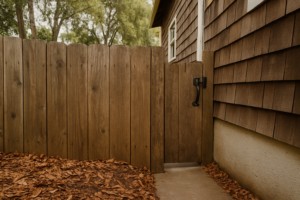
Berkeley also has a site-detail issue that catches remodels and additions late in the job. In the Grizzly Peak and Panoramic Mitigation Areas, combustible fences or gates that connect to the structure must be replaced with noncombustible materials for the first five feet starting in mid-2026, per the same Berkeley WUI guidance.
That rule is aimed at ember transfer and direct flame spread at the building edge. Inspectors look at it because a compliant wall does not solve a bad connection detail at the perimeter.
A common miss looks like this: the wall assembly passes, the plans are approved, and the crew leaves an attached wood fence returning straight into the siding. That can still create a correction.
Berkeley WUI compliance often turns on the weak link at the edge of the building, not the main wall section in the middle of the elevation.
A practical Berkeley review checklist
Before you order specialty lumber or finalize exterior details, run through these four checks:
Confirm the property location.
Verify whether the address is in the WUI zone, the Very High Fire Hazard Severity Zone, or a mitigation area with added perimeter rules.Identify the exact building element.
A wall, soffit, projection, trim area, deck edge, and fence connection can each be reviewed differently.Separate material requirements from assembly requirements.
A listed wood product solves one kind of problem. A tested wall or soffit assembly solves another.Match the plans to the field condition.
Berkeley review problems often come from a clean plan set paired with a substituted exterior detail that changes the code path.
For projects balancing wildfire rules with other Berkeley material requirements, this overview of Berkeley green building mandates and related window and lumber choices can help you coordinate decisions before they turn into inspection delays.
Key Lumber Types and Assembly Ratings
If you want a clean answer to what type of fire rated lumber do i need in berkeley’s wui zones?, start by separating wood products from rated coverings. In many Berkeley WUI conditions, the most reliable path is not exposed wood alone. It’s a code-compliant combination.
A common wall strategy in Berkeley
One primary option for walls and projections in Berkeley’s WUI zones is one layer of 5/8-inch Type X gypsum sheathing behind the exterior covering or as soffit lining, delivering a one-hour fire-resistance rating under Chapter 7A. The same Berkeley fire-zone guidance states this assembly has been shown in SGH analysis to withstand 65 kW/m² radiant heat flux without flame penetration when combined with ignition-resistant siding (City of Berkeley, “Restrictions in the Fire Zone”).
That fact changes the conversation. If someone asks for “fire-rated lumber,” what they may really need is a wall system using standard framing plus the right fire-resistive layer and exterior finish.
Fire Resistance Ratings for Common Materials
| Material | Fire Rating | Common Uses |
|---|---|---|
| Fire-retardant-treated wood | Varies by listed product and approved use | Exterior details where FRT wood is specifically allowed and documented |
| 5/8-inch Type X gypsum sheathing | 1-hour when used in the approved wall assembly | Exterior wall backing, soffits, projections |
| Heavy timber | Allowed in certain code-recognized situations | Structural applications where code allows heavy timber |
| Noncombustible materials such as steel or stucco | Used as ignition-resistant or noncombustible options rather than “lumber” | Exterior wall finishes, trim alternatives, soffit assemblies |
How to think about each option
FRT wood works best when the plans call for it clearly
FRT lumber is useful when you need wood for a specific application and the design, listing, and local code path all line up. It can help on details where a wood component is still desired but must perform better under fire exposure.
The key is not to treat it as universal. “FRT” doesn’t mean “okay anywhere outside.”
Type X gypsum often does the heavy lifting
A lot of builders focus on the visible exterior finish. In Berkeley WUI work, the hidden layer may be doing the primary fire-resistance work.
Because Type X gypsum can provide the one-hour rating when installed as part of the approved assembly, it often becomes the dependable backbone of the wall or soffit system. The framing may stay conventional while the assembly earns the needed protection through sheathing and finish layers.
Heavy timber is a specific code path, not a shortcut
Heavy timber can be acceptable in some cases, but it isn’t a casual substitute for all other fire-resistant materials. If the plans rely on heavy timber, make sure the design professional and building department agree on that path before purchase.
Noncombustible finishes can simplify exposed locations
For some exposed details, steel or stucco can remove ambiguity. That’s especially helpful where inspectors may scrutinize ember exposure points.
Some designers also explore specialty exterior finishes for a fire-conscious appearance. For example, charred cladding comes up in design discussions because it changes the wood surface and aesthetic. It may be architecturally interesting, but you still need to verify whether it fits your local code path and approved application. Appearance does not replace compliance.
Don’t forget lumber grade and structural role
Fire performance doesn’t replace structural requirements. If you’re matching a specified framing member, grade and species still matter. This overview of framing lumber grades is a useful reminder that code compliance on fire exposure and structural suitability are two separate checks.
The safest buy is the product that matches three things at once: the plans, the listing, and the actual installation condition.
Practical Selection and Ordering Tips

Material mistakes in Berkeley WUI jobs usually happen before anything gets delivered. Ordering gets easier when you start with the address, not the product.
Start with the property, not the lumber
Confirm whether the property is in a Berkeley WUI zone or one of the hillside mitigation areas. If the address is in a regulated fire-prone area, pull your permit notes and exterior details before calling the yard.
Then mark each location where fire performance matters:
- exterior walls
- soffits and eaves
- exposed projections
- attached fencing or gates
- any detail where the plans call out ignition-resistant construction
That simple review keeps you from ordering one “fire-safe” product and trying to use it everywhere.
Ask for exact documentation up front
When you request material, ask for the product name, the use condition, and the supporting paperwork in the same conversation. Don’t wait until inspection week.
Here’s the practical checklist:
Match the plan note
If the plans call for FRT wood, order FRT wood. If they call for a one-hour wall assembly, make sure the sheathing and finish layers align with that assembly.Check whether exposure matters
Exterior use can change the acceptable product choice.Verify the label language
The stamp or tag should support the intended application, not just sound similar.Keep submittals with the order
Product data, evaluation reports, and cut sheets should travel with the job file.Order enough for repairs and field changes
Substitutions made in a hurry are where compliance problems start.
Local supply matters on WUI work
Specialty fire-conscious materials can have different lead times than standard framing stock. If your plans include FRT lumber, ignition-resistant sheathing, or less common exterior components, ask about availability early.
For Bay Area builders who want to avoid sourcing blind, choosing the right lumber supplier for your next project is less about brand loyalty and more about getting clear answers on specification, documentation, and turnaround. Truitt & White can help contractors and homeowners source code-compliant fire-retardant-treated lumber and related building materials for local projects when the permit set calls for them.
Buy from the permit backward. The approved detail should control the order, not the other way around.
Installation and Documentation Best Practices
A lot of jobs fail inspection for paperwork and detailing, not because the crew brought the wrong material. In Berkeley WUI work, the installed condition has to match the approved condition.
On site, protect the assembly you paid for
If you’re using FRT lumber, store it carefully and keep it identified. Once pieces are scattered around a site with mixed stock, it gets harder to prove what went where.
For wall assemblies, pay attention to the details that make the tested system work:
- Gypsum placement matters: Put the sheathing where the approved detail requires it.
- Joint layout matters: Stagger joints where the assembly instructions require that condition.
- Penetrations matter: Don’t let field cuts, vents, or utility work undermine the rated build-up.
- Transitions matter: Corners, soffits, and terminations are where inspectors often slow down.
The wall isn’t “rated” because the plans use that word. It’s rated because the installed materials match the tested arrangement.
Keep a clean inspection folder
The easiest jobs to inspect are the jobs that make verification simple.
Your folder should include:
- manufacturer cut sheets
- mill certificates if applicable
- evaluation reports or listings tied to the specified product
- plan details showing where each product is used
- any substitutions approved before installation
If a product changes, update the paperwork before the inspection. Don’t assume a similar-looking product will slide through.
Watch the field substitutions
This is one of the most common sources of trouble. A crew runs short, someone grabs another treated board, and now the installed condition no longer matches the approved one.
A few guardrails help:
- Keep specialty fire-related material separated from general stock
- Mark approved substitute products in writing
- Have the superintendent confirm the tags before installation
- Save bundle labels until the rough inspection is complete
An inspector can’t approve what nobody can identify.
Don’t ignore the hidden parts
Contractors often focus on visible siding and trim because that’s what the owner sees. Inspectors are often looking behind that finish.
If the approved path relies on Type X gypsum, ignition-resistant sheathing, or a specific protected projection detail, that hidden layer is not optional. Once covered, it becomes harder to prove. Take photos before close-in if your process allows it, and keep them with the job record.
Common Misconceptions and Pitfalls
A Berkeley hillside job can go sideways on a small assumption. The plans pass, the material shows up, framing starts, and then the field check stalls because the product was acceptable on a different project, in a different fire area, or under an older interpretation.
That is the pattern behind many avoidable delays.
Here is a better way to look at the common myths contractors run into on Berkeley WUI work.
Myth: If a product was accepted in one Berkeley fire-prone area, it will be accepted everywhere in the hills.
Reality: Berkeley approvals follow the project location, the permit set, and the detail being inspected. A material that worked on one lot near Grizzly Peak does not automatically satisfy a different lot with different exposure, access, or assembly requirements. Treat each address like its own inspection file.
Myth: The 2026 fence rule is only a new-construction issue.
Reality: Fence and gate work often gets misunderstood because crews treat it like ordinary site work. In Berkeley’s fire-prone areas, replacement work near the structure can trigger closer review than contractors expect. If a scope includes a new fence run, a rebuilt section, or a gate change near the house, check the current local requirements before ordering redwood or cedar by habit.
Myth: If the lumber yard says the product is “good for WUI,” that settles it.
Reality: Yard advice is useful, especially from suppliers who see Berkeley plans every week, but the inspector is checking your approved application, not a general counter recommendation. Local suppliers such as Truitt and White can help flag common Berkeley submittal issues, but you still need the exact product to match the exact use on the plans.
Myth: Fire safety review only focuses on walls and siding.
Reality: Berkeley WUI corrections often come from the transition points. Deck edges, fence-to-house connections, exposed blocking at eaves, and small exterior attachments can draw attention because they create paths for flame spread. Contractors lose time here because those pieces feel minor in the field but matter during inspection.
The practical lesson is simple. Generic fire-lumber advice gets you part of the way. Berkeley jobs usually pass faster when the crew checks the site-specific rule, the current local interpretation, and the exact detail before material is ordered.
Conclusion and Next Steps
If you’re asking what type of fire rated lumber do i need in berkeley’s wui zones?, the short answer is that you need the product or assembly your plans call for. Sometimes that means fire-retardant-treated wood. Sometimes it means a one-hour exterior wall assembly using the right sheathing and finish layers. Sometimes the right move is a noncombustible alternative in the exposed location.
In Berkeley’s fire-prone areas, the safest path is to confirm the property’s designation, read the permit details carefully, and make sure every specialty material comes with documentation that matches the intended use. That’s what keeps inspections moving and avoids last-minute swaps.
FAQ
Q: Does pressure-treated lumber count as fire rated in Berkeley?
A: No. Pressure-treated lumber and fire-retardant-treated lumber are different products with different purposes. If your plans or inspector require fire-retardant-treated wood or a rated assembly, standard pressure-treated stock usually won’t satisfy that requirement.
Q: Do I need fire-retardant-treated wood for every exterior wall?
A: Not always. Some projects meet Berkeley WUI requirements through a tested wall assembly rather than through FRT wood alone. The plans and the approved code path determine which approach applies.
Q: Is a one-hour wall rating the same thing as using fire-rated lumber?
A: No. A one-hour rating usually belongs to the full wall assembly, not to a single framing member by itself. That assembly can include framing, gypsum sheathing, fasteners, and exterior finishes installed in a specific way.
Q: Can I use wood siding in Berkeley’s WUI zones?
A: It depends on the product and the approved assembly. Some wood-based products may be acceptable if they meet the required ignition-resistant or fire-retardant criteria, but you need the right documentation and installation method to support that use.
Q: What paperwork should I keep for inspection?
A: Keep product cut sheets, evaluation reports or listings, tags or bundle labels, and any related plan details. If there’s a substitution, keep the approval with the rest of the job file.
Q: What’s the fastest way to avoid an inspection delay?
A: Confirm the address, match the plan note exactly, and verify the material tag before installation. Most delays happen when a product name sounds right but the documentation doesn’t back up the actual use.
Q: Do Berkeley fence rules affect remodels too?
A: They can, especially where combustible fencing connects directly to the structure in the affected mitigation areas. If your project includes site work, gates, or fence replacement near the house, check those details early.
Q: Should I order fire-related materials late in the project once framing is underway?
A: That’s risky. Specialty materials often need more careful review and may not be as interchangeable as standard framing stock. Ordering earlier gives you time to confirm availability, paperwork, and any needed approvals.
Berkeley WUI work tends to go better when you can talk through the plan details with someone who understands how local code language maps to actual material choices. That matters when you’re trying to sort out whether the job needs FRT lumber, a rated wall build-up, or a noncombustible substitute in one exposed area.
Because Truitt & White works every day with structural lumber, framing materials, general building products, and project guidance for Bay Area builders, their team can help you sort through specification questions before an order gets locked in. That kind of early clarification is often what prevents a material mix-up from turning into a field delay.
If you want help figuring out what type of fire rated lumber you need in Berkeley’s WUI zones, a practical next step is to call the Lumberyard and Hardware at 510-841-0511, visit 642 Hearst Ave, Berkeley, CA 94710, or reach out through truittandwhite.com or info@truittandwhite.com. Bring your plans, wall details, or product notes, and talk through the material list before you place the order.
Sources
Truitt & White. "WUI Zone Construction Made Easy. A Material Guide for Fire-Safe Homes." Year not provided. https://truittandwhite.com/wui-zone-construction-made-easy-a-material-guide-for-fire-safe-homes
City of Berkeley. "Restrictions in the Fire Zone." Year not provided. https://berkeleyca.gov/sites/default/files/2022-02/RestrictionsintheFireZone.pdf