Direct Answer: Most windows and doors fail during El Niño winters not because they’re old, but because seals, weatherstripping, and thresholds were never maintained. Fix those first — then evaluate whether full replacement makes sense.
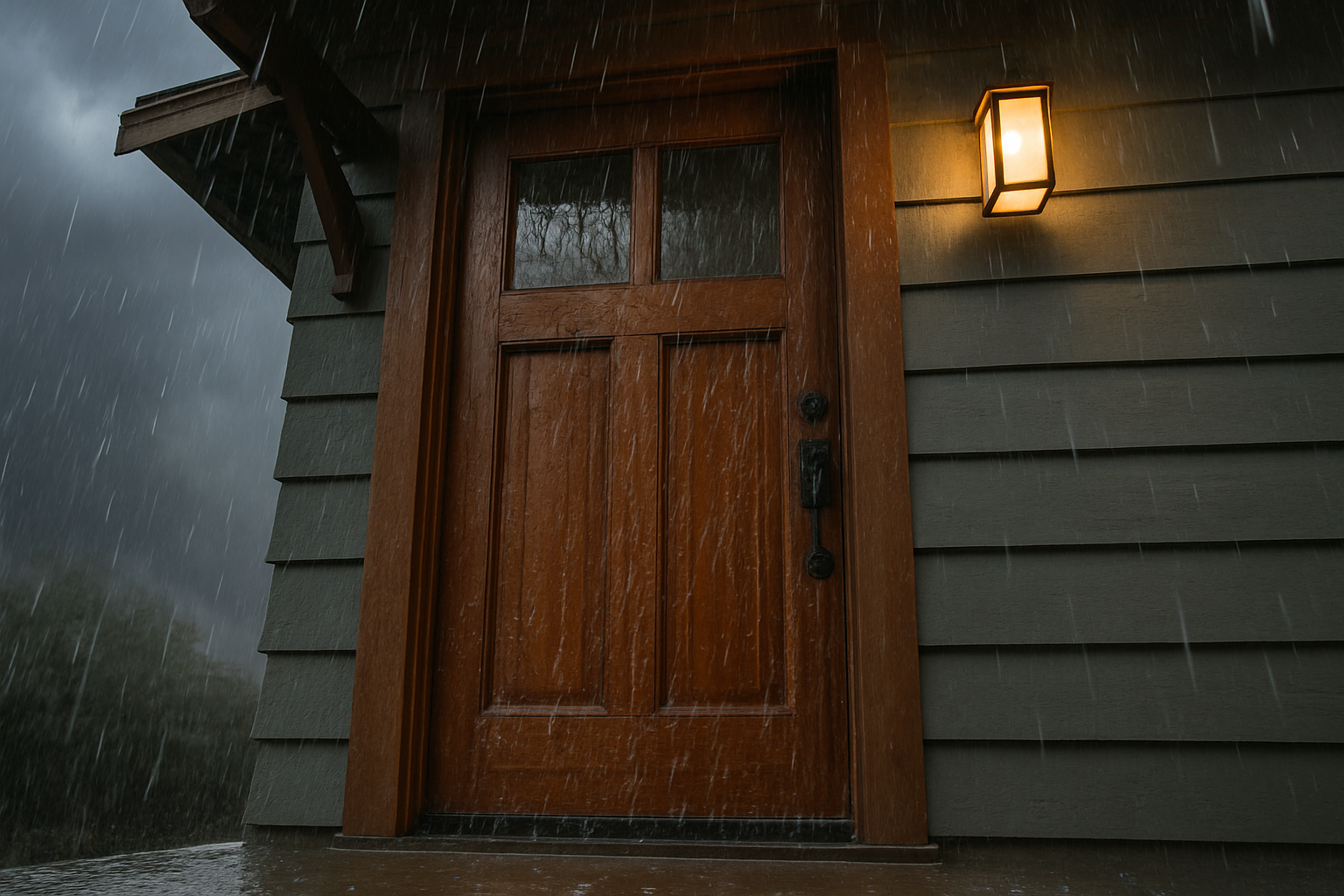
When a strong El Niño system rolls into the Bay Area, the first places you’ll feel it are the same places you probably stopped thinking about years ago — the edges of your windows, the bottom of your front door, the threshold that’s been a little loose since 2019. Wind-driven rain doesn’t need a wide-open gap to get inside. It finds the half-inch of dried-out weatherstripping, the cracked bead of exterior caulk, the threshold that never quite sealed tight.
Berkeley’s own storm preparedness guidance points to openings first — windows, doors, and anywhere water can push in under pressure. That’s practical advice, because water damage that starts at a bad door sweep or a failed window seal rarely stays contained to the opening itself.
This article covers the two things that matter most before storm season: the low-cost weatherization fixes that most homeowners can do in a weekend, and the window replacement decisions worth making now if your units are already failing — including what 2025 Title 24 standards require for Climate Zone 3 projects starting January 1, 2026.
The Fixes That Cost Almost Nothing but Matter the Most
Before anyone starts talking about window replacement, there’s a short list of maintenance items that hold back more water damage than most people realize. These are not glamorous. They are also not expensive, and most can be finished in a Saturday morning.
The places to check first:
- Weatherstripping on all exterior doors — compress it with your hand; if it doesn’t spring back firmly, it’s not sealing
- Door sweeps at the bottom of entry doors — the rubber or brush insert that actually blocks wind-driven rain from pushing under the door
- Threshold seals — the adjustable strip the door closes against; a warped or worn threshold creates a gap that’s invisible until it’s raining sideways
- Exterior sealant around window frames and door casings — look for cracks, gaps where caulk has pulled away from the frame, or spots where the sealant has gone brittle
- Jamb weatherstrip kits for doors that no longer close squarely against their stops
- Expanding foam or backer rod in larger gaps around utility penetrations near openings
For replacement weatherstripping on exterior doors, the material itself is inexpensive — foam tape, vinyl bulb, or pile strip depending on the application. Getting the right product for your door profile matters more than most people expect, and staff at the Hearst Avenue hardware location can help you match material to door type.
None of these fixes require a contractor. Most require a tape measure, a utility knife, and about two hours per door.
The Hidden Cost Nobody Budgets For: Moisture After the Storm
The storm passes. The sun comes back out. And then, three weeks later, you notice a dark stain spreading across the corner of your window trim or a musty smell in the bedroom closet that shares a wall with an exterior window.
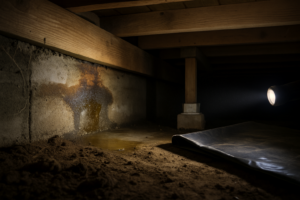
Failed seals and drafty openings don’t just let water in during the storm — they create conditions for condensation and mold in the weeks that follow. This is especially true in Bay Area homes with marginally insulated wall cavities, where temperature differences between inside and outside air create persistent moisture problems after any major wet period.
Mold remediation in the East Bay runs well into the thousands of dollars depending on how far it spreads. That’s a cleanup cost that outlasts the storm by months, and it traces directly back to an opening that wasn’t properly sealed.
There’s another angle worth mentioning: power outages. El Niño storms knock out electricity across the East Bay every few years, sometimes for days at a time. A well-sealed, well-insulated window doesn’t just save on heating bills — it keeps interior temperatures stable longer when the furnace isn’t running. Air sealing and insulation performance belong in storm prep conversations, not just energy efficiency conversations.
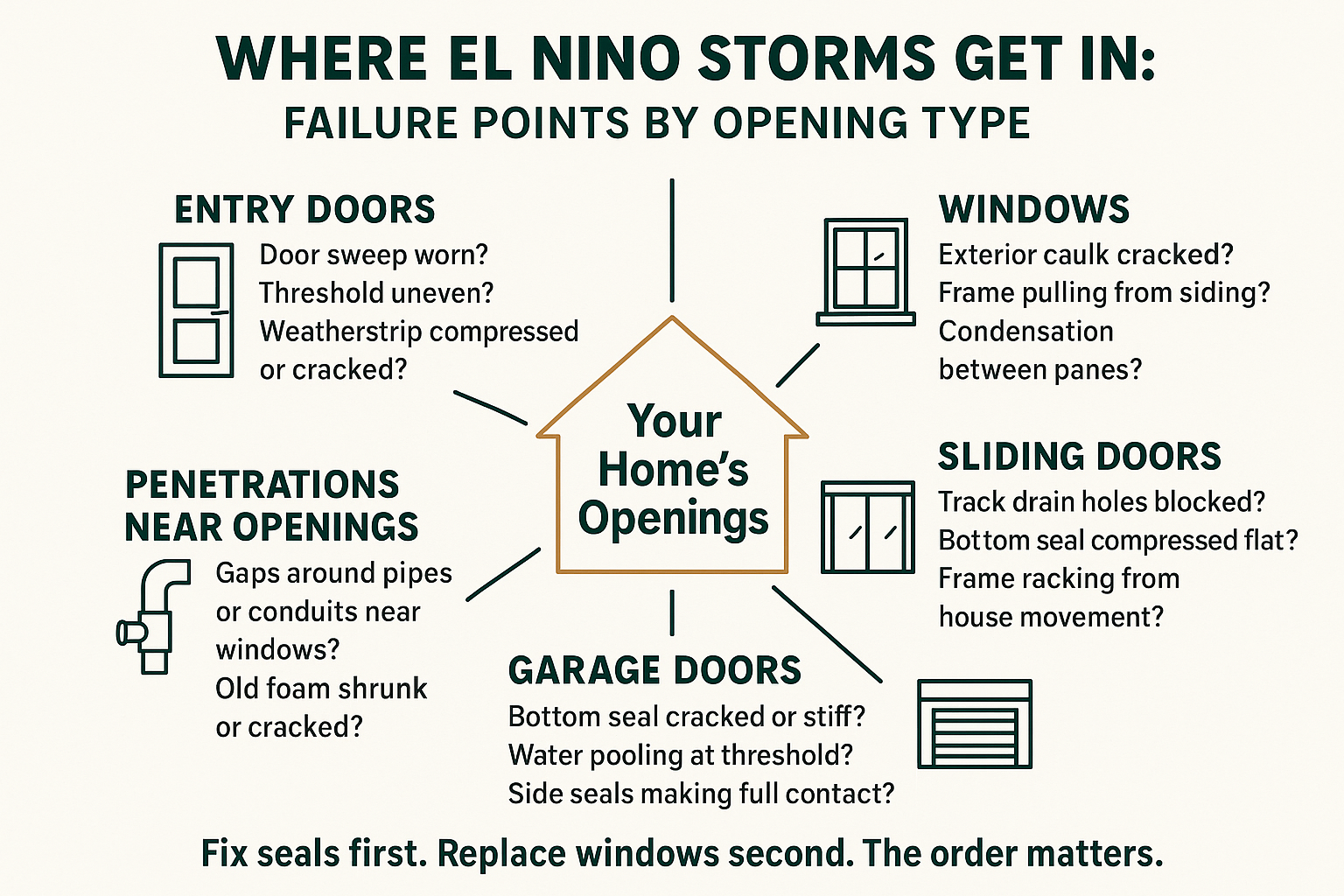
Where El Niño Storms Get In: A Quick Checklist by Opening Type
This infographic maps the most common failure points by opening type so you can work through your prep systematically.
When the Weatherstripping Isn’t the Real Problem: Window Replacement and Title 24
Sometimes the seal is fine and the window itself is the problem. If your windows have failed IGU seals (the fog between the panes that won’t go away), aluminum frames with no thermal break, or single-pane glass that frosts in January, no amount of weatherstripping fixes what the window is actually doing wrong.
If you’re considering full window replacement before the next storm season, there’s a compliance deadline worth knowing. Starting January 1, 2026, new California 2025 Title 24 standards take effect. For Berkeley, Oakland, and San Francisco — all in Climate Zone 3 — the residential requirement is:
- U-factor of 0.27 or lower (how well the window holds heat in)
- No SHGC requirement for Climate Zone 3 residential (solar heat gain coefficient is not currently required here)
- Fenestration area limited to 20% of conditioned floor area
In practical terms, a U-factor of 0.27 means dual-pane Low-E glass is your minimum baseline. Most code-compliant windows in this performance range will meet that threshold, but not all dual-pane products do — the Low-E coating is what gets you there. Triple-pane windows push performance further, particularly on north-facing elevations in hillside homes that see little direct sun and significant fog exposure through winter.
For a deeper look at why Bay Area windows need different specs than the rest of California, Climate Zone 3 creates some specific demands that generic window specs don’t address. Coastal moisture, marine layer, and the temperature swings between foggy mornings and warm afternoons place real stress on frame materials and seal integrity.
If you’re specifying windows for a project heading to permit, the U-factor needs to be documented on your plans. What to ask before buying replacement windows in Berkeley or Oakland covers the compliance questions worth raising before you get to plan check.
2025 Title 24 Window Requirements vs. Common Performance Levels — Climate Zone 3
This table shows where the 2026 code floor sits relative to typical product performance tiers, so you can see at a glance what qualifies and what doesn’t.
| Window Type | Typical U-Factor Range | Meets 2025 Title 24 CZ3? |
|---|---|---|
| Single-pane, no coating | 0.85 – 1.10 | No |
| Dual-pane, no Low-E | 0.45 – 0.55 | No |
| Dual-pane, Low-E coating | 0.22 – 0.30 | Yes (if ≤ 0.27) |
| Dual-pane, Low-E + gas fill | 0.18 – 0.27 | Yes |
| Triple-pane, Low-E + gas fill | 0.12 – 0.20 | Yes — exceeds minimum |
Storm Doors: Often Overlooked, Frequently Worth the Investment
A storm door — the secondary door installed in front of your main exterior door — does two things in a wet winter. It adds a second air barrier that reduces wind infiltration significantly, and it protects the primary door from direct rain exposure, which matters a lot for wood entry doors that swell, warp, and degrade with repeated wetting.
For older homes in Berkeley and the Oakland hills, where historic-character wood doors are worth preserving but weren’t built to modern weather standards, a storm door is often a better short-term answer than full door replacement. The performance improvement is real, and the cost is considerably lower than a new pre-hung unit.
The threshold assembly on any door — storm or primary — is also worth examining on its own. A door with good weatherstripping but a worn or unlevel threshold still leaves a gap at the bottom that wind-driven rain will find. Adjustable thresholds are available for most standard door widths and are a common Hearst Avenue hardware purchase in the fall.
Frequently Asked Questions About Windows, Doors, and Storm Season Prep
How do I know if my weatherstripping actually needs replacing, or if I can just add more caulk?
They’re doing different jobs. Weatherstripping seals the moving joint between the door and the frame — it compresses when the door closes and springs back when it opens. Caulk seals the static joint between the window or door frame and the surrounding wall. If you can see daylight around a closed door, or feel air movement with your hand on a windy day, the weatherstripping is the problem. Caulk won’t fix a moving seal.
My windows fog up between the panes. Is that a weatherization problem or a replacement problem?
That’s a failed IGU seal — the inert gas fill between the panes has leaked and moisture has gotten in. No amount of exterior caulking or weatherstripping fixes it. The glass unit itself needs replacement. Depending on the window brand and age, you may be able to replace just the glass unit without replacing the full frame, but that depends on whether the manufacturer still makes a matching sash.
Do I need to pull a permit to replace windows in Berkeley?
Generally yes, if you’re replacing the full window unit (frame and all). Berkeley Building Services typically requires a permit for window replacements, and your plans will need to document U-factor compliance with Title 24 Climate Zone 3 requirements — which means 0.27 or lower starting January 1, 2026. Like-for-like sash replacements within an existing frame sometimes fall under different thresholds, but check with Berkeley’s building department before assuming a permit isn’t needed.
What’s the difference between a U-factor and an R-value for windows?
R-value measures resistance to heat flow — higher is better, and it’s typically how insulation is rated. U-factor measures the rate of heat transfer — lower is better, and it’s how windows are rated. A U-factor of 0.27 means the window loses heat at a rate of 0.27 BTU per hour per square foot per degree of temperature difference. The two values are mathematical inverses, but they’re used in different parts of the building code, so it’s worth keeping them straight when you’re reading specs.
Is triple-pane glass worth it for Bay Area conditions, or is dual-pane Low-E enough?
For most south- and west-facing applications in Berkeley and Oakland, dual-pane Low-E with a quality gas fill meets the code and performs well. Triple-pane becomes more relevant on north-facing elevations, in hillside homes with significant wind exposure, or when the homeowner is prioritizing long-term comfort over minimum compliance. The cost premium for triple-pane is real — it varies depending on brand, size, and configuration — so the decision usually comes down to where the window sits and how long the owner plans to stay in the home.
Choosing Windows Before Storm Season — and Before Plan Check
If you’re weighing window or door replacement before the rains arrive, Truitt & White’s Windows and Doors showroom at 1831 Second Street in Berkeley is set up for exactly that conversation. The staff there work with Title 24 Climate Zone 3 requirements regularly, which means the products they carry and the guidance they offer are grounded in what actually passes plan check in Berkeley, Oakland, and San Francisco — not what works in Sacramento or Southern California. Reach the showroom directly at 510-649-4400, or visit truittandwhite.com to learn more about what’s in stock.