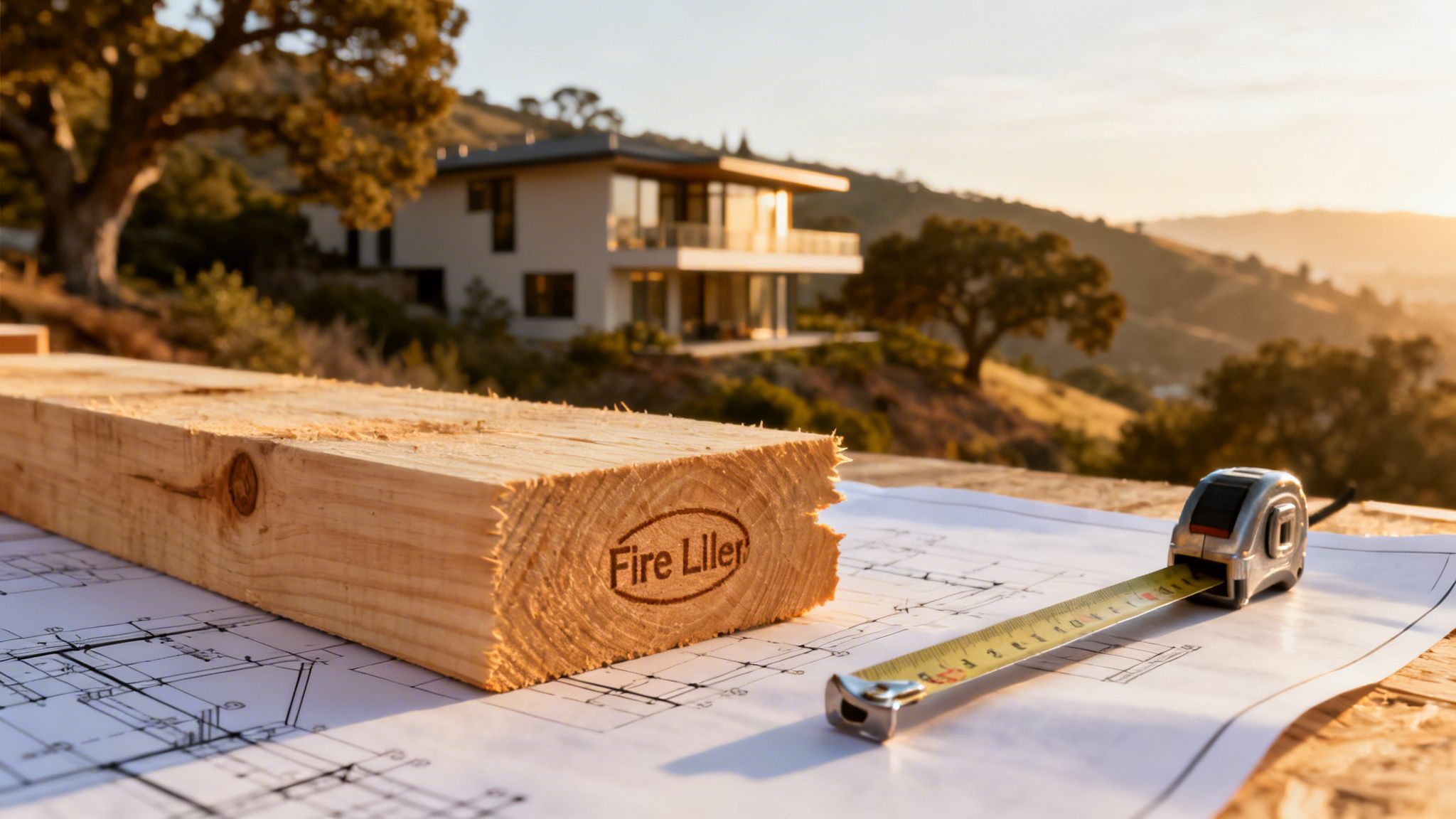
If you’re a builder in the Berkeley hills, you know that steep grades and incredible views come with a serious partner: wildfire risk. For contractors, architects, and remodelers, meeting Berkeley WUI rules isn’t optional. It means complying with Chapter 7A of the California Building Code, which often requires specific materials like fire-rated lumber, not just standard pressure-treated wood.
Getting this right is the difference between passing an inspection and facing expensive, project-killing delays. In Berkeley’s tough permit environment, one wrong material choice can stall a project and drive up holding costs.
Your Guide to Building Safely in Berkeley's WUI Zones

For builders and contractors in the East Bay, the term Wildland-Urban Interface (WUI) is a critical legal designation. When a property in Berkeley, Oakland, or the surrounding hills falls within a WUI zone, it triggers a strict set of building standards. These rules are designed to give homes a fighting chance against wildfire.
This guide cuts through the complexity of Berkeley WUI rules and fire rated lumber explained. We'll provide a clear roadmap for navigating Berkeley’s fire safety regulations, explaining the core concepts behind Chapter 7A and offering practical advice to keep your build compliant, safe, and on schedule.
Key WUI Terms at a Glance
Before you order materials or break ground, you need to speak the language of fire-safe construction. This table breaks down the essential terms for any WUI project in the Bay Area. Getting these right prevents costly material mix-ups and failed inspections. You can also protect your build with fire-resistant essentials in our related article.
Key WUI and Fire-Rated Lumber Terms
| Term | What It Means for Your Project |
|---|---|
| WUI Zone | A mapped area where homes and wildland meet, automatically triggering stricter fire-resistant building codes like Chapter 7A. |
| Chapter 7A | The section of the California Building Code that sets specific rules for ignition-resistant materials in WUI zones. |
| Ignition-Resistant Material | Building materials tested and approved to resist catching fire from wind-blown embers and radiant heat. |
| Fire-Retardant-Treated (FRT) Lumber | Wood pressure-treated with chemicals to reduce flame spread and smoke. It is not the same as standard pressure-treated wood. |
| Defensible Space | The managed, cleared area between a structure and wildland vegetation, required by law to slow wildfire spread. |
| Home Hardening | The process of using fire-resistant materials and construction techniques to make a home more resilient to wildfire. |
Mastering these concepts helps you select the right Berkeley building materials, meet inspector expectations, and deliver a safer final product for your clients.
Understanding the Wildland-Urban Interface in Berkeley
For any builder working in the Bay Area, the Wildland-Urban Interface (WUI) is a legal designation with major consequences. A WUI zone is any area where homes meet or mix with undeveloped wildland. In places like Berkeley and the Oakland hills, this proximity creates a serious wildfire risk and triggers a different set of building rules.
This designation isn’t a vague suggestion; it's a hard line on an official map. If your project's address falls within a WUI zone, Chapter 7A of the California Building Code automatically comes into play. This chapter sets non-negotiable standards for construction materials and methods, all designed to protect buildings from catching fire.
How to Check if Your Project is in a WUI Zone
Before you draft plans or order materials, your first job is to confirm if the property is in a WUI zone. Getting this wrong from the start can lead to using incorrect materials, failing inspections, and facing expensive delays.
You can verify a property’s status using official maps from the city and county. These are the same guides building inspectors use.
- City of Berkeley: The city offers detailed maps that outline its Fire Hazard Severity Zones. These maps are essential for any project inside city limits.
- Alameda County: The county provides maps of high-fire-hazard areas, which are critical for jobs in the unincorporated East Bay hills.
- CAL FIRE: The state's fire agency, CAL FIRE, produces Fire Hazard Severity Zone maps that serve as the foundation for all local regulations.
Our team at Truitt & White works with these resources daily. We can help you confirm your project’s requirements and ensure you start with a compliant plan.
Why WUI Designation Matters for Your Build
Once you confirm a property is in a WUI zone, Chapter 7A becomes the rulebook for the building's exterior. The code is designed to create a "hardened" home that resists ignition from wind-blown embers, a primary cause of home loss during wildfires.
Residents of Berkeley know that hillside neighborhoods face elevated wildfire risk. Many properties fall within these zones, where Chapter 7A standards influence exterior wall assemblies, eaves, and structural components. Connect with our team for expert guidance on these specific local requirements.
Key Takeaway: WUI is a legal trigger mandating ignition-resistant materials for nearly every part of a building's exterior—from the roof down to the foundation. This includes siding, windows, vents, decks, and even structural framing.
Understanding this link between a property's location and required building codes is key to any successful WUI project. It lets you budget correctly, order the right materials like fire rated lumber, and move through Berkeley's tough permitting process with confidence.
Your Chapter 7A Compliance Checklist for WUI Projects
For builders in the East Bay hills, Chapter 7A is your rulebook for wildfire safety. While it can seem complex, it boils down to specific steps to harden a home's exterior against flying embers.
Getting these details right the first time is crucial for passing inspections and building a safer home. This checklist breaks down the code into a practical guide, clarifying when to use materials like fire-retardant-treated (FRT) lumber.
Before you order materials, your first step is always the same: confirm if your project falls within a designated WUI zone. This single step determines everything that follows.

Once you've confirmed your project is in a regulated zone, Chapter 7A compliance becomes mandatory for every exterior component.
Roofing and Vents
The roof is a home’s most exposed surface, acting like a landing pad for embers. Your material choice is absolutely critical.
- Roofing: All roofing materials must carry a Class A fire rating. This is the highest level of fire resistance, met by materials like quality asphalt shingles, concrete or clay tiles, and metal roofing.
- Vents: Vents can be direct highways for embers into attics and foundations. All vents must be designed to block ember intrusion and meet the ASTM E2886 standard.
Siding and Exterior Walls
A home's vertical surfaces are at risk from intense radiant heat. Chapter 7A sets strict standards for the entire exterior wall assembly.
Your materials must be non-combustible or have passed ignition-resistance testing. Common compliant choices include:
- Fiber-cement siding
- Stucco
- Brick or stone veneer
- Approved ignition-resistant wood siding products
It’s not enough for a product to look the part. You must check the manufacturer's specs to confirm it has the WUI rating your project demands.
Eaves and Soffits
Overhanging eaves are a weak point that can trap hot gases and embers. In a WUI zone, their construction requires careful management.
Practical Tip: Chapter 7A mandates enclosed eaves or, for open-eave designs, construction with ignition-resistant materials. This often means using non-combustible or FRT materials for soffits and fascia to stop fire from entering the roof assembly.
Windows and Doors
Openings like windows and doors are obvious vulnerabilities. Intense heat can shatter glass, letting embers inside.
- Windows: All windows must have at least double-pane glass, with one pane being tempered. This combination is far more resilient to heat than standard single-pane glass.
- Doors: Exterior doors must be non-combustible or have a solid wood core at least 1-3/8 inches thick. Understanding fire rated door safety, compliance, and liability is also critical.
Decks and Underfloor Areas
An attached deck can act like a fuse, carrying fire to the main structure. The decking, its supports, and the space underneath are all tightly regulated.
- Decking Surfaces: Deck boards must be made of non-combustible materials, approved ignition-resistant products, or specific FRT lumber.
- Joists and Beams: The supporting structure for any attached deck—the joists and beams—must also meet these fire-resistant standards.
- Underfloor Enclosure: The space beneath an attached deck must be enclosed with ignition-resistant material to keep embers from collecting there. You can read also about WUI zone construction materials in our guide.
Getting a handle on each component is vital. By using this checklist, you can move forward with confidence, knowing your build meets the high safety standards of the East Bay hills.
Fire-Rated Lumber vs. Standard Treated Lumber

On a Berkeley WUI project, one costly mistake is common: confusing standard pressure-treated lumber with fire-retardant-treated (FRT) lumber. While both are "treated," they do completely different jobs. Only one meets the fire-safety demands of Chapter 7A, and getting it wrong will stop your project cold.
Standard pressure-treated lumber is your go-to for fighting rot, fungus, and termites. It's infused with chemicals that make it perfect for ground contact or damp places. What it’s not designed to do is resist fire.
Fire-retardant-treated (FRT) lumber goes through a different process. It's pressure-treated with fire-inhibiting chemicals that, when exposed to heat, create a chemical reaction. This slows combustion and reduces flame spread.
The Inspection-Killing Mistake
Contractors who misunderstand local WUI triggers or assume standard pressure-treated lumber qualifies as fire rated risk failing inspections. In Berkeley’s permit environment, one incorrect material choice can stall a project and increase holding costs.
To help you avoid this pitfall, it’s crucial to understand the distinct roles these materials play.
Fire-Retardant-Treated (FRT) Wood vs. Pressure-Treated Wood
| Attribute | Fire-Retardant-Treated (FRT) Wood | Standard Pressure-Treated Wood |
|---|---|---|
| Primary Purpose | To slow the spread of flames and reduce smoke in a fire. | To resist rot, fungal decay, and insect damage. |
| Treatment Chemicals | Phosphate- and sulfate-based fire-retardant chemicals. | Copper-based preservatives (e.g., ACQ, MCQ). |
| Best Application | Structural elements where fire resistance is required by code. | Fences, posts, and ground-contact structures not requiring a fire rating. |
| WUI Compliance | Yes, it is a key component of many Chapter 7A assemblies. | No, it provides no fire resistance and will fail inspection. |
Understanding this difference is critical. Grabbing the wrong stack of lumber can lead to a failed inspection that stops your project in its tracks.
Understanding Fire Ratings and Documentation
When you order FRT lumber, you are buying a certified performance rating. Berkeley and Oakland inspectors will demand proof that your materials meet specific standards.
The rating you'll most often need is Class A, which indicates a flame spread index between 0-25.
Key Takeaway: An inspector will ask for documentation. Always ensure your FRT lumber has a legible stamp from an approved testing agency like Underwriters Laboratories (UL). You must also have the manufacturer’s technical data sheets on-site.
Failing to produce this paperwork is just as bad as using the wrong material. Sourcing your lumber from a trusted Berkeley lumberyard like Truitt & White is critical; we ensure you get fully documented, code-compliant materials. You can learn more in our guide to treated lumber.
Sourcing Compliant Building Materials in the Bay Area
Knowing the WUI building rules is half the battle. The other half is sourcing the correct, compliant materials. For any job in Berkeley or Oakland, success hinges on getting every product right, from the fire-rated lumber to the vents that guard the attic.
The fine print in Chapter 7A means you can't just take a product’s "fire-resistant" label at face value. Berkeley inspectors expect clear documentation for every component. Partnering with a local supplier who lives and breathes these codes is a strategic move.
Finding a Lumberyard That Understands Berkeley WUI Rules
Big-box stores are great for many things, but specialized WUI projects aren't usually one of them. Their staff often aren't trained on the critical difference between standard and fire-retardant-treated (FRT) lumber required by Chapter 7A.
A Berkeley-based lumber yard familiar with Chapter 7A requirements can help contractors confirm when FRT lumber is required versus when alternative ignition-resistant assemblies are acceptable. Truitt & White’s long-standing presence in the East Bay means our team understands local hillside construction demands and inspection expectations.
Expert Tip: Before ordering, verify whether the property address falls within a designated WUI map zone. Having product spec sheets ready can prevent delays during Berkeley inspections.
Essential Compliant Materials for WUI Construction
Building a fire-hardened home involves a system of ignition-resistant products working together.
Your material checklist should include:
- Ignition-Resistant Decking: Options like durable aluminum deck materials, listed composite products, or FRT wood that meet Chapter 7A standards are compliant choices.
- Ember-Resistant Vents: All attic, soffit, and foundation vents must be designed to block wind-blown embers and meet the ASTM E2886 standard.
- Non-Combustible Siding: Create a fire-resistant exterior wall with materials like fiber cement, stucco, or brick veneer.
Finding a dedicated lumberyard near Oakland and Berkeley that stocks these specialized items in one place simplifies logistics and ensures consistency. Learn more about where to find quality lumber in the East Bay.
Building Smarter and Safer in the East Bay Hills
Building in the East Bay hills carries a responsibility to the entire community. When you understand and apply Berkeley WUI rules, you aren't just passing inspections—you're building homes that are fundamentally safer. In the East Bay, these decisions are heavily influenced by community safety awareness, and homeowners often research materials online before contacting contractors.
Think of Chapter 7A compliance as a commitment to safety in a region that knows wildfire risk firsthand. Every piece of compliant material you install contributes to a stronger, more fire-hardened neighborhood. This focus protects your project from delays and makes our whole community safer.
Your Partner in WUI Compliance
Pulling off a WUI project requires a solid supply chain and expert support. For contractors building or remodeling in Berkeley, Oakland, and the East Bay Hills, sourcing fire rated lumber from a knowledgeable local supplier helps keep projects compliant, on schedule, and aligned with regional wildfire safety standards.
Contact our team of experts for project support.
Our team at Truitt & White is here to be your partner. We understand the demands of building in Climate Zone 3 and know what documentation Berkeley inspectors require.
A supplier should be more than a vendor—they should be a strategic partner. Our deep knowledge of local codes and access to compliant Bay Area building materials ensures your project moves forward smoothly.
Let our experts provide personalized guidance on your next WUI project, whether it's a new build, an ADU, or a major remodel. We can help you navigate everything from Title 24 window requirements to ignition-resistant decking.
Get Expert Help for Your Next Project
Building smarter starts with the right materials and partners. Don't leave compliance to chance.
Visit our Berkeley window and door showroom or contact our lumberyard services today for expert guidance.
Frequently Asked Questions about Bay Area Building Codes
What should I know about the 2026 California Energy Code?
The 2026 California Energy Code, effective January 1, 2026, will introduce stricter energy efficiency standards for the Bay Area. We expect it will lower the required U-Factor for windows and may adjust the 20% glazing limits for prescriptive compliance. Planning ahead with high-performance, energy-efficient building materials now will help future-proof your projects.
How do I ensure my windows meet Title 24 window requirements?
To comply with Title 24 window requirements in Climate Zone 3, your windows must meet specific energy performance targets. Currently, this means a U-Factor ≤ 0.27. Always check the product's NFRC label to confirm its U-Factor and SHGC values meet the code for your project's location.
What makes Climate Zone 3 unique for building?
Climate Zone 3, which covers much of the Bay Area including Berkeley and Oakland, has a temperate marine climate. This drives specific energy code requirements under Title 24, focusing on high-performance windows and insulation to maintain comfort without excessive energy use. These requirements are separate from, but must be balanced with, WUI fire safety rules.
Where can I find the right Bay Area building materials for my project?
Sourcing the correct Bay Area building materials for local codes can be challenging. A knowledgeable local supplier is your best partner. At Truitt & White, we stock a wide range of code-compliant products, from fire-rated lumber to energy-efficient windows in the Bay Area, all with the documentation you need.
How do WUI rules and Title 24 interact for windows?
WUI rules and Title 24 are separate but equally important. A window in a Berkeley WUI zone must meet both sets of codes. It needs the fire-resistant features required by Chapter 7A (like tempered glass) and the energy efficiency (U-Factor and SHGC) mandated by Title 24 for Climate Zone 3. Learn more about our team’s expertise on local requirements.
For personalized guidance on sourcing compliant fire-rated lumber, windows, and other WUI-approved materials for your next project, trust the experts at Truitt & White. Visit our Berkeley showroom or contact us today to ensure your build is safe, compliant, and successful.